Overview
11 stories in this issue. The first 3 are today's priorities.
Hot Model Updates
- Top · Claude Code's cyber safeguard draws 68 false-block reports since October 1
- Top · PDE mathematician says OpenAI's Navier-Stokes construction may be beyond human invention
- Top · Kimi apologizes for K3.1 Pro rate limits and refunds 25% of members' monthly quota
Global AI News
- Tsinghua open-sources AKV: agents drop KV cache instead of summarizing, cutting cost 27.7%
- SpaceX secures $40 billion in debt to buy AI chips
- Wall Street's high-frequency traders build data centers and back chip startups for AI compute
- iFLYTEK details SparkAudio 1.0, a 30B-A3B speech model trained on domestic chips
- Kingdee releases Lingee Bench with 1,400+ enterprise agent tasks
Regional & Early Signals
- AI-written ForgeKernel tops two kernel leaderboards and claims to beat DeepSeek's open kernels
- Inference provider Approaching.AI raises over ¥1.3 billion in Series B
- Counterpoint forecasts over 1 million humanoid-robot AI accelerators shipped by 2030
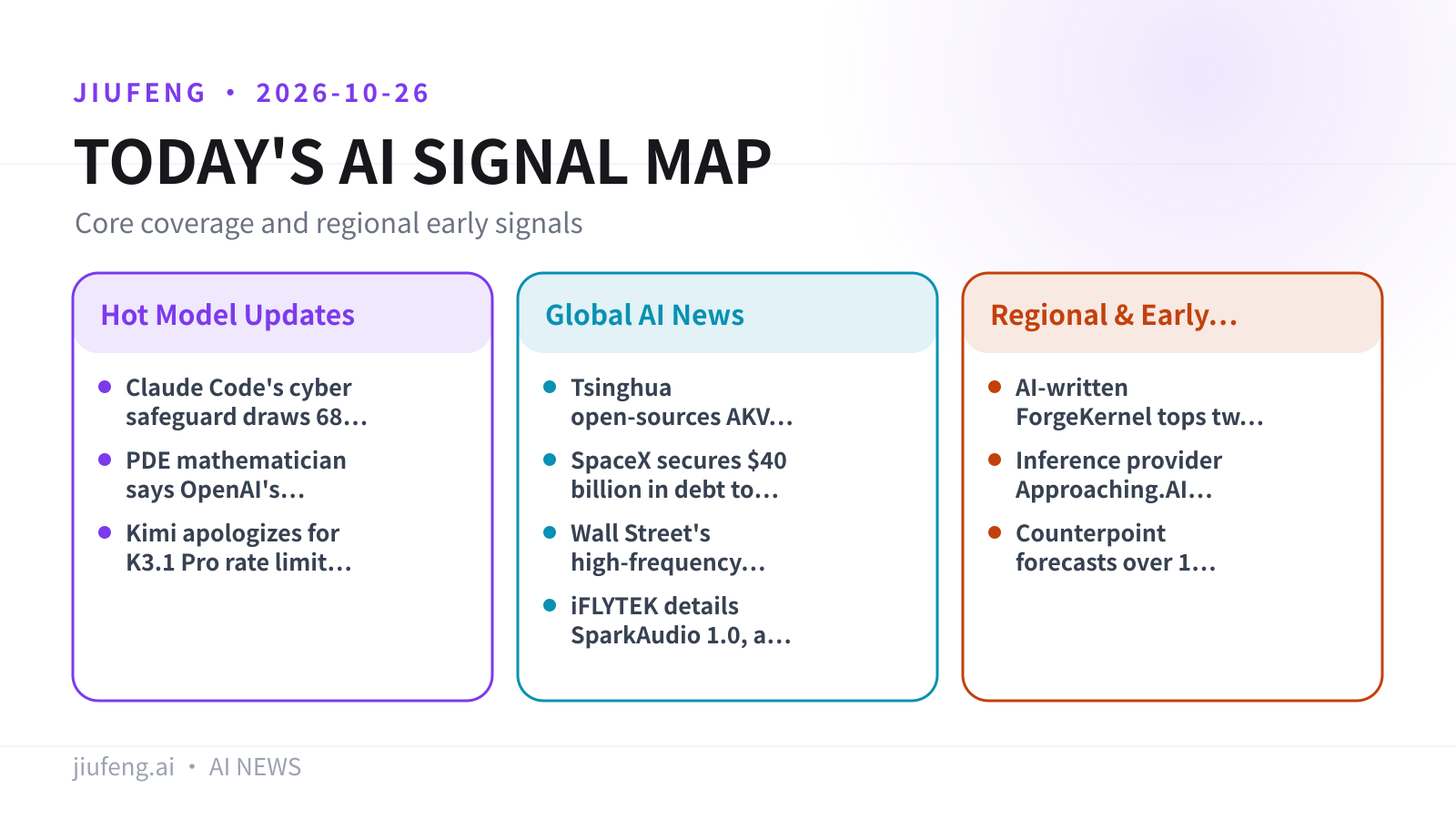
Jiufeng graphic based on the sources cited in this issue.
Hot Model Updates
01/11
Claude Code's cyber safeguard draws 68 false-block reports since October 1
Users on Anthropic's public tracker report that Claude Code's "[cyber]" safeguard is stopping work that isn't malicious. Anthropic has not replied to any of them.
RuntimeWire went through the public anthropics/claude-code repository:
- Volume: 68 issues opened since Oct. 1, from 54 accounts.
- Status: As of 1:05 p.m. CT Sunday, 65 were still open, and none had a reply from Anthropic.
- Content: About a third describe ordinary tasks with no security content. The people affected include security researchers, sysadmins and developers writing UI code. Several say the block ended the whole session.
- Appeals path: The link in the block notice that paying customers are supposed to use to report a mistake returns HTTP 403 errors, so reports are ending up on GitHub.
Limitations: The figures come from RuntimeWire's count of public issues. They are users' own accounts, and nobody has checked whether each one was really a false positive. Anthropic has not commented, and it has not published the safeguard's criteria or its false-positive rate.
Source: RuntimeWire · GitHub issue example
02/11
PDE mathematician says OpenAI's Navier-Stokes construction may be beyond human invention
A mathematician who works on partial differential equations rates OpenAI's Navier-Stokes paper very highly, but that is not a referee's verdict on whether it is correct.
On October 25, Scott Armstrong called the result "unbelievable." He said it may be beyond what a human could have come up with, though not beyond human understanding. Armstrong is a mathematics professor at NYU's Courant Institute and a CNRS research director at Sorbonne Université, and his research interests include partial differential equations.
Limitations: RuntimeWire notes that his reaction speaks to the ambition of the work, not to its correctness. A separate October preprint questions whether OpenAI's Lean formalization matches the written paper.
Source: RuntimeWire · X post
03/11
Kimi apologizes for K3.1 Pro rate limits and refunds 25% of members' monthly quota
Two days after K3.1 Pro launched, Moonshot AI apologized for rate limits and wasted quota, and it cut sub-agent calls that weren't needed.
According to Pandaily, every paid Kimi member gets 25% of their monthly allowance back. Moonshot also cut unneeded sub-agent calls in K3.1 Pro.
Limitations: Pandaily is the only outlet reporting this so far. The report does not give the actual rate-limit thresholds or how many users were affected, and it does not say whether fewer sub-agent calls change task quality.
Source: Pandaily
Global AI News
04/11
Tsinghua open-sources AKV: agents drop KV cache instead of summarizing, cutting cost 27.7%
AKV is built on SGLang. Agents drop and reposition KV cache entries instead of summarizing their history. The code is released under the Apache-2.0 license.
Researchers from Tsinghua University and CUHK released AKV, a serving system plus a policy library. It does not include model weights.
- Models tested: GPT-OSS-120B (5.1B active), MiniMax-M2.7 (230B total, 10B active) and MiroThinker-1.7-Mini (30B total, 3B active).
- Benchmarks: BrowseComp-Plus, GAIA-Text, SWE-bench Verified and xbench-DeepSearch-2510.
- Overall: Compared with threshold summarization, average cost is 27.7% lower and the average score is 1.7 points higher.
- Hardware: The paper ran on 8 A800-80GB GPUs in BF16. The quick start serves GPT-OSS-120B on 2 GPUs with tensor parallel 2.
The best result was GPT-OSS-120B on SWE-bench Verified:
| Setup | Cost per task (cents) | Score |
|---|---|---|
| Threshold summarization | 20.0 | 40.0 |
| AKV | 9.7 | 43.2 |
Limitations: The gains depend on the model and the task. MiniMax-M2.7 on BrowseComp-Plus was the weakest case. The listed runtime is NVIDIA GPUs via SGLang.
Image source: GitHub; mirrored on Jiufeng R2.
Source: MarkTechPost · arXiv paper · GitHub
05/11
SpaceX secures $40 billion in debt to buy AI chips
Musk says SpaceX's investment-grade credit rating made the financing possible, and he predicts a shakeout among neoclouds as credit gets harder to find.
In a post on X, Musk said SpaceX raised $40 billion in debt to buy GPUs from Nvidia and other suppliers for its AI data centers. The GPUs are due in the first and second quarters of 2027. He credited the company's investment-grade rating and its revenue from Starlink and launches, and said he expects most of the debt to be repaid early.
Limitations: Musk's post does not disclose the interest rate, term or which chips are being bought. The neocloud shakeout is Musk's prediction, not something that has happened.
Source: SiliconANGLE
06/11
Wall Street's high-frequency traders build data centers and back chip startups for AI compute
Firms like Jane Street and Hudson River Trading are spending billions on cloud contracts, startups and their own data centers.
According to Bloomberg, as summarized by The Decoder:
- Jane Street: Runs a Texas data center with more than 4,000 Nvidia GPUs. It invested $1 billion directly in CoreWeave and committed $6 billion to its computing services. It also led a round in chip startup Etched and is the first customer for Etched's AI chip.
- Hudson River Trading: Spends $1 billion a year on AI, according to AI chief Iain Dunning, and signed a multiyear deal with CoreWeave.
- XTX Markets: Is building a data center in Finland.
Limitations: The claim that compute spending is 10-20x what it was before ChatGPT is one executive's estimate. This item relies on a secondary summary; we did not check the original Bloomberg report.
Source: The Decoder
07/11
iFLYTEK details SparkAudio 1.0, a 30B-A3B speech model trained on domestic chips
iFLYTEK described how SparkAudio 1.0 is built and launched Robot Super Brain Platform 3.0.
- SparkAudio 1.0: A 0.65B-parameter audio encoder paired with a 30B-total, 3B-active MoE model, trained on domestic Chinese chips.
- Robot Super Brain Platform 3.0: Bundles boards, modules and a robot harness.
Limitations: The available material has no benchmark scores or license terms and does not say whether weights will be released. Treat this as a vendor announcement.
Source: Pandaily
08/11
Kingdee releases Lingee Bench with 1,400+ enterprise agent tasks
Kingdee added a manager-facing agent hub and an enterprise context layer to Lingee, plus a benchmark that tests whether agents can finish real business work.
- Connectors: 70 ERP connectors exposing 1,127 tools.
- New modules: A manager-facing agent hub and an enterprise context layer.
- Lingee Bench: More than 1,400 enterprise agent tasks that check whether agents complete real business work.
Limitations: This is a benchmark the vendor built itself. The available material publishes no model scores and does not say whether third parties can run it.
Source: Pandaily
Regional & Early Signals
09/11
AI-written ForgeKernel tops two kernel leaderboards and claims to beat DeepSeek's open kernels
ForgeKernel was written entirely by AI with no line-by-line human tuning. It claims to outperform DeepSeek's open-source NVIDIA kernels on DeepSeek V4.1 Flash operators.
Leiphone reports that as of October 22, ForgeKernel ranked first on SOL-ExecBench's FlashInfer-Bench collection and on the CANNBench A3 hardware board maintained in Ascend's official CANN repository. Its baseline speedup is 1.835×, 25% ahead of second place. The report says hand-tuned versions of DeepSeek's FlashMLA reach more than 90% of the hardware limit.
Limitations: This comes from a Chinese-language source that attributes the claims to unnamed sources. The report does not name ForgeKernel's developer, how much faster it is than DeepSeek's kernels, or the test conditions. No one has independently reproduced the results.
Source: Leiphone (Chinese-language source)
10/11
Inference provider Approaching.AI raises over ¥1.3 billion in Series B
Approaching.AI has raised ¥2.4 billion so far this year. The new money will go mainly to token capacity and its ATaaS platform.
Leiphone reports the round was co-led by 浙财创新, Xiaoshan Capital, ICBC Investment, Zhongguancun Science City, 星连资本 and 钱江世纪城, with SenseTime and Wangsu among the followers. It comes a few months after a July Series A. The funds will go to expanding token capacity, upgrading the ATaaS (Approaching.AI Token as a Service) platform and inference R&D. Xiaoshan Capital says the two sides are building a 10,000-card "token factory."
Limitations: This is a Chinese-language source. The claim of "over 10x growth in core metrics in six months" does not say which metrics or from what baseline; it comes from the company and its investors.
Source: Leiphone (Chinese-language source)
11/11
Counterpoint forecasts over 1 million humanoid-robot AI accelerators shipped by 2030
Counterpoint expects a 144% CAGR over 2026-2030. GPUs remain the main architecture for now, with ASICs growing fast.
According to IT Home's summary of the Counterpoint report, Nvidia leads the humanoid-robot GPU market, with partners including AgiBot, Unitree, UBTech and Figure AI. Qualcomm has design wins with Neura Robotics, VinMotion, Booster Robotics and Figure AI, but ships far fewer units than Nvidia. Tesla and XPeng are moving their in-house automotive chips into humanoid robots. D-Robotics' RDK S100 uses a CPU+BPU+MCU design with an 80 TOPS BPU.
Limitations: These shipment and growth figures are analyst forecasts, not actual shipments. This is a Chinese-language media summary, and we did not check the original report.
Write a prompt in your browser and get an image — 1K, 2K or 4K output, up to 15 reference images. 50 free generations on sign-up, no credit card.
Generate free