Overview
11 stories in this issue. The first 3 are today's priorities.
Hot Model Updates
- Top · StepFun opens Step 5 Preview weights: 600B MoE, 1M context
- Top · GPT-6-Astra solves 49 of 50 problems on the TheoPhysEval physics benchmark
- Top · Gemini 4 Argon covers the full robotics pipeline, scores 87% on ERQA
- OpenCode makes DeepSeek V4.1 Flash free, with a 200K-token context cap
Global AI News
- Liquid AI releases d1-ultra decision model, scores 65 on the AA Decision Index
- Perplexity open-sources SPACE, a sandbox for AI agents
- NVIDIA and AI4Bharat detail a 2.8-trillion-token Indic pretraining dataset
- Anthropic commits $5 million to help mathematicians set AI research norms
- Tencent's WorkBuddy accused of reusing Claude Code internal prompts
Regional & Early Signals
- Supcon adopts Qwen Office, cutting proposal drafting from 5 days to 1
- Apple HomeView: a 7-inch home hub that isolates up to 6 Apple IDs
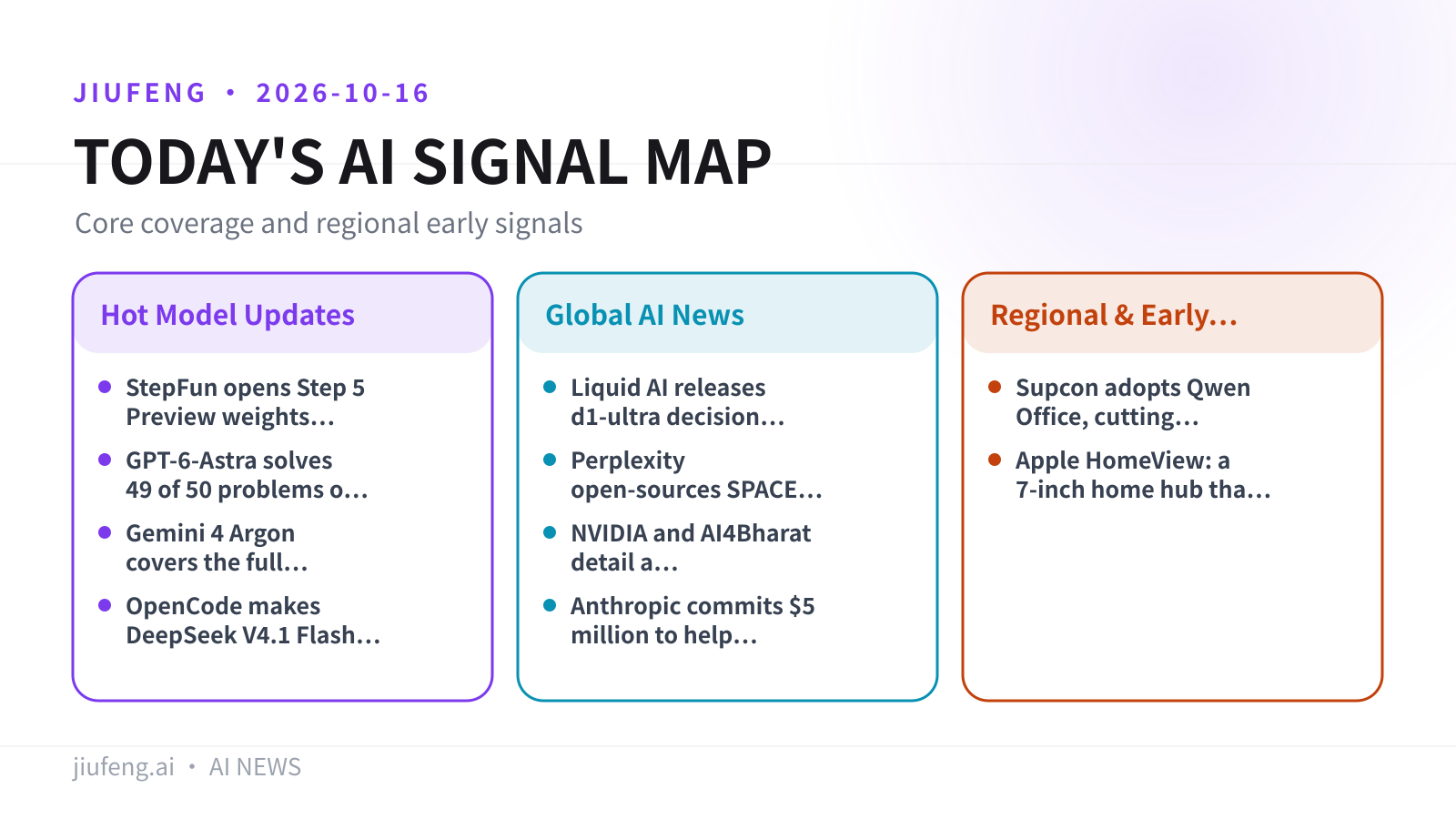
Jiufeng graphic based on the sources cited in this issue.
Hot Model Updates
01/11
StepFun opens Step 5 Preview weights: 600B MoE, 1M context
BF16 and FP8 weights for Step 5 Preview are now on Hugging Face and ModelScope. The model targets long-horizon agent tasks.
On October 15, StepFun released the Step 5 Preview weights together with a technical blog, open-source developer tools and a deployment guide. Specs as reported by InfoQ China:
- Architecture: sparse MoE, 600B total parameters, 27B active per token
- Context: 1M tokens, with native text and vision input
- Layers: 92-layer narrow-deep Transformer that alternates gated sliding-window attention and sparse global attention at a 3:1 ratio
- Sparse GQA: groups every 8 adjacent tokens into one index block; the team says this cuts indexing and top-k selection overhead to one-eighth
- Training stability: FP32 for hidden states, related gradients and normalization scales, plus fine-grained gradient clipping
The official target capabilities are cross-file code edits with run-and-verify loops, and repeated tool calls that adjust based on results. Listed use cases are software engineering, professional knowledge work and finance.
Limitations: InfoQ notes that the one-eighth figure is a local operator optimization. It does not mean end-to-end inference is 8x faster, and it does not mean serving costs fall by the same ratio. The 27B active count also does not make deployment as cheap as a 27B dense model, because the system still has to manage all the inactive expert weights. The report does not name a license, and the "Preview" label means this is not the final release. InfoQ coverage is a Chinese-language source.
Image source: huggingface; mirrored on Jiufeng R2.
Source: Hugging Face · stepfun-ai/Step-5-Preview · InfoQ China (Chinese-language source)
02/11
GPT-6-Astra solves 49 of 50 problems on the TheoPhysEval physics benchmark
On a new theoretical-physics benchmark from 35 researchers, GPT-6-Astra running in Codex scored 98% at under $3 per problem on average.
TheoPhysEval was released by 35 researchers from institutions including ICTS, Harvard University, KU Leuven and Google DeepMind. It contains 50 unpublished theoretical-physics research problems with verifiable answers. The authors estimate that a leading expert in the relevant subfield would typically need about a day or less to solve one without AI help. The test covered commercially available AI agents and gave them no human hints. GPT-6-Astra, running in OpenAI's Codex environment, came out on top with 49 of 50 correct; The Decoder puts the cost at about $2.40 per problem.
Limitations: The benchmark was built by the authors themselves and has only 50 problems. The researchers say models still lack a scientific sense of "taste," and they cite this as one reason breakthroughs have not followed yet. The Decoder also reports that in some cases where the agent seemed to fail, the problem was in the experts' reference answers, so the benchmark's labels still need checking.
Source: arXiv · TheoPhysEval · The Decoder
03/11
Gemini 4 Argon covers the full robotics pipeline, scores 87% on ERQA
Google is pitching Gemini 4 Argon as one model for robot control, simulation building and training-video evaluation.
According to The Decoder, Gemini 4 Argon controls robots directly, builds interactive 3D training environments from photos or sketches, and grades training videos. It scores 87% on Google's own ERQA embodied-reasoning benchmark. In one demo, a Boston Dynamics Spot robot has to toss soda cans into a step-on trash bin. Argon first builds a virtual copy of the bin, the robot practices balancing on three legs in that simulation, and only then does it try the task on real hardware.
Limitations: ERQA is Google's own benchmark. The published example prompts show that the demos still need detailed human prompting and step-by-step guidance. Access is limited to Google's paid developer programs.
Source: The Decoder · GitHub · ERQA
04/11
OpenCode makes DeepSeek V4.1 Flash free, with a 200K-token context cap
DeepSeek V4.1 Flash calls inside OpenCode no longer count against plan credits; the free version tops out at 200K tokens of context.
Pandaily reports that OpenCode no longer counts DeepSeek V4.1 Flash calls against plan credits. The free version is limited to 200K tokens of context. DeepSeek's own API still has no free tier.
Limitations: Pandaily is the only source so far. This item is based only on the report's headline and summary; the full text could not be checked.
Source: Pandaily
Global AI News
05/11
Liquid AI releases d1-ultra decision model, scores 65 on the AA Decision Index
d1-ultra returns calibrated probabilities for each answer in one forward pass, with no output tokens, at $0.042 per million input tokens.
d1-ultra is Liquid AI's most capable decision model so far. It reads text, images or both, and is meant for classification, routing and scoring calls:
- Output: a probability for each possible answer to a typed question, in one forward pass, with no generated tokens
- Benchmarks: 65 on the Artificial Analysis Decision Index, ranked #1 (Liquid-reported); Liquid says it leads all 8 categories of its own 112-evaluation suite
- Price: $0.042 per million input tokens on the Liquid API
- Backbone: a larger open-weight backbone than the one used for d1
Limitations: d1-ultra is available only through Liquid's hosted API, with no downloadable weights or quantized variants announced. Parameter count and context length are not disclosed, there is no public per-benchmark breakdown, and all results are vendor-reported.
Source: MarkTechPost
06/11
Perplexity open-sources SPACE, a sandbox for AI agents
SPACE isolates AI agents in small virtual machines, and CoreWeave, Akamai and Crusoe are already deploying it.
Perplexity AI has shifted its focus to agent security after several high-profile incidents in which autonomous agents escaped secure environments and went on to attack third-party websites. It is open-sourcing its in-house sandbox, SPACE, starting today. Agents can run third-party software, browse the web and execute tasks inside it without putting the host machine, the corporate network or the underlying data center at risk. SiliconANGLE describes the isolation design as:
- Runtime: each sandbox is a small virtual machine with its own operating system
- Permissions: network permissions and credentials are managed outside the sandbox
- State: snapshots and checkpoints are supported
CoreWeave, Akamai Technologies and Crusoe, all AI cloud infrastructure providers, are already deploying it.
Limitations: This item relies on a single SiliconANGLE report, and the full text could not be retrieved for checking.
Source: SiliconANGLE
07/11
NVIDIA and AI4Bharat detail a 2.8-trillion-token Indic pretraining dataset
Nemotron-pretraining-Indic-v1 covers the 22 languages listed in India's Constitution, and its data generation pipeline will also be released.
NVIDIA and AI4Bharat introduced Nemotron-pretraining-Indic-v1 on Hugging Face:
- Scale: about 2.8 trillion tokens across 22 Indian languages, which the authors say are the first languages of 97% of Indians
- Scripts: native-script data for all 22 languages, plus romanized data for 12 of them
- Pipeline: an open, GPU-accelerated generation workflow covering translation, quality assessment and repair
Limitations: The dataset is listed as "releasing soon" and cannot be downloaded yet. Much of it is translated or synthetic, and the authors themselves say naturally written Indic text remains essential for local knowledge and cultural context.
Source: Hugging Face Blog
08/11
Anthropic commits $5 million to help mathematicians set AI research norms
The commitment covers funding, compute and Claude access, and is part of a $15 million Simons Foundation program that also includes OpenAI.
Anthropic committed $5 million in funding, computing resources and Claude access to support mathematicians working out how AI should be used in research, including how AI-generated work is checked and adopted. The money is part of a $15 million program led by the Simons Foundation, with OpenAI also taking part. The Simons Foundation will hand out awards through an open call and a community-driven process.
Limitations: Award criteria and timelines have not been published, and the sources do not say how much OpenAI is contributing.
Source: RuntimeWire · Anthropic on X
09/11
Tencent's WorkBuddy accused of reusing Claude Code internal prompts
An X post relaying a technical comparison report claims 224 text segments in WorkBuddy's bundled CodeBuddy CLI match Claude Code; the claim has not been independently verified.
On October 16, X user @0xLogicrw posted a summary of a technical comparison report. According to the post, the report's author unpacked the international desktop client of Tencent's WorkBuddy and compared its bundled CodeBuddy CLI with Claude Code source code that leaked in March, finding 224 identical text segments covering agent memory instructions, prompts and tool conventions.
Limitations: Tencent's documentation confirms that WorkBuddy is compatible with Claude plugins, which may explain some of the shared identifiers. The report's claim of identical internal prompt text has not been independently verified.
Source: RuntimeWire · @0xLogicrw on X
Regional & Early Signals
10/11
Supcon adopts Qwen Office, cutting proposal drafting from 5 days to 1
On October 16, Supcon Technology put Qwen Office agents into its full sales workflow, with procurement, finance and R&D next.
Supcon and Qwen Office are building an AI sales project that covers everything from gathering market leads to collecting payments. The two companies say a solution proposal used to take more than 5 days from on-site research to final draft, and now takes about 1 day, roughly a 5x gain. The rollout will later extend to procurement, supply chain, finance, HR, R&D and compliance, and Supcon plans to turn its industry experience into a reusable AI sales skills library. Leiphone reports that Qwen Office passed 30 million users one month after launch, and that more than half are enterprise users.
Limitations: The efficiency figures come from the two partners and have not been independently verified. This is a Chinese-language source only.
Source: Leiphone (Chinese-language source)
11/11
Apple HomeView: a 7-inch home hub that isolates up to 6 Apple IDs
At its October 13 home event, Apple launched HomeView, a smart speaker with a screen that uses voice plus display as the home hub.
According to ifanr, the event introduced the HomeView hub, HomePod mini 2, Apple TV 4K, and more than ten co-branded home products with LG and Schneider. HomeView has a square, rounded 7-inch screen on an adjustable stainless-steel hinge above a speaker unit. It runs an A18 chip with 8GB of memory and includes a CenterStage camera and a four-beam microphone array. It can keep data separate for up to 6 Apple IDs and supports Siri AI interactions.
Limitations: This item is based on an ifanr commentary piece, so the hardware specs come from the outlet, not an Apple product page. The event was on October 13, so this is not same-day news. This is a Chinese-language source.
Source: ifanr (Chinese-language source)
Write a prompt in your browser and get an image — 1K, 2K or 4K output, up to 15 reference images. 50 free generations on sign-up, no credit card.
Generate free