Overview
10 stories in this issue. The first 3 are today's priorities.
Hot Model Updates
- Top · Meta releases Muse Spark Open weights: an 816B MoE with 1M context
- Top · GPT-Live-1.1 adds voices in six languages across ChatGPT, Codex and Dots
- Top · Mistral launches Timestral, its first time-series foundation models, up to 209M parameters
- Robocurve: Gemini does better on robot tasks than its general AI scores predict
Global AI News
- NVIDIA releases Nemotron 3.5 Super VL, a 120B open multimodal model
- Anthropic gives six METR evaluators internal access and the right to publish
- IBM Granite Switch 4.1 handles chat, decisions and speech-to-text from one endpoint
- Google Antigravity finds a new antimicrobial peptide candidate in UniProt
Regional & Early Signals
- Qwen's N1 AI glasses go on sale with no display and 5 mW always-on vision
- Hesai launches the Kosmo One spatial camera, which scans about 100 m² in 15 minutes
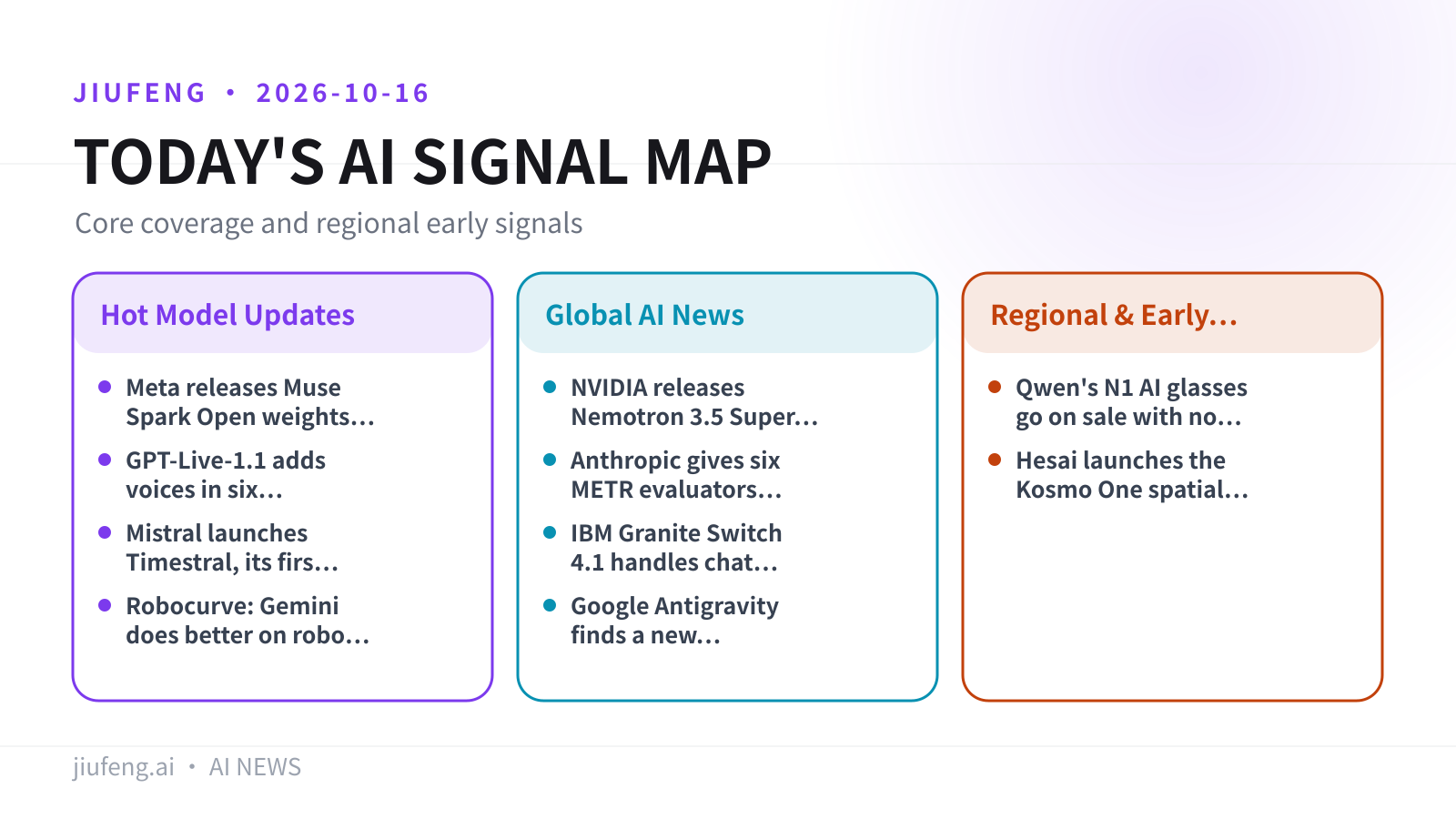
Jiufeng graphic based on the sources cited in this issue.
Hot Model Updates
01/10
Meta releases Muse Spark Open weights: an 816B MoE with 1M context
Meta has released Muse Spark Open, an open-weight model built for coding and agentic tasks that it pitches against Qwen 3.8, GLM 5.3 and Kimi K3.
- Scale: 816B total parameters, 42B active per token
- Context: up to 1 million tokens
- Modalities: supports text, images, video and audio
- Local use: Meta says it is optimized for Apple's M5 Ultra and runs on two Mac Studios with 512 GB of unified memory each
- Weights: published on Hugging Face
On benchmarks including JobBench, MCP-Atlas, HLE-Diamond and ZeroBench, Meta says it leads Qwen 3.8, GLM 5.3 and Kimi K3 in the agentic, knowledge and reasoning, and multimodal categories.
Limitations: All of these results come from Meta. The Decoder reports that the model trails some competitors on coding benchmarks and falls well short of Meta's paid Muse Wonder Full models. The license allows free use but comes with conditions, so read it in full before deploying.
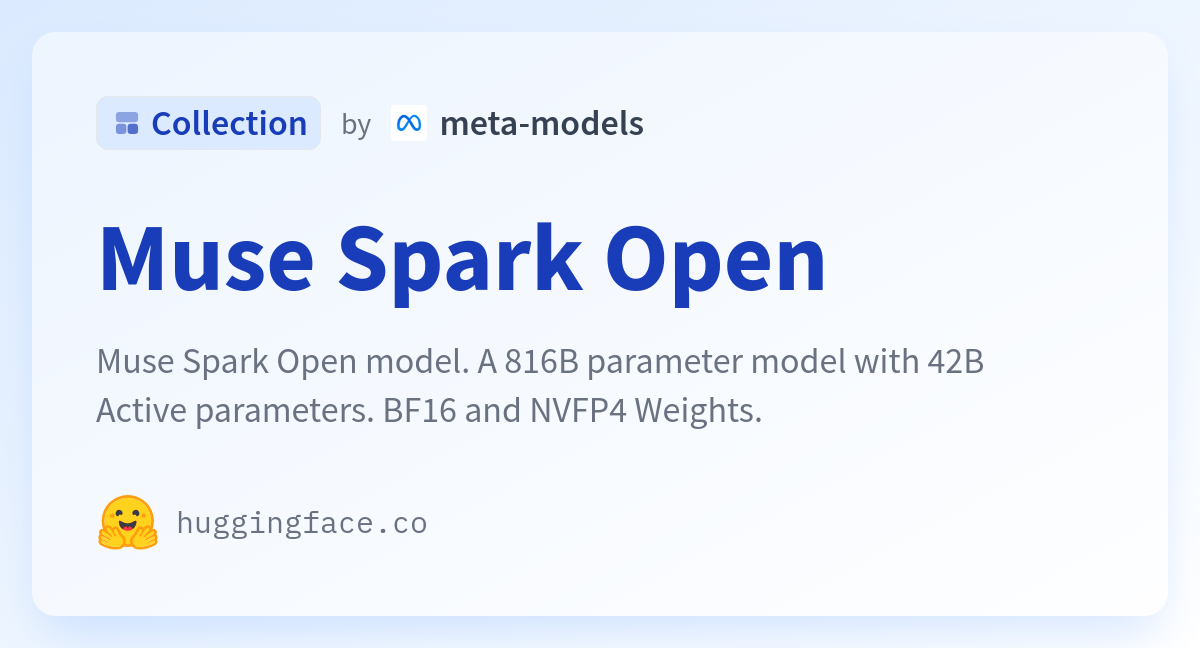
Image source: huggingface; mirrored on Jiufeng R2.
Source: The Decoder · Hugging Face weights
02/10
GPT-Live-1.1 adds voices in six languages across ChatGPT, Codex and Dots
OpenAI's real-time voice model moves to version 1.1 in its own apps first. The API version comes later.
On October 15th, OpenAI said GPT-Live-1.1 is rolling out to ChatGPT, Codex and Dots with new voices in French, German, Hindi, Mexican Spanish, Korean and Japanese. OpenAI says accents are improved and there is less spoken progress narration, the audible "checking..." that makes an assistant sound stuck.
Limitations: Developers stay on the earlier model for now. OpenAI only says the API version will follow and gives no date. It published no latency or pricing figures.
Source: RuntimeWire · OpenAI on X
03/10
Mistral launches Timestral, its first time-series foundation models, up to 209M parameters
Timestral comes in four sizes from 5M to 209M. Mistral says the largest ranks first on the field's three main public forecasting benchmarks.
- Sizes: four, from 5M to 209M parameters
- Benchmarks: the 209M model ranks first on GIFT-Eval, TIME and fev-bench, with two-thirds the parameters of the previous best model
- Capabilities: probabilistic, multivariate forecasts; supports past-only and known-future covariates; works zero-shot
- Deployment: Mistral says it runs efficiently on CPUs; domain fine-tuning is available through Mistral Forge
- License: according to the GitHub README, the code is Apache 2.0 and the model weights on Hugging Face use a Modified MIT license
Mistral says the models combine synthetic pre-training, covariate-aware attention and long-context learning.
Limitations: The benchmark rankings come from Mistral's own announcement and have not yet been reproduced by a third party.
Source: Mistral AI · GitHub
04/10
Robocurve: Gemini does better on robot tasks than its general AI scores predict
A small pilot suggests general AI leaderboards may not predict how models perform on physical tasks, with Gemini as the clearest outlier.
On October 15th, San Francisco public benefit corporation Robocurve published a small pilot index in an X thread and a technical report led by Drew T. Nguyen. It covers five bimanual tasks and 11 model configurations. Gemini models scored far above what their general AI capability rankings predicted on real-robot tasks. With Gemini removed, the correlation between robot scores and general AI capability rises from 0.20 to 0.96.
Limitations: Robocurve itself describes this as a small pilot. RuntimeWire notes that the small task and model sample leaves the finding preliminary.
Source: RuntimeWire · Robocurve on X
Global AI News
05/10
NVIDIA releases Nemotron 3.5 Super VL, a 120B open multimodal model
One open checkpoint handles text, images, documents and video, built for enterprise agents that run continuously in the background.
- Architecture: MoE with 120B total and 12B active parameters
- Modalities: text, images, documents and video
- Target: specialized enterprise agents that run continuously in the background
The release includes two edge models, Nemotron 3.5 Bolt 74B-A9B and Bolt E4B. According to The Decoder, the first targets systems with 24 GB of memory or more, and the second is a later, roughly 4 GB version for voice assistants. NVIDIA is publishing the datasets and training recipes alongside the models.
Limitations: The Decoder notes that everything is optimized for NVIDIA's own hardware to drive chip and system sales.
Source: The Decoder · NVIDIA technical blog · NVIDIA
06/10
Anthropic gives six METR evaluators internal access and the right to publish
Outside evaluators get employee-like access, and Anthropic says it cannot veto METR's published risk assessments.
Starting October 15th, six employees of the nonprofit METR have access to Anthropic's internal systems and risk-assessment work. METR will publish its results. Anthropic says it has already worked with METR on several reviews of its Risk Reports. SecureBio and Accenture currently serve as evaluators, and Anthropic is in early discussions with other organizations, including Hugging Face. Anthropic previously signed the White House Accord on Super Intelligence, which includes a pledge to work with independent external auditors or evaluators.
Limitations: RuntimeWire reports that Anthropic keeps narrow redaction powers and controls the access tiers. Anthropic says it won't publish some safety information because it could help malicious actors or is commercially sensitive.
Source: Anthropic · RuntimeWire
07/10
IBM Granite Switch 4.1 handles chat, decisions and speech-to-text from one endpoint
The 8B and 30B models use switchable aLoRA adapters to move between tasks on a single hosted endpoint.
Granite-Switch-4.1-8B and -30B include three components. A Decision aLoRA handles general decision-making. A Guardian aLoRA handles safety decisions, and IBM says it beats Jev 1.13, Microsoft-Decision-1, GPT-Luna-Decisions and Clef-Flash on average on safety-related decision tasks. Granite-Speech-5.0-Turbo-CTC, the fastest ASR model on the OpenASR Leaderboard, handles transcription. The project code is public on GitHub.
Limitations: IBM published the comparisons with the other decision models itself. The available material gives no specific scores, and there is no third-party evaluation.
Source: Hugging Face Blog · GitHub
08/10
Google Antigravity finds a new antimicrobial peptide candidate in UniProt
DeepMind shows an agentic science workbench turning a search that used to span multiple databases into a single session.
According to DeepMind, researchers used ProtNLM inside Google Antigravity to scan millions of uncharacterized proteins in UniProt. ProtNLM is a model that predicts biological function from amino acid sequences. The researchers then evaluated structures and prioritized targets in the workbench, and found a new antimicrobial peptide candidate. It is predicted to be active against pathogens involved in respiratory tract infections.
Limitations: This is a technical walkthrough, and the candidate's activity is still a computational prediction. DeepMind says the lead is now undergoing wet-lab validation. No results have been published yet.
Source: Google DeepMind
Regional & Early Signals
09/10
Qwen's N1 AI glasses go on sale with no display and 5 mW always-on vision
Chinese-language source. Alibaba's Qwen calls the glasses "Personal Agent hardware" built to keep sensing the wearer's real-world surroundings.
After national subsidies and launch discounts, N1 starts at 2,218 yuan and N1 Pro at 2,600 yuan. An AI ear-clip earphone made with Bose costs 1,099 yuan. The N1 line drops the display and relies mainly on voice. N1 Pro has a 50MP sensor, eye tracking and biometric sensors, and weighs about 44 g without lenses. Always-on vision runs at 5 mW on a mixed platform of Snapdragon AR1 Gen 1, BES2800 and Himax HX6538 chips.
Limitations: The only source is a hands-on piece from InfoQ China, and the power and weight figures come from the vendor. The same report cites IDC data showing China's smart-glasses shipments fell 8% year over year in Q2 2026, as the category faces pressure from look-alike products.
Source: InfoQ China (Chinese-language source)
10/10
Hesai launches the Kosmo One spatial camera, which scans about 100 m² in 15 minutes
Chinese-language source. Automotive lidar maker Hesai launches Kosmo, a 3D world data engine, as it moves into embodied AI.
On October 14th, Hesai launched the Kosmo engine: a handheld capture device, Kosmo One, and a cloud platform, Kosmo World. Kosmo One combines lidar, a 1-inch CMOS sensor and a high-precision IMU, synchronized to the microsecond. Hesai says its geometry is millimeter-accurate, fine enough to resolve the roughly 5 mm mesh on a tennis racket. Video captures at up to 8K and exports at up to 6K. Hesai says a typical 100 m² indoor space takes about 15 minutes to scan. Kosmo World reconstructs, edits and manages the resulting 3D assets.
Limitations: The only source is iFanr in Chinese, the accuracy and speed figures come from Hesai, and the report gives no price.
Source: iFanr (Chinese-language source)
Write a prompt in your browser and get an image — 1K, 2K or 4K output, up to 15 reference images. 50 free generations on sign-up, no credit card.
Generate free