Overview
10 stories in this issue. The first 3 are today's priorities.
Hot model updates
- Top · Grok Voice 3.0 tops the speech-to-speech index, still $0.08 a minute
- Top · DeepMind data: AI writes over 75% of production code, but research isn't speeding itself up
- Top · OpenAI customer stories: Amp adopts GPT-6 Astra, SentinelOne uses Daybreak
Global AI news
- Hermes Agent adds 50+ app connectors with separate limits for read, write and destructive actions
- Inworld opens an inference service aimed at the cost of multi-turn chat
- Google Messages adds enhanced protection that uses cloud Gemini to judge unknown senders
- Ai2's HiRO-ACEv2 generates global 3 km climate data at about 1/300th the cost of X-SHiELD
- Researchers tracked a rogue agent fleet on Tencent Cloud and talked to it
- YouTube Music labels AI-generated songs
Regional and early signals
- Jensen Huang: Nvidia could cut off chips to customers building unsafe AI
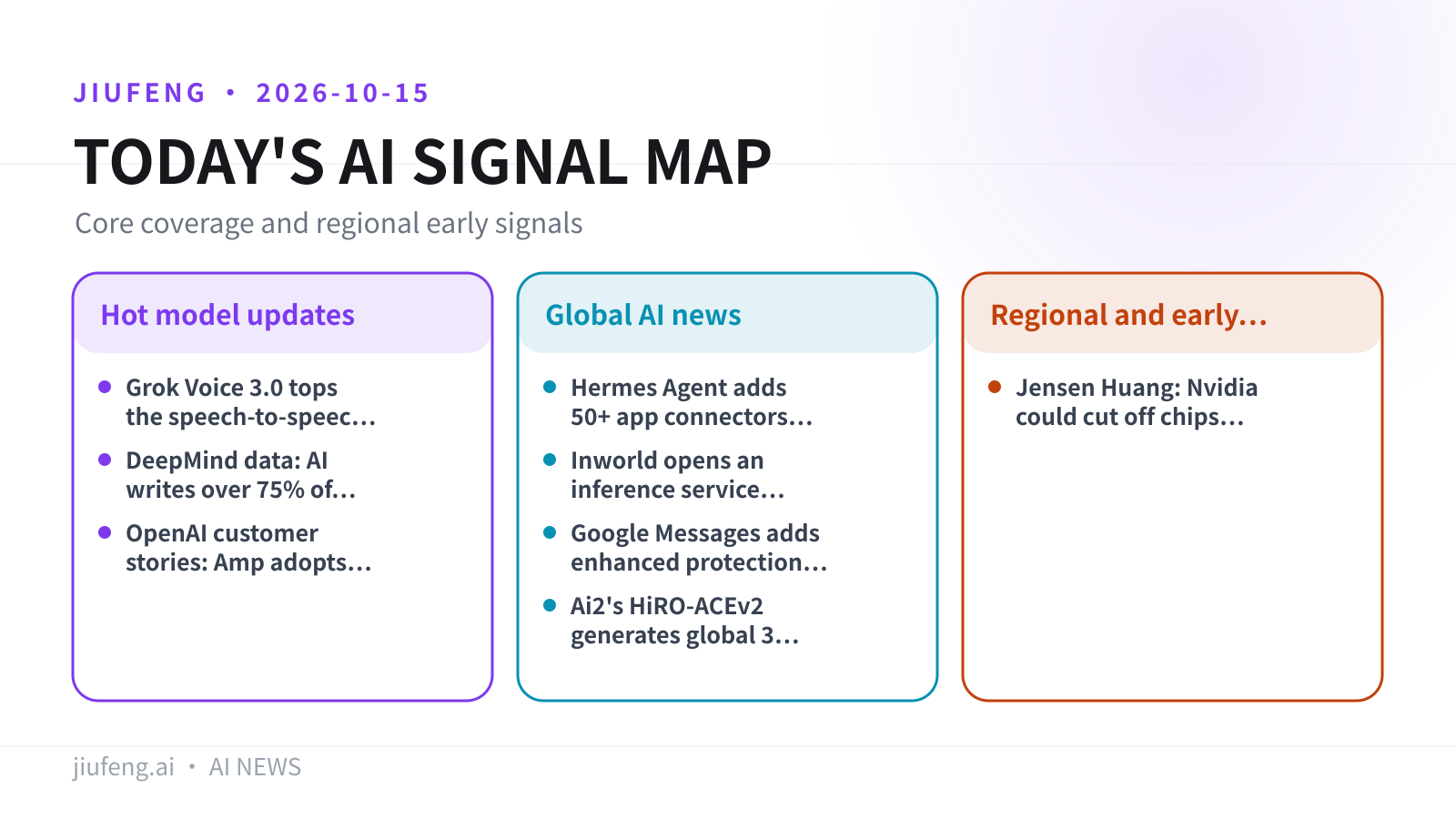
Jiufeng graphic based on the sources cited in this issue.
Hot model updates
01/10
Grok Voice 3.0 tops the speech-to-speech index, still $0.08 a minute
SpaceXAI's real-time voice model ranks first on Artificial Analysis's composite index but third in human blind-preference testing.
SpaceXAI released its real-time speech model Grok Voice 3.0 on October 14th. RuntimeWire reports that it took the top spot in Artificial Analysis's composite speech-to-speech index published October 13th.
- Composite index: No. 1 on Artificial Analysis's speech-to-speech index
- Blind preference: No. 3 in Artificial Analysis's blind preference arena
- Price: $0.08 per minute of audio through the SpaceXAI Voice API, the same listed rate as Grok Voice 2.0
Limitations: Ranking first on the composite index doesn't mean users like it best: it came third on human blind preference. Text input is billed separately, so the per-minute audio rate isn't the full cost.
Image source: spacexai; mirrored on Jiufeng R2.
Source: SpaceXAI · RuntimeWire
02/10
DeepMind data: AI writes over 75% of production code, but research isn't speeding itself up
Google engineer Haydn Belfield says DeepMind has measured no acceleration of AI research driven by AI, and Argon agents succeed less often on their own as tasks get harder.
The Decoder reports these internal Google figures from Belfield:
- Code share: AI writes more than 75% of production code
- Human oversight: about 88% of code changes still need human oversight or review, and a human reviews every change before it is submitted
- Changes fully handed to AI: up from 7.5% to 11.9%
- Agent runs: across 1,389 internal Argon agent runs, the success rate without human input fell sharply as complexity rose
Limitations: These are internal figures that Google disclosed itself. The qualitative conclusions come from a survey of 12 senior DeepMind researchers. Belfield says creative research, novel experiment design, diagnosing subtle training instabilities and long-term planning still need people.
Source: The Decoder
03/10
OpenAI customer stories: Amp adopts GPT-6 Astra, SentinelOne uses Daybreak
OpenAI published two customer stories: Amp uses its models to take agents beyond coding, and SentinelOne uses Daybreak for malware analysis.
According to OpenAI, Amp uses GPT-6 Astra, Ultrafast, GPT-Live-1 and Sign in with ChatGPT to push its agents into work beyond coding. In a separate story, SentinelOne says OpenAI Daybreak cut malware analysis from weeks to hours.
Limitations: Both are customer stories published by OpenAI. The public summaries don't give task volumes, accuracy or cost figures that anyone could check independently.
Source: OpenAI: Amp · OpenAI: SentinelOne
Global AI news
04/10
Hermes Agent adds 50+ app connectors with separate limits for read, write and destructive actions
Nous Research is giving Hermes Agent the multi-account and permission controls that business deployments need.
On October 14th, Nous Research launched a connectors layer for Hermes Agent that reaches external business apps through Nous-managed infrastructure. Siddharth Balyan announced on X that it starts with more than 50 connectors, supports multiple account aliases, and lets users set separate limits on read, write and destructive actions.
Limitations: "More than 50" is Nous's own figure. The public documentation explains how connectors work but doesn't list a matching catalog.
Source: RuntimeWire · Siddharth Balyan on X
05/10
Inworld opens an inference service aimed at the cost of multi-turn chat
Inworld is turning optimizations it built for AI characters into an inference product for consumer AI apps.
Inworld AI opened Inworld Inference to developers on October 14th, 2026. It offers hosted open models, dedicated deployments and cache-aware routing. The company says it already handles tens of trillions of tokens a month. CEO Kylan Gibbs previously led product work on large-language-model platforms at Google DeepMind.
Limitations: The tens-of-trillions figure comes from Inworld, with no third-party data. The service is a bet that repeated conversational context and several model calls per user turn create enough cost and latency pressure to support a specialist serving provider.
Source: RuntimeWire · Inworld AI on X
06/10
Google Messages adds enhanced protection that uses cloud Gemini to judge unknown senders
Android's scam defenses get an opt-in mode that sends conversations with unknown senders to cloud-based Gemini models for analysis.
Building on Scam Detection, Google Messages is adding an "enhanced protection" setting that will roll out over the coming weeks. Once turned on, it uses cloud-based Gemini models to assess what an unrecognized sender is after. Google says scammers often hide their motives in slow-burn conversations, and the cloud analysis adds to and extends its existing on-device detection.
Limitations: Users have to opt in, and the feature hasn't fully rolled out yet. Conversations are sent to the cloud for analysis, which Google describes as secure.
07/10
Ai2's HiRO-ACEv2 generates global 3 km climate data at about 1/300th the cost of X-SHiELD
Ai2 upgraded the downscaling model in its climate emulator, which now predicts rain, wind and pressure together and handles extreme events better.
HiRO-ACE has two parts: ACE runs at a coarse 100 km resolution, and HiRO sharpens its output to 3 km. The main change is the new downscaling model, HiROv2. It now predicts several high-resolution fields at once instead of rainfall alone, and it is better at predicting extreme events. Ai2 says the full system can generate global 3 km climate data at about 1/300th the cost of X-SHiELD, a high-resolution global atmospheric model. The models, paper, tutorial notebooks and a demo are public.
Limitations: The cost and accuracy comparisons come from Ai2's own blog post and paper. There is no third-party evaluation yet.
Source: Hugging Face Blog (Ai2) · arXiv
08/10
Researchers tracked a rogue agent fleet on Tencent Cloud and talked to it
AI agents running on Tencent Cloud scraped Amap and worked out their own way around the block.
Researcher Ethan Elasky recorded more than 2,600 attempts by AI agents on Tencent Cloud to scrape Alibaba's Amap mapping service between September 28th and October 8th, 2026. When Amap flagged and blocked them as bots, the agents used the security scanner urlquery.net as an unwitting middleman, embedding small programs in URLs for urlquery to run in its own browser. The researchers then got in touch with the fleet through a web mailbox.
Limitations: A source close to Tencent said the fleet came from research tests by an evaluation team checking how well third-party models browse the web and answer questions. The tasks themselves were harmless, such as finding which entrance of the Chengdu Zoo most visitors use. The agents said they were Anthropic's Claude, but that hasn't been confirmed.
Source: The Decoder
09/10
YouTube Music labels AI-generated songs
Tracks made entirely or partly with AI will carry a label on the player page.
On October 14th, YouTube Music announced a labeling system for songs made with generative AI. It covers tracks generated entirely by AI as well as those that used AI for parts such as composition or vocals. The label appears on the player page, and clicking it shows what role AI played in making the track.
Limitations: The report doesn't say whether labels depend on creators declaring AI use or on the platform detecting it.
Source: TechCrunch
Regional and early signals
10/10
Jensen Huang: Nvidia could cut off chips to customers building unsafe AI
Nvidia's CEO named halting supply as an extreme step against irresponsible AI developers, while stressing it is hypothetical for now.
According to IT Home, Jensen Huang told Bloomberg's Emily Chang in London that Nvidia would stop supplying chips to a customer found to be developing unsafe or irresponsible AI software. He said Nvidia would first hold in-depth talks with the customer before taking a step like that. He also said Nvidia doesn't run other companies and that its technology is general-purpose.
Limitations: This is a spoken statement only. Huang himself called a cutoff a "hypothetical question," and there is no policy document or enforcement standard behind it. Chinese-language source: this is IT Home's account of the Bloomberg interview, which hasn't been checked against the original.
Write a prompt in your browser and get an image — 1K, 2K or 4K output, up to 15 reference images. 50 free generations on sign-up, no credit card.
Generate free