Overview
9 stories in this issue. The first 3 are today's priorities.
Hot model updates
- Top · BootLoops opens code for Claude scientific calculations
- Top · Strands Decider 2B targets local decisions
- Top · Anthropic commits $100M to Claude deployment training
- Utopai X ranks second on audio-video leaderboard
Global AI news
- OpenAI Dots brings web tasks into chat
- AWS outlines multi-turn RL for search agents
- AllenAI open-sources AstaBrief report model
- Decision models compete on typed probabilities
Regional and early signals
- QCon Shanghai spotlights Agent runtime isolation
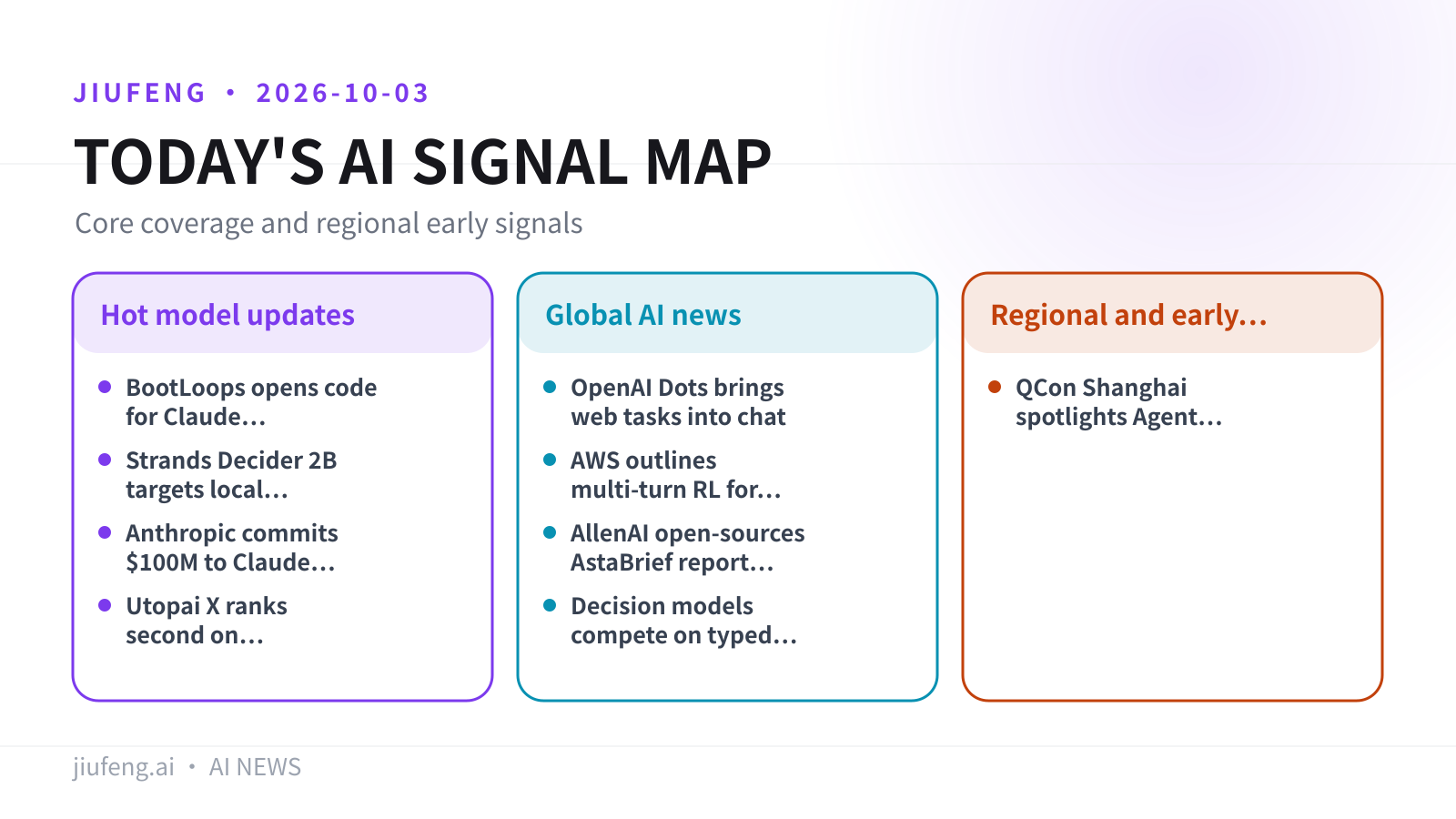
Jiufeng graphic based on the sources cited in this issue.
Hot model updates
01/09
BootLoops opens code for Claude scientific calculations
Open-source BootLoops has been used with Claude for precise scientific calculations, and its code is now public on GitHub.
The Decoder reported that Harvard physicist Matthew Schwartz used BootLoops and Claude to produce 36 manuscripts across 18 fields in three months, including particle physics and linguistics. The BootLoops code repository is public, and Anthropic has published related Vibe Physics research material.
Limitations: The Decoder reported that the results often had problems. Public material does not establish peer-review status for the manuscripts or reproducible results with other models.
Image source: GitHub; mirrored on Jiufeng R2.
Source: The Decoder · BootLoops GitHub · Anthropic Vibe Physics
02/09
Strands Decider 2B targets local decisions
Amazon's Strands Agents released an open decision model based on Qwen3.5-2B for local scoring and choice tasks.
Strands Decider 2B replaces a text-generation head with a scoring pointer head and uses a rank-16 LoRA adapter. IT Home reported that the head has just over 1 million parameters, ranks third among 2B-class models on JevBench, and reaches 113 ms median decision latency on common hardware.
Limitations: This is a Chinese-language source report. The available extract does not provide full benchmark scores, license terms, or repository links for the weights.
Source: IT Home
03/09
Anthropic commits $100M to Claude deployment training
Anthropic says Claude Frontier Academy will train 10,000 Frontier Deployed Engineers by the end of 2027.
Anthropic committed $100 million to the program and said its first cohorts include engineers from Accenture, Bain, Capgemini, Commonwealth Bank of Australia, Deloitte, McKinsey, Morgan Stanley, and Novo Nordisk. The company says the training follows the standards used for its own deployment engineers.
Limitations: This is an Anthropic first-party training announcement and does not disclose course pricing, cohort allocation, or independently measured outcomes.
Source: Anthropic Newsroom
04/09
Utopai X ranks second on audio-video leaderboard
Utopai Studios says its Utopai X model placed second on Artificial Analysis's audio text-to-video ranking.
According to iFanr, the September 30 ranking put Utopai X behind Wan 3.0 and ahead of Dreamina Seedance 2.5. The ranking uses Video Arena blind voting and Elo scores, while Utopai says the model supports film development work on characters, scenes, and shots.
Limitations: This is a Chinese-language source report. It provides no model size, pricing, weights license, or direct product-access details.
Source: iFanr
Global AI news
05/09
OpenAI Dots brings web tasks into chat
The Verge's hands-on report describes OpenAI Dots as a task-agent interface that currently resembles enterprise workflow software.
Users can currently create and name one Dot, while OpenAI says multiple Dots are planned. In testing, Dot attempted web tasks including food ordering, but its cloud-browser footprint more often triggered website security checks.
Limitations: The report is based on hands-on use and does not fully specify feature availability by region. OpenAI's help page says some websites can block cloud-browser tasks.
Source: The Verge · OpenAI Help
06/09
AWS outlines multi-turn RL for search agents
AWS published a SageMaker method for teaching smaller search agents to use tools across multiple retrieval rounds.
The approach trains an agent to decide what to search, which retrieval strategy to use, and when to stop based on prior results. AWS positions fine-tuning as a route to multi-turn tool behavior with lower latency and cost than relying on a frontier model.
Limitations: This is an AWS technical tutorial, not a benchmark release; it provides no specific model scores, training cost, or quantified comparison with frontier models.
Source: AWS Machine Learning Blog · FRAMES dataset
07/09
AllenAI open-sources AstaBrief report model
AllenAI released AstaBrief on Hugging Face for locally run, cited scientific-report generation.
The model targets research workflows that require literature synthesis, evidence-grounded claims, and outputs that can be checked later. AllenAI says users can download and run the model themselves.
Limitations: The announcement does not disclose parameter count, inference cost, license details, or complete comparative benchmark results.
Source: Hugging Face Blog
08/09
Decision models compete on typed probabilities
A MarkTechPost overview tracks Jev, GLiDE, and open alternatives that return typed choices, scores, or probabilities instead of prose.
TypeSafe's Jev supports Choice, Score, and Noul primitives, with Choice handling up to 255 options. The report lists Jev at $0.042 per million input tokens and 70 to 500 ms responses, while Fastino Labs shipped two rivals within three weeks of Jev's launch.
Limitations: This is a product overview, and some prices, latency figures, and capability claims come from vendors. The linked paper is research material, not independent validation of every product.
Source: MarkTechPost · arXiv
Regional and early signals
09/09
QCon Shanghai spotlights Agent runtime isolation
QCon Shanghai's October program highlights sandboxing, networking, identity, and credential controls for enterprise Agents.
InfoQ reported that a session by SAIC Group's cloud-computing architect Fang Yuchen will discuss Kubernetes Agent Sandbox, OVN-Kubernetes, Istio Sidecar, tenant-level Egress Gateway, and Keycloak. The report identifies unknown-code execution, L3/L4 isolation, API authorization, and credential exposure as enterprise Agent infrastructure issues.
Limitations: This is a Chinese-language conference preview and proposed architecture, not a verified product release or independent deployment evaluation.
Source: InfoQ China
Write a prompt in your browser and get an image — 1K, 2K or 4K output, up to 15 reference images. 50 free generations on sign-up, no credit card.
Generate free