Overview
8 stories in this issue. The first 3 are today's priorities.
Notable model developments
- Top · Cloudflare releases Qwen-based Clef decision models
Global AI news
- Top · Meta opens code for homemade Muse gadgets
- Top · Apple changes full disk access permissions
- DGX Spark adds a 64GB configuration
- AWS connects Claude Desktop to managed web search
Regional and early signals
- Nebula connects external agents to a shared workspace
- Grok gets an experimental TypeScript SDK
- llama.cpp adds typed decisions for five model families
Notable model developments
01/08
Cloudflare releases Qwen-based Clef decision models
Clef and Clef-flash accept text and images, returning probabilities over predefined choices instead of long responses.
Cloudflare has released two Qwen-based decision models for tasks such as classifying support tickets and assessing urgency, with downstream code routing requests or triggering escalations. The company reports these response times:
| Model | Median response time (ms) |
|---|---|
| Clef-flash | 39 |
| Clef | 209 |
Both models are available through Workers AI and released under Apache-2.0.
Limitations: These latency figures come from Cloudflare, rather than an independent test by the publication; claims that agents can operate without human involvement are also the company's position.
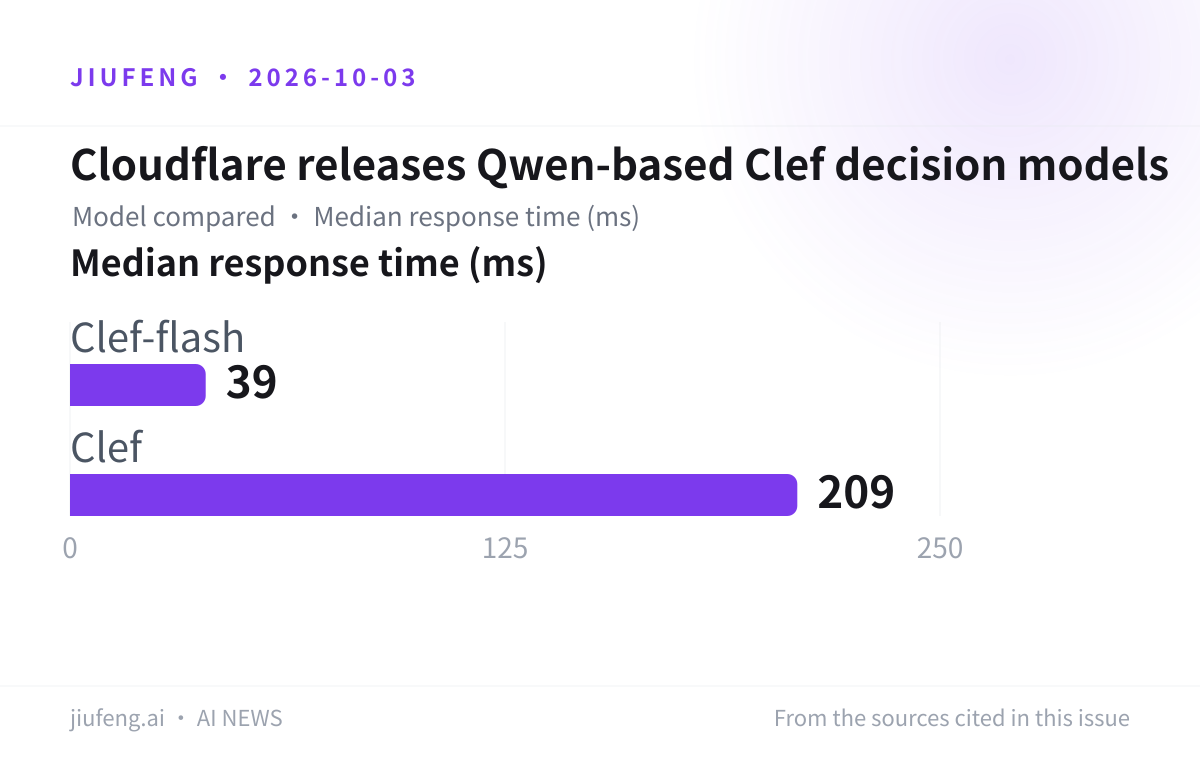
Jiufeng graphic based on the sources cited in this issue.
Image source: huggingface; mirrored on Jiufeng R2.
Source: The Decoder · Cloudflare model repository
Global AI news
02/08
Meta opens code for homemade Muse gadgets
Developers can connect Muse to devices built with an ESP32 board or Raspberry Pi.
The Verge reports that Meta has opened code and SDKs for Muse gadgets, connecting the agent to displays, buttons, sensors and actuators. Suggested projects include a color E Ink reminder display, an HDMI device for a larger screen and a small touchscreen terminal.
Limitations: These are devices users build themselves.
Source: The Verge · Nat Friedman's announcement
03/08
Apple changes full disk access permissions
Apple is changing full disk access permissions to curb abuse by AI agents.
Ars Technica reports on the permissions change. Its summary also notes that Meta and Apple disagree over the role of full disk access in Muse reading messages.
Limitations: The companies' interpretations of the permissions should not be presented as an agreed conclusion.
Source: Ars Technica
04/08
DGX Spark adds a 64GB configuration
NVIDIA's new 64GB DGX Spark configuration supports two-system clusters with 128GB of aggregate memory.
MarkTechPost reports that Acer, ASUS, Dell, Gigabyte, HP and MSI will offer the configuration for local models and desktop agent workloads. Its hardware and software include:
- Chip: GB10 Grace Blackwell.
- Memory: 64GB of unified memory per system.
- Networking: ConnectX-7.
- Software: NVIDIA's CUDA-accelerated AI stack.
| Configuration | Total memory (GB) |
|---|---|
| One 64GB system | 64 |
| Two 64GB systems | 128 |
Limitations: The 128GB figure is the aggregate memory of two systems; the supplied material does not provide pricing or measured throughput for a specific model.
Source: MarkTechPost · NVIDIA DGX Spark
05/08
AWS connects Claude Desktop to managed web search
An AWS walkthrough uses AgentCore Gateway to add MCP-compatible web search to Claude Desktop on Bedrock.
The search service uses an Amazon web index spanning tens of billions of documents, allowing retrieval of information such as recent documentation and current prices. The integration includes:
- Gateway: AgentCore Gateway with a Web Search target enabled.
- Protocol: Managed MCP servers.
- Authentication: JWT-based inbound authentication.
- Query handling: AWS says traffic remains within its infrastructure, without external API keys.
Limitations: Users must configure the gateway and authentication; without search integration, the model cannot retrieve current information independently, and this tutorial does not introduce a new Claude model version.
Source: AWS walkthrough
Regional and early signals
06/08
Nebula connects external agents to a shared workspace
Nebula lets teams use custom agents and existing Claude or Codex agents in one workspace.
RuntimeWire reports that Nebula, founded by Furqan Rydhan, described agent creation and connection in an October 2 announcement, with its product site listing Claude and Codex support. Nebula's pricing page lists a charge of $25 per seat per month, with its own agents metered separately.
Limitations: The product still has to establish its place in teams' daily work; the supplied material does not specify usage rates for its own agents.
Source: RuntimeWire · Nebula announcement
07/08
Grok gets an experimental TypeScript SDK
@xai-official/sdkcombines Grok APIs and hosted tools in one TypeScript client.
SpaceXAI's Eric Zakariasson announced the SDK on October 2, covering text responses, voice, image and video generation, plus search and code tools running on xAI's servers. RuntimeWire found three commits in the open-source repository when it reviewed the package, which remains pre-1.0.
Limitations: The team explicitly warns that interfaces may change between releases; hosted tools depend on xAI's servers, and adopters should account for version pinning and compatibility changes.
Source: RuntimeWire · Developer announcement · SDK repository
08/08
llama.cpp adds typed decisions for five model families
A new local endpoint returns yes-or-no answers, classifications, scores and probability distributions.
RuntimeWire reports that llama.cpp merged the /v1/systemone endpoint, authored by Xuan-Son Nguyen, on October 2, supporting Laya, Julia-1, Lev, OpenJev and Kev. The endpoint can ask several questions against shared input, such as whether a ticket is urgent, which team should handle it and how frustrated the customer sounds.
Limitations: Development builds are available, with v0.6.0 still an expected release; probability reliability needs validation on real workloads, and this is not a version update to Meta's Llama models.
Source: RuntimeWire · llama.cpp repository
Write a prompt in your browser and get an image — 1K, 2K or 4K output, up to 15 reference images. 50 free generations on sign-up, no credit card.
Generate free