Overview
8 stories in this issue. The first 3 are today's priorities.
Popular Model Updates
- Top · Llama Prompt Guard 2 22M enters model catalog
- Top · Claude Opus 5.5 leads APEX Accounting
Global AI News
- Top · Microsoft releases streaming transcription and speech models
- Suno Speech enters public beta
- ServiceNow outlines enterprise-agent training data generation
Regional and Early Signals
- openJiuwen introduces X-Router model routing
- Docker proposes portable agent permissions through CNCF
- TwinDEX performs a 24-step chemistry experiment
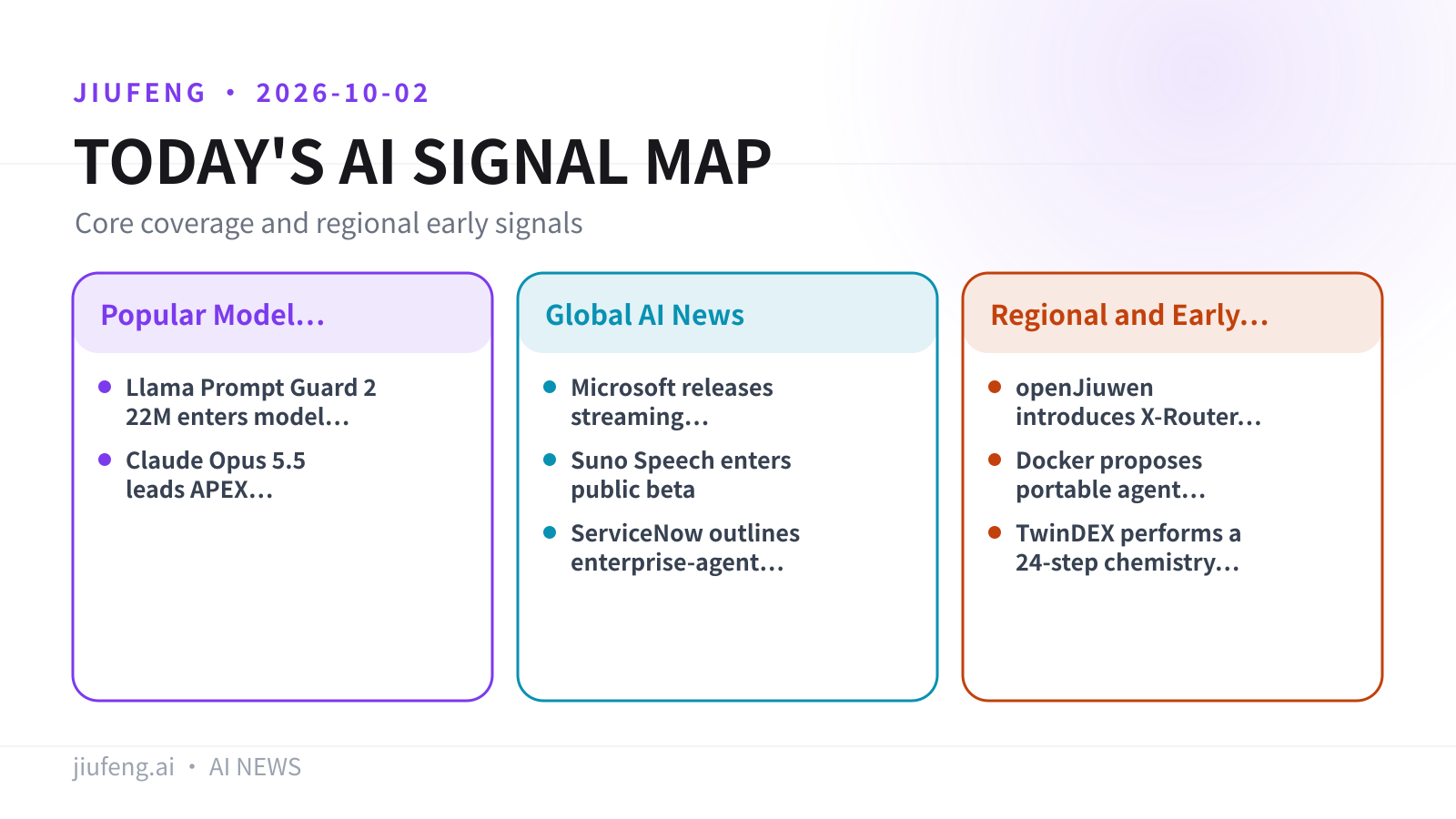
Jiufeng graphic based on the sources cited in this issue.
Popular Model Updates
01/08
Llama Prompt Guard 2 22M enters model catalog
RuntimeWire cataloged Meta’s text-classification repository, without establishing a new release date.
RuntimeWire listed the Hugging Face repository meta-llama/Llama-Prompt-Guard-2-22M under the text-classification task. The entry points to a public model repository and explicitly distinguishes it from an inference endpoint.
Limitations: The report states that discovering a repository does not establish its release date or inference availability; this entry cannot substantiate a model launch or API rollout today.
Image source: huggingface; mirrored on Jiufeng R2.
Source: RuntimeWire · Meta model repository
02/08
Claude Opus 5.5 leads APEX Accounting
Opus 5.5 meets 61.8% of grading criteria, but almost 60% of full-benchmark tasks remain unsolved by any model.
The Decoder reports that the full APEX Accounting benchmark contains 160 tasks across 10 simulated companies, developed by more than 40 professionals averaging 11 years of experience. Current results measure the share of grading criteria met:
| Model | Grading criteria met (%) |
|---|---|
| Claude Opus 5.5 | 61.8 |
| Fable 5.1 | 61.0 |
| GPT-6 Astra | 57.9 |
A separate comparison on simplified tasks involved 12 licensed CPAs averaging 5.5 years of experience; Mercor says current models surpassed those participants in speed and accuracy on these structured tasks.
Limitations: The simplified human comparison and the full benchmark are different evaluations; Mercor says no model fully solved almost 60% of full-benchmark tasks, and closing the books still requires oversight.
Source: The Decoder
Global AI News
03/08
Microsoft releases streaming transcription and speech models
The transcription model supports 60 languages; Microsoft claims 150-millisecond latency for its Flash speech model.
The Decoder reports that Microsoft AI released MAI-Transcribe-2-Streaming alongside MAI-Voice-2.1 and MAI-Voice-2.1-Flash, covering real-time transcription and speech generation.
- Streaming transcription: Supports 60 languages, with initial partial results in just over 100 milliseconds; introductory pricing is $0.54 per audio hour through the end of 2026.
- Multilingual speech: MAI-Voice-2.1 supports the same voice across 23 languages, with native accents according to Microsoft.
- Flash specifications: Microsoft claims 150-millisecond latency and pricing of $15 per million characters.
- Availability: Access includes Microsoft Foundry and MAI Playground; both speech-generation models are also on OpenRouter.
Limitations: Accuracy rankings and latency figures are Microsoft’s claims; both speech models can clone voices from seconds of reference audio, and the supplied material mentions safeguards without presenting an effectiveness evaluation.
Source: The Decoder
04/08
Suno Speech enters public beta
Suno’s new feature generates spoken voices and accompanying background music on web and mobile.
The Verge reports that Speech accepts scripts or prompted descriptions to generate voices. It can simultaneously create background music for the spoken output, extending Suno into voiceover generation, with a maximum generation length of approximately eight minutes.
Limitations: Speech remains in public beta; the supplied material does not specify pricing or supported languages, so it does not establish a complete set of production-use specifications.
Source: The Verge
05/08
ServiceNow outlines enterprise-agent training data generation
AutoSynthData targets weaknesses that emerge when agents operate in specific enterprise environments.
ServiceNow-AI published its AutoSynthData article on Hugging Face, describing enterprise systems, business rules, and data state as constraints on training tasks. The article outlines generating tasks around weak capabilities and shifting the curriculum as models improve, using EnterpriseOps Gym to illustrate the pipeline.
Limitations: This is a first-party methodology article; the supplied excerpts provide no performance gains, training costs, or independent replication results that can be quoted here.
Source: ServiceNow-AI article · Related EnterpriseOps Gym paper
Regional and Early Signals
06/08
openJiuwen introduces X-Router model routing
X-Router selects models using requests and feedback; the report’s headline claims token savings exceeding 50% in testing.
Chinese-language source QbitAI reports that openJiuwen’s routing engine sits between agents and models, supporting business preferences such as cost and speed. Its model capability profiles combine offline historical analysis with online updates, and the project emphasizes visibility into routing decisions and execution feedback.
Limitations: The reported savings are a project testing claim; the supplied excerpt does not contain complete test conditions or independent validation, so the figure cannot be generalized to every workload.
Source: QbitAI — Chinese-language source · openJiuwen repository
07/08
Docker proposes portable agent permissions through CNCF
The Sandbox Kit Specification aims to package AI-agent access permissions as OCI images.
InfoQ reports that Docker announced plans to bring the Sandbox Kit Specification to the CNCF. The specification addresses which resources an agent may access, aiming to make those permissions portable alongside the agent.
Limitations: This item relies on the report’s summary; the announced plan does not establish CNCF acceptance, and the available material provides no specification version, implementation schedule, or compatibility test results.
Source: InfoQ
08/08
TwinDEX performs a 24-step chemistry experiment
Pandaily reports that a policy trained only on a few hundred robot-free demonstrations executed a 24-step chemistry experiment.
X Square Robot’s TwinDEX pairs a wearable exoskeleton with a matching three-finger robotic hand. According to the report’s summary, training used demonstrations collected without a robot before the policy was deployed for the chemistry experiment.
Limitations: This item relies on the report’s summary, which provides no repeated-trial count, success rate, or independent replication; zero on-robot training data does not mean zero training data.
Source: Pandaily
Write a prompt in your browser and get an image — 1K, 2K or 4K output, up to 15 reference images. 50 free generations on sign-up, no credit card.
Generate free