Overview
9 stories in this issue. The first 3 are today's priorities.
Hot model updates
- Top · Liquid AI's d1 returns probabilities with zero output tokens
- Top · NVIDIA opens Kumo Tabular for training-free table prediction
- Top · ChatGPT adds a shared Space workspace and saved meeting notes
Global AI news
- OpenClaw Enterprise open-sources a free agent control plane
- Grokipedia resumes updates after a months-long pause
- Wabi turns its app builder into a personal agent messenger
- ProvenanceGuard checks which MCP tool backs each claim
Regional and early signals
- DeepSeek Harness launches an official desktop app
- Yuandian's Xiaoqiao humanoid sells out its first 1,000 units
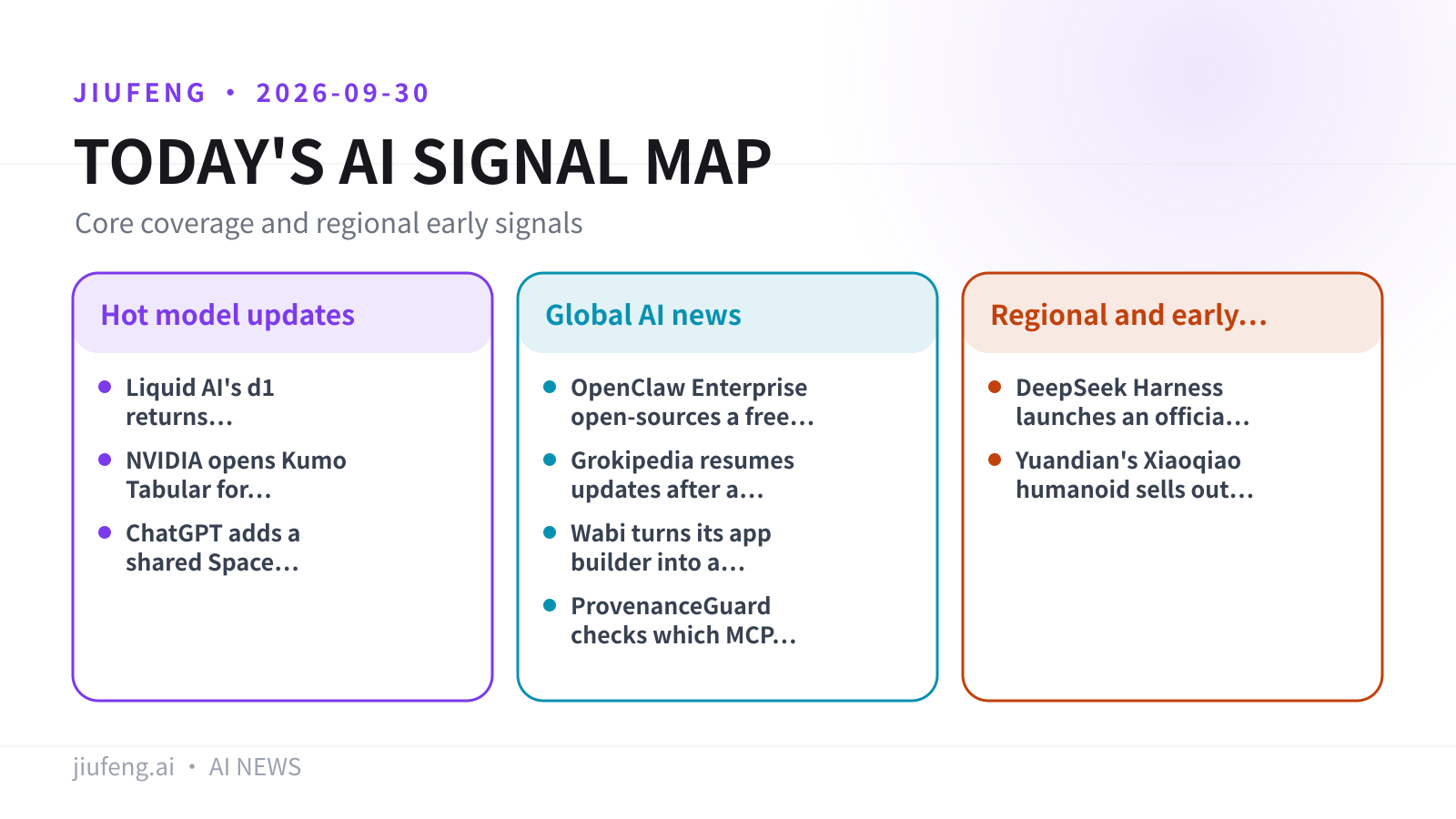
Jiufeng graphic based on the sources cited in this issue.
Hot model updates
01/09
Liquid AI's d1 returns probabilities with zero output tokens
d1 doesn't write text. It returns calibrated probabilities over options the caller defines in advance, and it is built for classification, routing and scoring.
Liquid AI has released d1, which it calls a "decision model." You send it context and a set of typed questions, and one call returns calibrated probabilities across a fixed set of outcomes. Every response reports usage.output_tokens as 0. Liquid's migration guide gives a simple rule: if the answer is one of N known options, use a decision model; if the model has to compose a new string, keep your LLM.
- Target tasks: classification, ticket routing, scoring, moderation, reranking and LLM-as-judge checks
- Access: hosted on the Liquid API as
d1:free - Weights: listed as API-only and not trainable, with no GGUF, MLX or ONNX weights
- Demo: Liquid's road-decider cookbook is a pixel-art survival racer where d1 picks left, center or right at every step
Limitations: d1 is available only through the hosted API, so you can't self-host or fine-tune it. The coverage doesn't compare its accuracy with general LLMs on the same tasks, and MarkTechPost notes that complex multi-step reasoning still belongs with an LLM.
Image source: GitHub; mirrored on Jiufeng R2.
Source: MarkTechPost · Liquid4All cookbook: road-decider
02/09
NVIDIA opens Kumo Tabular for training-free table prediction
Kumo Tabular reads a labeled table and predicts new rows in one forward pass. It comes in three sizes from 28M to 215M parameters and is released under the commercially usable OpenMDW-1.1 license.
NVIDIA Kumo Tabular is part of the NVIDIA Kumo Structured collection. It is an open foundation model for tabular data and is now on Hugging Face. Given a table of labeled rows, it predicts labels for new rows in a single forward pass, with no training, tuning or feature engineering. It handles both classification and regression.
- Sizes: three, from 28M to 215M parameters
- License: OpenMDW-1.1, commercial use allowed
- Pretraining data: synthetic data only
- Leaderboards: NVIDIA says it ranks first on TabArena, BeyondArena, TALENT and ScoringBench
Limitations: The first-place rankings and the "new accuracy-efficiency frontier" claim come from NVIDIA's own blog post and haven't been independently reproduced.
Source: Hugging Face Blog (NVIDIA)
03/09
ChatGPT adds a shared Space workspace and saved meeting notes
At DevDay, OpenAI introduced ChatGPT Space, a shared team workspace, and Meetings, which takes notes and saves personalized summaries.
OpenAI held DevDay in San Francisco on September 29, and ChatGPT's X account announced Space and Meetings the same day. Space is for creating and collaborating with a team and AI. Its pages are interactive documents that can include charts, images, checklists and dashboards, and ChatGPT can build pages around what a user is working on. Meetings takes notes and saves personalized summaries and next steps to the workspace. Axios had reported that OpenAI planned more than 20 product and feature announcements for DevDay.
Limitations: So far the features have been announced mainly through X posts, and the coverage doesn't say which plans get them, when they roll out or what they cost. OpenAI already offers a recording and transcription feature, ChatGPT Record.
Source: RuntimeWire · OpenAI Help: ChatGPT Record · OpenAI DevDay
Global AI news
04/09
OpenClaw Enterprise open-sources a free agent control plane
The OpenClaw Foundation released OpenClaw Enterprise for deploying and governing persistent AI agents on an organization's own infrastructure. For now it is meant for internal pilots.
On September 29, the OpenClaw Foundation released OpenClaw Enterprise, an open-source control plane for deploying and governing persistent agents on an organization's own infrastructure. The foundation says organizations will always be able to use it for free, and the code is public on GitHub. The project began as work at OpenAI, which donated it to the OpenClaw Foundation. Since then it has been developed with Red Hat and NVIDIA.
Limitations: The foundation says it is ready for internal pilot workloads, not production. The license is free, but running an agent still requires access to a model provider, which admins can swap for third-party or internal alternatives. RuntimeWire notes that maturity and running costs matter as much as the free license.
Source: RuntimeWire · OpenClaw on X · GitHub: openclaw-enterprise
05/09
Grokipedia resumes updates after a months-long pause
SpaceXAI's AI encyclopedia is changing articles again, but many of the edits are just a note to "recheck all references and sources."
In August, Lawfare reported that Grokipedia hadn't reviewed edits since April. The Verge found that the platform's live updates page now shows recent changes across a range of pages. President Barack Obama's page says it was "Fact-checked by Grok" two days ago, and Elon Musk's page was fact-checked within the hour while the reporter was writing.
Limitations: The updates aren't comprehensive. The Honolulu page, which Obama's page links to, was last fact-checked 7 months ago. Many changes carry only a "recheck all references and sources" note, so it's unclear how much content actually changed. SpaceXAI didn't immediately respond to a request for comment. Benji Taylor, head of design at X and SpaceXAI, posted about Grokipedia last week and said v0.2 would be better.
Source: The Verge
06/09
Wabi turns its app builder into a personal agent messenger
Wabi 2.0 changes the product from building apps with prompts to a personal agent that does tasks and builds interfaces on demand.
Wabi used to let anyone build apps from prompts. This week it announced it is becoming an AI messenger that combines chat, apps and ongoing tasks, and it can still make apps. Founder Eugenia Kuyda, who previously founded the AI companion startup Replika, described Wabi 2.0 as a "personal agent that does stuff for you and builds the interface you need in the moment."
Limitations: Neither the announcement nor the coverage gives pricing, regional availability or user numbers. So far only the company has described how well on-demand interfaces work.
Source: TechCrunch · Wabi on X
07/09
ProvenanceGuard checks which MCP tool backs each claim
A new Multiverse Computing paper checks whether each claim in an agent's answer comes from the specific MCP tool output the answer cites.
With the Model Context Protocol, an agent can call a search tool, read a structured patient or account record, query a database and pull metadata, then combine all of it into one answer. The authors note that common checkers such as RAGAS faithfulness, MiniCheck, AlignScore and SummaC judge claims against pooled evidence. In their usual form they can't tell which tool output supports a claim or whether that output is the source the answer names. ProvenanceGuard is built to close that gap.
- Medical-domain evaluation: 281 traces in total; on a 40-trace held-out split (260 source-eligible claims), block F1 0.802 and source accuracy 0.858
- Harder multi-source benchmark: block F1 0.846, source-plus-relation accuracy 0.229
- Injection probes: all 50 detected
Limitations: The paper is an arXiv preprint and hasn't been peer reviewed. The main evaluation uses medical-domain traces, and the 0.802 and 0.858 figures come only from the 40-trace held-out split. On the harder multi-source benchmark, source-plus-relation accuracy is only 0.229.
Source: Hugging Face Blog (Multiverse Computing) · arXiv
Regional and early signals
08/09
DeepSeek Harness launches an official desktop app
According to ifanr's hands-on test, DeepSeek Harness now has macOS and Windows desktop apps, so users no longer have to set it up from a terminal. It is now pitched for everyday office work as well as coding.
DeepSeek has released DeepSeek Harness as a desktop app for macOS and Windows. Anyone who installs the app and logs in gets a ¥6 credit, valid until October 6. You can log in with an account or an API key, and usage is charged to your DeepSeek open-platform balance. The four agent presets (Standard, PTC, Minimal and Creative) are still there, along with plugins and custom third-party models. Version 0.2.0-rc.1, released September 28, improved text selection and previews for Office files and PDFs.
Limitations: The current build is still a release candidate. In ifanr's test, logging in with an account did not sync chat history from the DeepSeek app. So far the only coverage is one Chinese-language hands-on review, with no global English reporting. Chinese-language source.
Source: ifanr (Chinese-language source)
09/09
Yuandian's Xiaoqiao humanoid sells out its first 1,000 units
The 88 cm, 13 kg humanoid launched at ¥8,888, and the company reportedly sold more than 600 units on day one.
According to Leiphone, Xiaoqiao went on sale September 2 at a launch price of ¥8,888. It sold more than 600 units on the first day, reached the top of JD.com's humanoid robot sales chart and sold out its first 1,000 units in under a week. It also won best in the "Next & Emerging Technologies" category of the IFA 2026 innovation awards.
- Specs: 88 cm tall, about 13 kg, joint modules up to 50 N·m
- Motions: standing, walking, jogging, dancing, backflips
- Development: VR, motion-capture and joystick teleoperation, plus the OpenBridge open-source ecosystem and a Skill Hub
Limitations: The sales figures and the "world's first AI-native embodied body" claim come from the company. The article reads like promotion, and there is no third-party data. Chinese-language source.
Write a prompt in your browser and get an image — 1K, 2K or 4K output, up to 15 reference images. 50 free generations on sign-up, no credit card.
Generate free