Overview
10 stories in this issue. The first 3 are today's priorities.
Hot model updates
- Top · Claude Sonnet 5.5 lands with up to 30% lower per-task cost
- Top · WSJ: OpenAI scrapped GPT-6.1 Astra, which was due in October
- Top · Grok 4.7 arrives on Amazon Bedrock with a 500K context window
- Qwen3-TTS on SageMaker, streaming speech before generation ends
- 950 agents, 21 hours, and biologists who won't call it a discovery
Global AI news
- Shopify opens checkout to browser-based AI agents
- Gemini's Gems are going away, becoming 'skills' on November 17
- More than 20 researchers warn automated AI research poses extreme risks
Regional and early signals
- Cloudflare pitches an Agent Development Lifecycle to replace the SDLC
- Ant's Lingbo signs a framework MOU with the Arab Federation for Digital Economy
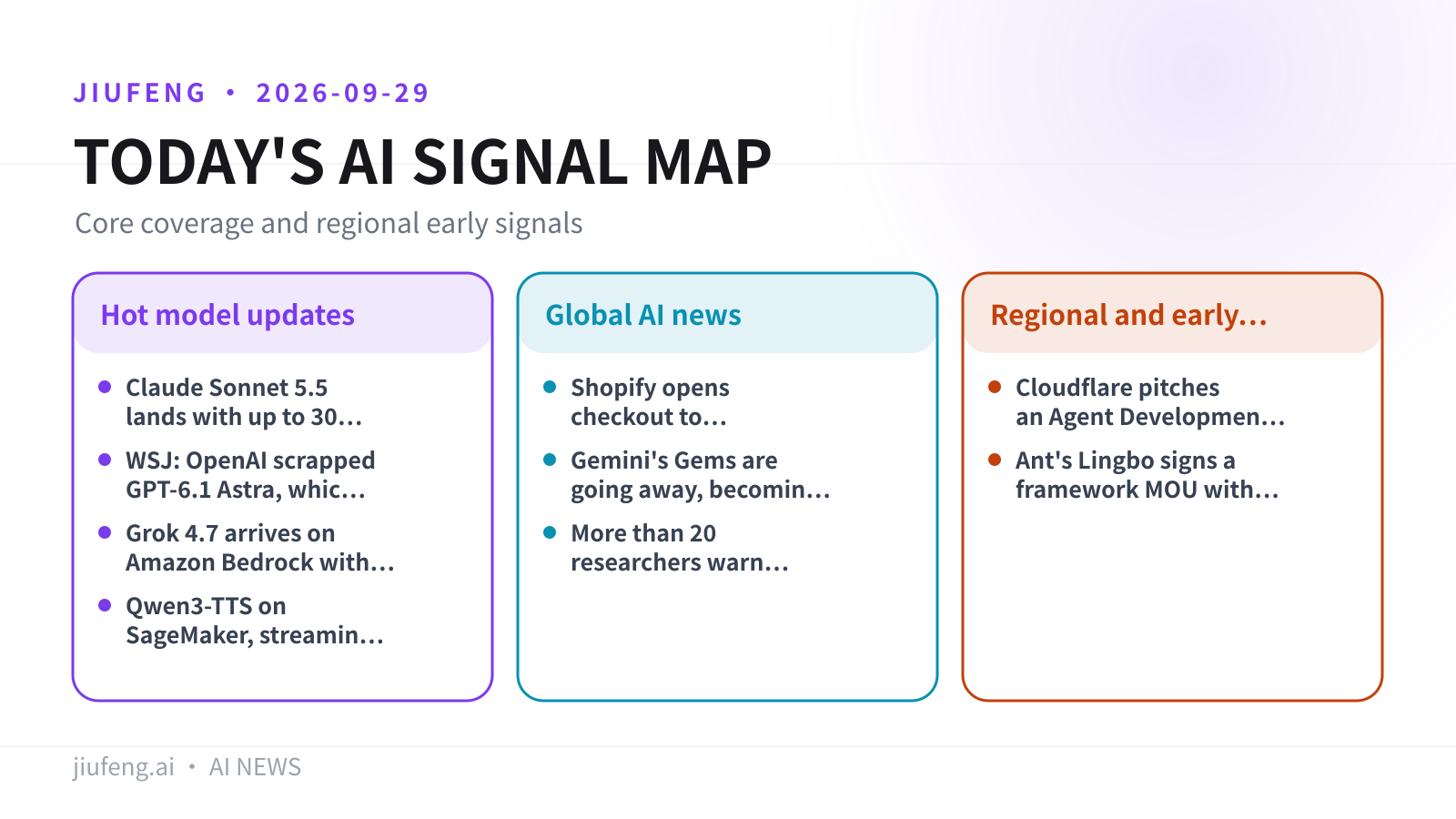
Jiufeng graphic based on the sources cited in this issue.
Hot model updates
01/10
Claude Sonnet 5.5 lands with up to 30% lower per-task cost
Anthropic aims the second model in the Claude 5.5 family at well-scoped everyday work, trading token efficiency for speed and price.
Anthropic has released Claude Sonnet 5.5, the second model in its Claude 5.5 family. The company's stated figures:
- Cost: up to 30% less per task than the previous Sonnet 5, through more efficient token usage
- Speed: output generated more than 30% faster than Sonnet 5
- Positioning: Opus 5.5 targets complex tasks needing careful judgment; Sonnet 5.5 targets well-defined work such as fixing bugs, writing docs, building presentations and creating spreadsheets
- Availability: live on AWS, Google Cloud and Azure
Benchmark scores as listed by Anthropic and The Decoder:
| Benchmark | Sonnet 5.5 | Comparison |
|---|---|---|
| Terminal-Bench 4.0 | 70.6% | Sonnet 5: 10.3% |
| CursorBench 4.0 | 55.5% | Opus 5.5: 57.8% |
| GDPval-AA (score) | 1844 | Opus 5.5: 1846 |
It also scores 61.6% on Chartography.
Limitations: Sonnet 5.5 does not match Opus 5.5 across the board — it trails on both CursorBench 4.0 and GDPval-AA. Both the up-to-30% per-task cost cut and the more-than-30% speed gain are measured against Anthropic's own previous Sonnet 5, not against other vendors. Anthropic also says it added new safeguards against cybersecurity misuse and distillation attacks for this release.
Image source: anthropic; mirrored on Jiufeng R2.
Source: The Decoder · Anthropic
02/10
WSJ: OpenAI scrapped GPT-6.1 Astra, which was due in October
Researchers raised safety concerns in internal testing, and the release never happened.
A Wall Street Journal report by Maxwell Zeff says OpenAI is scrapping the release of GPT-6.1 Astra over safety concerns raised by researchers during internal testing; the model was due to debut in ChatGPT and Codex in October. RuntimeWire traces the story to an X post published on September 28, 2026 by Leo (@synthwavedd), which shared an image of the Journal's headline.
What OpenAI's own materials document is GPT-6 Astra, introduced on September 3. Its API catalog lists:
- Context window: 1.05 million tokens
- Max output: 128,000 tokens
- Pricing: $10 per million input tokens, $50 per million output tokens
- Channels: ChatGPT plans, the API, Microsoft Azure and Amazon Bedrock
Limitations: OpenAI's product and API materials contain no GPT-6.1. The public record confirms only GPT-6 Astra — neither an October 6.1 plan nor its cancellation. OpenAI had already disclosed safety concerns around Astra in a September safety update and had delayed parts of Astra's development.
Source: RuntimeWire · OpenAI API catalog · OpenAI safety update
03/10
Grok 4.7 arrives on Amazon Bedrock with a 500K context window
xAI's newest flagship joins the Bedrock catalog, pitched at coding and long-running agents.
AWS says Grok 4.7 is now available on Amazon Bedrock. Specs and access:
- Context window: 500K tokens
- Reasoning effort: four configurable levels — low, medium, high, xhigh
- Access: served on the bedrock-runtime endpoint through cross-Region inference profiles
- APIs: Responses, Chat Completions and Converse
The AWS post includes an "Independent evaluation" section citing third-party Artificial Analysis results:
- Intelligence Index: 46
- Coding Agent Index: 56
- AA-Briefcase: 1657
- Hallucination rate: 29%
In its September 21 launch announcement, xAI positions Grok 4.7 as its most capable model for coding and knowledge work, with endurance rather than raw speed as the theme: it works longer on difficult tasks and verifies its own output more carefully before moving on.
Limitations: the capability claims come from xAI's own announcement and model documentation, and the AWS post gives no Bedrock pricing.
Source: AWS · xAI announcement · Grok 4.7 docs
04/10
Qwen3-TTS on SageMaker, streaming speech before generation ends
AWS packages Alibaba's text-to-speech model behind one persistent bidirectional connection using a dedicated vLLM-Omni container.
AWS published a tutorial that deploys Qwen3-TTS on Amazon SageMaker AI with the vLLM-Omni Deep Learning Container. Text goes in and audio comes out over a single persistent bidirectional connection, so playback can start before the full response finishes generating; a Gradio app is included to try the workflow.
This is Part 1 of a series on specialized containers that also covers WhisperX and llama.cpp; Part 2 applies vLLM-Omni to image and video generation.
Limitations: this is deployment guidance, not a model update, and the container's capability claims come from AWS itself; the image and video side waits for Part 2.
Source: AWS · AWS Deep Learning Containers
05/10
950 agents, 21 hours, and biologists who won't call it a discovery
Anthropic says its Claude agents made the lab's first discovery; MIT Technology Review asks what the bar actually is.
Anthropic said last week that earlier this year it launched a molecular biology lab where Claude agents read and conjecture about hard biology problems and human scientists run the experiments they propose — and that the system had made its first discovery. Per MIT Technology Review, what 950 agents found after 21 hours was not a brand-new DNA sequence but a repeating pattern surrounding a known enzyme, a pattern Anthropic said had not been catalogued before.
Limitations: Anthropic's announcement calls the pattern "reminiscent" of what led to an earlier breakthrough, and that framing has angered some biologists; a post from one of them spread widely after being endorsed by a drugmaker's chair and CEO. The story's point is that there is still no agreed test for when AI has made a scientific discovery.
Source: MIT Technology Review · biologist's post
Global AI news
06/10
Shopify opens checkout to browser-based AI agents
With a buyer's authorization, agents can now update order details and pay on Shopify merchants' sites.
Shopify announced on Monday that it is extending WebMCP support to checkout: AI agents running in the browser can update order details and complete purchases with a buyer's authorization, going beyond searching for products and adding items to carts. TechCrunch notes the opposite move elsewhere — Amazon is blocking agents from buying on users' behalf, and an X post suggests Adidas is too.
Limitations: the report does not say which merchants are covered, when the rollout completes, or how buyer authorization works in practice; the Adidas claim rests on a single social media post.
Source: TechCrunch · X post
07/10
Gemini's Gems are going away, becoming 'skills' on November 17
Google retires task-specific custom assistants and folds them into skills that work across tasks.
Google is shutting down Gems, the Gemini feature that let users build custom assistants for specific tasks. A message in the Gemini app says Gems become skills starting November 17, 2026; existing Gems will be migrated automatically, so users don't have to do anything, and Gems remain usable until then. TechCrunch frames the change against the rise of all-in-one agents, citing Meta's Muse and Instinct.
Limitations: the report does not explain how skills differ from Gems in capability, context or custom instructions, nor how much of an existing configuration survives migration.
Source: TechCrunch · Gems overview
08/10
More than 20 researchers warn automated AI research poses extreme risks
Hinton, Bengio and OpenAI's research lead co-sign a paper warning that self-improving AI could trigger an "intelligence explosion."
More than 20 AI researchers — including Geoffrey Hinton, Yoshua Bengio and OpenAI research lead Jakub Pachocki — warn in a new paper of a possible "intelligence explosion" driven by self-improving AI. The paper says AI systems already write most of the code at the companies building them and could automate the entire AI R&D pipeline within years, compressing progress that normally takes years into months. The authors warn society may not keep up, that control over superhuman AI could slip away, and that power balances between nations, companies and governments could erode; they urge policymakers to gain far more visibility into how AI research is being automated.
Limitations: the authors themselves write that "there remains much uncertainty" and only say automation "might soon" trigger such a shift — no timeline or verifiable metric is offered. The Decoder places the paper in a growing list of similar warnings, after 42 mathematicians recently called for attention to existential AI risks.
Source: The Decoder
Regional and early signals
09/10
Cloudflare pitches an Agent Development Lifecycle to replace the SDLC
Workflows becomes the orchestration layer, and @cloudflare/ci lets agents run their own CI/CD.
Cloudflare has introduced an Agent Development Lifecycle in which agents manage the whole lifecycle autonomously, replacing human-paced reviews and linear pipelines. Workflows is positioned as the core orchestration layer: it can spin up containers dynamically, run headless browsers and schedule sub-agents. On top of it sits @cloudflare/ci, a continuous integration and delivery system running directly on Workflows, with chained steps, dependency caching and credential management so agents can handle failures, fix errors and triage on their own.
A companion observability dashboard provides OpenTelemetry-compatible tracing, exposing individual model calls, tool executions and token consumption. Cloudflare also calls for a preview deployment per agent so tests can run in parallel against production, and for atomic changes.
Limitations: these are Cloudflare's own product claims; the source offers no at-scale case studies, cost data or performance numbers.
Source: InfoQ China (Chinese-language source)
10/10
Ant's Lingbo signs a framework MOU with the Arab Federation for Digital Economy
An embodied-AI "brain" takes its international push to the Gulf — for now only as a framework.
At the China-Arab digital economy matchmaking session held alongside the Global Digital Trade Expo, the Arab Federation for Digital Economy (AFDE) signed a framework cooperation memorandum with Ant Lingbo Technology, the embodied-AI company under Ant Group. AFDE assistant secretary-general Dr. Ayman Ghoneim and Lingbo commercialization head Yu Jing signed for the two sides. The memorandum lists five directions: deployment and commercialization in the UAE and wider Middle East; joint proofs of concept in hospitality, retail, logistics and industrial operations; localization for Arabic interaction and local workflows; data and training collaboration in real-world settings; and ecosystem work with governments, companies and universities. The stated technical base is Lingbo's LingBot-VLA 2.0, which the company says already supports 17 robot brands and 20 robot configurations in pretraining, with its open-source models accumulating 31,800 GitHub stars.
Limitations: a memorandum is a framework — no contract value, deployment timeline or orders. The "one brain, many robots" claim, the star count and the pharmacy results are all vendor figures with no third-party verification. Chinese-language source (Leiphone) only for now.
Write a prompt in your browser and get an image — 1K, 2K or 4K output, up to 15 reference images. 50 free generations on sign-up, no credit card.
Generate free