Overview
8 stories in this issue. The first 3 are today's priorities.
Popular Model Updates
- Top · Gemini Live adds avatars supporting 97 languages
- Top · Qwen3.8-27B powers a 22-second reservation test
Global AI News
- Top · Meta gives Muse users Ubuntu cloud computers
- Microsoft unveils Copilot with three work tabs
- Musk says Colossus 2 chip count may more than double
- Pentagon requests $30.3 million for AI lie detection
Regional and Early Signals
- Skild AI reports 140 simulated years of robot soccer
- Goncourt removes novel following AI-writing allegations
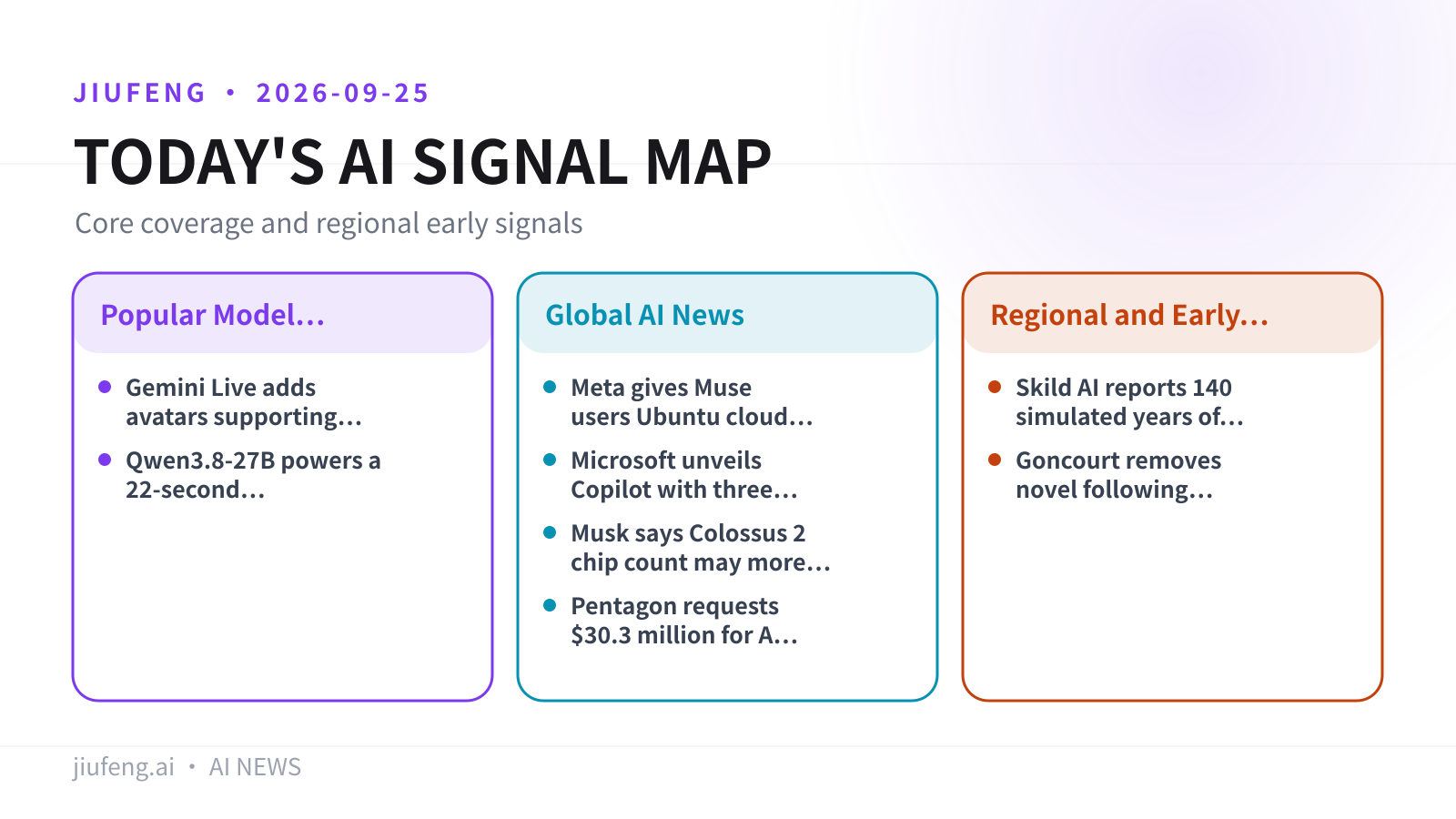
Jiufeng graphic based on the sources cited in this issue.
Popular Model Updates
01/08
Gemini Live adds avatars supporting 97 languages
Gemini 3.8 Live adds lip-synced, expressive Live Avatars, currently available to Gemini Enterprise customers.
Google announced Live Avatar on September 24, saying it can switch between 97 languages without degrading video fidelity or introducing visual drift; its demonstration shows synchronized English and Japanese speech and information displayed during conversation. RuntimeWire identifies Cox Automotive as a customer using the feature to build an Autotrader car-shopping assistant.
Limitations: Custom likenesses require allowlisting; the supplied materials do not disclose Live Avatar-specific pricing, Autotrader deployment scale, or independent comparisons of effectiveness.
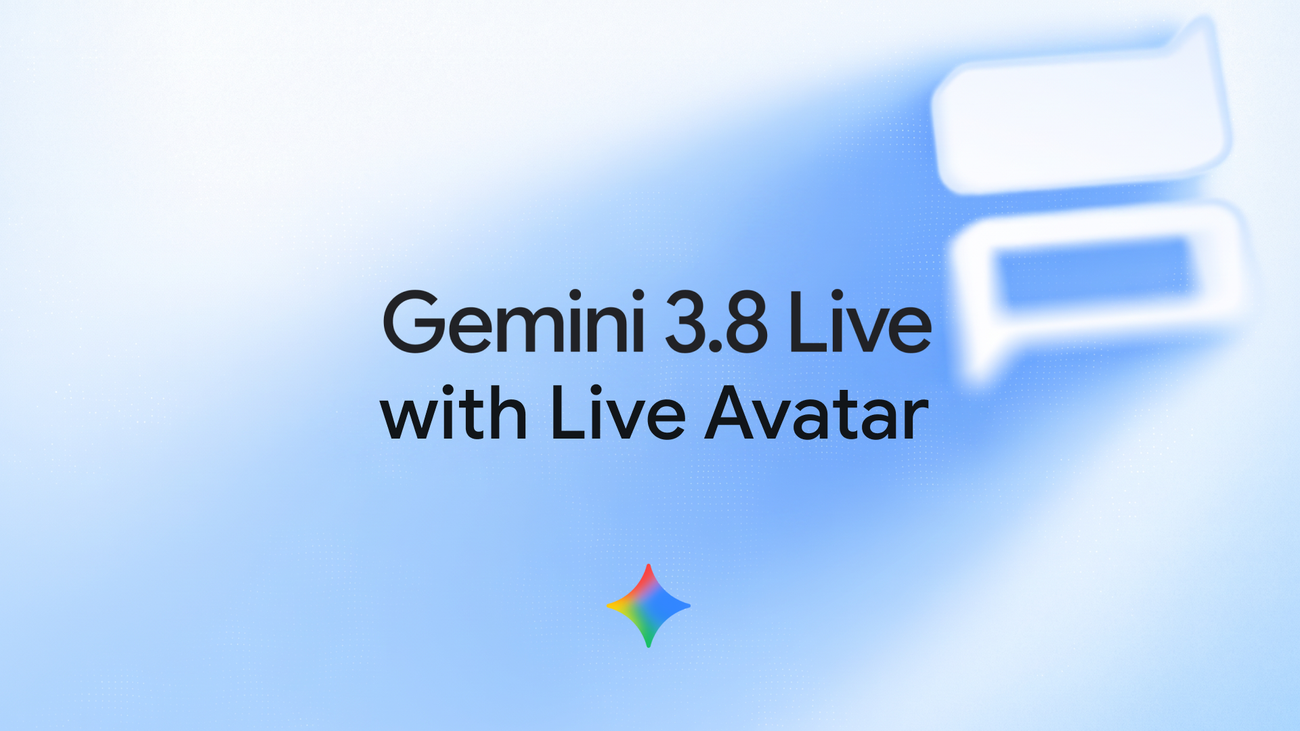
Image source: Google; mirrored on Jiufeng R2.
Source: Google announcement · The Verge · RuntimeWire
02/08
Qwen3.8-27B powers a 22-second reservation test
Cerebras used Qwen3.8-27B in a reservation agent that recorded a 22-second median across two successful runs.
RuntimeWire reporting and Cerebras’s experiment published on September 24 describe an assistant running Qwen3.8-27B on Cerebras hardware with the Pi agent harness. The team parallelized restaurant checks and supplied a saved website-navigation skill to reduce the time spent discovering the booking route during execution.
Limitations: This was a company-run test with only two successful runs and a rehearsed navigation path; the result combines model, hardware, and workflow changes and does not establish a general speed advantage for the model itself.
Source: Cerebras experiment · RuntimeWire
Global AI News
03/08
Meta gives Muse users Ubuntu cloud computers
A Meta engineering executive says every Muse user receives a free Ubuntu cloud computer for installing software, compiling code, and browsing the web.
According to Meta Superintelligence Labs VP of Engineering David Singleton, each computer runs a full Ubuntu Linux image, with users and their Muse agent operating inside a Runtime Cell. The Muse Secure VM separates that workspace from sensitive system components, while an external Sentinel process monitors sensitive actions.
Limitations: These architecture and availability descriptions come from Meta’s public account; the supplied material contains no independent security test results establishing the effectiveness of the isolation and monitoring mechanisms.
Source: The Decoder · David Singleton’s statement
04/08
Microsoft unveils Copilot with three work tabs
Microsoft’s redesigned Copilot puts chat, coding, and agent tasks into Home, Code, and Autopilot tabs.
The September 25 launch report says Home combines Copilot Chat and Cowork as the default entry point, while the personal assistant previously introduced at Build as Scout is renamed Autopilot. Microsoft also plans to add a Today dashboard to Home for important emails, meeting requests, and Teams threads.
Limitations: Today remains a planned addition in the reporting; the supplied excerpt does not establish regional availability, subscription requirements, or a complete rollout schedule for all features.
Source: The Verge · Satya Nadella’s statement
05/08
Musk says Colossus 2 chip count may more than double
Musk says SpaceXAI may more than double Colossus 2’s NVIDIA chip count by December 31.
RuntimeWire, citing Bloomberg, reports that the target concerns the Memphis-area Colossus 2 computing cluster and forms part of SpaceXAI’s infrastructure expansion plans. The report supplies neither the current chip count nor a specific planned total.
Limitations: This is a proposed expansion rather than a completed installation, and it is unclear whether the target counts installed, operational, or contracted chips; the statement therefore cannot establish additional usable computing capacity.
Source: RuntimeWire
06/08
Pentagon requests $30.3 million for AI lie detection
A Defense Department budget request proposes $30.3 million over five years for AI scoring and contactless physiological sensing.
MIT Technology Review reports that the program, called Polygraph+ or Polygraph Next, would study AI and machine-learning scoring algorithms alongside “standoff sensing,” which takes physiological readings without attaching equipment to a subject. The budget document describes an effort to modernize federal polygraph and credibility-assessment technologies and improve their accuracy and reliability.
Limitations: A budget request does not establish funding approval or technical effectiveness; the report quotes legal scholar Kyri Kotsoglou questioning the attempt to reduce complex human behavior to measurable signals.
Source: MIT Technology Review
Regional and Early Signals
07/08
Skild AI reports 140 simulated years of robot soccer
Chinese-language reporting describes Skild AI training Messinator through self-play before transferring its soccer policy to a physical humanoid.
According to QbitAI, the team added reinforcement learning and self-play to S1, accumulating approximately 140 simulated years in a soccer environment built with NVIDIA Isaac Sim. The report describes goal scoring as the reward objective, without separate rewards for dribbling, shielding, tackling, or getting up, and says the physical demonstration showed those behaviors and adjustments during play against people.
Limitations: Chinese-language source; this account describes company training claims and demonstrations, with no independent match results or reproducible success rates in the supplied material, and does not establish professional-player performance.
Source: QbitAI
08/08
Goncourt removes novel following AI-writing allegations
The Goncourt Academy removed a disputed novel from its initial selection and reaffirmed its focus on works created by human authors.
IT Home, citing Reuters, reports that the academy removed Thélison Aurélien’s C'etait Ca ou Mourir on September 25 following allegations of AI writing and plagiarism. The academy said it would not comment further before announcing its shortlist on October 6.
Limitations: Chinese-language source; the author denies using AI to write the novel, and the report notes expert doubts about AI-detector reliability, so the Pangram results cited by accusers should not be treated as proof of AI authorship.
Source: IT Home, citing Reuters
Write a prompt in your browser and get an image — 1K, 2K or 4K output, up to 15 reference images. 50 free generations on sign-up, no credit card.
Generate free