Overview
9 stories in this issue. The first 3 are today's priorities.
Model Watch
- Top · jina-ocr-v1 open weights: 3.4B total, 570M active per token
- Top · Claude Code falls back to AGENTS.md when CLAUDE.md is missing
- Top · Kimi K3 lands on Amazon Bedrock with 2.8T parameters
- Grok Voice Transcribe 2.0 ships, Loom transcribes every video with it
Global AI News
- Accenture becomes Anthropic's first embedded evaluator
- ChatGPT's desktop browser now runs Chrome extensions
- Meta's Muse arrives on Mac and can act on local files
Regional & Early Signals
- Microsoft internal memos surface in the New York Times brief
- Wuwen Xingqiong and Huahuan Electronics sign a domestic compute pact
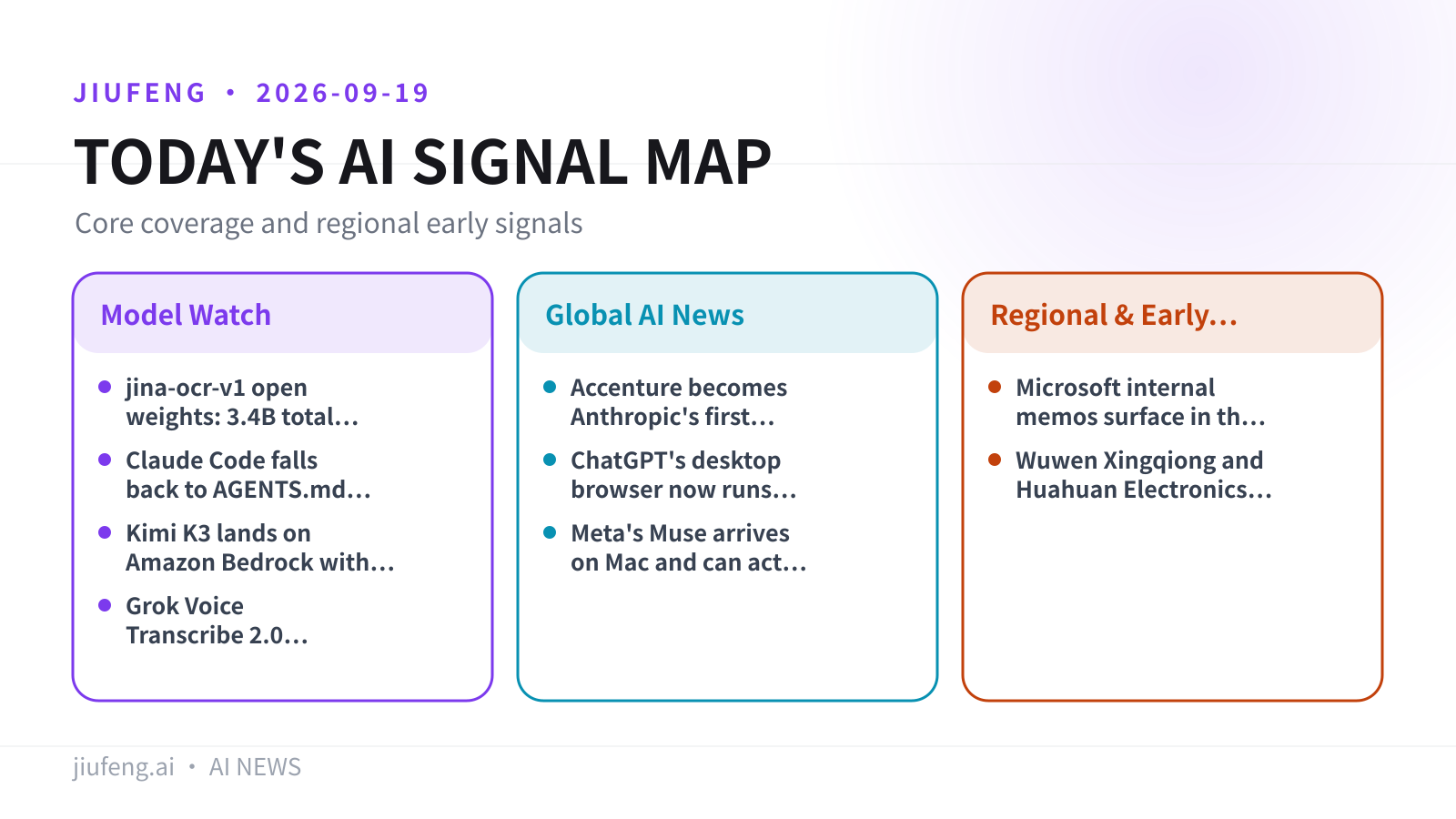
Jiufeng graphic based on the sources cited in this issue.
Model Watch
01/09
jina-ocr-v1 open weights: 3.4B total, 570M active per token
Takeaway: Jina AI released an end-to-end document parser scoring 91.14 on OmniDocBench v1.6, with weights under CC BY-NC 4.0.
Jina AI, part of Elastic, released jina-ocr-v1, which takes PDFs, scans, tables, charts or invoices and returns clean Markdown in one pass. The model post-trains DeepSeek-OCR and keeps its two efficiency components. The specifications:
- Parameters: 3.4B total, with about 570M decoder parameters active per token; a speculative decoding head ships inside the checkpoint
- Vision encoder: DeepEncoder has about 380M parameters and chains SAM, a 16x convolutional compressor and CLIP-L, turning a 1024×1024 page view from 4,096 patches into 256 visual tokens
- Dynamic resolution: a mode that adds up to 9 local tiles at 100 tokens each
- Deployment: open weights are about 6.8 GB in BF16 and run on Transformers or vLLM, targeting low-budget GPUs such as the NVIDIA L4
The source also publishes a side-by-side comparison against other parsers:
| Model | OmniDocBench v1.6 | olmOCR-Bench |
|---|---|---|
| jina-ocr-v1 | 91.14 | 83.4 |
| PaddleOCR-VL-1.6 | 96.34 | — |
| HunyuanOCR-1.5 | 94.74 | — |
| chandra-ocr-2 | — | 85.8 |
| dots.mocr | — | 83.9 |
Limitations: the weights carry a CC BY-NC 4.0 license covering research and non-commercial use only; commercial use requires contacting Jina AI. The source states plainly that this model does not lead on accuracy — PaddleOCR-VL-1.6 and HunyuanOCR-1.5 both score higher on OmniDocBench v1.6, and both chandra-ocr-2 and dots.mocr score higher on olmOCR-Bench. The pitch is small size and cheap deployment, not a top ranking.
Image source: huggingface; mirrored on Jiufeng R2.
Source: MarkTechPost · technical report · open weights · OmniDocBench
02/09
Claude Code falls back to AGENTS.md when CLAUDE.md is missing
Takeaway: From version 2.1.277, Claude Code reads AGENTS.md when a repository has no CLAUDE.md, so teams running several coding agents in one repo stop maintaining two rule files.
Anthropic added AGENTS.md support to Claude Code on September 18th. Thariq Shihipar (@trq212), an engineer on the Claude Code team, announced the change alongside version 2.1.277, and Anthropic's release notes confirm that AGENTS.md becomes the fallback when a project has no CLAUDE.md; users can change the behavior through the "Project instructions" setting in /config. AGENTS.md provides build commands, testing requirements, code conventions and other standing instructions in standard Markdown, and a team using that file with Codex, Cursor or Gemini CLI previously needed a separate CLAUDE.md, an import or a workaround to deliver the same guidance to Claude Code.
Limitations: the existing Claude convention retains priority, so AGENTS.md only applies in its absence. The report also notes that the implementation previews Anthropic's coming mods system, which has not shipped.
Source: RuntimeWire · release notes · Thariq Shihipar on X
03/09
Kimi K3 lands on Amazon Bedrock with 2.8T parameters
Takeaway: Moonshot AI's Kimi K3 is now available on Amazon Bedrock, the first open-weight model there to support explicit prompt caching.
AWS announced Kimi K3 on Amazon Bedrock, positioned as an open-weight option for coding and knowledge work:
- Parameters: Moonshot AI says K3 is its most capable model and the first open model to reach 2.8 trillion parameters
- Context and modality: native vision capabilities with a 1-million-token context window
- Efficiency: an approximate 2.5x improvement in scaling efficiency over Kimi K2
- Platform capability: the first open-weight model on Bedrock to support explicit prompt caching, cutting latency and input costs when reusing context across calls
- Getting started: AWS published a Moonshot AI on AWS samples repository
Limitations: the parameter count and the 2.5x efficiency gain are Moonshot AI's own figures, and the AWS post offers no independent evaluation. Prompt caching has to be enabled explicitly rather than applying by default.
Source: AWS Machine Learning Blog · Moonshot AI · samples repository
04/09
Grok Voice Transcribe 2.0 ships, Loom transcribes every video with it
Takeaway: SpaceXAI moved its speech-to-text model to 2.0 at unchanged pricing, and Atlassian says Loom now uses it for every video.
SpaceXAI released Grok Voice Transcribe 2.0 on September 18th, claiming a 2x gain in speech recognition accuracy. According to the release notes the model became available through the API on September 17th, a day before the public launch, and existing speech-to-text integrations can move to version 2.0 without code changes. Pricing stayed where it was:
| Tier | Price per hour |
|---|---|
| Batch transcription | $0.10 |
| Streaming transcription | $0.20 |
Limitations: the 2x accuracy figure is SpaceXAI's own claim. The only third-party yardstick in the source is the Artificial Analysis streaming leaderboard, where SpaceXAI says the model ranks first for accuracy among 32 streaming models, while the leaderboard page describes itself as covering 27 of 33 models ranked by WER methodology; that independent ranking at most supports leading on one leaderboard and does not confirm being twice as accurate as version 1.0. SpaceXAI also plans to make 2.0 the default and deprecate version 1.0 in the coming weeks, leaving developers only the option to temporarily pin the older model.
Source: RuntimeWire · SpaceXAI · release notes
Global AI News
05/09
Accenture becomes Anthropic's first embedded evaluator
Takeaway: Anthropic's first embedded evaluator is Accenture, with the work led by Faculty, the AI business Accenture acquired in January.
Anthropic announced on September 18th that it is partnering with Accenture on independent evaluation of frontier AI. Faculty, Accenture's specialist AI business, will lead the work, which includes evaluating and red-teaming models, conducting alignment assessments, and testing model safeguards. Both companies expect to invest at least $1 billion each over the next five years. Anthropic frames the deal as delivering on the commitment in its CEO's essay "We Must Pace the Frontier": unlike today's external evaluators, embedded evaluators work inside AI companies with access comparable to an employee's, letting them watch models take shape in training and follow the decisions that govern how those models are built.
Limitations: Anthropic says embedded evaluation is new and many operational details are still being worked out. TechCrunch questioned the choice of partner, calling this the most high-risk consulting engagement the firm has taken on.
Source: Anthropic · TechCrunch
06/09
ChatGPT's desktop browser now runs Chrome extensions
Takeaway: OpenAI lets users install Chrome extensions inside the ChatGPT desktop app's browser, while saying the agent cannot interact with extensions or their data.
James Sun (@JamesZmSun) said OpenAI added Chrome extension support to the browser inside its ChatGPT desktop app on September 18th, letting users install and pin extensions without moving their work into a separate browser window. He cited 1Password as an example, bringing password management into the same window where a user can ask ChatGPT to browse websites, work across tabs and complete tasks.
Limitations: extensions still have to be installed inside ChatGPT's browser. OpenAI's documentation for the built-in browser says it maintains its own browser state rather than inheriting a user's Chrome profile, cookies, signed-in sessions or extensions; Sun added in a reply on X that cookies created inside the in-app browser persist. OpenAI says ChatGPT's agent cannot interact with extensions or their data, and the report argues that agent-extension boundary will determine whether the convenience survives enterprise security review.
Source: RuntimeWire · OpenAI documentation
07/09
Meta's Muse arrives on Mac and can act on local files
Takeaway: Muse's desktop app landed on Mac, where it works inside native apps with files, messages, calendar, notes and mail.
Meta's AI assistant app Muse is now available on Mac. Per a September 17th post on X from Alexandr Wang, on the Mac it can interact with a user's files, messages, calendar, notes and mail, all within their native applications, and take action on the user's behalf. The desktop release follows the launch of Muse on mobile and the web earlier this month, when it quickly rose to the top of the U.S. App Store charts.
Limitations: access is granted on an opt-in basis, with the user controlling what Muse can reach, and Meta says the app always asks for approval before performing sensitive actions. The report does not give regional availability or system requirements for the Mac version.
Source: TechCrunch · Alexandr Wang on X
Regional & Early Signals
08/09
Microsoft internal memos surface in the New York Times brief
Takeaway: The legal brief filed with the New York Times' summary judgment motion quotes internal Microsoft and OpenAI material, including a memo calling training-data use "the largest theft of labor in human history."
Chinese-language source. Per a September 18th Tom's Hardware report relayed by IT之家, the New York Times has moved for summary judgment in its copyright suit against Microsoft and OpenAI and filed a brief citing internal documents from both defendants. The brief quotes a January 2023 memo by Microsoft applied science director Brent Hecht saying that millions of people will soon view large models consuming all their labor as an unprecedented theft, which he called the largest theft of labor in human history; another Microsoft document states that almost no one wants their content used this way without compensation. The brief also cites Microsoft's own data showing Copilot cut click-through to the New York Times by as much as 93% compared with Bing search, and quotes OpenAI's ChatGPT lead Nick Turley calling AI chatbots an existential threat to publishers because they are "largely substitutive."
Limitations: these quotations come from a brief the plaintiff selected and filed, and the report carries no response from either defendant. Summary judgment is a procedural motion that a court may grant, deny or grant in part, and granting it does not end every related dispute. This item rests on a Chinese-language relay of an English report, with no public link to the underlying court filing.
Source: IT之家
09/09
Wuwen Xingqiong and Huahuan Electronics sign a domestic compute pact
Takeaway: Two Tsinghua-rooted companies signed a strategic framework agreement pairing heterogeneous compute scheduling with optical transport for AI data centers.
Chinese-language source. Per 量子位, Wuwen Xingqiong and Huahuan Electronics signed a strategic cooperation framework agreement on September 17th: Wuwen Xingqiong contributes heterogeneous compute management and its AI software platform, Huahuan contributes network communications, hardware development and field operations, and the two plan to jointly handle design, hardware-software adaptation, integration delivery and maintenance for AI data centers. The figures in the report: Wuwen Xingqiong's cross-domain training system for heterogeneous clusters has reached more than 37,000P of deployed compute nationwide across 16 mainstream chips, and its Agentic MaaS platform cut inference costs tenfold over the past year; Huahuan has worked in optical transport for over 30 years, with equipment long serving China Mobile, China Telecom and China Unicom.
Limitations: this is a framework agreement, with no deal value, timetable or first projects disclosed. The 37,000P figure, the 16-chip coverage and the tenfold cost reduction are Wuwen Xingqiong's own claims, unverified in the report, and the source gives "37,000P" without stating the numeric precision it refers to. This item has only a Chinese-language source.
Source: 量子位
Write a prompt in your browser and get an image — 1K, 2K or 4K output, up to 15 reference images. 50 free generations on sign-up, no credit card.
Generate free