Overview
10 stories in this issue. The first 3 are today's priorities.
Model updates
- Top · Firefox's AI assistant now runs on Mistral Small 4
- Top · Salesforce's first CRM reasoning model is a post-trained Nemotron 3 Super
Global AI news
- Top · Zuckerberg rejects a coordinated slowdown, trusts liability and competition
- Manchester trains Earth-2 CorrDiff to forecast UK air pollution
- Google's science round-up: 25,000 x-rays screened for tuberculosis
- SageMaker training jobs accept a list of backup instance types
- OpenAI names three-month-old Telon a legal AI select partner
- 61% of likely US voters oppose building AI data centers
Regional and early signals
- Doubao 2.1 Pro ships an 0915 build, wired into Doubao Work
- Ant's LingBot bets on the embodied "brain", with pharmacy picking already in stores
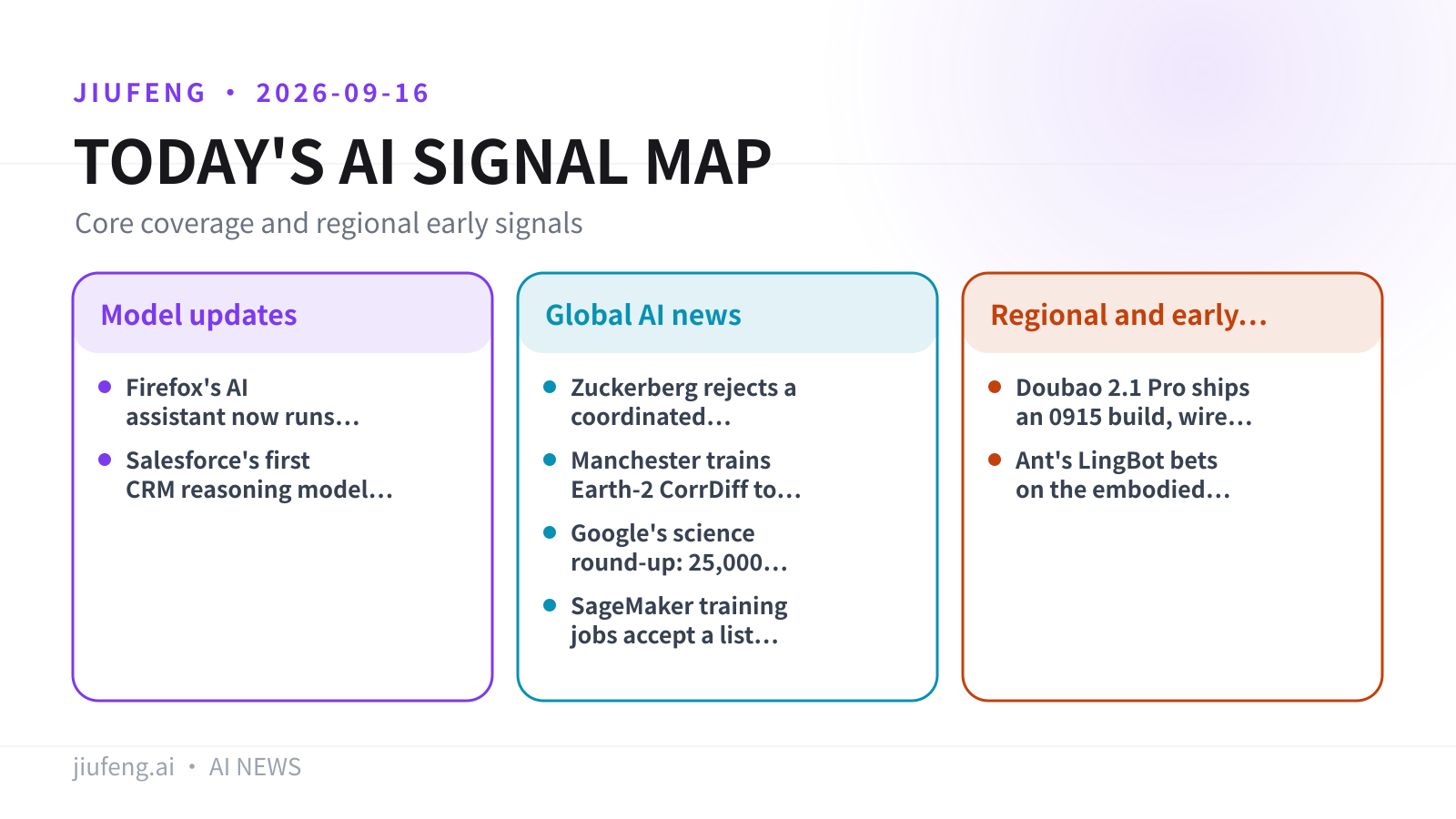
Jiufeng graphic based on the sources cited in this issue.
Model updates
01/10
Firefox's AI assistant now runs on Mistral Small 4
Mozilla hands Smart Window's underlying model to Mistral, starting with the US, Canada and France.
Mistral and Mozilla announced a partnership on September 16: Smart Window (beta), Firefox's optional AI browsing assistant, is now powered by Mistral models. Mozilla's account of the deal identifies the model as Mistral Small 4, chosen after an evaluation that included multilingual performance. Smart Window can draw on open tabs, browsing history and saved "Memories" to summarize pages, compare information, retrieve material a user viewed earlier and organize tabs.
| Market | Smart Window status |
|---|---|
| US / Canada | Mistral Small 4 live for beta users |
| France | First market with official French support |
| UK / Germany | Expected later this year |
Limitations: Smart Window is still a beta and an optional feature, and Mozilla preserves the user's ability to switch models, so this is not an exclusive default slot; no parameter count, context length or benchmark score has been published for Mistral Small 4, only that the evaluation covered multilingual performance; the UK and Germany have nothing firmer than "later this year".
Image source: Mistral; mirrored on Jiufeng R2.
Source: Mistral newsroom · RuntimeWire
02/10
Salesforce's first CRM reasoning model is a post-trained Nemotron 3 Super
Supervised fine-tuning plus RL on Nemotron 3 Super, with Salesforce's own CRM Bench claiming 3x fewer errors.
Salesforce announced Koa at Dreamforce, its first CRM reasoning model, on the same day Jensen Huang appeared onstage with Marc Benioff. According to NVIDIA, Koa was built by post-training NVIDIA Nemotron 3 Super.
- Training: supervised fine-tuning plus reinforcement learning, using NVIDIA NeMo RL, NeMo Gym and NeMo AutoModel
- Corpus: a proprietary Salesforce synthetic dataset derived from nearly thirty years of enterprise CRM deployments, spanning more than 14 industries
- Benchmark: on Salesforce's own CRM Bench, Koa matches or exceeds leading models on CRM operation tasks while making 3x fewer errors
| Stage | Timing | Scope |
|---|---|---|
| Internal use | Live now | Inside Salesforce, powering employee agents in Slack |
| Customer pilots | October | First cohort includes Formula 1 and UChicago Medicine |
| General availability | Winter 2026 | US regions |
Limitations: CRM Bench is Salesforce's own benchmark and the "3x fewer errors" figure is vendor-reported, with no external reproduction; the training corpus is likewise proprietary synthetic data; customers do not get hands on the model until the October pilots, with general availability only in winter; this comes from NVIDIA's own blog, a single source.
Source: NVIDIA blog
Global AI news
03/10
Zuckerberg rejects a coordinated slowdown, trusts liability and competition
His argument: market incentives, legal exposure and outside evaluation already do the job, so no industry pact is needed.
Mark Zuckerberg publicly rejected calls for a coordinated slowdown in frontier AI development on September 15, arguing that competition, legal liability and independent evaluation already give each lab enough reason to train models safely. Each lab, he said, can decide when its own safety work requires a delay; users will avoid agents that fail to follow instructions, which makes trust and alignment competitive product features rather than obligations requiring an industry agreement. The debate was opened three days earlier by Anthropic's Dario Amodei in "We Must Pace the Frontier"; Sam Altman and Elon Musk subsequently endorsed the broad call for pacing, according to Reuters.
Limitations: so far both sides have offered positions, not commitments — no lab has published a verifiable slowdown threshold or timetable; the Altman and Musk endorsements are relayed by Reuters rather than stated directly.
Source: RuntimeWire · Mark Zuckerberg on X
04/10
Manchester trains Earth-2 CorrDiff to forecast UK air pollution
A generative downscaling model routes around the compute cost of chemistry-based forecasting.
Air pollution contributed to an estimated 30,000 deaths in the UK last year. David Topping, a professor in the University of Manchester's department of Earth and environmental science, generated training data from existing chemistry-climate simulations and then trained NVIDIA Earth-2 CorrDiff — a generative downscaling model — on Isambard-AI, the UK's national AI supercomputer in Bristol, to produce pollution fields. His stated motivation is blunt: "Once you put chemistry into weather models, they get really, really slow," and that compute cost limits how detailed and how frequent air quality forecasts can be.
Limitations: the training data comes from existing chemistry-climate simulations rather than new observations, so the model learns to downscale prior simulation output; the account comes from NVIDIA's own blog with no third-party review, and it does not say when the forecasts might reach a public service.
Source: NVIDIA blog
05/10
Google's science round-up: 25,000 x-rays screened for tuberculosis
A September 15 portfolio post, with every figure self-reported.
Google published "Building AI to accelerate science and improve lives" on September 15, collecting its AI deployments in research and health in one place.
- Tuberculosis screening: screening has read more than 25,000 x-rays across 40 locations in six nations
- Research tools: the post says the structure-prediction work is now used by 4 million researchers in 190 countries, from drug discovery to neglected diseases such as Chagas disease and leishmaniasis
- Open source: AI tools including DeepConsensus have been open sourced on GitHub
Limitations: this is Google's own portfolio round-up, with all numbers self-reported and no independent verification; the figures describe usage scale rather than outcomes — "25,000 x-rays read" says how many, and none of the sources cited here give a corresponding accuracy or false-positive rate.
Source: Google AI · DeepMind · Chagas disease and leishmaniasis · DeepConsensus repo
06/10
SageMaker training jobs accept a list of backup instance types
Submit up to five instance types in priority order and take the first one with capacity.
AWS added instance preference lists to Amazon SageMaker AI Training Jobs and Processing Jobs: a job can specify an ordered list of up to five acceptable instance types, and SageMaker evaluates them in priority order, launching on the first type with available on-demand capacity. Previously a job was tied to one GPU configuration, so when the preferred type was unavailable at peak demand the only options were to wait or manually try alternatives.
Limitations: it covers training and processing jobs only, not inference endpoints; the cap is five instance types; the AWS post gives no measured reduction in wait time, and it is the vendor's own primary source.
Source: AWS Machine Learning Blog
07/10
OpenAI names three-month-old Telon a legal AI select partner
A 30-person team embeds in law firms to configure models, write prompts and build agents for shared customers.
According to Business Insider's report, OpenAI has named Telon, a legal AI services company, a "select partner" three months after its launch. Telon was founded in June by Lewis Bretts and Tom Mellor; its 30-person team configures models, writes prompts, builds agents and trains lawyers for shared customers. It hires and trains legal engineers, many of them former lawyers, and places them inside law firms and corporate legal departments to turn AI tools into working processes. Bretts and Mellor previously worked together at SYKE on AI-enabled legal delivery. On OpenAI's side, the public framework is the OpenAI Partner Network.
Limitations: commercial terms, customer count and revenue are undisclosed; the reporting traces back to Business Insider, with OpenAI offering only its partner network page; RuntimeWire flags the risk itself — the model is labor-intensive, and whether Telon can turn legal implementation into repeatable agents and playbooks is unproven.
Source: RuntimeWire · OpenAI Partner Network
08/10
61% of likely US voters oppose building AI data centers
A New York Times / Siena University poll of 1,503 likely voters found only 14% strongly supportive.
The poll reported by The Verge was released by The New York Times and Siena University, surveying 1,503 likely voters in early September. Asked whether they support or oppose the construction of data centers to power AI technology, 61% said they were opposed, and only 14% said they strongly support it. The Verge notes that neither major party has much of an edge on the question, with 2024 Trump voters split about evenly.
Limitations: the fieldwork was done in early September, before the recent AI safety slowdown discussion, so it does not capture attitudes after that debate; the sample covers US likely voters only; the question asked about data center construction in general, not about specific projects or locations.
Source: The Verge
Regional and early signals
09/10
Doubao 2.1 Pro ships an 0915 build, wired into Doubao Work
Volcano Engine's own test: 83% of 1,000 historical issues in a 387k-line repo fixed in about 36 hours.
Volcano Engine said on September 16 that Doubao 2.1 Pro has been updated to an 0915 build, with the new model API fully live on Volcano Ark and selectable inside Doubao Work as "Doubao 2.1 Pro (0915)".
- Coding (vendor self-test): against 1,000 real historical issues in the open source game Luanti (roughly 387,000 lines of code), the model dispatched parallel sub-agents and brought 83% to merge-ready standard in close to 36 hours
- Multimodal: stronger video reasoning and 3D object recognition, including generating a camera-controllable 3D animated scene from a four-season courtyard design drawing
- Cost: token consumption for image and video reasoning is down more than 30% versus the previous generation, with fewer reasoning rounds and tool calls
- Long-horizon agents: financial research and office automation workflows get reinforced evidence tracing, authoritative-source retrieval, recency judgement and data verification
Limitations: every figure comes from Volcano Engine's own account, with no third-party leaderboard and no published reproducible evaluation script; who judges "merge-ready standard" is unspecified; "leading domestically" is vendor phrasing with no comparison scores. Chinese-language source only.
Source: Leiphone (Chinese-language source)
10/10
Ant's LingBot bets on the embodied "brain", with pharmacy picking already in stores
CEO Zhu Xing: today's robots still can't digest "coarse grain" data, and both capability and cost fall short.
At the 2026 Bund Summit, Ant's LingBot demonstrated pharmacy item picking, logistics sorting and industrial load-unload operations; the pharmacy demo ran in aisles just 80 centimeters wide, and the solution is already deployed in Guoda Pharmacy retail stores. Unlike hardware makers that build around a finished robot, LingBot concentrates on the embodied "brain": one foundation model meant to adapt across body types and tasks, with post-training lowering the barrier for specific scenarios. Its stack runs from LingBot-World, which generates interactive worlds, through LingBot-Video, a video generation base for embodied use, to LingBot-VLA 2.0, the action model trained on top, plus data pipelines and deployment tooling; the in-house R-series bodies are kept for research.
Limitations: these are vendor statements and on-site demos, with no published success rates, cycle times or deployment counts; Zhu Xing concedes that even a corner shop is "very hard to deploy into", that "capability and cost are both problems" today, and that everyday data still cannot be fed into the models. Chinese-language source only.
Source: ifanr (Chinese-language source)
Write a prompt in your browser and get an image — 1K, 2K or 4K output, up to 15 reference images. 50 free generations on sign-up, no credit card.
Generate free