Overview
11 stories in this issue. The first 3 are today's priorities.
Model Watch
- Top · Qwen-Drive 1.0 merges driving system and cockpit assistant
- Top · MiniMax H3 renders a five-second clip in 1.653 s on eight B300s
- Top · GPT-6 Astra identifies sounds from spectrogram images zero-shot
Global AI News
- OpenAI code reveals managed agents as Agent Builder winds down
- AXIS opens 207 manipulation tasks and 50,129 robot trajectories
- Anthropic reportedly signs $517B in compute deals in 11 months
- HashiCorp positions HCP Terraform as control plane for AI agents
- Cloudflare AI Search adds sitemap-free discovery and a public endpoint
Regional & Early Signals
- Samsung readies in-house humanoid robot for CES 2027 debut
- Lenovo Yoga Pro 9n: 128GB unified memory, 120B-parameter models on device
- vivo X500 AI photo assistant recognizes 5,000 scene tags
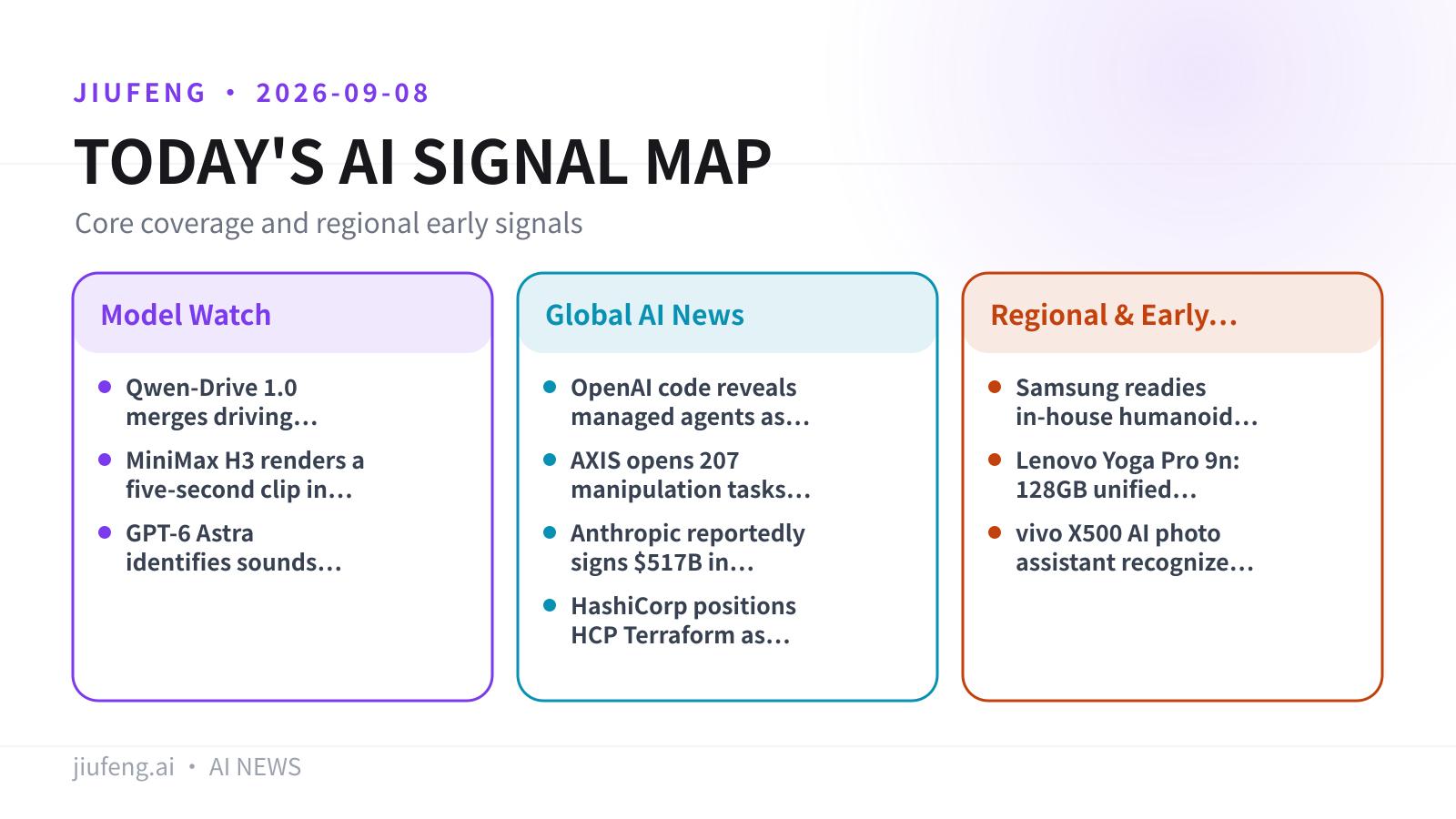
Jiufeng graphic based on the sources cited in this issue.
Model Watch
01/11
Qwen-Drive 1.0 merges driving system and cockpit assistant
Alibaba's Qwen team folds spatial perception, traffic Q&A and route planning into one model and halves the simulated off-road rate from 24% to 12%, but its explanations do not always match its maneuvers.
The Decoder reported on September 7 that Qwen-Drive 1.0 handles three tasks in a single model: spatial perception of the environment, answering questions about traffic, and route planning. The researchers' starting point is that a text-image model does not automatically understand three-dimensional space just because it can describe pictures; existing driving models fine-tune a general text-image model on driving Q&A data, an approach the paper says has two weaknesses. Qwen-Drive 1.0 extends the base language model with two modules, one for 3D mapping and one for route planning, so the same model can run as both a driving system and a cockpit assistant without losing existing knowledge. After retraining, the rate at which the car veered off the road in simulations fell from 24 percent to 12 percent. The Qwen team is releasing the model free to the research community on Hugging Face (repository Qwen-Drive-1.0-4B), ModelScope and GitHub, with the paper on arXiv.
Limitations: The Decoder notes the model's textual explanations for actions such as braking do not always match the driving decisions it makes. The off-road figure comes from simulation and the report gives no real-road test results; it is the only quantitative metric in the report, and license terms should be checked in the official repository.
Image source: huggingface; mirrored on Jiufeng R2.
Source: The Decoder · Hugging Face · GitHub · arXiv
02/11
MiniMax H3 renders a five-second clip in 1.653 s on eight B300s
NVIDIA Research built the Sol-H3 inference stack for MiniMax's open-weight H3: a five-second audio-synced clip in 1.653 seconds; the code is Apache 2.0, but the weights keep a community license with temporary restrictions in the US, EU, UK and South Korea.
According to RuntimeWire, MiniMax promoted the work in an official post on September 7, three days after NVIDIA published the acceleration package: on eight NVIDIA B300 GPUs, the stack generated a five-second, audio-synced clip in 1.653 seconds. The optimization came from NVIDIA Research's Efficient AI Team and Singapore Lab, with core contributors Yitong Li, Haopeng Li and Enze Xie. Sol-H3 combines sparse attention, fused GPU kernels, faster communication between GPUs, parallel video decoding and cached conditioning inside one runtime, and NVIDIA released the code under Apache 2.0. RuntimeWire ties the result to founder Yan Junjie's decision to open H3's weights, which lets outside engineers inspect the model, change its serving stack and publish improvements.
Limitations: RuntimeWire says the 1.653-second benchmark used a four-step adapter and warm hardware and excluded MP4 encoding; it does not establish faster-than-playback generation on a workstation, an RTX card or an uncached prompt. By September 7 the B300 was no longer NVIDIA's newest announced data-center platform, as Vera Rubin had been introduced with deployments underway. The Sol-H3 code is Apache 2.0, but H3's weights keep a separate community license, whose FAQ says open-weight use is temporarily restricted in the United States, European Union, United Kingdom and South Korea, where organizations must apply to MiniMax.
Source: RuntimeWire · MiniMax on X · Sol-H3 code · H3 license FAQ
03/11
GPT-6 Astra identifies sounds from spectrogram images zero-shot
An image-only input path let Astra infer a dog bark and a lightsaber sound from mel spectrograms, but the test used two images and the second answer needed a retry.
RuntimeWire reports that Max Rubin, an aerospace engineering student at Cal Poly Pomona, posted the results on X on September 7. Fed a mel spectrogram, which maps audio energy across frequency and time, GPT-6 Astra identified a dog bark without receiving any audio; on a second image its first answer missed, after which it recognized a lightsaber sound. Rubin described the test as zero-shot and said he used Astra's light reasoning setting. OpenAI's model documentation lists images as an input modality for Astra while marking audio and video input as unsupported, so the model was working from a picture of the sound rather than listening to a recording or running speech recognition. OpenAI released GPT-6 Astra on September 3, positioning it around computer use, browsing, coding, science and professional work.
Limitations: RuntimeWire stresses the tiny test set and the corrected answer, and says such demonstrations still need controlled evaluation. This is a user experiment, not an OpenAI capability claim.
Source: RuntimeWire · Max Rubin on X · OpenAI model docs · OpenAI release post
Global AI News
04/11
OpenAI code reveals managed agents as Agent Builder winds down
TestingCatalog found references to a managed agent service with configurable environments, skills, plugins and deployment controls, pointing to the September 29 DevDay; the interface is not accessible.
RuntimeWire reports that Alexey Shabanov of TestingCatalog found references in OpenAI's codebase to a managed agent service, according to his report published Sunday. The options include creating and managing multiple agents and environments, using a developer plugin to configure agents, and deploying them in self-hosted environments. OpenAI DevDay is scheduled for September 29 at Fort Mason in San Francisco, with Sam Altman leading the 10 a.m. keynote. OpenAI launched Agent Builder in October 2025 as part of AgentKit, describing it as a drag-and-drop canvas for composing multi-agent workflows, connecting tools and adding guardrails, and is now retiring it. RuntimeWire says a managed runtime would close a product gap with Anthropic, whose Claude Managed Agents runs custom agents as hosted services with long-running sessions, scoped tool permissions, managed credentials and audit logs.
Limitations: the report rests on underlying code and unreleased product screens, the interface cannot be accessed, and OpenAI could change or abandon the features before release. The link to ads and commercial workflows is RuntimeWire's analysis, not an OpenAI statement.
Source: RuntimeWire · OpenAI DevDay · OpenAI AgentKit launch post · Anthropic: Claude Managed Agents
05/11
AXIS opens 207 manipulation tasks and 50,129 robot trajectories
Demonstration collection moves into the browser with compute on backend GPUs; π0.5 plus the full AXIS set rises from 83.9 to 88.8 on LIBERO-Plus, but the 2.36 TB release is gated, non-commercial and ships no policy checkpoints.
MarkTechPost reports that a team from Axis Robotics, UC Berkeley, Georgia Tech, NTU and other institutions proposes AXIS, which moves demonstration collection into a web browser, sends everything else to backend GPUs, and treats the dataset as something that keeps expanding rather than a fixed benchmark that ships once. The initial release covers 207 manipulation tasks and 50,129 trajectories. On LIBERO-Plus, MarkTechPost reports that π0.5 trained with 100 percent of the AXIS data scores 88.8, against 83.9 for the original π0.5 and 57.5 for the RoboCasa365 comparison, and lists scores for models trained on 25, 50 and 100 percent of the data. The training code is public as a patch layer over OpenPI, the teleoperation platform is live in any browser, and the dataset is hosted on Hugging Face (axisrobotics/Franka-Dataset) at 2.36 TB behind a gate.
Limitations: MarkTechPost rates deployability as partial: the dataset is restricted to non-commercial academic use and no policy checkpoints are released.
Source: MarkTechPost · Hugging Face dataset · Training code · Paper
06/11
Anthropic reportedly signs $517B in compute deals in 11 months
The Information says Anthropic has locked in at least 14.8 GW since October 2025 and is planning its own data centers; annualized revenue above $65 billion still cannot cover the commitments.
The Decoder relays The Information's report that Anthropic has signed compute contracts worth up to $517 billion in eleven months. Since October 2025 the company has locked in at least 14.8 gigawatts on top of the one to two gigawatts it already had, and is planning its own data centers. The Information notes that total planned capacity likely still falls short of OpenAI's 30-gigawatt target for 2030, though many of Anthropic's contracts extend well past that date, which makes a direct comparison tricky. Bloomberg puts Anthropic's annualized revenue above $65 billion; OpenAI was above $40 billion as of July. In early 2026 CEO Dario Amodei warned against investing too fast, saying competitors "don't really understand the risks they're taking", while OpenAI CEO Sam Altman is now warning about "unsustainable silliness" from neo-cloud providers.
Limitations: the contract total, capacity and revenue figures come from The Information and Bloomberg and have not been confirmed by Anthropic or OpenAI; The Decoder notes neither company can yet cover these commitments from revenue alone.
Source: The Decoder
07/11
HashiCorp positions HCP Terraform as control plane for AI agents
The rule is "agents propose, Terraform governs": policy as code, project-scoped identity, per-run OIDC credentials and full run history keep agent autonomy inside a governed plane.
InfoQ reports that HashiCorp's latest guide positions HCP Terraform as the governance and control plane for AI-driven infrastructure: AI agents can author Terraform configuration, initiate changes and trigger runs, while HCP Terraform supplies policy, identity, isolation, provenance and audit controls. The layered mechanisms include approved modules and organizational standards as authoritative context for agents; policy as code and run tasks that evaluate pending changes; project-scoped identity that limits what an agent can reach; isolated projects and workspaces that bound the blast radius; and run history that retains plans, policy decisions, approvals and executions. For credentials, HCP Terraform uses project-scoped identity with OIDC-based credentials issued per run and revoked when the run ends, instead of standing cloud credentials. HashiCorp's core principle is that an agent may generate, validate and explain a change, but should not approve its own change, weaken policy, obtain elevated credentials or bypass deployment controls.
Limitations: this is a vendor guide and positioning piece, and InfoQ cites no adoption or outcome data. InfoQ notes HashiCorp is not alone here, naming Pulumi Neo and Amazon Q Developer as moving in a related direction.
Source: InfoQ China · InfoQ
08/11
Cloudflare AI Search adds sitemap-free discovery and a public endpoint
One wrangler command now crawls, ingests, embeds and serves search; embeddings and reranking are free, answer generation and query rewriting are billed by model usage, and everything is free during the beta.
InfoQ reports that Cloudflare AI Search is a built-in search and retrieval service for AI agents and applications that chains Workers AI, AI Gateway, Vectorize, R2 and Browser Run into an end-to-end pipeline. Changes include a "discover" mode that finds pages on sites without a sitemap, which was previously mandatory; a single unauthenticated public endpoint that searches across multiple instances or sites at once; and a dedicated plugin for sites built on the open-source CMS EmDash. A single npx wrangler ai-search create command handles crawling, ingestion, embedding and retrieval. Cloudflare's own API and developer docs, along with Astro, Vite, Hono and Replicate, are indexed as one corpus; integration runs through a Worker into an existing app or MCP server (Cloudflare's recommended path) or via public /mcp and /search endpoints. With the default model or specific Workers AI catalog models, embeddings and reranking are free, while answer generation and query rewriting are billed by model usage.
Limitations: the pricing model takes effect only at general availability and the service is free during the beta; InfoQ's English original ran in August with the Chinese translation on September 7, and the report gives no latency or retrieval-quality figures.
Source: InfoQ China · InfoQ
Regional & Early Signals
09/11
Samsung readies in-house humanoid robot for CES 2027 debut
Korean media say Samsung's DX division CTO now runs both the hardware and AI software teams of the Robot RX unit, with patents locked in for hip joints, dexterous hands and AI motion control.
IT Home reported on September 7, citing Korean outlet sedaily, that Samsung Electronics is accelerating a humanoid robot prototype and plans to unveil its self-developed humanoid for the first time at CES 2027 in Las Vegas in January. The prototype is led by the Robot RX unit under DX division head Roh Tae-moon, and DX division CTO and president Janghyun Yoon heads both the hardware and AI software teams, an arrangement the report describes as rare in the industry and aimed at compressing the development cycle. IT Home says Samsung has secured core patents covering hip-joint design, next-generation high-dexterity hands and AI-based motion control.
Limitations: the account comes from industry sources cited by Korean media and Samsung has not confirmed it; the report gives no prototype specifications, production plans or details of the models used. Chinese-language source only.
Source: IT Home (Chinese-language source)
10/11
Lenovo Yoga Pro 9n: 128GB unified memory, 120B-parameter models on device
The RTX Spark laptop shown at IFA 2026 weighs 1.65 kg and fuses a 20-core Grace CPU with a 6,144-CUDA-core Blackwell GPU over NVLink-C2C for 1 PFLOPS of FP4 compute.
ifanr reports that Lenovo used Lenovo Innovation World 2026 during IFA 2026 in Berlin to launch the Yoga Pro 9n (China model YOGA Pro 15 Spark), built with NVIDIA. The machine weighs 1.65 kg, is 16.7 mm at its thinnest, and offers up to 128GB of unified memory. Its NVIDIA RTX Spark superchip links a 20-core Grace CPU with a Blackwell RTX GPU of 6,144 CUDA cores through NVLink-C2C and delivers 1 PFLOPS of FP4 AI performance. Citing NVIDIA's RTX Spark specifications, ifanr says this configuration can run a 120-billion-parameter language model with up to a 1-million-token context locally; unified memory lets the CPU and GPU share one physical pool, sidestepping the roughly 10-20 GB of VRAM on consumer discrete GPUs.
Limitations: the 120B-parameter figure comes from NVIDIA's specification for RTX Spark, not from Lenovo throughput tests; ifanr itself notes that local large models have mostly lived on demo stages and that heavier AI workflows still return to the cloud. Chinese-language source only.
Source: ifanr (Chinese-language source)
11/11
vivo X500 AI photo assistant recognizes 5,000 scene tags
vivo's imaging event detailed RAW-domain generative reconstruction with an on-device model for speed and a cloud model for quality, plus one-sentence photo editing; the hardware debuts the 蓝图光御 900 sensor with 17EV dynamic range.
IT Home reported on September 7 that vivo disclosed the X500 series' imaging setup at its creator event. The AI pieces: RAW-domain generative reconstruction uses an on-device model to keep output fast and a cloud large model to push image quality; an upgraded AI photography assistant recognizes 5,000 scene tags and suggests poses, framing and color grading; "album inspiration editing", built with MediaTek, edits photos from a single sentence; and the X500 Pro Max debuts telephoto subject tracking with framing assistance and pose recognition, co-developed with MediaTek. On hardware, the series is first to ship the 蓝图光御 900 sensor, reaches up to 17EV dynamic range with vivo's high-dynamic technology, brings both main and periscope cameras to CIPA 7.0 stabilization, and the Pro Max supports a 400mm teleconverter with a Samsung HP0 telephoto sensor.
Limitations: neither the on-device model nor the cloud model is named or sized, no latency or accuracy figures are given for the 5,000 scene tags, and only the imaging configuration was announced, with no price or launch date in the report. Chinese-language source only.
Source: IT Home (Chinese-language source)
Write a prompt in your browser and get an image — 1K, 2K or 4K output, up to 15 reference images. 50 free generations on sign-up, no credit card.
Generate free