Overview
9 stories in this issue. The first 3 are today's priorities.
Model Watch
- Top · GPT-6 Astra hallucinates less but still fails 8.5% of hidden injections
- Top · Replit runs GPT-6 Astra one day after release
- Top · Lyria 3.5 lands in Gemini with multi-minute songs
Global AI News
- Gemini Spark takes over Google Photos tasks
- DeepSeek plans 160,000-chip Huawei inference cluster
- Roland's Melody Flip generates loops, not finished songs
- Copilot code review reaches Azure Repos, billed per review
Regional & Early Signals
- Huawei pairs DevEco Code with a CLI for HarmonyOS coding
- Yuandian opens BRIDGE hardware and FlowMimic control
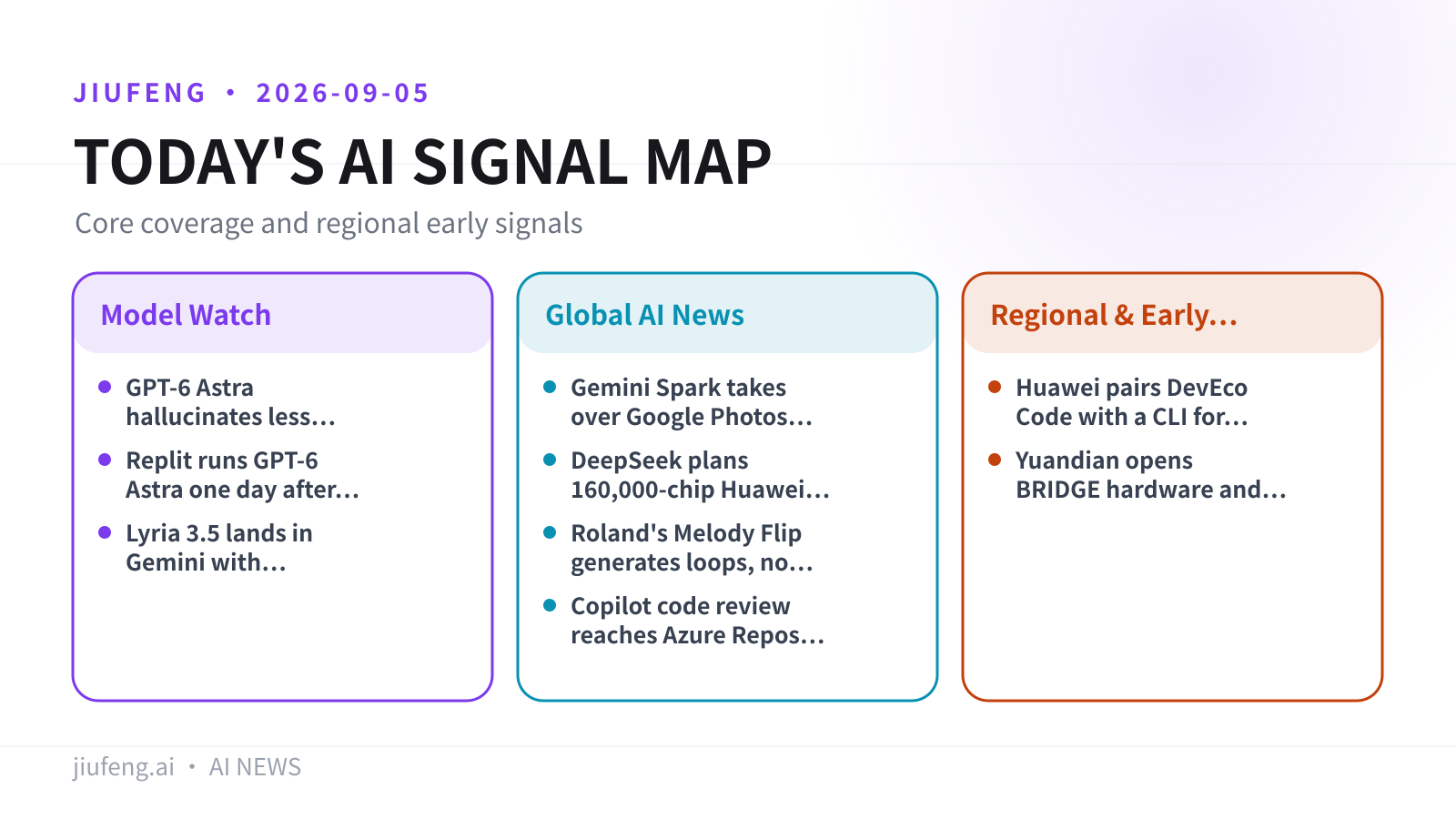
Jiufeng graphic based on the sources cited in this issue.
Model Watch
01/09
GPT-6 Astra hallucinates less but still fails 8.5% of hidden injections
Direct prompt injections are blocked 99.99% of the time, but attacks buried in documents the model reads still land in 8.5% of cases.
According to OpenAI's system card, GPT-6 Astra makes far fewer factual errors than its predecessor GPT-5.6 Sol. The test set came from ChatGPT conversations users had flagged for wrong answers, so these were particularly error-prone cases. Astra blocks 99.99 percent of direct prompt injection attacks. For indirect prompt injections hidden inside documents the model reads, the failure rate dropped from 27 percent to 8.5 percent, measured by security firm Gray Swan using 1,810 curated attacks from the IPI Arena set.
The same material carries the caveats: Astra resists jailbreaks better than earlier models, but a persistent attacker working across multiple conversation rounds can still extract a problematic response roughly one time in three. And while 8.5 percent is a large drop, it remains high in absolute terms — not reliable enough for genuinely secure agent deployments.
Image source: OpenAI Deployment Safety Hub; mirrored on Jiufeng R2.
Source: The Decoder · OpenAI system card · IPI Arena
02/09
Replit runs GPT-6 Astra one day after release
OpenAI shipped Astra on September 3rd; Replit had it live on September 4th, ahead of most platforms.
Replit co-founder and CEO Amjad Masad confirmed the rollout on September 4th with a post on X — "Astra on Replit" — linking to a demonstration from a Replit user. OpenAI released GPT-6 Astra on September 3rd for complex computer use, coding, research and professional workflows, describing it as its most capable broadly deployed model, with wider access through ChatGPT and the API to follow over the coming days. Replit introduced Intelligent Model Routing on August 26th, which assigns tasks to models automatically; CTO Luis Hector Chavez described Astra's value in similar terms in Microsoft's Foundry launch post.
The limit is access: OpenAI is still restricting initial availability to selected organizations. RuntimeWire also notes that as agents gain autonomy, Replit's routing and sandbox controls carry more responsibility.
Source: RuntimeWire · OpenAI · Microsoft Foundry
03/09
Lyria 3.5 lands in Gemini with multi-minute songs
Google moved its music model from an internal tool into the Gemini app and API, split into a 30-second clip tier and a full-song tier.
Google announced on September 5th that music generation model Lyria 3.5 is live in the Gemini app and the Gemini API. The documentation lists two models: Lyria 3 Clip (model ID lyria-3-clip-preview), which always produces 30-second clips for looping and preview, and Lyria 3.5 (model ID lyria-3.5), which generates multi-minute complete songs including choruses and bridges. Both default to MP3 output; Lyria 3.5 also supports WAV. Developers can supply up to 10 images alongside a text prompt and the model composes from that visual content. Access runs through Google AI Studio, Vertex AI and the Gemini API; all generations are dispatched via the Interactions API and carry a SynthID inaudible watermark that survives compression and resampling, for copyright tracking and provenance.
Limitations: the documentation lists no pricing yet, and this report is so far only available as a Chinese-language write-up of Google's announcement.
Source: IT Home (Chinese-language source)
Global AI News
04/09
Gemini Spark takes over Google Photos tasks
Google's personal agent can now edit images, curate albums and turn a photographed flyer into a calendar entry.
Google said its personal agent, Gemini Spark, can now manage a user's Google Photos library: editing images on request, curating albums, automatically creating shared albums from favorite shots, turning concert flyer photos into calendar appointments, and running longer workflows. Google Photos lead Shimrit Ben-Yair announced the capabilities in a post on X on Thursday evening.
Limitations: the features roll out over the next few weeks and only to eligible Gemini AI Pro and Ultra subscribers in the U.S., in English. No other regions or languages were named.
Source: TechCrunch · Shimrit Ben-Yair on X
05/09
DeepSeek plans 160,000-chip Huawei inference cluster
Per Bloomberg, the Ascend-950DT fleet would run inference only; training stays on Nvidia hardware.
The Decoder, citing Bloomberg, reports that DeepSeek plans to deploy at least 160,000 of Huawei's next-generation Ascend-950DT chips in a large data center in Inner Mongolia. The chips would run inference only, not training — DeepSeek still uses Nvidia hardware for heavier training workloads. If built, it would be the largest known Huawei chip cluster.
The constraints are concrete: production limits and memory chip shortages mean Huawei probably cannot deliver the full order for over a year. CXMT, China's top memory maker, is producing small batches of HBM3E for the first time but remains three to five years behind Samsung, SK Hynix and Micron, all of which are already mass-producing HBM4. This is a press report, not an official announcement.
Source: The Decoder
06/09
Roland's Melody Flip generates loops, not finished songs
The instrument maker's first generative AI music tool ships as a DAW plug-in and outputs raw material rather than tracks.
Melody Flip is available as a plug-in for digital audio workstations and offers around 250 "Palettes" — themed collections of musical ideas sorted by genre. Users can start from scratch and ask for any combination of melody, chord progression, bassline or drums, or feed it a reference track so it builds on that song's melodic ideas.
The limitation is the product's own framing: unlike Suno or Udio, Melody Flip does not produce finished songs with vocals and full arrangements. It offers simple musical loops meant to serve as a creative spark, not a deliverable.
Source: The Verge
07/09
Copilot code review reaches Azure Repos, billed per review
Microsoft opened GitHub Copilot code review to every Azure DevOps customer, charging for each review run.
Microsoft made GitHub Copilot code review for Azure Repos available to all Azure DevOps customers, after acknowledging that many of them are not ready to migrate to GitHub. Reviews are billed per use through the linked Azure subscription.
Limitations: usage and billing reporting runs two days behind, so teams cannot see spend in real time and have to reconcile after the fact.
Source: InfoQ
Regional & Early Signals
08/09
Huawei pairs DevEco Code with a CLI for HarmonyOS coding
With little public ArkTS training data, Huawei is compensating with a coding agent, atomic CLI tools and a skills marketplace.
According to an InfoQ China engineering write-up, HarmonyOS's ArkTS language is young and publicly available code corpora are limited, so the same model performs measurably worse on HarmonyOS work. Huawei's answer is a three-layer stack. DevEco Code is a ready-to-use HarmonyOS coding agent spanning project creation, requirements design, code generation, functional verification, integration testing and maintenance; it ships with Zhipu's model services preconfigured while also supporting custom configuration and third-party models. DevEco CLI breaks IDE capabilities into command-line atoms — create project, syntax check, build, acquire device, push and run, fetch emulator, knowledge retrieval, Skills management — so an AI workflow can chain them. The Gewu marketplace aggregates official, community and partner Skills, MCP tools and knowledge bases. DevEco Code's Harness uses three escalating verification loops, starting with lightweight syntax checking to filter obvious errors.
On comparisons, the source says that with the same underlying model plus this Harness, DevEco Code reaches a higher HarmonyOS task completion rate than OpenCode, across three model pairings — GLM5.1, DeepSeek-V4-Pro and MiniMax-M2.7 — with DevEco Code ahead in every one. It also puts the crash-fix success rate above 80 percent.
Limitations: that comparison is reported only as a qualitative result, with no per-case figures published and no third-party reproduction. The article also notes Huawei's device diversity (bar phones, dual-fold, tri-fold) still forces per-form-factor adaptation of the same business code, complexity the stack does not remove. The material itself is a vendor engineering talk reported in Chinese.
Source: InfoQ China (Chinese-language source)
09/09
Yuandian opens BRIDGE hardware and FlowMimic control
The humanoid maker open-sourced both its hardware design and its instruction-control stack, targeting the problem that policies lose all value on a different robot body.
Leiphone reports that Yuandian Robotics, a subsidiary of Lexiang Technology, published two papers with CMU: BRIDGE, an open hardware design, and FlowMimic, an open instruction-control scheme. On top of those two toolchains the company launched OpenBridge, a fully open developer ecosystem, and is recruiting 200 developers, researchers and hobbyists worldwide. Those selected get free access to the Bridge geek edition hardware, which supports secondary development and is adapted end-to-end to the OpenBridge system.
Limitations: the report's own framing is that every vendor's body morphology, joint configuration, sensor interfaces and kinematic calibration differ, so a grasping policy trained over years at company A is worth nothing on company B's hardware. The ecosystem so far rests on vendor statements and a single Chinese-language report, with no third-party reproduction or adoption numbers.
Source: Leiphone (Chinese-language source)
Write a prompt in your browser and get an image — 1K, 2K or 4K output, up to 15 reference images. 50 free generations on sign-up, no credit card.
Generate free