Overview
10 stories in this issue. The first 3 are today's priorities.
Hot model watch
- Top · Codex gains a "Watch and fix" mode for pull requests
- Top · GLM-5.3 turns up stripped of guardrails, sold through an API
- Top · Anthropic open-sources a commerce agent blueprint under Apache-2.0
Global AI news
- Why AI food images look wrong: thin structures break diffusion models
- A $149 USB-C computer built to keep agents off your phone
- Nvidia's IFA local-AI update: up to 1.9x inference, RTX Spark in October
- OpenAI commits $1B to cyber defenders of essential services
- AWS publishes two AgentCore reference implementations
Regional and early signals
- Qujing Technology and Moore Threads put PD-disaggregated inference into production (Chinese-language source)
- Moonshot AI reportedly weighs a Hong Kong IPO of $3B to $5B (Chinese-language source)
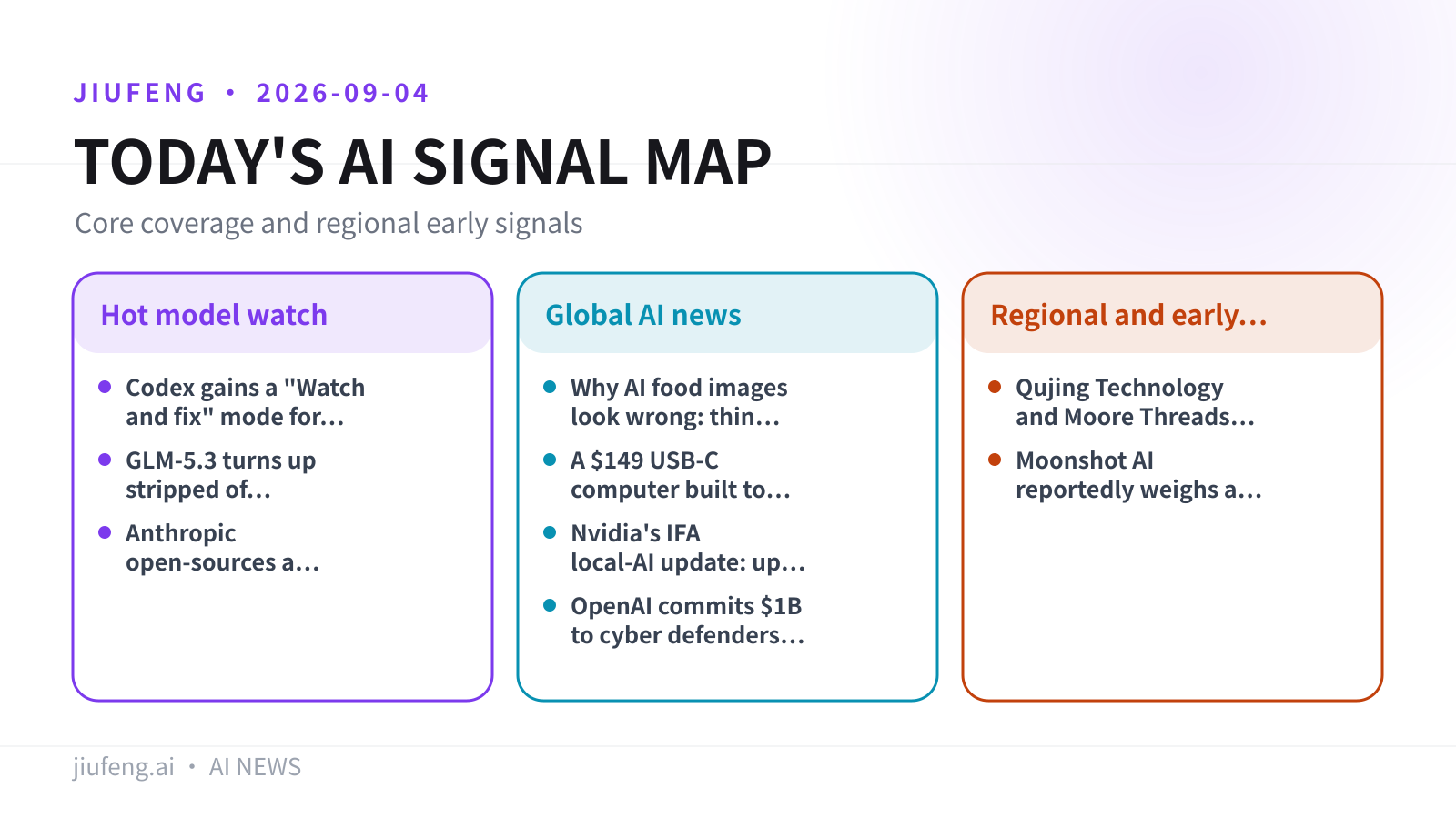
Jiufeng graphic based on the sources cited in this issue.
Hot model watch
01/10
Codex gains a "Watch and fix" mode for pull requests
A pull-request babysitting switch has appeared in OpenAI's production desktop app: Codex rechecks the PR every 10 minutes, repairs CI failures and merge conflicts, and pushes the fixes back.
RuntimeWire found user-facing settings titled "Watch and fix pull requests" in OpenAI desktop version 26.901.20858, build 7658, alongside controls for "Auto-merge when ready" and custom "Pull request watch instructions." Enabling it creates an automation of type heartbeat named Auto-fix PR #; the child task is first told "Begin automatically fixing PR #," then a 10-minute heartbeat keeps checking the live PR state, fixing relevant CI failures and merge conflicts, and pushing repairs. The heartbeat by default runs until the task is complete or blocked; only when the user separately enables Auto-merge when ready does it continue until GitHub records the merge. OpenAI had already shipped automatic Codex reviews that analyze pull requests, plus support for updating existing pull requests.
The limits are clear: this is original reporting based on RuntimeWire's own testing and documents. OpenAI published no release note for the feature, and while it ships inside a production build, the company has not announced it as generally available.
Source: RuntimeWire · OpenAI Codex upgrades · Codex changelog
02/10
GLM-5.3 turns up stripped of guardrails, sold through an API
A startup called Abliteration.ai has turned guardrail removal into a hosted service, and its lineup includes Z.ai's recently released GLM-5.3.
TechCrunch reports that Abliteration.ai hosts modified open-weight models with their refusal behavior removed, queryable from a web browser or through an API. The name comes from abliteration, the technique that strips a model's tendency to refuse harmful requests. GLM-5.3 is among the hosted models named in the report.
Worth separating out: the argument that giving defenders the same tools as bad actors could ultimately improve cybersecurity is Abliteration.ai's own, not an independent finding. The only evidence available for this item is that single TechCrunch report.
Source: TechCrunch
03/10
Anthropic open-sources a commerce agent blueprint under Apache-2.0
Anthropic has packaged the scaffolding every shopping-agent team rebuilds, covering retail, travel, telecom and entertainment.
According to MarkTechPost, Anthropic released Claude Commerce Agents under Apache-2.0. The release covers the agent loop, a tool layer over the catalog, an approval gate and an eval suite — exactly the pieces teams keep rewriting when they build a shopping assistant or merchant agent.
The limitation is evidentiary: the only source available for this item is the single MarkTechPost write-up, which carries no benchmark numbers and names no merchants already using the blueprint.
Source: MarkTechPost
Global AI news
04/10
Why AI food images look wrong: thin structures break diffusion models
The Verge dissected the restaurant industry's AI image problem, tracing it to how diffusion models handle thin, continuous structures.
The Verge collected the promotional images restaurants, cafes and brands are generating: donut shrimp, wormlike noodles, stringy chicken, and ice cream that looks like masonry — all sharing lumps, holes and cracks. The technical explanation quoted in the piece is that diffusion models are notoriously weak at generating thin, continuous, terminating structures.
This is observation plus explanation. The piece puts no number on how many food businesses are generating imagery this way, and it names no specific image model or version.
Source: The Verge
05/10
A $149 USB-C computer built to keep agents off your phone
TrustKernel began worldwide shipments of PlugClaw on September 4th, containing agents and credentials on a stick and calling out to cloud models only when needed.
RuntimeWire reports (primary source: a PR Newswire release) that PlugClaw is a complete Android and Ubuntu computer built into a USB-C stick, starting at $149 with no required subscription, bundled cloud model credits, and support for user-supplied API keys. It measures 50 x 19 x 8 millimeters and runs a MediaTek Helio G80 with up to 6 GB of memory. TrustKernel first announced the device on August 12th; the September 4th announcement moves it from preorder into general availability and adds free access to confidential-model inference on newly deployed servers. Founder Li Wenhao is an operating-system security researcher who started the company out of Shanghai Jiao Tong University.
TrustKernel's claim that data stays hidden from both itself and the cloud provider is a company statement with no third-party audit in the report, and the numbers disagree on weight: the product page says 14.3 grams while the shipping announcement rounds to 15.
Source: RuntimeWire
06/10
Nvidia's IFA local-AI update: up to 1.9x inference, RTX Spark in October
At IFA 2026 Nvidia said new llama.cpp and vLLM optimizations make local inference up to 1.9x faster, with compact RTX Spark Windows PCs arriving in October from Lenovo and Acer.
The official blog lists the package: llama.cpp and vLLM optimizations available now, both directly and through LM Studio and Ollama, for up to 1.9x faster local inference; simplified local AI support for Nvidia GPUs coming to Hermes Agent, OpenClaw and Perplexity Portable Computer; and compact NVIDIA RTX Spark Windows PCs shipping in October from Lenovo and Acer. The post also highlights Qwen3.8-Flash-Next, an open-weight multimodal MoE model that can run locally on DGX Spark and DGX Station, plus Qwen3.8-27B, a 27-billion-parameter open model described as optimized for local agentic and coding workloads on Nvidia GPUs.
The 1.9x figure is a vendor-stated upper bound with no test model, precision or hardware configuration disclosed, and RTX Spark pricing and specs remain unannounced; this item rests on Nvidia's own blog alone.

Image source: NVIDIA Blog; mirrored on Jiufeng R2.
Source: NVIDIA AI Blog · Qwen3.8-27B
07/10
OpenAI commits $1B to cyber defenders of essential services
OpenAI introduced Daybreak for Frontline Defenders, a $1 billion commitment to widen access to frontier cyber AI, training and support for essential services.
The announcement frames the money around frontline defenders: expanding access to frontier cybersecurity AI capabilities for organizations that run essential services, together with training and support.
The scope is limited to organizations running essential services, and OpenAI presents the $1 billion as a commitment. The evidence available for this item is that framing on the announcement page.
Source: OpenAI
08/10
AWS publishes two AgentCore reference implementations
AWS turned its AI-driven development lifecycle into runnable code: one sample converts SQL schemas into Mermaid ER diagrams, the other runs multi-agent code security analysis.
Both reference implementations in the official post are built on Amazon Bedrock AgentCore. The first runs on AgentCore Runtime and generates Mermaid entity relationship diagrams from SQL schemas. The second uses AgentCore Gateway and AgentCore memory for a multi-agent automated code security analysis. The agents themselves are built with the open-source Strands framework and run containerized, with client credentials stored in AWS Systems Manager Parameter Store.
This is a reference implementation and architecture walkthrough rather than a product launch: the post gives no latency, cost or accuracy numbers, and the samples are tied to the Kiro plus AgentCore stack.
Source: AWS Machine Learning Blog · Strands SDK
Regional and early signals
09/10
Qujing Technology and Moore Threads put PD-disaggregated inference into production (Chinese-language source)
Qujing Technology's domestic PD-disaggregated stack now runs on Moore Threads' MTT S5000, and the two companies say the setup is already serving real token traffic for a major model vendor.
QbitAI reports that the strategic agreement was signed on September 3rd: the MTT S5000 handles prefill — input computation and KV cache generation — while high-bandwidth GPUs handle decode-stage token generation. The MTT S5000 supports native FP8 and ships with the MUSA software stack, which lets prefill be decoupled into an independently provisioned and independently billed compute pool. The production figures given in the article are an average generation speed above 50 TPS, a KV cache hit rate above 90%, and 99.9% stability; in the current project a prefill pool of four to five MTT S5000 cards is said to beat leading international compute on cost per input token processed.
That cost-performance claim comes from the two companies. The article names no comparison hardware and no unit prices, mentions time-to-first-token without giving a number, and does not identify the model vendor whose traffic it serves; this item rests on a single Chinese-language report (Chinese-language source).
Source: QbitAI
10/10
Moonshot AI reportedly weighs a Hong Kong IPO of $3B to $5B (Chinese-language source)
Bloomberg, via people familiar with the matter, says the company behind Kimi is considering a Hong Kong listing as early as this year, raising $3 billion to $5 billion.
IT Home relays Bloomberg's September 4th report: Moonshot AI has hired Bank of America as overall coordinator, with CICC, Deutsche Bank and Goldman Sachs also working on the deal, targeting $3 billion to $5 billion and a listing as early as this year. The company recently closed a $3.5 billion round at a $35 billion valuation and is approaching investors for a new round at a $50 billion pre-money valuation. Kimi K3, the open model it released in July, is what brought it global attention.
Everything here comes from anonymous sources, and the report states plainly that both the final size and the timing may change; Moonshot has not confirmed anything publicly. This is a capital-markets signal, not a model capability one, and reaches us through a Chinese-language relay (Chinese-language source).
Source: IT Home
Write a prompt in your browser and get an image — 1K, 2K or 4K output, up to 15 reference images. 50 free generations on sign-up, no credit card.
Generate free