Overview
9 stories in this issue. The first 3 are today's priorities.
Hot model updates
- Top · Hidden desktop setting lets Codex drive a BUSY Bar status light
- Top · Changan Auto puts Qwen Office across five business lines
- Top · 100 GRPO steps lift a 350M model's structured-output score to 29.7%
Global AI news
- Anthropic signs a $35 billion compute deal with Lambda
- funes gives coding agents a memory you own
- Diagrid Catalyst 2.0 adds durable, verifiable agent execution
- Flock's AI watchlists let police search for people by description
Regional and early signals
- Hyper3D's WorldGen builds editable 3D scenes, not single assets
- Zhipu puts GLM Coding Plan token subscriptions on Tmall
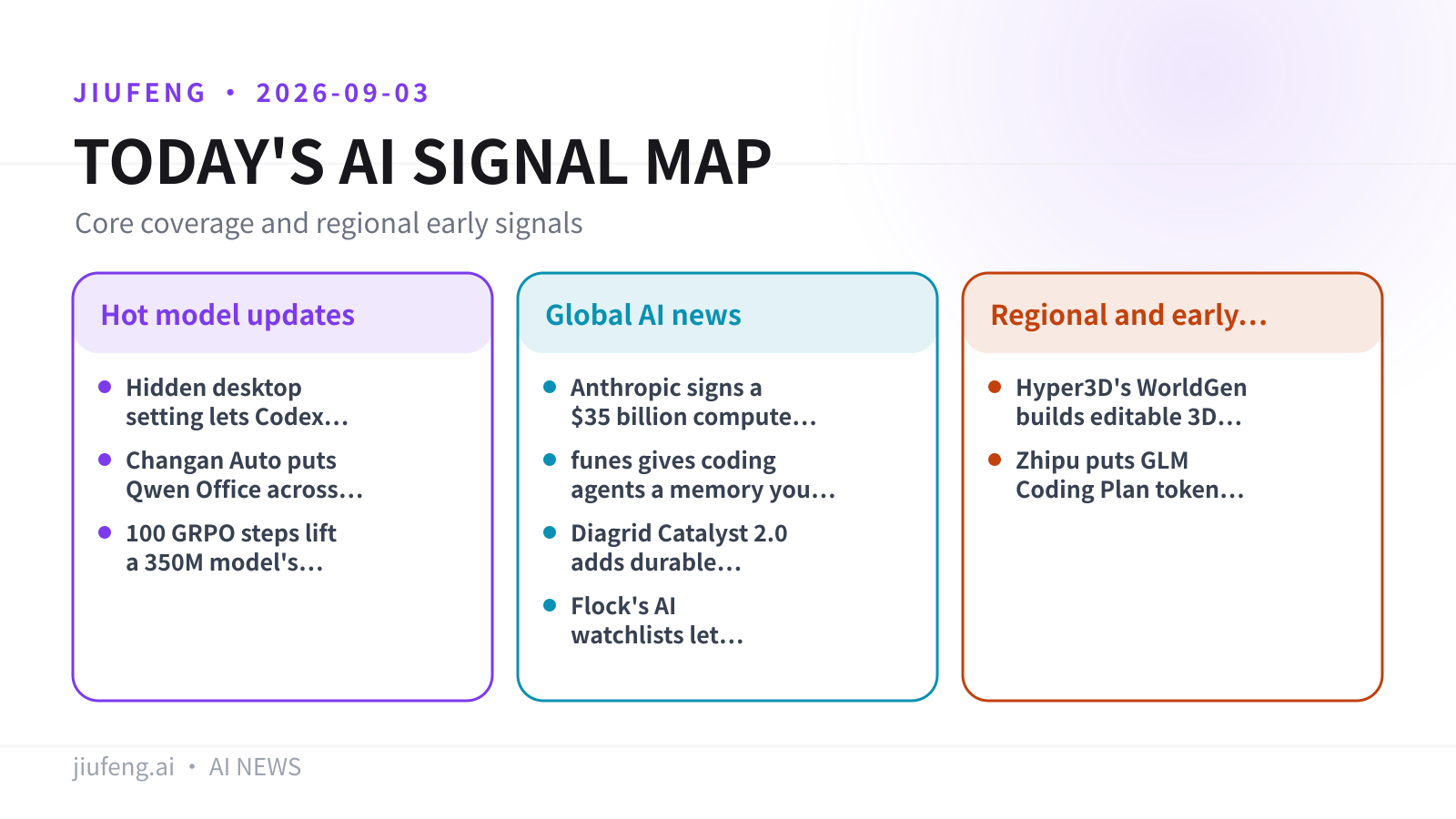
Jiufeng graphic based on the sources cited in this issue.
Hot model updates
01/09
Hidden desktop setting lets Codex drive a BUSY Bar status light
RuntimeWire reverse-engineered OpenAI desktop build 26.901.20858 (build 7658) and found a hidden, disabled-by-default preference named busy-bar-enabled.
RuntimeWire compared OpenAI desktop application packages from builds 7119 and 7658 and isolated a new hidden preference, busy-bar-enabled, whose internal description reads "Whether Codex controls a connected BUSY Bar." The setting is marked hidden and defaults to false. The build also ships a busy-bar.asar resource package with animations and device-status graphics sized for the BUSY Bar display, covering task, ready, pending, error and disconnected states. BUSY Bar is Flipper's desk hardware.
This is a reverse-engineering finding, not an OpenAI announcement: the switch is hidden and off by default, and OpenAI has not said whether it will ship. RuntimeWire also notes that independent developers have already connected Codex to the same device through an open-source controller on GitHub — the novelty here is first-party support, not the first pairing of Codex and BUSY Bar hardware.
Source: RuntimeWire · busybar-codex on GitHub
02/09
Changan Auto puts Qwen Office across five business lines
China's Changan Auto has wired Qwen Office into R&D, manufacturing, supply chain, sales and service, and asked all staff to use AI agents.
Per Leiphone's September 3 report (events dated September 2), an electrical systems engineer built a wiring-harness selection calculator with Qwen Office: parameter calculations covering hundreds to thousands of harnesses per vehicle model previously took a senior engineer about two days by hand and now return results five minutes after the parameter sheet is imported. A vehicle-document checker covering dozens of parameters across conformity certificates, COC certificates and environmental lists cut manual per-vehicle checking from more than ten minutes to one or two. In the supply chain, a packaging review process spanning hundreds of suppliers and thousands of parts per project was broken into seven or eight automation scripts, cutting the workload by more than 90 percent. In customer research, classifying 20,000–30,000 user responses per project dropped from several days to under half a day.
All of these figures come from Changan Auto and Alibaba Cloud themselves, with no independent verification. The report gives no deployment scale, model version, token consumption or cost data, and this is a Chinese-language source with no English-language counterpart.
Source: Leiphone (Chinese-language source)
03/09
100 GRPO steps lift a 350M model's structured-output score to 29.7%
Hugging Face published a fully public recipe that fine-tunes LFM2.5-350M with TRL, moving IFStruct scores from 22.6% to 29.7%.
The September 3 guide fine-tunes LiquidAI's LFM2.5-350M with Group Relative Policy Optimization using about 500 samples and 100 training steps — small enough, the authors say, for a free-tier Colab or Kaggle GPU — with the full run available on GitHub. It is evaluated on the IFStruct benchmark, improving from 22.6% to 29.7%. The motivation stated in the post: structured output is one of the most common real-world LLM tasks, yet most benchmarks fold it into broader reasoning or extraction scores instead of measuring schema compliance on its own, even though that often decides whether a model can be wired into a downstream system at all.
The limits are in the post itself: 29.7% is still a low absolute score, this is a demonstration of how much a light fine-tuning procedure can move the needle rather than a claim of production readiness, and results are reported on IFStruct alone.
Image source: huggingface; mirrored on Jiufeng R2.
Source: Hugging Face Blog · Source on GitHub
Global AI news
04/09
Anthropic signs a $35 billion compute deal with Lambda
Reuters, citing an anonymous source, reports Anthropic has signed a $35 billion cloud computing contract with Nvidia-backed Lambda.
As relayed by The Decoder on September 3, the data center is being built in Nueces County, Texas, with roughly 350 megawatts of capacity, developed by former crypto miner Hut 8; the Wall Street Journal reports Nvidia itself holds the lease. Hut 8 had announced a 15-year lease with an unnamed client back in July. Just last week Anthropic announced a $45 billion contract with Nscale for a data center in West Virginia. The added capacity is meant to keep up with demand for Claude and Claude Code, and comes ahead of the company's planned IPO.
The reporting rests on an anonymous source, and none of the companies involved commented to Reuters. Contract value, timeline and payment structure are unconfirmed by any party.
Source: The Decoder
05/09
funes gives coding agents a memory you own
A Hugging Face post introduces funes: a durable memory layer that turns agent session traces into indexed, retrievable records with exact provenance.
Author David Corvoysier writes on September 3 that he works across several machines and switches coding agents by task, so every agent meets his projects as a stranger and the reasoning from "last Tuesday" disappears when the session ends. The post builds on an earlier piece, Software Forgets: Agent Traces Are the Memory: as agents search a codebase, try approaches, hit errors, read documentation and change direction, they leave a dense account of not just what changed but why. funes adds indexing, retrieval, ranking and exact provenance on top of those traces, and currently targets Claude Code, Codex, pi and Hermes.
The author states the caveat himself: traces are only potential memory, session logs remain an archive, and you cannot grep your way to "why did we move off the streaming parser?" across ten thousand turns. The post is a first-person tool introduction with no quantitative evaluation of retrieval quality.
Source: Hugging Face Blog · Source on GitHub
06/09
Diagrid Catalyst 2.0 adds durable, verifiable agent execution
Model calls and tool calls become durable workflow activities, so interrupted runs resume from the break and execution history can be verified outside the app that produced it.
Per InfoQ, Diagrid released Catalyst 2.0 on July 28, 2026, with ten framework integrations covering LangGraph, LangGraph Deep Agents, Microsoft Agent Framework, Google ADK, Dapr Agents, AWS Strands, OpenAI Agents SDK, Claude Managed Agents, CrewAI and Pydantic AI; developers add a single Diagrid package to an existing agent app. The failure it targets is common: a long multi-step task fails at the end of the sequence, and without checkpointing at call granularity the retry pays again for every model call already completed. The verification model comes from Dapr 1.18, which batch-hashes workflow history events, chains each digest to the previous signature, and signs the result using the Dapr sidecar's SPIFFE-based identity; the chain is checked on load, detecting deleted, reordered or modified history. Durable agents are built with the Python SDK, the workflow SDKs cover .NET, Go, Java, JavaScript and Python, and the open-source Dapr 1.18 SDK adds Rust.
Signing in Dapr 1.18 is disabled by default behind the WorkflowHistorySigning feature flag and depends on mTLS — enable signing without mTLS and daprd refuses to start. The per-workflow signing decision is one-way: existing history cannot be signed retroactively, and toggling it on a running workflow triggers verification errors. InfoQ also notes signing proves what happened was not altered, but not that the agent decided correctly, that tools returned accurate data, or that all external side effects were captured; teams should evaluate retry handling for non-idempotent tools, storage and latency overhead, certificate rotation, and which capabilities are open-source Dapr versus commercial Catalyst. Known early adopters are few — optics maker ZEISS Group is listed as one.
Source: InfoQ · InfoQ China
07/09
Flock's AI watchlists let police search for people by description
WIRED reconstructed Flock Safety's police-facing interface: draw a boundary on a city map and create an AI watchlist for anyone matching a written description.
RuntimeWire reported on September 3, citing WIRED's interface reconstruction published the same day, that Garrett Langley's Flock Safety lets officers draw a boundary on a city map and create an AI watchlist for anyone matching a written description, after which cameras inside the selected area run a continuous automated search for a potential match. The reconstruction adds the officer-facing controls missing from RuntimeWire's August 19 coverage of OS Investigate: how an officer configures a person watchlist, refines ranked images with Smart Sort, and encounters moderation decisions that can block a query or issue a warning. Server-side models evaluate what police may search; the interface blocks some sensitive queries and warns on others.
WIRED built the mockup from files Flock sends to a user's browser before login, so it is not official documentation and cannot confirm the server-side policy. Ars Technica reported in August that political resistance has grown with the network, with cities terminating Flock contracts at a record pace; Flock said at the time that annual recurring revenue had exceeded $300 million and was growing 70 percent year over year.
Source: RuntimeWire · Ars Technica
Regional and early signals
08/09
Hyper3D's WorldGen builds editable 3D scenes, not single assets
A single image produces an interactive, editable 3D scene whose assets can be lifted out, swapped and simulated with physical properties.
Per QbitAI on September 3, 3D generation company Hyper3D released a world generation model called WorldGen. Conventional approaches generate an entire scene as one model, which tends to fuse everything into an indivisible whole; WorldGen instead decomposes the scene into individually manipulable assets while preserving their spatial and physical relationships, fills in the background environment with 3D Gaussian Splatting, and compresses the whole process to two or three minutes. In SimReady mode it adds collision bodies to each asset and estimates mass, friction coefficients, restitution and other properties needed for simulation; the resulting standalone assets can be taken into Blender, Unity, PlayCanvas, Tuanjie Engine and Unreal Engine for further work. Hyper3D previously won a SIGGRAPH 2025 best paper for its scene-level generation technique CAST, partnered with Unity China in July, and is a member of Nvidia's Inception program; physics and parallel simulation come from Motrix's MotrixSim engine.
The "ready for production pipelines" claim rests on the vendor and this single Chinese-language report. There is no public benchmark, third-party evaluation or reproducible comparison, and generation quality, failure rates, pricing and availability are undisclosed.
Source: QbitAI (Chinese-language source)
09/09
Zhipu puts GLM Coding Plan token subscriptions on Tmall
Zhipu AI opened a Tmall flagship store selling GLM Coding Plan token subscriptions, reportedly the first listed large-model company to put its core AI product on a mainstream e-commerce shelf.
Pandaily reported on September 3 that Zhipu AI has opened a Tmall flagship store selling GLM Coding Plan token subscriptions, describing it as the first time a listed large-model company has placed its core AI product on a mainstream e-commerce platform.
This rests on a single report with no official announcement to check against. Pricing tiers, how the subscription is delivered and activated, and any sales figures are undisclosed, and the "first" claim cannot be independently verified from public material.
Source: Pandaily
Write a prompt in your browser and get an image — 1K, 2K or 4K output, up to 15 reference images. 50 free generations on sign-up, no credit card.
Generate free