Overview
9 stories in this issue. The first 3 are today's priorities.
Top model developments
- Top · A better harness makes DeepSeek-V4-Flash outscore Opus 4.8
- Top · Shopify's CEO threatens to ban Claude Code over AGENTS.md
- Top · Gemini 3.5 Pro keeps slipping; Jeff Dean departs to found Discovery Loop
- StartLux's 27B local model takes second on CAICT's MCP test, beating DeepSeek-V4-Flash
Global AI news
- OpenClaw 2.0 closes the collaboration gap but still won't bundle models or infra
- Google open-sources EnvHarness to make static agent environments adaptive
- Glassdoor analysis: positive employee sentiment on AI fell from 81% to 43%
Regional & early signals
- AI video now generates faster than it plays, powering an "infinite slop" livestream (Chinese-language source)
- SenseTime spin-out Imvision bets on AI imaging co-processors to escape Ambarella's shadow
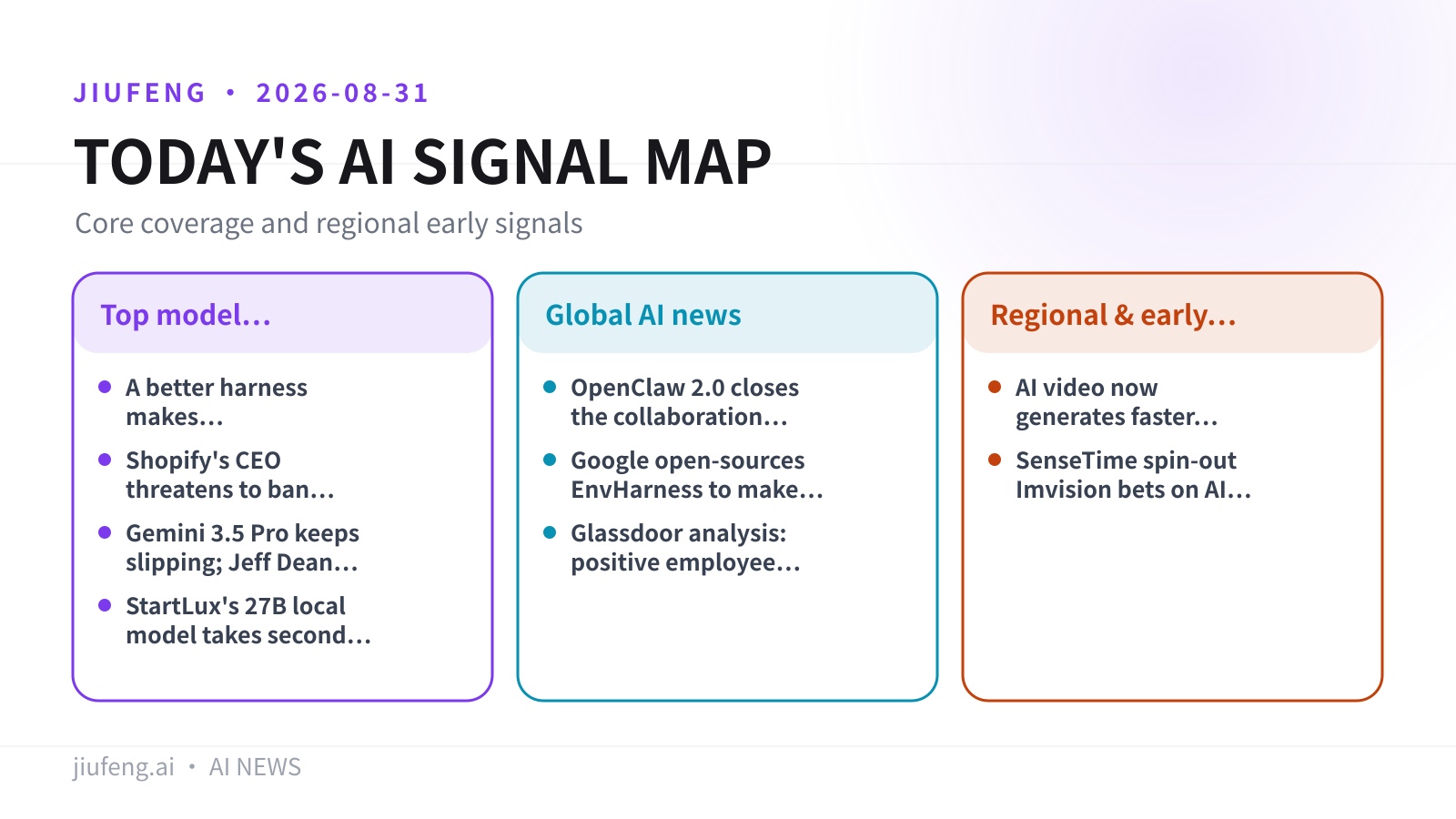
Jiufeng graphic based on the sources cited in this issue.
Top model developments
01/09
A better harness makes DeepSeek-V4-Flash outscore Opus 4.8
The same DeepSeek-V4-Flash wins all five benchmarks and beats Claude Opus 4.8—57.1× more expensive—once it runs on Floatboat's harness.
Per InfoQ, general-agent company Floatboat published an evaluation in August 2026: DeepSeek-V4-Flash (blended price $0.175/M) beat Claude Opus 4.8—which costs 57.1× more—on all five benchmarks. The decisive variable was the harness, not the model: the same model won zero of five on DeepSeek's official harness but all five on Floatboat's. The team built its own Runtime, Agent Loop, Tools and Infra plus an adaptive system called FloatSail, packaging a file manager, editor and browser into a desktop runtime for the agent. The gain scales with task length: just 1.9% on short tasks, 23.6% on the long-horizon DeepSWE; Floatboat's Harness Leverage Ratio (HLR) rose from 0.78× to 3.57×.
Limitations: Floatboat's numbers are self-run on self-chosen benchmarks with no independent replication, and absolute scores and prompt details are not fully public; the METR and Anthropic links below are further-reading references appended by InfoQ's report, not an official methodology statement from the evaluators.

Image source: anthropic; mirrored on Jiufeng R2.
Source: InfoQ · METR arXiv:2503.14499 · Anthropic
02/09
Shopify's CEO threatens to ban Claude Code over AGENTS.md
By refusing the AGENTS.md format adopted by 60,000+ open-source projects, Claude Code drew a public threat of a company-wide ban at Shopify.
Per InfoQ, Claude Code sticks to its own CLAUDE.md and refuses to read AGENTS.md, a format becoming an industry standard. Shopify CEO Tobi Lütke wrote on X that with thousands of developers maintaining one monorepo, a tool that misses the shared instruction file leaves some agents "with a slice of their brain cut out," a "stupid complexity tax that shouldn't have to be paid"—and that he is considering banning Claude Code across Shopify until it reads AGENTS.md, .agents/skills and similar files. The demand is long-standing: a feature request filed in August 2025 drew nearly 5,000 GitHub upvotes, one of the community's strongest compatibility asks, yet the issues were repeatedly closed as "won't fix." A 2026 study of 2,853 GitHub repositories found context files have become the standard way developers instruct coding agents. On Anthropic's side, Claude Code team member Thariq responded that the team is improving customizability and explained why they stick with CLAUDE.md—different models need different context—and disclosed that Anthropic cut about 80% of the Claude Code system prompt for Claude 5. The response did not settle the dispute; developers grew angrier.
Limitations: this is an engineering dispute over a config format, with no actual Shopify ban yet and no Anthropic commitment to support AGENTS.md.
Source: InfoQ · GitHub issue · arXiv:2602.14690
03/09
Gemini 3.5 Pro keeps slipping; Jeff Dean departs to found Discovery Loop
Google's flagship went from "shipping this month" to "soon," and its response has been organizational: an operator over Gemini, faster cheap Flash models, and its chief scientist leaving to build outside.
Per RuntimeWire, Google's Gemini 3.5 Pro has slipped repeatedly: Alphabet's June 2026 investor presentation said it would ship that month, a July post said partners were testing it, and by August it was still "soon." Google's response has been organizational and commercial—putting an operator over Gemini and shipping cheaper Flash models faster. On the talent side, Jeff Dean—Google's 30th employee, there 27 years, a builder of MapReduce, Bigtable, TensorFlow, the TPU program and Google Brain, and chief scientist of Google DeepMind—left on August 5 to co-found the public-benefit corporation Discovery Loop with Sanjay Ghemawat, Oriol Vinyals and Quoc Le, with Alphabet as a founding investor and cloud partner; his google.com account was closed around August 14.
Limitations: Gemini 3.5 Pro still has no confirmed ship date beyond "soon"; the report is built on Dean's own X posts and Sundar Pichai's memo—a synthesis of public information—and Google has issued no official technical explanation for the delay.
Source: RuntimeWire · Jeff Dean on X · Pichai memo
04/09
StartLux's 27B local model takes second on CAICT's MCP test, beating DeepSeek-V4-Flash
A 27-billion-parameter local model placed second on China's CAICT MCP benchmark, outscoring DeepSeek-V4-Flash.
Per Pandaily, StartLux's 27-billion-parameter local model took second place on the CAICT MCP test, beating DeepSeek-V4-Flash and, in the report's words, reaching "trillion-parameter capability territory." Placing in the top two at 27B points to the cost-performance headroom smaller models can have on specific agent/tool-use benchmarks.
Limitations: this rests on a single Pandaily report and is a thin regional signal; "trillion-parameter capability" is the report's framing rather than an official score; the source refers to the evaluator only by the abbreviation "CAICT" without spelling it out, and the full MCP leaderboard, methodology and rival results are not given, with no independent replication.
Source: Pandaily
Global AI news
05/09
OpenClaw 2.0 closes the collaboration gap but still won't bundle models or infra
The open-source, self-hosted agent OpenClaw ships 2.0 with persistent sessions, cloud workers and handoffs—while still leaving models and infrastructure to the operator.
Per RuntimeWire, Peter Steinberger's open-source OpenClaw released version 2.0 on August 30 with capabilities that define Grok Bot and ChatGPT Work: persistent agents, shared sessions, computer access, recurring jobs and handoffs. The difference is what it refuses to bundle—Grok Bot (beta on August 11) and ChatGPT Work package agent execution, models and infrastructure inside managed products, while OpenClaw lets operators run agents on a laptop, server, paired device or chosen cloud worker, with hosted or local models, preserving control over execution and credentials.
Limitations: that control comes at the cost of setup, maintenance and security being left to the user; the report frames 2.0 as closing "convenience and collaboration gaps" rather than a standalone launch, and gives no performance benchmarks or user numbers.
Source: RuntimeWire · Grok Bot · ChatGPT Work
06/09
Google open-sources EnvHarness to make static agent environments adaptive
An Apache-2.0 programmable layer turns a fixed agent benchmark into one that adapts as the policy training on it improves.
Per MarkTechPost, Google Cloud AI Research, with Washington University in St. Louis and UNC Chapel Hill, released EnvHarness under Apache-2.0. Most agent environments are hand-built and frozen—behaving identically no matter which agent acts or how much it improves. EnvHarness inverts that: it wraps an existing environment in plug-in components that work strictly through the standard reset() / step() interface, changing where an episode starts, what the agent may do and what it sees, while the underlying simulator, tasks and human-built verifiers stay unchanged.
Limitations: it changes an environment's presentation and starting conditions, not the underlying tasks or verification; effectiveness and scope are defined by the accompanying paper and repository, and the report gives no quantified training gains across tasks.
Source: MarkTechPost · GitHub · arXiv
07/09
Glassdoor analysis: positive employee sentiment on AI fell from 81% to 43%
An analysis of employer reviews finds workplace positivity toward AI dropping from 81% to 43%, with negative mentions now at 53%.
Per The Decoder, an analysis of Glassdoor employee reviews found U.S. workers' positive sentiment on AI fell from 81% in 2019 to 43% by mid-2026, with negative comments rising to 53%. The splits are stark: only 21% of AI-related comments from Gen Z women are positive, the most skeptical group; executives are the most optimistic; software architects mention AI most and mostly positively, while software engineers—whose work leans on writing and reviewing code—are more skeptical (about 57% negative); insurance claim adjusters, writers and customer-service staff view it almost universally negatively.
Limitations: this is an observational analysis of public reviews reflecting subjective sentiment, not productivity or headcount data; the sample and sampling method are per the original, and it cannot establish AI's net effect on any specific role.
Source: The Decoder
Regional & early signals
08/09
AI video now generates faster than it plays, powering an "infinite slop" livestream (Chinese-language source)
A fal engineer wired H3 Max—a redesign of the open MiniMax H3—into a livestream that generates a 15-second clip in about 9 seconds, spawning an endlessly running interactive AI stream.
Per ifanr, on August 29 fal engineer Rehan Sheikh connected H3 Max (his redesign built on the open model MiniMax H3) to a livestream as a never-ending "infinite interdimensional cable," and the demo thread drew over 5 million views in two days. Because generation first outpaced playback—a 15-second clip in about 9 seconds—developer Pieter Levels built the interactive Infinite Slop site: anyone types a line, the AI generates a clip with visuals, dialogue and sound effects into a queue; day one drew 37,000 viewers and peaked above 1,000 concurrent.
Limitations: Sheikh's Twitch stream was banned over DMCA and other rules, banned again on Kick, and finally moved to Rumble; the content is self-described "slop" and demo-grade, and H3 Max's parameters, license and stable availability are undisclosed. This item is from a Chinese-language outlet.
Source: ifanr
09/09
SenseTime spin-out Imvision bets on AI imaging co-processors to escape Ambarella's shadow
Spun out of SenseTime, Imvision is entering top camera supply chains as an AI imaging co-processor, testing whether it can grow from a second chip into a full SoC.
Per Pandaily, Imvision Innovation, a spin-out from SenseTime, is entering top camera supply chains as an AI imaging co-processor—positioned as a "second chip" alongside the main SoC—and aims to grow into a full SoC of its own, stepping out of Ambarella's shadow.
Limitations: this is a single, thin Pandaily report and an early industry signal; the scale of supply-chain wins, customers, shipments and mass-production timing are undisclosed, and "growing into an SoC" is the company's intent, not a verified product.
Source: Pandaily
Write a prompt in your browser and get an image — 1K, 2K or 4K output, up to 15 reference images. 50 free generations on sign-up, no credit card.
Generate free