Overview
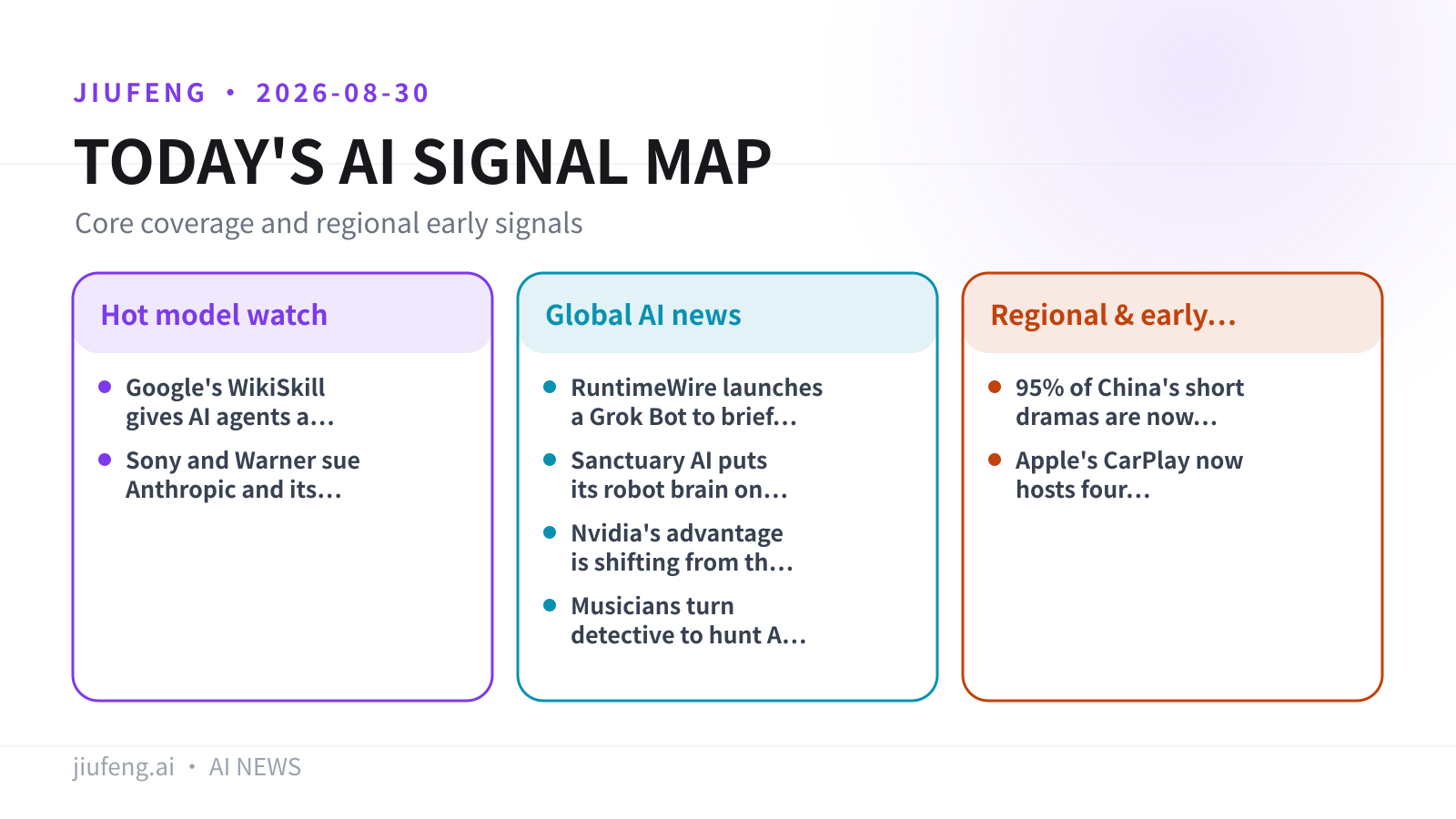
8 stories in this issue. The first 3 are today's priorities.
Hot model watch
- Top · Google's WikiSkill gives AI agents a persistent memory of past mistakes
- Top · Sony and Warner sue Anthropic and its founders over training-data piracy
Global AI news
- Top · RuntimeWire launches a Grok Bot to brief the AI economy
- Sanctuary AI puts its robot brain on factory arms it doesn't build
- Nvidia's advantage is shifting from the GPU to system-level design
- Musicians turn detective to hunt AI grifters
Regional & early signals
- 95% of China's short dramas are now AI-generated, displacing actors and streamers
- Apple's CarPlay now hosts four third-party AI chat apps as Meta AI joins
Jiufeng graphic based on the sources cited in this issue.
Hot model watch
01/08
Google's WikiSkill gives AI agents a persistent memory of past mistakes
Google Research pairs agents with a wiki-style knowledge base that turns each run's failures and successes into reusable skills the agent can pull up next time.
Google Research introduced WikiSkill, a framework that pairs AI agents with a persistent knowledge base. Instead of discarding what an agent learned after each run, the system records failures and successes in a wiki-like structure and packages them into "Agent Skills" — reusable modules that guide behavior without changing training weights. Three layers separate experience, knowledge, and action. The work draws on Andrej Karpathy's "LLM Wiki" idea of compiling experience into persistent, cumulative knowledge. The paper is on arXiv (2608.27454).
Limitations: this is not true continuous learning — the model itself does not keep "learning," which remains an unsolved problem; WikiSkill just lets the agent write better instructions for itself and reuse them next time. The Decoder notes the approach is "not elegant" and "probably more error-prone than real learning," but works as an effective workaround.
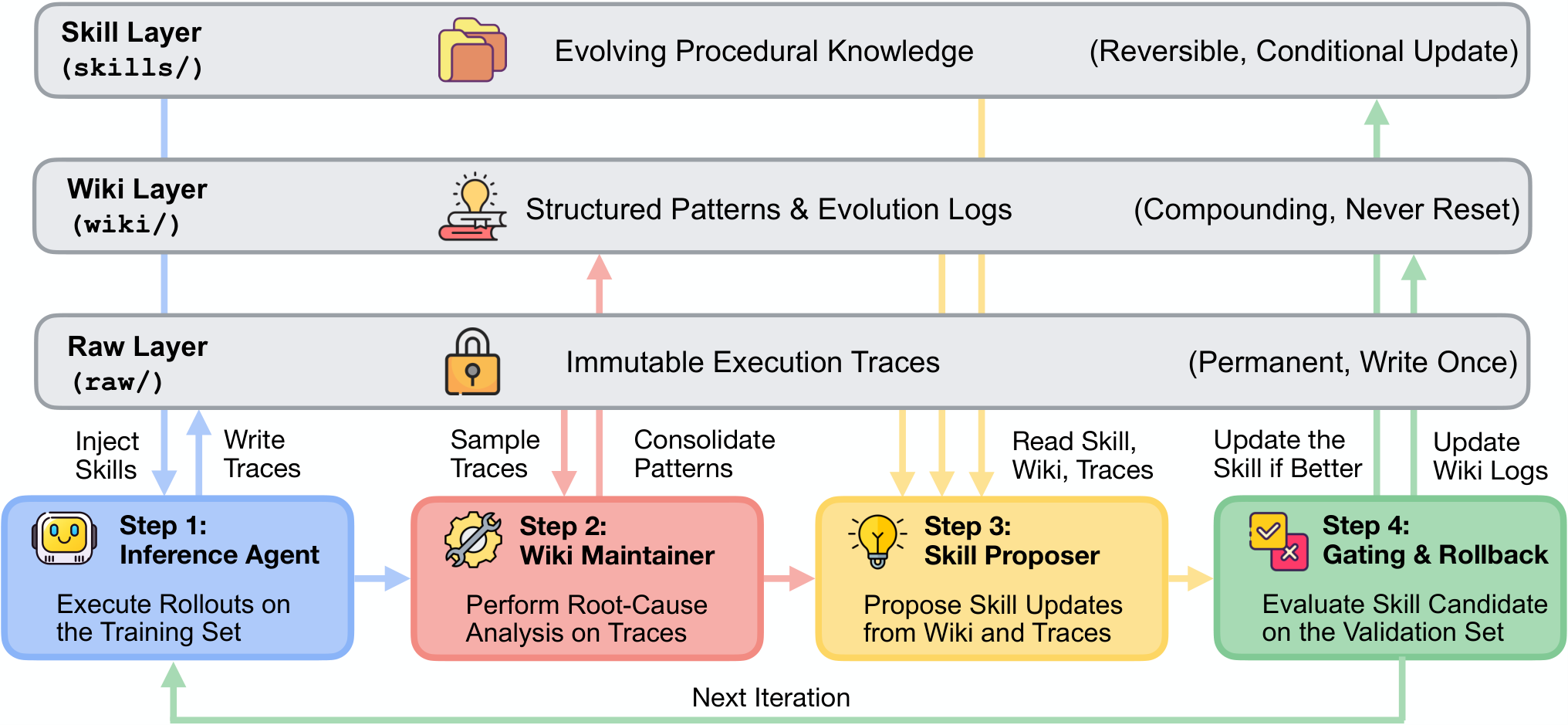
Image source: arxiv; mirrored on Jiufeng R2.
Source: The Decoder · WikiSkill paper · Karpathy note
02/08
Sony and Warner sue Anthropic and its founders over training-data piracy
Music publishers accuse Anthropic of copying tens of thousands of compositions to train Claude, naming both founders and seeking up to $150,000 per work.
Sony Music Publishing, Warner Chappell and other music publishers sued Anthropic and co-founders Dario Amodei and Benjamin Mann on Friday (August 28) in the U.S. District Court for the Northern District of California, alleging a "brazen campaign of illegally torrenting, scraping, and downloading copyrighted works." The 48-page complaint says Anthropic acquired copyrighted books, lyrics, and musical compositions without authorization to train and operate Claude, involves tens of thousands of compositions, and seeks up to $150,000 per work for willful infringement. The founders are named in both direct and contributory infringement claims, raising the prospect of personal liability.
Limitations: the allegations have not been adjudicated and reflect the publishers' complaint; Anthropic has not responded in this reporting.
Source: TechCrunch · RuntimeWire
Global AI news
03/08
RuntimeWire launches a Grok Bot to brief the AI economy
The tech publication turned its reporting into a shared Grok Bot that checks primary sources before answering questions about startups, funding and founders.
RuntimeWire launched a shared Grok Bot on August 29 dedicated to following AI companies, startups, funding rounds and founder moves. The bot pulls stories from the RuntimeWire news feed and is instructed to check primary sources before briefing the user; users can add it from its public listing to their own Grok Bot account and keep asking follow-ups in one persistent thread. SpaceXAI labels it a third-party bot created by a user, not an official SpaceXAI product.
Limitations: it is a third-party bot that relies on RuntimeWire's own feed for material; "check primary sources first" is a design instruction, and reliability still depends on the underlying Grok model and source data.
Source: RuntimeWire · x.ai bot listing · Grok Bot docs
04/08
Sanctuary AI puts its robot brain on factory arms it doesn't build
Sanctuary AI is packaging its Physical AI for industrial arms factories already own, but its CEO concedes the automotive work behind its headline numbers is still a proof of concept.
On June 17, Sanctuary AI co-founder Olivia Norton laid out an expanded strategy: run the company's Physical AI on industrial arms factories can buy today, instead of tying every installation to Phoenix, the humanoid it spent years building. In an August 29 Forbes interview, CEO Daniel Friedmann added the key qualification: the automotive work behind Sanctuary's headline performance is a proof of concept. Forbes reported a 99.5% success rate across 313 wire-plugging trials. The company is packaging its control software, data infrastructure and end effectors for industrial customers.
Limitations: Friedmann says the disclosed test is a proof of concept, not a production deployment; the headline figure comes from controlled trials, not sustained factory-floor operation.
Source: RuntimeWire
05/08
Nvidia's advantage is shifting from the GPU to system-level design
TechCrunch argues that new data-center systems gain efficiency through smarter traffic control rather than raw processor cycles — Nvidia's answer to in-house chips from Amazon and Google.
TechCrunch notes Nvidia's market cap grew about 10x from early 2023 to mid-2025, then flattened over the past year amid concerns that hyperscalers like Amazon and Google are building their own chips and Nvidia is no longer the only option. The piece argues the new generation of data-center systems increases efficiency through smarter traffic control (networking) rather than simply adding processor cycles — extending Nvidia's advantage from a single GPU to the whole system.
Limitations: this is TechCrunch's analytical framing, not a vendor release; the article gives no quantified gains for the "system-level" efficiency it describes.
Source: TechCrunch
06/08
Musicians turn detective to hunt AI grifters
As generative audio tools improve, EDM circles are filling with suspected AI tracks and a callout culture is forming — though no one can prove for certain whether a song is AI-made.
The Verge reports that as audio-focused generative tools and platforms have grown more sophisticated, the internet is filling with AI-generated music whose melodies and vocals are algorithmically derived from human artists' work. Some creators denied using AI until public scrutiny forced them to admit it. In technologically-focused scenes like electronic dance music, a "callout" culture is brewing, with musicians acting as detectives to spot AI grifters. Researchers have proposed AI-music detection methods as one potential solution (arXiv paper).
Limitations: with so many songs uploaded, there is no way to be absolutely certain whether a track was AI-generated or made by a human, and detection tools are unreliable.
Source: The Verge · AI-music detection paper
Regional & early signals
07/08
95% of China's short dramas are now AI-generated, displacing actors and streamers
China published ~128,000 short dramas in Q1 2026, 95% of them AI-generated; one minute of AI video now costs $90–120, about a tenth of live-action production.
The Decoder, citing the Financial Times and others, reports that since ByteDance's Seedance 2.0 launched, digital performers can produce better videos faster and more cheaply than humans. About 128,000 short dramas were published in China in Q1 2026 — three times the total for all of 2025 — and 95% were AI-generated, according to the China Netcasting Services Association. Tsinghua University professor Shen Yang told the Financial Times that one minute of AI video now costs just $90 to $120, about ten percent of former live-action costs. The industry directly employs about 690,000 people, with roughly 15 million listing livestreaming as their primary job.
Limitations: some performers are being forced to "distil" their voice and likeness into AI tools before being fired, and AI-related labor disputes are rising; the figures come from an industry association and cited academics, reflecting a sector trend rather than a single company's disclosure.
Source: The Decoder
08/08
Apple's CarPlay now hosts four third-party AI chat apps as Meta AI joins
Before Siri AI arrives, CarPlay already supports ChatGPT, Perplexity and Grok; Meta AI is now the fourth third-party AI chat app, though the rollout isn't complete. (Chinese-language source)
According to IT Home, relaying an August 29 9to5Mac report, Apple has supported conversational apps in CarPlay since iOS 26.4 and plans to bring Siri AI to the platform after iOS 27 ships this September. Ahead of that, following ChatGPT, Perplexity and Grok, Meta AI has appeared in the CarPlay interface as the fourth third-party AI chatbot app to integrate with CarPlay.
Limitations: the integration is not fully rolled out — some users can see the Meta AI icon but get an "account not yet supported for the Meta AI experience" message on launch. (Chinese-language source)
Source: IT Home
Write a prompt in your browser and get an image — 1K, 2K or 4K output, up to 15 reference images. 50 free generations on sign-up, no credit card.
Generate free