Overview
9 stories in this issue. The first 3 are today's priorities.
Hot model updates
- Top · Z.ai opens GLM-5.3 weights for coding and vulnerability hunting
- Top · Grok Bot tests a marketplace for third-party AI teammates
- Top · Qwen3.8-Flash powers a "standard mode" that cuts token use 75%
Global AI news
- LAION releases a 10-million-hour open video dataset
- Ex-Yandex team rebuilds a search engine for AI agents
- OpenAI moves to cut Cursor's direct model access from November 12
- Andreessen Horowitz raises a $1.1B AI infrastructure fund
Regional & early signals
- HarmonyOS 7 ships text-to-image search and image super-resolution
- Dual-arm robot makes ice cream in a Shanghai store at ~90% success over 55 steps
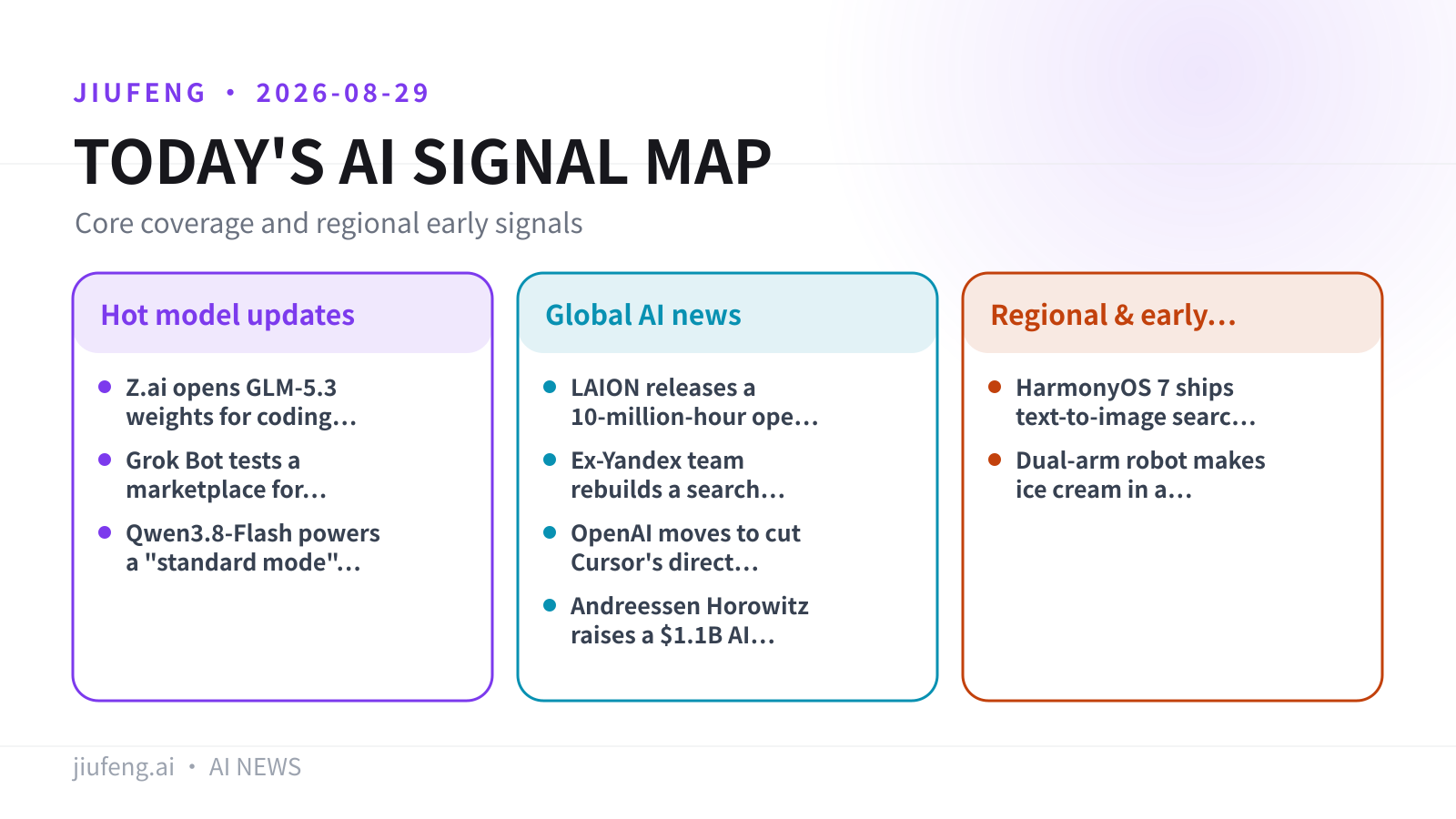
Jiufeng graphic based on the sources cited in this issue.
Hot model updates
01/09
Z.ai opens GLM-5.3 weights for coding and vulnerability hunting
Z.ai releases downloadable weights for GLM-5.3, its flagship agentic coding and cyber-defense model previously offered only through hosted products.
On August 28, Z.ai published the GLM-5.3 weights: a repository of 141 Safetensors shards totaling 756 GB, with config files, deployment instructions and a custom commercial license; the config describes a mixture-of-experts model. Z.ai calls it its most capable model for agentic coding and cyber defense, and reports steep gains on exploitation benchmarks. The release extends a strategy founder Tang Jie laid out in an April 2026 statement — autonomous agents for long-running work — applied here to completing complex engineering projects and finding exploitable software flaws.
Limitations: the exploitation-benchmark gains are Z.ai's own claims and not independently reproduced; the model is dual-use (it hunts exploitable flaws), and the license leaves most deployment controls to the user. Weights can now be downloaded and self-hosted rather than accessed only through hosted products.
Image source: huggingface; mirrored on Jiufeng R2.
Source: RuntimeWire · Z.ai on X · Hugging Face
02/09
Grok Bot tests a marketplace for third-party AI teammates
SpaceXAI previews a Grok Bot Marketplace that would let users add complete third-party agents to their existing bot teams.
The feature surfaced on August 28 in a video posted to X by Grok community moderator @blankspeaker. The marketplace is split into Plugins (already available) and Bots (marked "coming soon"). Per the preview, users can inspect a Bot's instructions, memories, skills, routines and integrations before adding it. Where a Plugin connects an agent to a service or packages a narrow capability, a marketplace Bot arrives as a reusable worker with its own instructions and operational setup. SpaceXAI already lets users share individual Bots via public links and maintains an official plugin-marketplace repository (xai-org/plugin-marketplace).
Limitations: this is a moderator-posted preview and the Bots category is still "coming soon," not live. Per the Bot management docs, existing MCP controls — server allowlists and whether members may add their own servers — carry over, making review and permissions central.
Source: RuntimeWire · Bot docs · xai-org/plugin-marketplace
03/09
Qwen3.8-Flash powers a "standard mode" that cuts token use 75%
Chinese-language source. Alibaba's Qwen Office debuts a standard mode on Qwen3.8-Flash, claiming ~2x faster single tasks and 75% lower token use.
On the evening of August 26, Alibaba's Qwen team released Qwen3.8-Flash and open-sourced the open-weight variant Qwen3.8-Flash-Next: a multimodal MoE with a 125B main model plus 51B N-gram embedding, activating only 6B parameters per token, priced at ¥0.8 per million input tokens and ¥2.7 per million output. Qwen Office's new standard mode runs on it, with Alibaba claiming ~100% faster single-task generation and an average 75% cut in token consumption, and saying the mode covers about 95% of daily office tasks and can deliver results into connected apps such as DingTalk.
Limitations: the speed and token figures are Alibaba's own; InfoQ's trial was hands-on editorial testing, not a standardized benchmark, and the "95% of tasks" figure is a vendor claim to validate against your own workflow.
Source: InfoQ (Chinese)
Global AI news
04/09
LAION releases a 10-million-hour open video dataset
LAION's Big Video Dataset (BVD) is one of the largest open video datasets for AI research, for research use only.
BVD starts from 1.3 billion video URLs in CommonCrawl; the team downloaded 80 million videos totaling 10 million hours and extracted 55 million clips with auto-generated video and audio descriptions plus 300 million still images. Most videos come from YouTube and are mostly in English. According to the paper, models trained on BVD outperform comparable models trained on InternVid by up to 2.1 percentage points on common video-to-text benchmarks, with training that ties video, audio and text together.
Limitations: the dataset is research-only; LAION says it can likely rely on a 2024 Hamburg Regional Court ruling permitting collection of copyrighted content for non-commercial research, and asks users to respect original creators' rights.
Source: The Decoder · paper
05/09
Ex-Yandex team rebuilds a search engine for AI agents
Keenable exits stealth aiming to be "the next Google" for AI agents, with a $26M seed round led by Accel.
Keenable was founded by former Yandex search/AI/cloud head Andrey Styskin and co-founder Matthias Petri, previously at Amazon AGI; the ~15-engineer team builds crawling, indexing, retrieval and ranking from scratch and exposes them to agents via REST API, MCP Server and CLI. Per its site, the index already covers over 100 billion documents with US-East query latency under 250ms (p95), and pricing as low as $1 per 1,000 requests for customers above 100 RPS. The seed round was led by Accel. Keenable says its API is already in production at several AI labs and inference providers, used for both training and runtime retrieval.
Limitations: Styskin told TechCrunch that building a giant web index is "painfully expensive" and costs spiral if the index isn't optimized per task; the company did not name customers, and the coverage and latency figures are its own.
Source: TechCrunch · InfoQ (Chinese)
06/09
OpenAI moves to cut Cursor's direct model access from November 12
After SpaceX acquired Cursor, OpenAI says it can't trust SpaceX to honor terms and will end the partnership on November 12.
OpenAI said on August 29 it will terminate its contract with AI coding tool Cursor effective November 12, 2026 — the maximum notice period allowed, under a clause letting OpenAI end the deal within a limited window after a change of ownership, which SpaceX's acquisition triggered. "It boils down to trust," OpenAI's Thibault Sottiaux said, citing Musk's companies repeatedly breaking contracts. Users accessing GPT models through Cursor can still use their own OpenAI API keys, and OpenAI will keep providing access through its IDE extensions for Cursor.
Limitations: OpenAI's wording leaves the commercial process unresolved, calling it both "ending" the partnership and, under its proposal, ending direct access on November 12. Cursor co-founder Michael Truell downplayed the move, and Sottiaux stressed this targets Musk specifically, not the broader AI coding-tool ecosystem.
Source: The Decoder · RuntimeWire · OpenAI
07/09
Andreessen Horowitz raises a $1.1B AI infrastructure fund
a16z's Machine Age Fund will back chips, memory, networking gear, edge AI hardware and robots.
On August 28, Andreessen Horowitz announced a $1.1 billion Machine Age Fund to invest in makers of data-center equipment such as chips, memory and networking gear, prioritizing edge AI hardware and listing smart-home appliances and robots among its focus areas. The fund expands a16z's existing AI program; over the past two years the firm backed more than half a dozen AI infrastructure startups across subsegments. In 2025 it invested in Heron Power, which builds solid-state data-center transformers in place of the traditional metal-coil-in-insulating-liquid design.
Limitations: this is a fund-raise and mandate announcement with no specific new portfolio deals disclosed; the stated focus priorities are a16z's own.
Source: SiliconANGLE
Regional & early signals
08/09
HarmonyOS 7 ships text-to-image search and image super-resolution
Chinese-language source. Huawei adds two system-level vision capabilities to HarmonyOS 7's Core Vision Kit.
HarmonyOS 7 API 26's Core Vision Kit adds two capabilities: "text-to-image search," letting apps retrieve images from an indexed library by text semantics (e.g., "meeting whiteboard," "tech cover with a blue background"), and "image super-resolution," which reconstructs low-resolution images. The developer site offers 26.0.0 Beta2 docs and tooling, and both capabilities are still marked Beta in the API catalog. A HarmonyOS developer interviewed by InfoQ notes that text-to-image search handles visual semantics and fuzzy memory, complementing filename search, tags and OCR rather than replacing them.
Limitations: whether the interfaces are queryable, whether local projects compile, and real-world results on supported devices must each be judged separately, per the official Beta labeling.
Source: InfoQ (Chinese)
09/09
Dual-arm robot makes ice cream in a Shanghai store at ~90% success over 55 steps
Chinese-language source. Tmtpost reports dexterous-hand maker Sharpa's dual-arm robot makes a full DQ Blizzard in a Shanghai store.
In August 2026, at a DQ store on Shanghai's Wujiang Road, a dual-arm robot takes a cup ring from a sterilizer, pulls a paper cup, dispenses soft-serve, scoops three spoons of Oreo, blends at high speed, and inverts the cup without spilling. Tmtpost describes 55-step long-horizon task planning, tactile and force-control algorithms, roughly 90% success, integrated hardware-and-"brain," and zero scene modification. Sharpa, founded in late 2024, has three co-founders who also founded lidar company Hesai; its Sharpa Wave dexterous hand is used by several leading robotics labs.
Limitations: the step count, success rate and "zero modification" come from Tmtpost's on-site report and vendor accounts, not independent testing; Sharpa keeps a very low public profile and has not disclosed capacity or scaled delivery.
Source: Tmtpost (Chinese)
Write a prompt in your browser and get an image — 1K, 2K or 4K output, up to 15 reference images. 50 free generations on sign-up, no credit card.
Generate free