Overview
9 stories in this issue. The first 3 are today's priorities.
Hot model watch
- Top · Tencent open-sources Hunyuan Hy4 preview: 770B total, 49B active
- Top · GLM-5.3-Flash and Qwen3.8-Flash-Next converge on the same architecture
- Top · Anthropic paper: automated researchers can reliably mitigate alignment failures
- DeepMind's AI Co-Scientist now plans experiments, runs equipment, and writes papers
- Grok Bot adds Stripe Link, can shop online with per-charge human approval
Global AI briefs
- OpenAI built a hidden task system for ChatGPT inside Excel and PowerPoint
- Cloudflare launches Kitesurf, a lightweight browser engine for AI agents
- Vercel open-sources vgpu, a TypeScript WebGPU library for AI agent shaders
- Decathlon runs demand forecasting at scale on Amazon's Chronos-2
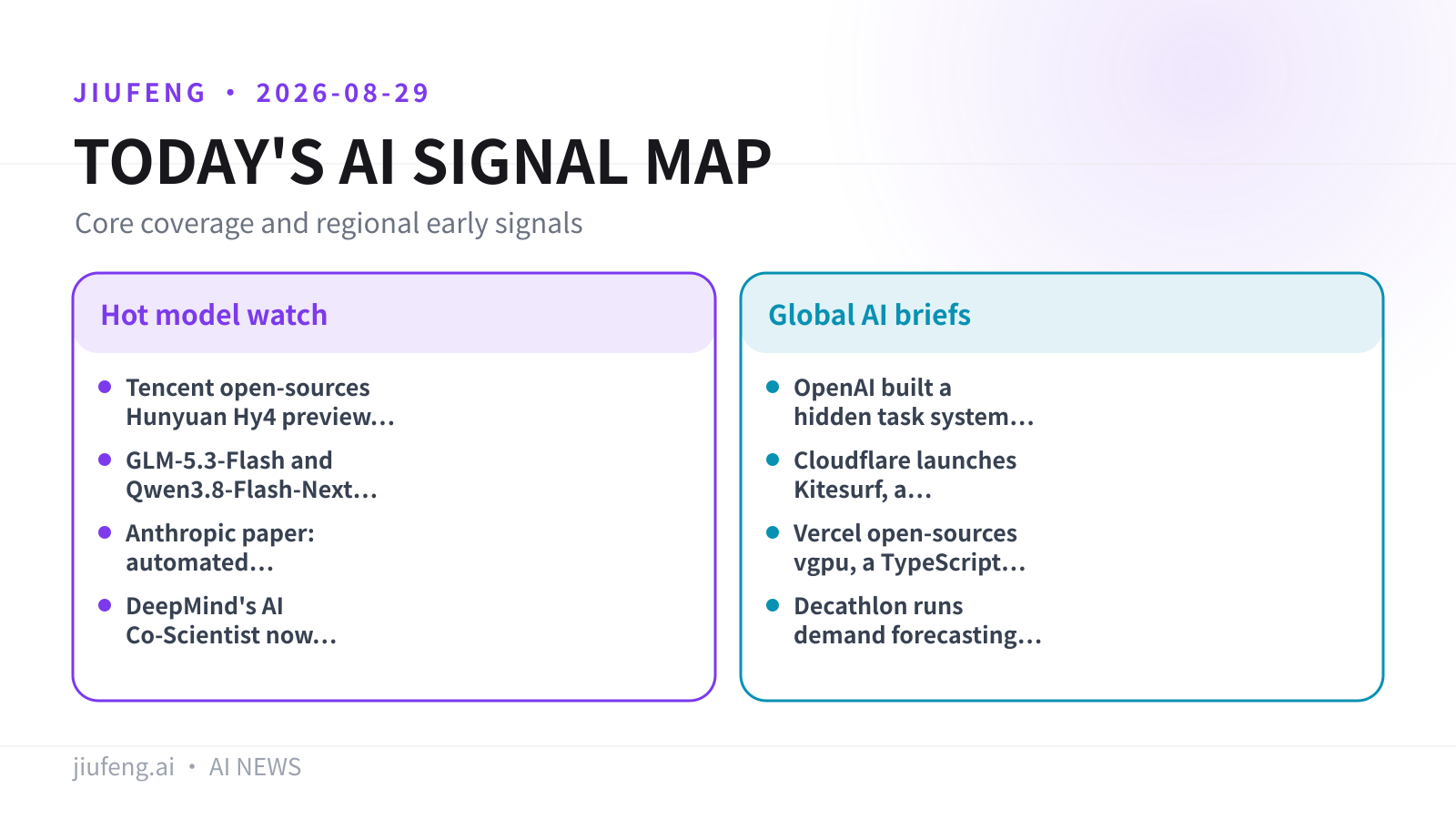
Jiufeng graphic based on the sources cited in this issue.
Hot model watch
01/09
Tencent open-sources Hunyuan Hy4 preview: 770B total, 49B active
Tencent ships a new open-weight model aimed at agents and coding, and says it helped "train itself."
Tencent released and open-sourced Hunyuan Hy4 preview on August 28: 770B total parameters, 49B active, and a context window past 1M, tuned for agent, coding and productivity workloads. Tencent says that versus the prior generation it improves multi-step agent, code-development and productivity tasks, with better task decomposition, context carry-over, instruction following and long-chain execution. It also says Hy4 preview took part in automatically optimizing its own training methods, data strategy, evaluation and low-level operators — proposing plans, running experiments and iterating on results in an early recursive self-improvement loop — and that self-analysis of inference bottlenecks around operator fusion and communication lifted end-to-end throughput 31.8% over baseline.
Pricing is aggressive: 6 RMB per million input tokens, 18 RMB per million output, 0.3 RMB per million on cache hits; it debuts across WorkBuddy/CodeBuddy (domestic and international), Yuanbao and ima, with API access via Tencent Cloud Tokenhub and OpenRouter, plus a two-week free window on WorkBuddy/CodeBuddy. Note the caveats: the "recursive self-improvement" claim and the 31.8% throughput figure are Tencent's own, and InfoQ's hands-on with WorkBuddy concluded it "now has the delivery muscle of a small team, but still needs someone watching" — i.e. complex tasks still require human oversight.
Image source: huggingface; mirrored on Jiufeng R2.
Source: Hugging Face · GitHub · InfoQ (Chinese-language source)
02/09
GLM-5.3-Flash and Qwen3.8-Flash-Next converge on the same architecture
Two Chinese labs shipped open-weight models a day apart, designed independently, yet their configs read like near-copies.
MarkTechPost dissects two open-weight models released within a day of each other. Z.ai's GLM-5.3-Flash is the first natively multimodal model in the GLM-5 series — a 320B-parameter MoE with 18B active, released under the MIT license on Hugging Face, and tested anonymously as "Ox Alpha" on OpenRouter, where it topped the popularity chart. Alibaba's Qwen3.8-Flash-Next is a 125B model with 6B active that previews the Qwen4 architecture. The teams designed them independently, yet the configs align: both use a 3:1 hybrid of linear and full attention, compress context with an indexer capped at 2048 tokens before scoring, widen the residual stream into 4 gated branches, and train with the Muon optimizer (fused parameter matrices split before orthogonalization).
Qwen3.8-Flash-Next stacks 48 layers in blocks of 3 Gated DeltaNet layers plus 1 Qwen Sparse Attention (QSA) layer; per MarkTechPost, Qwen credits QSA with up to 7.6x prefill and 4.9x decoding speedups over full attention at 1M tokens. This is a third-party architectural comparison of two already-released models; the convergence is an observation, not a joint announcement.
Source: MarkTechPost · GLM-5.3-Flash (Hugging Face) · Qwen3.8-Flash-Next (vLLM recipe) · NVIDIA developer blog
03/09
Anthropic paper: automated researchers can reliably mitigate alignment failures
An Anthropic fellows researcher shows automated systems improving all 10 alignment benchmarks without hurting overall performance.
On August 28 Anthropic published "Automated Researchers Can Reliably Mitigate Alignment Failures," showing how AI systems can improve a model's scores on a set of alignment benchmarks. Given 10 benchmarks for specific misaligned behaviors, the automated systems improved performance on every single one without degrading the model's overall performance. TechCrunch frames it as an early look at "training AI with AI," a goal that has become popular among neolabs.
The caveat: this is a research preview, not a product. The result is scoped to those 10 alignment benchmarks and is described as a "peek" at self-improving AI, without broader deployment or long-term stability claims.
Source: TechCrunch · Anthropic paper
04/09
DeepMind's AI Co-Scientist now plans experiments, runs equipment, and writes papers
Google DeepMind turns Co-Scientist from a hypothesis generator into a closed-loop system with experimentally validated results across three fields.
Per The Decoder, Google DeepMind expanded its multi-agent Co-Scientist from a hypothesis generator into a lab-integrated research partner built on current Gemini models. It now derives hypotheses from a research question, writes code, produces machine-readable lab protocols, analyzes results, and drafts manuscripts in a closed loop; verification modules cross-check numerical claims in the text against the execution logs of the generated code to reduce fabricated results. Google says the system delivered experimentally validated results across three disciplines, with a paper on arXiv. Co-Scientist first appeared in February 2025 on Gemini 2.0, with shortcomings in fact-checking and literature review.
Limitations are stated: lead author Samuel Schmidgall notes precursor materials were still prepared manually, the fast mode produced smaller, less uniform crystals than carefully optimized recipes, and whether the recipes transfer to other labs remains open.
Source: The Decoder · arXiv paper · Lead author on X
05/09
Grok Bot adds Stripe Link, can shop online with per-charge human approval
SpaceXAI gives its two-week-old browser agent single-use payments, moving it from product research to checkout.
Per RuntimeWire, SpaceXAI's browser agent Grok Bot (@bot) can now complete online purchases using single-use payment cards from Stripe Link, extending it from product research into transactions. A user connects a Link wallet, tells a Bot what to shop for, and receives a request to approve the proposed charge; after approval, Link issues a single-use secure card for that payment while the Bot handles browsing, selection and checkout. The feature is initially US-only, with mobile access planned later. Grok Bot launched on August 11 as a set of persistent agents running on a cloud computer with access to a browser, terminal, files and signed-in web services.
A human gate is built in: the user must authorize each charge, and the Bot cannot decide to spend on its own. SpaceXAI's security documentation notes that once money is involved, the cost of a bad agent decision rises.
Source: RuntimeWire · SpaceXAI · Security docs
Global AI briefs
06/09
OpenAI built a hidden task system for ChatGPT inside Excel and PowerPoint
A reverse-engineered, unreleased feature turns comments on cells and slides into batched tasks ChatGPT can complete.
RuntimeWire, reverse-engineering the production app.asar in OpenAI's Windows desktop package OpenAI.Codex_26.825.4187.0, found an unannounced, gated review system in the ChatGPT/Codex desktop client called "Artifact comments." It has two parallel comment systems: native Excel and PowerPoint comments saved directly into the Office file, and private ChatGPT comment threads that are persistent but non-exported. Users can select an Excel range, chart, or PowerPoint slide/shape, attach comments or assignments, batch them, and receive threaded replies after the agent works on the underlying file — turning document review into delegated agent work.
Evidence boundary: this is a single-source scoop based on reverse engineering, and the feature is unreleased and gated. The report also cites OpenAI's ChatGPT Work documentation and a Codex page for context, but there is no official confirmation of the feature.
Source: RuntimeWire · ChatGPT Work docs · OpenAI Codex
07/09
Cloudflare launches Kitesurf, a lightweight browser engine for AI agents
Cloudflare runs Rust/WebAssembly rendering on Workers for screenshots and HTML extraction — but it can't replace Chromium yet.
Cloudflare unveiled Kitesurf, a lightweight browser for automated workloads that runs browser components in an isolated WebAssembly/Rust environment on Cloudflare Workers and supports the Chrome DevTools Protocol, letting Playwright and Puppeteer drive it with lower overhead than full Chromium. Built for screenshots and HTML extraction, it uses the Rust-based Blitz rendering engine and Firefox's Stylo CSS parser, running each page or out-of-process iframe in a long-lived Dynamic Worker with its own JS environment and DOM. Cloudflare argues agents should prioritize token consumption, scalability, cost and structured content over pixel-perfect fidelity.
Limitations are explicit: Kitesurf cannot yet replace Chromium — no video, WebGL, real-world TLS-based bot verification or long-lived authenticated sessions — and CDP/WPT compatibility is still pending; Cloudflare says it plans to open-source the project soon but has not yet published code. On Hacker News, some questioned a potential conflict of interest for a company that also runs the world's largest CDN and security products.
Source: InfoQ · Blitz (GitHub)
08/09
Vercel open-sources vgpu, a TypeScript WebGPU library for AI agent shaders
Vercel releases the WebGPU library behind vercel.com; one shader runs in the browser, Node, and CI.
Vercel open-sourced vgpu, the WebGPU library it built to ship the shaders on vercel.com. The TypeScript library treats .wgsl files as importable modules, exposes a single Gpu context, and runs the same shader in a browser canvas, in headless Node.js, and in a CI snapshot test; init() acquires an adapter and device and returns one Gpu handle that everything else hangs off. It is MIT licensed and published to npm, so pnpm add vgpu is the whole install path.
Usability boundary: vgpu is a library, not a hosted service — there is no account, quota, or inference bill. It targets the friction of raw WebGPU (adapters, bind group layouts, pipeline descriptors), not online inference.
Source: MarkTechPost · vgpu (GitHub)
09/09
Decathlon runs demand forecasting at scale on Amazon's Chronos-2
After evaluating several time-series foundation models, Decathlon picked Chronos-2 as the core of its forecasting stack on AWS.
Per the AWS Machine Learning Blog, Decathlon — one of the world's largest sporting-goods retailers, with more than 100,000 teammates, 400 million users, and tens of thousands of products across 80+ sports and multiple continents — selected Amazon's Chronos-2 as a core component of its forecasting stack after evaluating multiple time-series foundation models. The blog says Chronos-2 improved forecast accuracy by 11–15 percentage points, with further fine-tuning cutting error by several more points. Chronos-2 is a roughly 120M-parameter encoder-only transformer that closely follows the T5 encoder design, with weights available on Hugging Face.
Evidence boundary: this is a deployment case study co-written by AWS and Decathlon — an adoption signal — and the quantified gains come from this vendor-co-authored post, without independent third-party verification.
Source: AWS Machine Learning Blog · amazon/chronos-2 (Hugging Face)
Write a prompt in your browser and get an image — 1K, 2K or 4K output, up to 15 reference images. 50 free generations on sign-up, no credit card.
Generate free