Overview
9 stories in this issue. The first 3 are today's priorities.
Popular Model Updates
- Top · Grok Bot Tests Chrome Sessions Through Local Routing
- Top · Gemini Omni 1.1 Flash Adds Scene and 4K Controls
- Top · GPT-5.6 Models Get In-Country Bedrock Inference in India
- One Outside Source Can Shift Some Shopping Agents' Choices
Global AI News
- OpenAI Client Hints at Subscription Sharing
- Gemini Notebook Can Query Purchased Books
- Open-Source Microduck Robot Costs $399
Regional and Early Signals
- GLM and Kimi Configs Share a KDA Gate Value
- WALL-SS Simulates 60-Second Robot Tasks
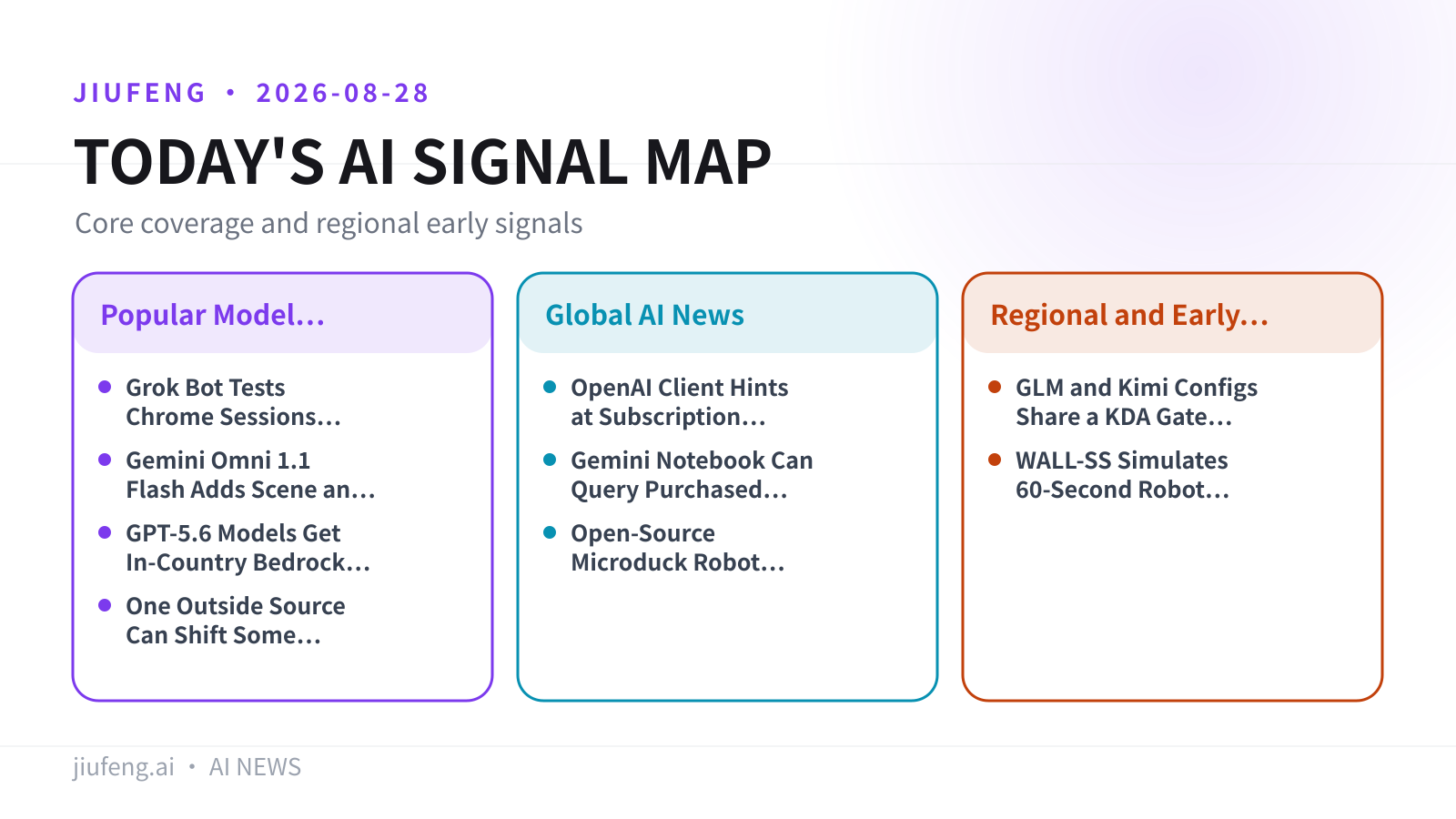
Jiufeng graphic based on the sources cited in this issue.
Popular Model Updates
01/09
Grok Bot Tests Chrome Sessions Through Local Routing
New controls could copy Chrome sessions into Grok Bot’s cloud VM and route its traffic through a user’s desktop.
RuntimeWire reported on a settings screenshot posted by @blankspeaker that contains “Import cookies from Chrome” and “Route egress through this desktop” controls. It also distinguishes local computers connected to the agent and lets users decide whether Grok Bot may execute work locally. Grok Bot already operates in an early-beta persistent Linux VM with a browser, filesystem, and terminal.
The controls remain under testing, with no evidence of general availability. Cookie imports would broaden the cloud computer’s access to authenticated sessions, while the available material does not detail encryption, revocation, or isolation safeguards.
Image source: spacexai; mirrored on Jiufeng R2.
Source: RuntimeWire · original X post · xAI documentation
02/09
Gemini Omni 1.1 Flash Adds Scene and 4K Controls
Gemini Omni 1.1 Flash adds scene extension, frame interpolation, and 4K upscaling for generative video.
Google DeepMind says the update lets developers extend existing scenes, specify first and last frames for transitions, and produce upscaled 4K output. It is accessible through Google AI Studio and the Gemini Enterprise Agent Platform, and the new capabilities are also available in Google Flow.
The supplied evidence is entirely from Google and gives no comparative quality score, generation time, price, or failure rate. Its “studio-quality” description is a vendor claim without independent validation here.
Source: Google DeepMind · Google Flow
03/09
GPT-5.6 Models Get In-Country Bedrock Inference in India
Amazon Bedrock now offers GPT-5.6 Terra and Luna through geographic cross-Region inference confined to India.
AWS says customers with local data-processing requirements can now use the two OpenAI models in India, with inference requests and data remaining within the country.
The available item is a brief AWS announcement with no region list, pricing, throughput, or latency figures. No independent report in the supplied material verifies AWS’s stated data-residency arrangement.
Source: AWS Machine Learning Blog
04/09
One Outside Source Can Shift Some Shopping Agents' Choices
A Wharton study found that one additional recommendation source could sharply alter an AI shopping agent’s final choice.
Researchers tested six current models with the ACES simulator, asking each to select a fitness watch from a fixed product grid. The agents read screenshots of product pages and could consult recommendation material before deciding. Models already differed at baseline, and a single external source caused large recommendation shifts in some cases.
The experiment covers one controlled product category rather than open-web commerce as a whole. It does not establish that every changed recommendation was wrong, but it shows that purchasing choices can be unstable under small changes in retrieval context.
Source: The Decoder · ACES paper
Global AI News
05/09
OpenAI Client Hints at Subscription Sharing
Dormant Codex desktop code points to a separately metered subscription-sharing system internally called ChatPass.
RuntimeWire’s reverse engineering found that the client can read an optional chatpass object from GET /wham/usage and render its windows under “Subscription sharing.” The code recognizes five-hour, daily, and weekly windows; the sample uses 604800 seconds for a weekly limit and supports any number of simultaneous meters.
The tested account did not have the server-side feature enabled, and OpenAI has not announced its eligibility, economics, or launch date. The public plugin architecture and “Sign in with ChatGPT” provide related infrastructure but do not confirm that outside applications will receive subscription allowance.
Source: RuntimeWire · OpenAI plugin documentation · OpenAI Help Center
06/09
Gemini Notebook Can Query Purchased Books
Expert Intelligence lets users import books bought through Google Play Books into Gemini Notebook for questions and generated material.
Users can ask about an imported book and generate plans, infographics, or AI podcasts from its contents. In Google’s demonstrations, the product used Michael Pollan’s Food Rules to create a recipe book and applied Kim Scott’s Radical Candor to a management question.
The feature is limited to books users have purchased and can import. The reporting does not specify supported languages, book-count limits, or the complete rollout scope, while demonstrations do not establish citation accuracy across long texts.
Source: The Verge · Google blog
07/09
Open-Source Microduck Robot Costs $399
Hugging Face unveiled the roughly 25-centimeter-tall duck-shaped Microduck for $399, with shipping planned before Christmas 2026.
Microduck can lift objects weighing up to 800 grams with its beak, waddle, stand after falling, crouch, and move on roller skates. Hugging Face CEO Clem Delangue described it as an “open-source robot” that can be taught new tricks with reinforcement learning.
The available behavior details come primarily from launch material. The sources do not specify the exact open-source scope or license, compute platform, battery life, or extra equipment needed to teach it new actions.
Source: TechCrunch · Clem Delangue
Regional and Early Signals
08/09
GLM and Kimi Configs Share a KDA Gate Value
A code comparison found that GLM-5.3-Flash and Kimi K3 both use KDA linear attention with a lower forget-gate bound of -5.
According to Chinese-language reporting by Leiphone, Moonshot researcher Chen Guangyu found closely matching KDA layouts and the same gate_lower_bound value in the two configurations. The report describes GLM-5.3-Flash as combining sparse attention, KDA linear attention, and manifold-constrained hyper-connections to manage long-context compute and cache costs.
This is a single-source technical signal based on configuration inspection. No training code, ablation study, or team statement establishes why the values match; the report notes that a narrow numerical stability range could cause independent teams to converge on similar settings.
Source: Leiphone — Chinese-language source
09/09
WALL-SS Simulates 60-Second Robot Tasks
X-Square Robot’s autoregressive world model simulates long manipulation tasks such as pouring water and organizing objects.
Chinese-language reporting says WALL-SS can roll out 60-second sequences and compare outcomes including missing, knocking over, or successfully grasping a cup. The team collected 600 paired closed-loop simulation and real-world outcomes; a separate comparison of aggregate success rates across 30 task-and-policy-version combinations produced a correlation coefficient of 0.926 and a mean absolute error of 0.062. Of the 600 paired outcomes, 527 agreed on final success or failure, while rankings between policies agreed 89% of the time.
This is an early signal supported only by regional Chinese-language reporting. The figures come from experiments attributed to the team and lack independent replication, while broader performance across robots, camera views, and unstructured environments remains unverified.
Source: ifanr — Chinese-language source
Write a prompt in your browser and get an image — 1K, 2K or 4K output, up to 15 reference images. 50 free generations on sign-up, no credit card.
Generate free