Overview
9 stories in this issue. The first 3 are today's priorities.
Popular model updates
- Top · ChatGPT Business Adds $100 Premium Seats
- Top · OpenAI Bans ChatGPT Accounts Tied to Russian Operators
- Top · Thomson Reuters Reportedly Launches Qwen-Based Thomson-1
Global AI news
- Pipette Opens Over 1,000 Edge Benchmark Configurations
- Perplexity Ships a Local Agent System for DGX Spark
- Skild S1 Prompts Robots With One Demonstration Video
- Groq 3 LPX Reaches 3,400 Tokens per Second
Regional and early signals
- New Mac Mini Reportedly Strengthens Local AI Hardware
- Qizhi Builds a Continuing Robot-Skill Delivery Stack
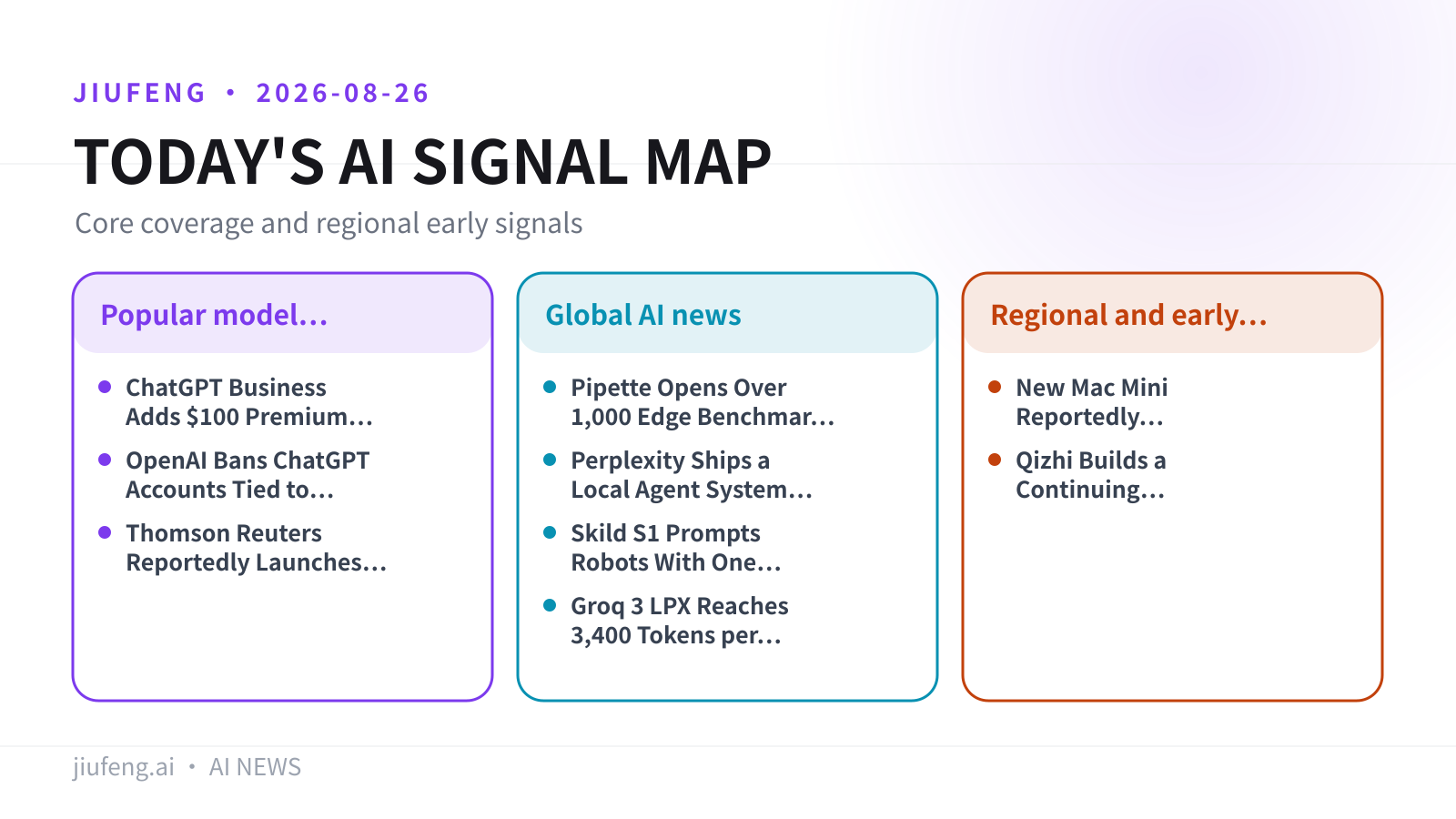
Jiufeng graphic based on the sources cited in this issue.
Popular model updates
01/09
ChatGPT Business Adds $100 Premium Seats
ChatGPT Business workspaces can now mix Standard and Premium seats, concentrating higher usage limits on heavy users.
Premium costs $100 per user per month with annual billing or $125 with monthly billing. Standard costs $20 or $25 respectively, while OpenAI advertises Premium as providing five times the usage within the same workspace.
Premium is a capacity upgrade rather than a separate model or product. Its allowances reset weekly, additional shared workspace credits may still be required, and the promotion offering early registrants up to $500 in credits ended before general availability.
Source: RuntimeWire · OpenAI announcement · OpenAI models and limits documentation · OpenAI on X
02/09
OpenAI Bans ChatGPT Accounts Tied to Russian Operators
OpenAI says Russia-linked operators used ChatGPT to produce English promotional content and branding for a covert influence campaign.
The accounts accessed OpenAI’s models through VPNs and used Russian-language prompts to generate mostly English comments promoting the International Burke Institute. Activity extended across Telegram, X, Facebook, LinkedIn, and Substack, while prompts also requested the removal of linguistic clues suggesting Russian origins.
OpenAI linked the accounts and operators to Russia but did not attribute the campaign to the Russian government. The evidence describes ChatGPT’s role in content production and promotion, not an autonomous campaign planned or published by the model.
Source: RuntimeWire · OpenAI report
03/09
Thomson Reuters Reportedly Launches Qwen-Based Thomson-1
A Chinese-language report says Thomson Reuters has launched Thomson-1, built on Qwen3.5, to take on some work previously handled by Claude.
The model will reportedly begin with professional tasks such as spreadsheet analysis and document review. Thomson Reuters previously connected its AI assistant to Claude, while Thomson-1 is intended to reduce dependence on closed models and lower long-term usage costs.
This story currently relies on one Chinese-language source and lacks a first-party Thomson Reuters announcement. No parameter count, context window, benchmark score, license, or precise availability scope was provided.
Source: Leiphone — Chinese-language source
Global AI news
04/09
Pipette Opens Over 1,000 Edge Benchmark Configurations
Liquid AI’s open-source Pipette measures a complete deployment configuration rather than treating the model as the only variable.
The initial dataset covers more than 30 models, five on-device performance metrics, and over 1,000 combinations of model, quantization, runtime, device, and context. Context lengths range from 256 to 8,192 tokens, with llama.cpp builds for macOS, iOS, Windows, and Android; the infrastructure is released under Apache 2.0.
Verified results currently cover only an M5 Max MacBook Pro, iPhone 17 Pro, and Galaxy S26 Ultra. Results therefore apply to particular deployment configurations and should not be attributed to a model independently of quantization, runtime, or hardware.
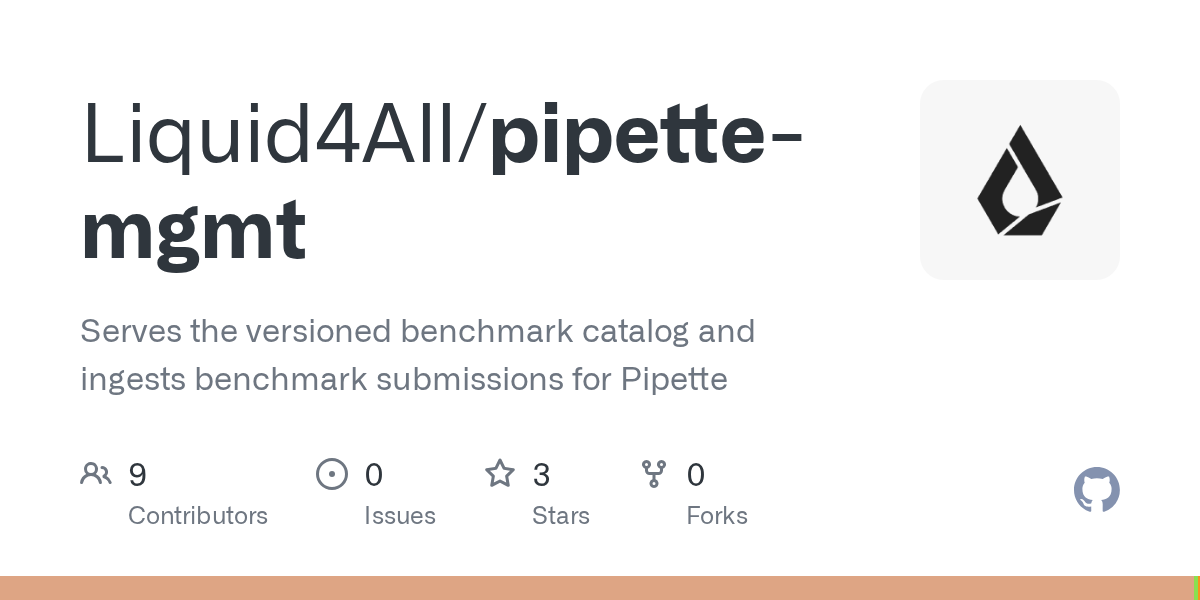
Image source: GitHub; mirrored on Jiufeng R2.
Source: MarkTechPost · Pipette GitHub · Granite model card
05/09
Perplexity Ships a Local Agent System for DGX Spark
Portable Computer packages models, orchestration, a tool sandbox, and connectors locally, asking permission before selected steps move to the cloud.
The system runs its agent harness, planner, tool router, and post-trained models on NVIDIA DGX Spark, with no per-token charge for locally completed steps. Users can select Qwen 3.8 27B or PPLX 27B, while the orchestrator can pause and request approval before sending one step to more than 15 cloud models.
The software is shipping, but it requires a GB10-class machine or an RTX GPU with at least 24 GB of VRAM. Zero per-token cost applies only to local steps and does not include the cost of purchasing or operating the workstation.
Source: MarkTechPost · NVIDIA DGX Spark · NVIDIA Nemotron 3.5 Lightning
06/09
Skild S1 Prompts Robots With One Demonstration Video
Skild AI says S1 can execute unseen tasks lasting up to 10 minutes after watching one human demonstration, without fine-tuning its weights.
Published examples include brewing pour-over coffee, potting a plant, assembling a kit, and frying a pancake. S1 places the video demonstration in its context and translates the observed activity into robot actions, avoiding another task-specific collection and training cycle.
The available evidence consists of Skild AI’s own tests and demonstrations, with no independent industrial deployment results. The supplied material does not quantify failure rates or robustness across robot bodies and changing environments.
Source: RuntimeWire · Skild AI on X
07/09
Groq 3 LPX Reaches 3,400 Tokens per Second
NVIDIA reports 3,400 tokens per second on Gemma 4 31B, but its four-times-Cerebras comparison uses a different hardware scale.
Groq 3 LPX has entered full production as an interactive AI inference accelerator for agentic systems within the Vera Rubin platform. NVIDIA cites a result of 3,400 tokens per second and presents it as four times the speed of a Cerebras system.
The reported Groq configuration needs at least 64 chips, while the Cerebras comparison uses one or two accelerators. Token speed alone therefore does not capture differences in chip count, cost, power, or total system throughput.
Source: The Decoder · NVIDIA announcement
Regional and early signals
08/09
New Mac Mini Reportedly Strengthens Local AI Hardware
A Chinese-language report says the new Mac mini uses M6 or M5 Pro chips and adjusts its memory configuration and positioning for local AI workloads.
The report provides unified-memory capacities and bandwidth figures for both processors, along with LM Studio model speeds. The M6 version starts at CNY 6,999, up CNY 1,000 from the current M4 version, while the M5 Pro version rises by CNY 500; preorders open August 27 and sales begin September 22.
The CNY 2,500 figure is the cumulative difference between the M6 model’s CNY 6,999 price and an earlier M4 price of CNY 4,499, not a single-generation increase. This remains a single Chinese-language report, and the supplied material provides no independent performance testing.
Source: APPSO — Chinese-language source
09/09
Qizhi Builds a Continuing Robot-Skill Delivery Stack
A Chinese-language report says Qizhi is extending robot delivery into skill capture, data governance, training, transfer, and continuing updates.
The reported stack assigns separate roles to its components: HALO captures skills in real work settings, the Dayan platform handles data governance and training, and HumanGPT is described specifically as a human-skill model. The broader platform, rather than HumanGPT alone, covers the continuing skill-delivery workflow.
The supplied material contains no HumanGPT model size, training-data volume, task success rate, or pricing information, and no first-party technical documentation is available. It should therefore be treated as an early product signal supported by a single regional report.
Write a prompt in your browser and get an image — 1K, 2K or 4K output, up to 15 reference images. 50 free generations on sign-up, no credit card.
Generate free