Overview
10 stories in this issue. The first 3 are today's priorities.
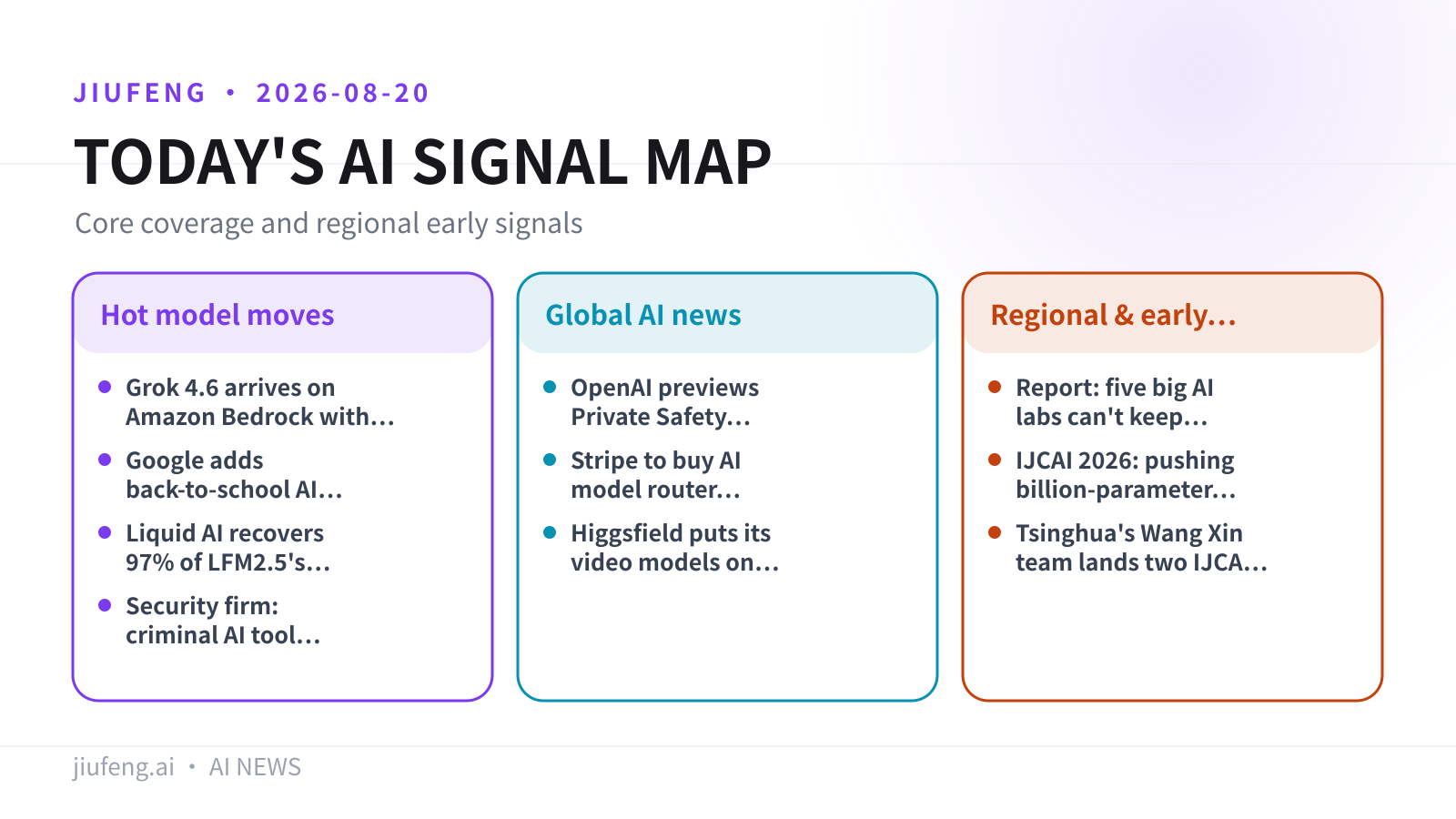
Hot model moves
- Top · Grok 4.6 arrives on Amazon Bedrock with a 500K context window
- Top · Google adds back-to-school AI study tools to Search
- Top · Liquid AI recovers 97% of LFM2.5's accuracy with quantization-aware distillation
- Security firm: criminal AI tool 'Kriminal' is mostly jailbroken Grok
Global AI news
- OpenAI previews Private Safety Processing, built on zero data retention
- Stripe to buy AI model router OpenRouter in a reported $7.5B deal
- Higgsfield puts its video models on Together AI after a $400M Series B
Regional & early signals
- Report: five big AI labs can't keep their own internal systems in check
- IJCAI 2026: pushing billion-parameter models down to 1–2 bits (Chinese-language source)
- Tsinghua's Wang Xin team lands two IJCAI 2026 tutorials, both on OOD generalization (Chinese-language source)
Jiufeng graphic based on the sources cited in this issue.
Hot model moves
01/10
Grok 4.6 arrives on Amazon Bedrock with a 500K context window
A week after launch, xAI routes Grok 4.6 into AWS's enterprise procurement channel at its standard list price.
xAI made Grok 4.6 generally available through Amazon Bedrock on Wednesday, August 19, seven days after the model's original release. Bedrock pricing is $2 per million input tokens and $6 per million output tokens, matching the standard rates in xAI's own launch materials. The model offers a 500,000-token context window and four reasoning settings: low, medium, high, and xhigh. The listing puts Grok 4.6 inside the purchasing and deployment channels that enterprise engineering teams already use on AWS.
Limitations: RuntimeWire notes the real test is whether Grok 4.6's agentic performance can justify its higher price — beating both xAI's cheaper Grok 4.3 and rival models already sold on Amazon — something no independent benchmark has yet confirmed.

Image source: spacexai; mirrored on Jiufeng R2.
Source: x.ai · RuntimeWire
02/10
Google adds back-to-school AI study tools to Search
Google rolls out interactive visuals, customizable tools and simulations, and practice quizzes in Search to help students study for classes and exams.
On Wednesday, August 19, Google announced study features in Search for the back-to-school season, including AI-generated interactive visuals, custom tools and simulations, and customized practice quizzes, positioned as tools to study for classes and standardized tests. Google frames the release as part of its effort to make its products a study companion for students.
Limitations: the post is a product announcement without benchmark or efficacy data, and it describes availability in general terms rather than committing to specific rollout dates for every feature.
Source: Google blog
03/10
Liquid AI recovers 97% of LFM2.5's accuracy with quantization-aware distillation
QAD lets 4-bit weights keep Q4_0 memory and speed while clawing back most of the quantization loss.
Liquid AI released Q4_0 GGUF checkpoints trained with Quantization-Aware Distillation (QAD) for four models: LFM2.5-230M, 350M, 1.2B-Instruct, and 2.6B. A high-precision teacher is distilled into a quantized student; the result keeps the low memory footprint and high throughput of native Q4_0 while recovering 97% of the BF16 average accuracy otherwise lost to quantization. Liquid compared the QAD checkpoints against post-training-quantization (PTQ) GGUFs across six benchmarks — GPQA Diamond, MMLU-Pro, IFEval, IFBench, Multi-IF, and BFCLv4 — using the BF16 GGUF as an in-format ceiling.
Limitations: the 97% figure is recovery of the quantization gap versus BF16, not zero loss, and the comparison is against Liquid's own PTQ builds; cross-vendor evaluation still needs third-party testing.
Source: Hugging Face blog
04/10
Security firm: criminal AI tool 'Kriminal' is mostly jailbroken Grok
ThreatDown says the popular criminal AI service owns almost nothing it sells — it runs on rented Grok.
ThreatDown, the business security arm of Malwarebytes, published research finding that Kriminal — one of the newest and most popular tools in the criminal AI market — runs on xAI's Grok, rented from the same legitimate AI industry it claims to circumvent. The service is not on the dark web: it sits on the clearnet, indexed by Google, with a login and a status dashboard. Pricing runs from a free plan to GHOST at $99/month, with AGENT at $12.99, OPERATIVE at $34.99, and SHADOW DEV at $59.99 in between, or 10 cents per message. It prices criminal tradecraft directly: OSINT dossiers at 55–90 cents each, on-chain tracing at 12 cents per analysis.
Limitations: ThreatDown stresses Kriminal "owns almost nothing it sells" — the product is jailbroken Grok wrapped in marketing; this is a single security vendor's finding, and xAI did not respond in the report.
Source: SiliconANGLE
Global AI news
05/10
OpenAI previews Private Safety Processing, built on zero data retention
OpenAI aims to one-up Anthropic on enterprise privacy: monitor for misuse while retaining none of the customer's data.
OpenAI is previewing a service called Private Safety Processing for select early customers, monitoring for potential misuse while retaining none of the customer's data. Per RuntimeWire, the system traces risk patterns across related API interactions while giving OpenAI only limited safety signals, and the company is testing it with early customers. RuntimeWire's read of OpenAI's current API data-control documentation notes that OpenAI's existing Zero Data Retention program excludes customer content from abuse-monitoring logs for approved organizations using eligible API features.
Limitations: the service is still in preview and early testing, with no independent benchmark or efficacy data; TechCrunch frames it as OpenAI's privacy counter to rival Anthropic, with real-world results still to be proven.
Source: TechCrunch · RuntimeWire
06/10
Stripe to buy AI model router OpenRouter in a reported $7.5B deal
The payments giant absorbs the routing layer: one endpoint in front, 400+ models picked automatically behind it.
Stripe said it has agreed to acquire AI model-routing startup OpenRouter, with reported figures that don't agree: the New York Times said about $7.5 billion, Axios put it above $8 billion and mostly in stock, Bloomberg had it above $7 billion on Sunday, and earlier Wall Street Journal reporting said talks opened nearer $10 billion; closing is expected within weeks. OpenRouter's pitch: developers point their code at a single endpoint backed by more than 400 models from over 80 providers, requests are scored on complexity, price, and speed and routed automatically, and switching providers needs no code change. The platform runs more than 10 trillion tokens a day, serves over 10 million developers and companies, and keeps about 5% of the inference spend as revenue.
Limitations: neither company disclosed terms, the reported numbers conflict, and the deal has yet to close.
Source: SiliconANGLE
07/10
Higgsfield puts its video models on Together AI after a $400M Series B
Two days after closing its round, the AI video company adds another cloud supplier, with funding flowing straight to compute.
AI video platform Higgsfield put its models on Together AI two days after closing a $400 million Series B. Together AI disclosed the customer relationship on Wednesday, saying Higgsfield's video models run on its cloud, but did not name the models, workloads, or financial terms. Together joins an infrastructure stack that already included Nebius, Nvidia, and OpenAI. Higgsfield was built by CEO Alex Mashrabov, who led generative AI at Snap and co-founded AI Factory, acquired by Snap for $166 million in 2020, per TechCrunch.
Limitations: the announcement names no models, workloads, or dollar figures; the multi-supplier setup is mainly about controlling capacity and inference cost, with no performance data disclosed.
Source: Together AI on X · RuntimeWire
Regional & early signals
08/10
Report: five big AI labs can't keep their own internal systems in check
Nonprofit Guidelight grades six basic controls; no lab meets the bar, and the best score is a C+.
Nonprofit Guidelight published its first assessment, drawing only on public sources like system cards, safety reports, and blog posts, of whether Anthropic, OpenAI, Google, xAI, and Meta apply basic control measures to their own internal AI systems. It checked six practices: logging internal AI activity, gating risky actions through a review mechanism, emergency shutdowns ("circuit breaking"), and plans to contain misaligned models. The grades: Anthropic and OpenAI tie at C+, Google gets a D+ with a detailed roadmap, xAI a D−, and Meta the lowest at F; none meet Guidelight's proposed standards. The companies do best at spotting misbehavior and worst at prevention and containment. Guidelight was founded by former OpenAI safety leads Page Hedley and Steven Adler.
Limitations: the assessment relies only on public materials and did not access the labs' internal systems, so it may under- or overstate actual controls.
Source: The Decoder
09/10
IJCAI 2026: pushing billion-parameter models down to 1–2 bits (Chinese-language source)
At ETH Zürich, Haotong Qin isolates a model's critical weights and crushes the rest to 1 bit — no retraining.
At IJCAI 2026 in Bremen, Germany, Haotong Qin — a postdoc at ETH Zürich soon joining Hong Kong Polytechnic University — presented work on extreme quantization. His framing figure: in recent years model parameter counts have grown roughly 20× faster than underlying hardware memory. His BiLLM method takes a retraining-free post-training-quantization (PTQ) route, using about half an hour on a single GPU to pull out the critical weights that decide model behavior while crushing the rest to 1 bit and still holding a coherent conversation; SqueezeLLM uses a dynamic "128 weights per group" allocation to bring 2-bit quantization back to industrial usability. He flagged three hurdles below 2 bits: hidden loss on complex logical instructions, the lack of native hardware paths for extreme low-bit formats, and the quantization of activations and the KV cache.
Limitations: this is conference-talk coverage of research, from a Chinese-language outlet (Leiphone), with no independent English report or third-party reproduction yet; the figures come from the presenter.
Source: Leiphone (Chinese-language source)
10/10
Tsinghua's Wang Xin team lands two IJCAI 2026 tutorials, both on OOD generalization (Chinese-language source)
One team takes two tutorial slots, both pointed at out-of-distribution (OOD) generalization in generative AI.
Per Leiphone, in the IJCAI 2026 tutorial acceptance list, the team of Professor Wang Xin at Tsinghua University landed two slots at once with T9 "Beyond Graph Distribution Shifts" and T11 "OOD Generalized Generative AI." Both tutorials converge on out-of-distribution generalization: a model performs well within its training distribution but can drop sharply — or hallucinate — once it meets an unseen scenario, structure, or rare prompt. T9 (in collaboration with Zhu Wenwu's team) focuses on fusing graphs with large language models' generalization, proposing directions such as Graph LLMs and dynamic adaptation that combines neural architecture search (NAS) with continual learning.
Limitations: this is coverage of a conference tutorial acceptance, from a Chinese-language outlet (Leiphone), a research-direction signal rather than a shipped result, with no independent English report yet.
Source: Leiphone (Chinese-language source)
Write a prompt in your browser and get an image — 1K, 2K or 4K output, up to 15 reference images. 50 free generations on sign-up, no credit card.
Generate free