Overview
9 stories in this issue. The first 3 are today's priorities.
Hot Model Watch
- Top · Claude Desktop's hidden recorder turns meetings into agent tasks
- Top · Claude Code builds a Mac driver for an HP printer in four hours
Global AI News
- Top · IBM tests 8 models: more agent memory isn't always better
- ChatGPT Ads expands to 31 European markets
- Amp connects remote MCP servers for use in orbs and the TUI
- Microsoft Copilot's secret input parameter enabled password theft
Regional & Early Signals
- 超维动力 demos a 117-DoF humanoid table-tennis robot at WRC
- 章鱼动力 unveils a "brain-hand-data" embodied stack at WRC
- Xiaomi's new humanoid robot makes its public debut at WRC
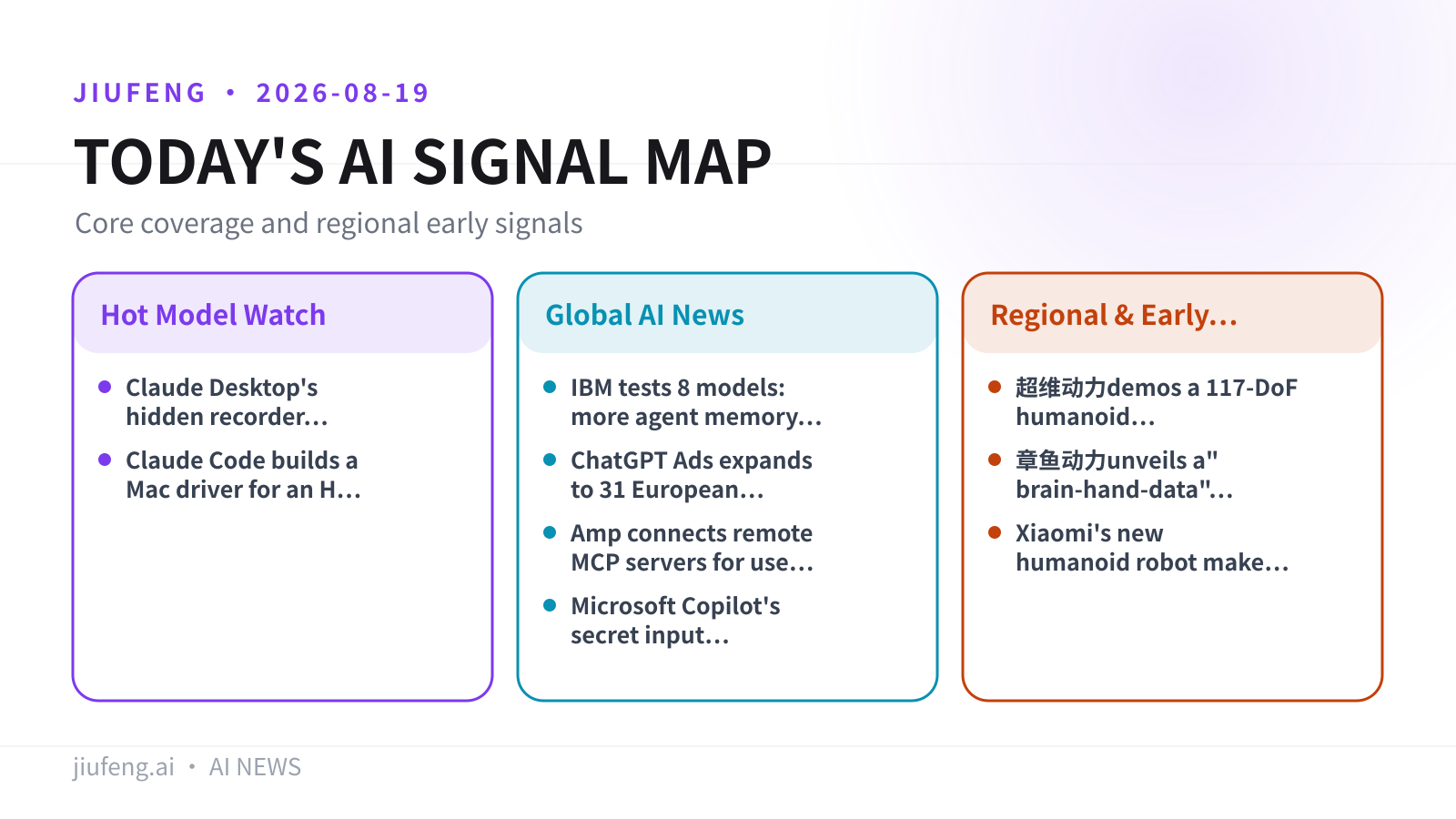
Jiufeng graphic based on the sources cited in this issue.
Hot Model Watch
01/09
Claude Desktop's hidden recorder turns meetings into agent tasks
RuntimeWire's reverse engineering found an unreleased meeting recorder, codenamed Parka, inside Claude Desktop.
RuntimeWire reverse-engineered Claude Desktop 1.32885.1 and found a Mac-first, unreleased meeting recorder codenamed Parka: it can capture system and microphone audio, stream a speaker-attributed live transcript, and carries calendar metadata, transcription keyterms, summaries and notes. Parka turns a transcript into runnable follow-up actions of three execution types — cowork, code and manual — each with a title, description, owner, full prompt, autoRunnable flag and an optional Claude session URL, routing what was said in a meeting straight to the Claude Code and Claude Cowork agents.
Limitations: current public builds keep the feature disabled and ship without a working native implementation or UI; the reporting is based on reverse engineering, Anthropic has not announced it, and RuntimeWire notes "Parka may never be its public name."

Image source: Claude; mirrored on Jiufeng R2.
Source: RuntimeWire · Claude Cowork · Claude Code
02/09
Claude Code builds a Mac driver for an HP printer in four hours
A developer used Claude Code to make the HP Laser 1008a print from an Apple Silicon Mac, reaching a working version in about four hours.
Kuber Mehta (@kuberwastaken) used Anthropic's Claude Code to make the HP Laser 1008a — a printer HP never shipped a Mac driver for — print from an Apple Silicon Mac, completing the first working version in a roughly four-hour session on August 17th. The result is an MIT-licensed repository that turns printing into an ordinary Cmd-P workflow for HP Laser 1003/1006/1008. Per the repo, the currently shipped and actually-running version is fully native: a patched SpliX rastertoqpdl CUPS filter plus a native IOKit helper that writes print jobs directly over USB through a CUPS queue — "No Docker, no VM, no vendor binary, no Python," having dropped Docker/colima/ULD entirely. Mehta says he ran the session with Claude Opus and published a lightly redacted transcript.
Limitations: the fix still depends on human testing and on installing a patched CUPS filter plus a native privileged helper locally; it began as a request to install a driver on a family Mac, not a planned release.
Source: RuntimeWire · GitHub repo · Claude Opus 4.8
Global AI News
03/09
IBM tests 8 models: more agent memory isn't always better
IBM Research scaled the "how much memory should an agent get" question to eight models and found more self-distilled experience doesn't always help.
IBM Research, writing on Hugging Face, extended its earlier ALTK-Evolve vs. ACE comparison to ask how much memory an agent actually needs. Scaling the evaluation to eight models — from a 30B dense model up to frontier proprietary systems — the team found that distilling past lessons into guidelines and injecting them back into context does not always improve accuracy or lower cost; how the memory is delivered (a few items retrieved per task vs. the whole set injected) matters more than raw volume.
Limitations: this is a follow-up analysis of existing ALTK-Evolve work, not a new model release; the authors note that where a model lands is shaped by several factors together — benchmark headroom, context-window size and architecture — and that separating those factors is still ongoing work.
Source: Hugging Face Blog · ACE paper · ALTK-Evolve
04/09
ChatGPT Ads expands to 31 European markets
OpenAI is bringing ChatGPT Ads to 31 European markets.
OpenAI announced that ChatGPT Ads is expanding to 31 European markets, letting advertisers reach people as they explore, compare options and make decisions. It is a commercialization move for OpenAI's in-ChatGPT advertising program.
Limitations: the announcement gives no ad-load density, pricing model, rollout dates or early performance figures, so real-world impact and user experience remain to be seen.
Source: OpenAI
05/09
Amp connects remote MCP servers for use in orbs and the TUI
Amp now lets you connect remote MCP servers and use them in orbs, the TUI and Puck.
Amp announced that you can now connect remote MCP (Model Context Protocol) servers on ampcode.com and use them in its cloud orbs, the terminal TUI and Puck. Servers are added at ampcode.com/settings/mcp-servers, choosing a pre-configured provider or a custom configuration.
Limitations: the post is a setup note and does not list available servers, authentication details or usage limits.
Source: Amp
06/09
Microsoft Copilot's secret input parameter enabled password theft
Ars Technica reports a hidden input parameter in Microsoft Copilot could be abused to steal passwords once a target clicked a link.
Ars Technica reported that Microsoft Copilot contained a secret input parameter that attackers could use to craft a malicious link; when a target clicked it, the flaw could lead to password theft.
Limitations: the public technical detail is limited — the report does not spell out the parameter's exact mechanism, scope or patch status; this is a single-outlet report without further independent corroboration here.
Source: Ars Technica
Regional & Early Signals
07/09
超维动力 demos a 117-DoF humanoid table-tennis robot at WRC
Chinese robotics startup 超维动力 showed what it calls the first fully autonomous table-tennis rally by a humanoid at the 2026 World Robot Conference.
At the 2026 World Robot Conference, which opened in Beijing on August 19th, Chinese startup 超维动力 (Chaowei Power) demonstrated its SMASH 2.0 high-dynamic humanoid table-tennis system, claiming the first fully autonomous table-tennis rally by a humanoid: within millisecond windows it chains visual perception, trajectory prediction, motion planning and whole-body control to serve, return and play long and cut shots, with the core algorithm portable across bodies. Its KAI world model is pre-trained on million-scale video data; the KAIBot body claims an industry-high 117 whole-body degrees of freedom, and the KAI Hand offers 37 DoF (20 active + 1 passive + 16 compliant) at 1:1 human-hand scale, alongside a KAI Halo first-person data-capture headband.
Limitations: these are on-site demos and vendor figures; "world-first" is the company's own claim, with no independent third-party evaluation or mass-production details.
Source: QbitAI (Chinese-language source)
08/09
章鱼动力 unveils a "brain-hand-data" embodied stack at WRC
SynapX presented a "brain-hand-data" system pairing a world model, a dexterous hand and a data-capture rig.
At WRC 2026, 章鱼动力 (SynapX) unveiled a "brain-hand-data" stack: the brain is SYNWorld, an embodied-native world foundation model for cognition, simulation and decision-making, branching into ACWM (action-controllable world model) and WAM (world-action model); the hand is the high-DoF OctoH-Hand; and the data layer is OctoSense, a capture scheme the company says achieves the first cross-subject zero-shot generalization of electromyography, aligning human hand motion to a real robot with near-lossless fidelity. CEO Du Dalong said the goal is to build general physical-world productivity from a general world model and a general dexterous hand.
Limitations: this is a vendor launch and live demo; claims like "world-first" and "near-lossless" are the company's own, without independent evaluation or deployment-scale data.
Source: QbitAI (Chinese-language source)
09/09
Xiaomi's new humanoid robot makes its public debut at WRC
Xiaomi's next-gen humanoid robot appeared publicly for the first time at the 2026 World Robot Expo.
Xiaomi's new humanoid robot debuted at the "Embodied Garden" booth of the 2026 World Robot Expo, playing a "florist" that picks and scatters flower petals and can shake hands and fist-bump; the booth opens to the public on August 20th. President Lu Weibing said on an August 18th earnings call that this is the robot's first public appearance, that it is a full-size humanoid around 1.7 meters, and that its first landing target is smart-manufacturing production lines; Xiaomi will not build robots alone but in synergy with its "human-car-home" ecosystem. Earlier, Lei Jun said the robot had "interned" at a car factory for about four months, hitting 90% success on tasks such as center-console side-cover loading and bin folding.
Limitations: the florist and handshake actions are booth demos; the factory "internship" success rates are Xiaomi's own figures, with workstation coverage and long-term stability not independently verified.
Source: ITHome (Chinese-language source)
Write a prompt in your browser and get an image — 1K, 2K or 4K output, up to 15 reference images. 50 free generations on sign-up, no credit card.
Generate free