Overview
10 stories in this issue. The first 3 are today's priorities.
Hot Model Watch
- Top · Claude Code adds /design for in-terminal UI mockups
- Top · DeepSeek V4 Pro–Sol cascade cuts DeepSWE cost 60%
- Top · SpaceXAI bars Grok users from building rivals
- Gemini Omni Flash adds personal avatar videos
Global AI News
- Stanford's AI Observatory audits how people really use AI
- Nous adds Bot Mode to open-source Hermes Agent
- Study: context compaction drops 83% of user instructions
- Amp launches 50% education discount
Regional & Early Signals
- Alibaba launches HappyShrimp AI music model
- Doubao adds a virtual desktop to control Windows PCs
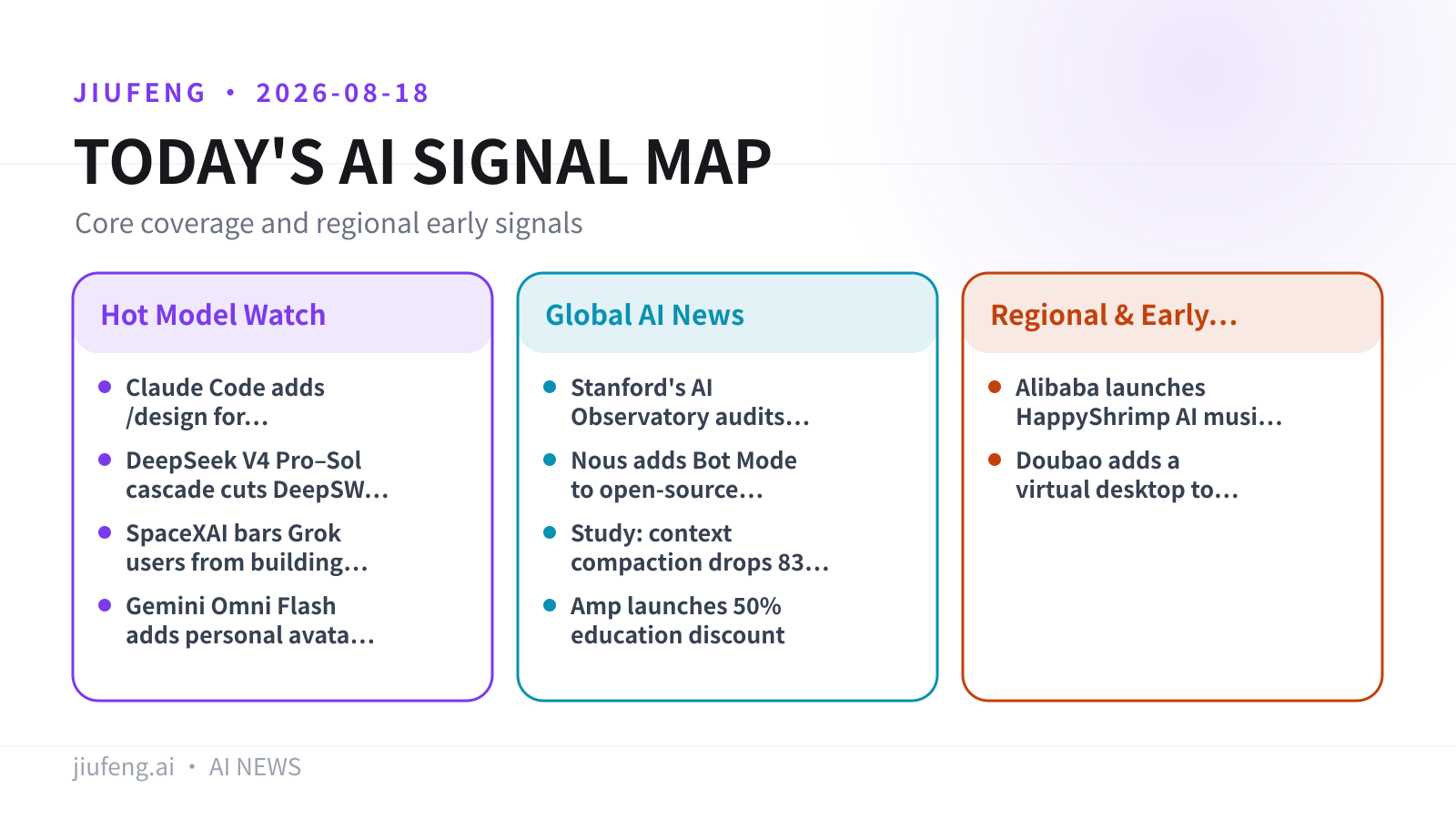
Jiufeng graphic based on the sources cited in this issue.
Hot Model Watch
01/10
Claude Code adds /design for in-terminal UI mockups
Generate editable UI mockups in the terminal before writing any code, then build from the one you pick.
Anthropic has shipped an early preview of the /design command in Claude Code. A developer runs something like /design a few options for {feature}, and Claude generates multiple drafts as artboards; you pick a favorite, edit it, and then build it out. According to developer Nate Parrott, Claude reads the existing codebase, matches the current UI style, and produces shareable mockups as Artifacts. The editor and prompting features come from Claude Design and are now built into Claude Code—run claude update to get it.
Limitations: designs carry into the build step but still need to be saved manually for now, and the command remains an early preview.
Source: The Decoder · Nate Parrott (X)
02/10
DeepSeek V4 Pro–Sol cascade cuts DeepSWE cost 60%
Together AI: run cheap V4 Pro first, escalate to GPT-5.6 Sol only on failures—higher pass rate at lower cost.
Together AI ran 904 DeepSWE rollouts comparing DeepSeek V4 Pro 0813 with GPT-5.6 Sol. Sol wins the early attempts (72.7% pass@1 vs 62.8%, and 81.0% vs 78.5% at pass@2), but Pro wins the last one (88.5% pass@4 vs 85.8%). The price gap is 35x: about $0.24 per rollout for Pro vs $8.37 for Sol, so per $100 spent Pro solves 261 tasks and Sol just 9. A cascade—run Pro first, escalate to Sol when tests fail—solves 83.0% of tasks at $3.35 each, versus Sol alone at 72.7% and $8.37: ten points better, 60% cheaper.
Limitations: Sol is faster and steadier (17 minutes and 53 steps per rollout vs Pro's 35 and 146), but its failures are messier—20% break tests that already passed (regressions) vs 11% for Pro, so Together recommends gating Sol's output on regressions. This is a first-party benchmark by Together, which now hosts V4 Pro 0813 on US infrastructure with a 1.05M context, function calling, and JSON mode.
Image source: together; mirrored on Jiufeng R2.
Source: Together AI Blog
03/10
SpaceXAI bars Grok users from building rivals
The new acceptable use policy forbids using Grok's services or outputs to help build "directly or indirectly" competing products.
SpaceXAI updated its acceptable use policy to bar customers from using its services or outputs to help build products that compete with SpaceXAI "directly or indirectly." The updated policy lists August 14, 2026, as its effective date and applies to consumers, developers, and businesses; violations can lead to account suspension or termination. The most consequential change for founders is the broader competitor restriction, which gives SpaceXAI wide discretion over what customers may build with Grok.
Limitations: the policy page's date is not fully settled—an indexed version of xAI's official page still lists June 26, 2026, as the effective date, and the current page links to that June 26 version as its predecessor.
Source: RuntimeWire · SpaceXAI policy page
04/10
Gemini Omni Flash adds personal avatar videos
Google put "record yourself once, then prompt a synthetic version of you" inside Gemini.
Google added a personal-avatar video capability to Gemini Omni Flash: record yourself once, write a prompt, and send a synthetic version of yourself in front of the camera. In Gemini Apps, avatar creation requires users to be at least 18 and signed in to a personal Google Account with a Google AI plan; eligible Google Workspace users can also use personal avatars in Google Vids, and Google planned availability for YouTube Shorts and YouTube Create. AI consultant Ashutosh Shrivastava posted a demo generating a personal avatar video with Gemini Omni Flash on May 25.
Limitations: a single prompt reportedly exhausted a five-hour usage allowance, and failed generations plus compute limits could keep the feature from becoming a dependable production workflow.
Source: RuntimeWire · Google blog · Gemini Omni Flash model card
Global AI News
05/10
Stanford's AI Observatory audits how people really use AI
Researchers say big labs only publish the usage data they want seen; a Stanford team built a platform to fill the gap.
Stanford's Trustworthy AI Research (STAIR) Lab co-launched the AI Observatory, a public platform that aggregates and analyzes real AI conversations—collected with users' consent through seven existing datasets across models like Claude and Gemini—to give researchers and policymakers an independent source on how people use generative AI. Co-lead Anka Reuel says there is currently no independent source to corroborate vendors' figures. The project found AI use differs significantly across models and has changed over time.
Limitations: the researchers note that while Anthropic and OpenAI publish reports on how people use their products (for example, Claude for support and companionship), those reports skew toward work and under-count sensitive behaviors, with no independent corroboration; the Observatory surfaced far more sensitive behaviors than company reports capture.
Source: MIT Technology Review · OpenAI usage report · Anthropic companionship report
06/10
Nous adds Bot Mode to open-source Hermes Agent
Bot Mode replaces the single-session list with a roster of named bots that message each other through a persistent inbox and hand off work by @mention.
Nous Research shipped Bot Mode for Hermes Agent, its MIT-licensed open-source agent. Bot Mode replaces the single-agent session list with a roster of named bots—each a real Hermes profile with its own chat, memory, skills, and pinned model—that message each other through a persistent Agent Inbox and hand off work via @mention. The feature launched as a one-day public beta plugin from co-founder Teknium and now ships bundled and default-on inside Hermes Desktop, in Hermes Agent v0.20.3; both the agent and plugin are MIT licensed.
Limitations: the report frames it as ready today for solo builders, startups, and small-to-mid engineering teams, but says enterprises should treat it as a workstation tool, not managed infrastructure—there is no admin console, SSO, central audit log, or policy layer.
Source: MarkTechPost · Hermes Agent (GitHub)
07/10
Study: context compaction drops 83% of user instructions
Penn State finds only 17% of user constraints survive compaction—and a small add-on model recovers most of the loss.
Researchers at Penn State systematically studied which details get lost when AI systems compress context (compaction—summarizing conversation history to free up space). The biggest loss is what they call "session constraints"—rules like "don't send emails without my approval"; on average only 17 percent of instructions survive compression, meaning about 83 percent are dropped. The researchers propose a small add-on LLM module that fixes most of the problem, and introduce an evaluation suite called COMPINT to measure the loss.
Limitations: the study exposes a systematic flaw in today's long-conversation products—everyday users who dump everything into one chat window are hit hardest—and the proposed module only fixes "most," not all, of the loss.
Source: The Decoder · Paper (arXiv) · COMPINT (GitHub)
08/10
Amp launches 50% education discount
Coding agent Amp gives students and teachers 50% off Megawatt at $10/month, including 750 hours of orbs.
Coding agent Amp launched an education discount: Amp Megawatt drops from $20/month to $10/month (50% off) for students and teachers. The plan includes 750 hours of orbs (remote machines), unlimited public/private repositories, and $10 of included agent usage; it lets you reuse your own ChatGPT or 𝕏 Premium+/SuperGrok subscription, and offers low and medium modes, plus high mode with a linked ChatGPT subscription.
Limitations: the discount is limited to students and teachers, who must sign in and fill out a form to verify eligibility.
Source: Amp Chronicle
Regional & Early Signals
09/10
Alibaba launches HappyShrimp AI music model
Chinese-language source: Alibaba released the AI music model HappyShrimp on Aug 17, generating lyrics, composition, arrangement, and vocals end to end.
On August 17, Alibaba released the AI music model HappyShrimp (Chinese name 快乐虾米). It uses an end-to-end whole-song generation approach, treating music as a special language with grammar, semantics, and context, and planning language descriptions, lyrics, genre, mood, era, and vocals as a whole rather than stitching separately generated parts. Alibaba says it understands both professional terms like "Lo-fi R&B" and everyday phrasing such as "a track to play in a café," turning them into musical decisions. On launch day it announced a strategic partnership with Taihe Music Group; it is live now on PC web in China (happyshrimp.cn) and overseas (happyshrimp.ai), with free credits for new users.
Limitations: the above is the vendor's launch description; there is no independent evaluation or third-party sampling to verify output quality yet (Chinese-language source).
Source: QbitAI (Chinese-language source)
10/10
Doubao adds a virtual desktop to control Windows PCs
Chinese-language source: ByteDance's Doubao added a "virtual desktop" that reads the screen and operates Windows apps without taking over the user's mouse and keyboard.
ByteDance's Doubao shipped a product update: in "work task" mode, it can operate a Windows PC through a new "Doubao virtual desktop." Per the vendor, the capability is based on more general GUI grounding—the model can read the interface and complete operations without MCP, API, plugins, or a CLI, operating apps, browsing the web, and finishing cross-app tasks in a non-intrusive environment without seizing the user's mouse or keyboard; users can watch the process in real time and pause or take over at any point. Using it requires downloading the latest Windows "Doubao PC" client and completing authorization and initialization in work-task mode.
Limitations: it currently supports only the Windows "Doubao PC" client; the above is the vendor's product description with no independent testing (Chinese-language source).
Write a prompt in your browser and get an image — 1K, 2K or 4K output, up to 15 reference images. 50 free generations on sign-up, no credit card.
Generate free