Overview
8 stories in this issue. The first 3 are today's priorities.
Hot model updates
- Top · Text harness lifts DeepSeek V4 Pro across nine benchmarks
- Top · Kimi Desktop shipped Moonshot's hidden off-quota gateway
Global AI news
- Top · AirTag tracking exposes Amazon shredding rare books to train AI
- Google pays $10M for Spirit Airlines' data to train AI
- Nvidia puts $1.5B into SoftBank data center, locking up an OpenAI site
- Same cluster, +33 points of utilization — only the order changed
Regional & early signals
- Bedrock AgentCore adds payments so agents can pay their own way
- WorkBuddy generates and publishes HTML from natural language, synced to CSV
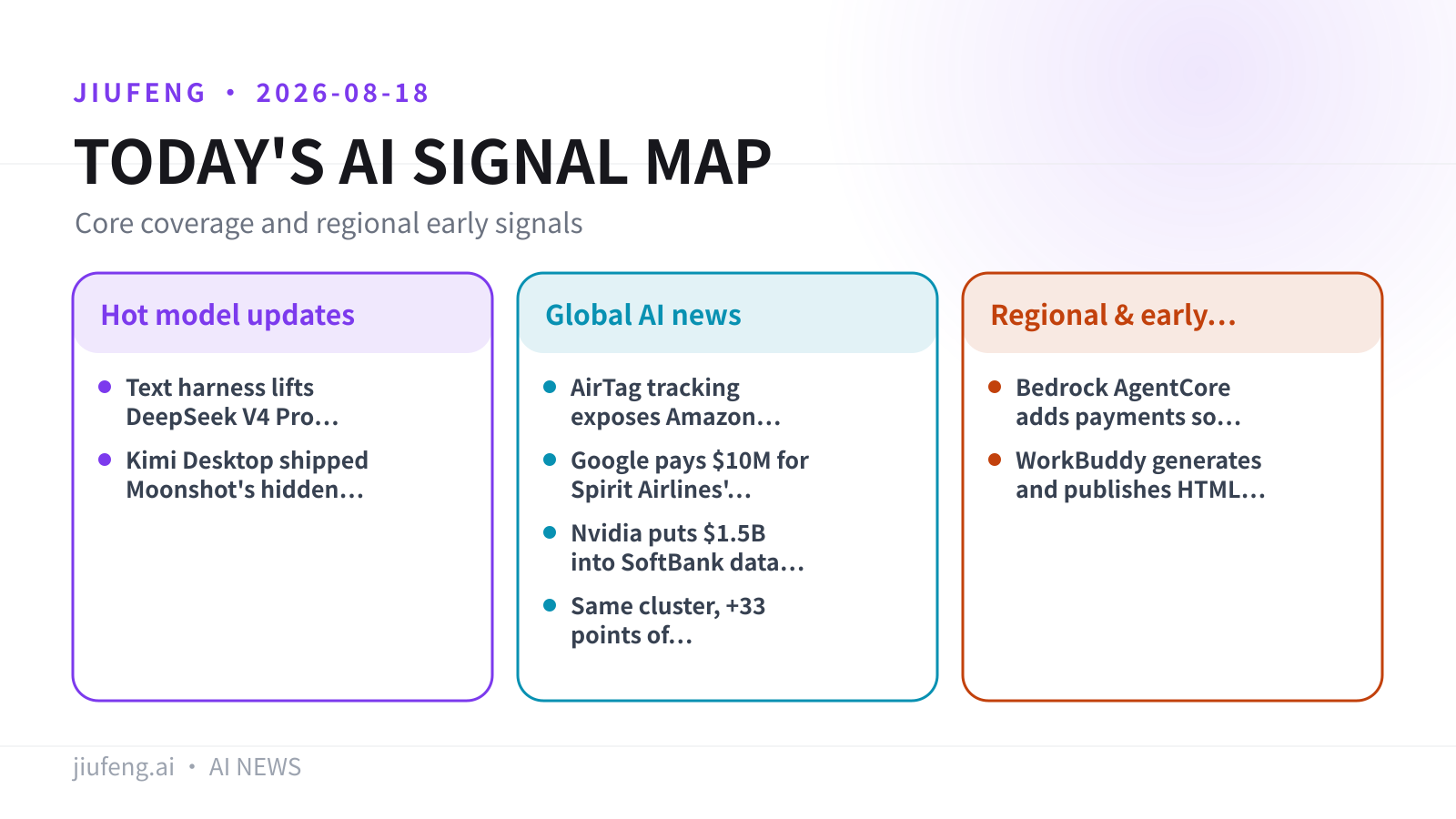
Jiufeng graphic based on the sources cited in this issue.
Hot model updates
01/08
Text harness lifts DeepSeek V4 Pro across nine benchmarks
A weights-untouched, inference-time layer raised DeepSeek's scores on all nine tests — but the viral "beats Fable 5 everywhere" claim outruns the data.
Open-source developer Tiger380 published J-Space Cognition Suite V3.6, an inference-time control layer that neither changes model weights nor fine-tunes DeepSeek. It packages instructions, task-routing rules and an optional Python state controller to keep goals and constraints active through long tasks. Tiger380's report shows DeepSeek V4-Pro-0813 gaining on all nine tested benchmarks when paired with J-Space.
On August 17, Jun Song (@jun_song) wrote on X that the harness "completely outperforms Fable across every task." The underlying report supports a narrower conclusion: it does not show DeepSeek beating Anthropic's Fable 5 on every task. The tests were single runs, and the cross-model comparison mixes scores published under different evaluation methods. J-Space borrows its name from Anthropic's July 6th global-workspace research, but it is an external inference layer with no access to a model's internals.
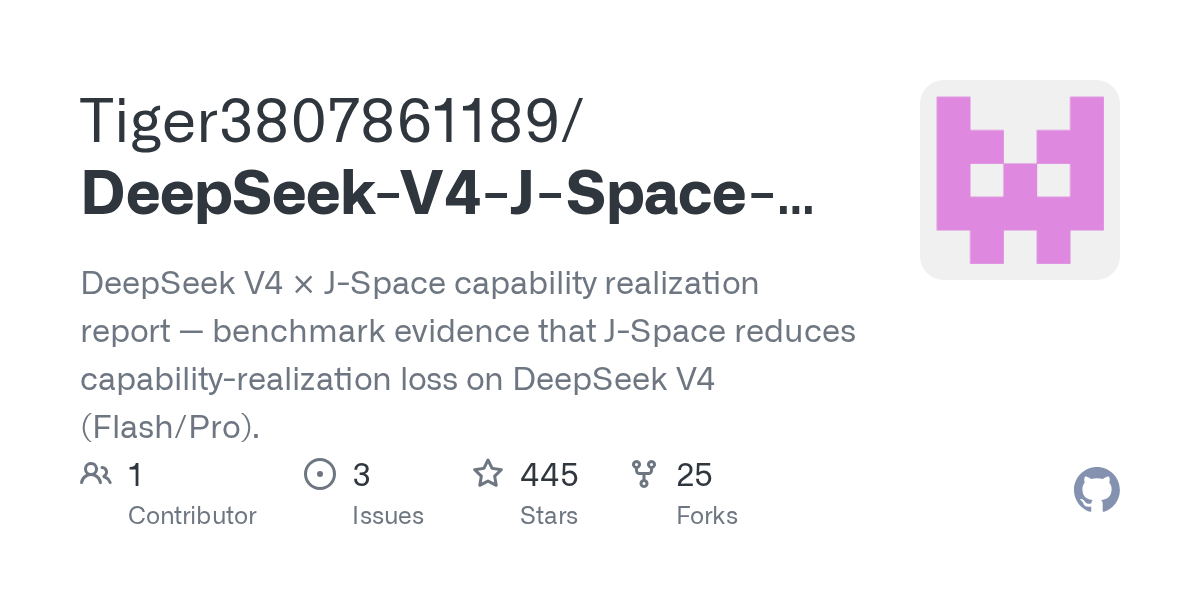
Image source: GitHub; mirrored on Jiufeng R2.
Source: RuntimeWire · J-Space report · V4 Pro model card
02/08
Kimi Desktop shipped Moonshot's hidden off-quota gateway
Kimi Desktop 3.1.10 hides an office/VPN-only internal gateway that imports off-quota Kimi, GPT and Codex models.
RuntimeWire's reverse-engineering found that Kimi Desktop 3.1.10 hides an internal gateway reachable only from an office network or VPN. Five rapid clicks on the "Version" row invoke a BYOK toggle absent from 3.1.5, persisting the setting in byok-availability.json. The interface labels the service "KTH Gateway (Internal)," defaults to https://free-tokens.msh.team/v1, requires a personal token, accepts kimi-, gpt- and codex-prefixed models that bypass membership quotas, and configures Kimi and OpenAI Responses providers accordingly.
This is a RuntimeWire investigation based on reverse engineering, testing and data analysis; Moonshot has issued no statement. RuntimeWire reads the panel as evidence that Moonshot separates employee model traffic from customer quotas. Moonshot's site says the company was founded in 2023.
Source: RuntimeWire · Moonshot
Global AI news
03/08
AirTag tracking exposes Amazon shredding rare books to train AI
An AirTag hidden in rare books traced Amazon's pipeline for destroying print books to train its models.
A 404 Media investigation placed an AirTag inside a shipment of rare books and tracked it to an Amazon warehouse in Las Vegas — a team called VGT3 whose logo is a T. rex holding a book. Workers reportedly cut off book spines to speed scanning, destroying the copies; the scanned data trains Amazon's own AI models. Booksellers suspect AI companies are systematically scanning every book by ISBN; print texts are prized because much of their content is not online and predates 2022, making it free of AI-generated content.
Amazon said it buys books through commercial channels to improve the products and services customers use. The Decoder notes Amazon isn't alone — a lawsuit by book authors previously revealed Anthropic's "Project Panama" book-buying operation.
Source: The Decoder
04/08
Google pays $10M for Spirit Airlines' data to train AI
Google bought a bankrupt airline's internal business data for AI training, pushing the boundary of where training corpora come from.
Alphabet's Google won an auction to acquire the bankrupt Spirit Airlines' internal business data for $10 million for AI training. Per Bloomberg, Google outbid rivals including AI training-data firm Mercor.io; a notice from the U.S. Bankruptcy Court for the Southern District of New York shows the data now belongs to Google. The haul includes roughly 100 million company emails, 500 million Microsoft Teams chats, 30 million lines of code, plus software algorithms, development metadata and records on revenue, aircraft operations and employee productivity.
The data largely concerns the airline's internal operations. The account comes from SiliconANGLE citing Bloomberg and the court notice, and is so far a single-outlet report.
Source: SiliconANGLE
05/08
Nvidia puts $1.5B into SoftBank data center, locking up an OpenAI site
Nvidia's investment plus up to $105B in credit makes it the sole compute supplier for an OpenAI data center.
Nvidia said Monday it will invest $1.5 billion in SB Energy, a SoftBank-linked data center developer, making it the sole compute-infrastructure supplier for OpenAI's Ports-Pike data center near Cincinnati, Ohio. Nvidia will also extend up to $105 billion in credit to help build the facility. Per documents filed with the SEC, the site starts at 4.25 gigawatts and can scale to 8 gigawatts.
The investment figures and capacity come from Nvidia's announcement and its SEC filing; construction and scale-up are planned, and the facility is not yet built.
Source: TechCrunch · Nvidia blog
06/08
Same cluster, +33 points of utilization — only the order changed
Dharma-AI says reordering allocation decisions, with no hardware change, raised GPU utilization by up to 33 points.
Dharma-AI published a "constraint-aware" GPU allocator on the Hugging Face blog and benchmarked it against a FIFO scheduler across seven scenarios. On identical hardware and identical workloads, the team says GPU utilization rose by as much as 33 percentage points and priority-weighted output rose in every scenario, by up to 105%; nothing about the hardware changed — only the order in which allocation decisions get made.
These are Dharma-AI's own benchmarks of its own allocator, each gain measured against the FIFO result on the same scenario, with no third-party replication.
Source: Hugging Face Blog
Regional & early signals
07/08
Bedrock AgentCore adds payments so agents can pay their own way
AWS gives autonomous agents a wallet and spending caps, supporting the x402 and MPP machine-payment protocols.
Amazon Bedrock AgentCore added a payments capability that gives autonomous agents wallet integration, spending limits and a consistent payment layer: when an agent hits a service returning HTTP 402 (Payment Required), it can pay within pre-approved limits without a human confirming each transaction. It supports the x402 and Machine Payments Protocol (MPP) schemes for programmatic agent-to-service payments, and connects to OpenClaw via the aws-agents-pay plugin.
By design, wallet credentials and the authority to create or expand payment sessions sit outside the model-facing runtime, which can only initiate approved payments within limits. The capability ships as an AWS tutorial, and the details are the vendor's own.
Source: AWS Machine Learning Blog
08/08
WorkBuddy generates and publishes HTML from natural language, synced to CSV
No code needed: describe a page in natural language, publish it to a public URL, and keep it two-way synced with a CSV. (Chinese-language source)
In a hands-on by Leiphone, WorkBuddy's upgraded "data library" lets users generate, edit and publish HTML pages to shareable public links using natural language, without writing code or handling deployment. The highlight is that the HTML page mounts CSV table data with two-way sync — adding, deleting or editing on the page writes back to the CSV, and vice versa. The reviewer built a continually updatable "reading-and-film world map" from Douban records, lighting up countries they had read or watched about.
This is a single hands-on account from Leiphone with no benchmark or third-party verification; the specific model and scale behind it were not disclosed. (Chinese-language source)
Write a prompt in your browser and get an image — 1K, 2K or 4K output, up to 15 reference images. 50 free generations on sign-up, no credit card.
Generate free