Overview
10 stories in this issue. The first 3 are today's priorities.
Featured model updates
- Top · Third-party benchmark ranks open Qwen3.8-27B 15th
- Top · AI floods the US Congress, with a Claude reply pasted into the NDAA record
Global AI news
- Top · Rootly scraps its "small PR" rule as AI writes by feature, not by increment
- SuperApp (formerly Instabase) launches a shared AI workspace for teams
- DoiT acquires Attribute to trace AI costs beneath the billing layer
- US campaigns: AI and data centers vault to a top issue
Regional & early signals
- vLLM distributed layerwise offload: a 124GB model on 64GB of HBM
- PKU and StepFun propose TensorCast, cutting time-to-first-token by up to 93.2%
- YC open-sources an enterprise agent harness, "QM," to 3.9k stars and #1 on HN (Chinese-language source)
- updream launches a "previz stage," shifting AI video toward visual pre-visualization (Chinese-language source)
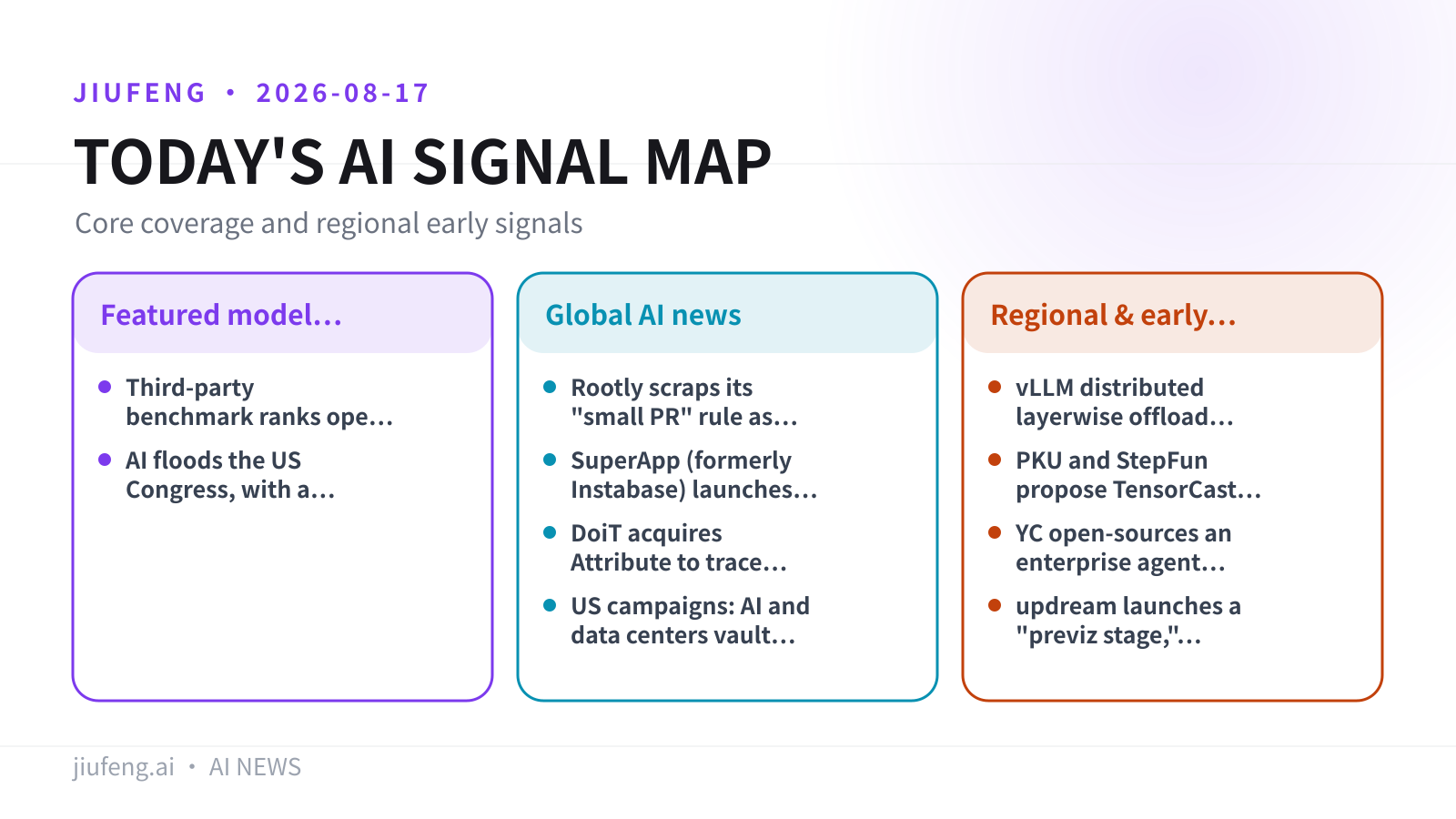
Jiufeng graphic based on the sources cited in this issue.
Featured model updates
01/10
Third-party benchmark ranks open Qwen3.8-27B 15th
WildClawBench scores Alibaba's 27B open-weight model 48.0% across 60 agent tasks, 15th of 33, even as the local-model community keeps tuning it.
RuntimeWire reports that Alibaba's Qwen3.8-27B scored 48.0% across 60 agent tasks on WildClawBench, finishing 15th of 33 models. The run went through the OpenClaw harness, took 516 minutes to complete, and listed cost as unavailable. The model trailed larger or hosted entries from OpenAI, Anthropic, xAI, Moonshot AI and Alibaba's own Qwen3.8-Max, but beat its Qwen3.6-27B predecessor. It ships as Apache 2.0 weights with native video input and a context window extendable to 1 million tokens.
The local-model community has been warmer than the restrained benchmark. InfoQ reports that developer Sudo Su published an acceleration repo (qwen38-mtp) for the model, and YouTuber Bijan Bowen (70,000+ subscribers) tested a Q8 quantization on an RTX Pro 6000 across browser-OS, 3D CAD, an FPS game, C++ and multimodal modeling, calling its output "clearly above its parameter class" on most tasks. Note that WildClawBench did not report self-hosting costs, no official hosted edition is live yet, and reliable completion on target hardware still needs local testing.
Image source: huggingface; mirrored on Jiufeng R2.
Source: RuntimeWire · InfoQ · Hugging Face
02/10
AI floods the US Congress, with a Claude reply pasted into the NDAA record
ChatGPT, Claude and Grok have become common Capitol Hill tools, and one congressional aide pasted Claude-generated text straight into a bill's public record.
Per The Washington Post (via IT之家), OpenAI's ChatGPT, Anthropic's Claude and xAI's Grok are quickly becoming go-to tools for US lawmakers and staff. The office of Rep. Anna Paulina Luna (R-FL) had a slip: a staffer pasted Claude output directly into the public record of the National Defense Authorization Act, leaving stray text reading "increasing example specific factors. Identical to H.R. 100 (118th Congress).11:25 AM????Claude responded:". Luna herself saw nothing unusual about using AI to draft, saying staff commonly use ChatGPT, Claude and Grok, and that she personally prefers Grok.
The report says Capitol Hill has almost no effective rules on AI use; existing guidance is scattered and loose, and no staffer has faced formal discipline for it. Some aides set their own rules — an aide to Rep. Cleo Fields (D) says she will never use AI to draft from scratch. This is anecdotal disclosure, without systematic data on how widely Congress uses AI.
Source: IT之家 (Chinese-language source, reporting The Washington Post)
Global AI news
03/10
Rootly scraps its "small PR" rule as AI writes by feature, not by increment
Incident-management firm Rootly drops a two-year small-pull-request culture, judging change risk by "blast radius" rather than lines of code.
InfoQ reports that Rootly co-founder and CTO Quentin Rousseau said the company had required stacked PRs capping atomic changes at a few hundred lines — sensible for human-written code, where small diffs are easier to review and roll back. But AI agents think in "features," not "increments," emitting a full implementation — database migration, model, service, controller, tests and frontend — at once, turning the old rule into overhead. The team notes AI mostly produces "context bugs": code that runs but is used in the wrong place, such as a migration dropping a field a background job still calls.
Rootly's answer is an internal AI code reviewer that asks each PR one question — if this change is buggy, which user-facing features break? — and returns a risk assessment, standardized and confidence scores, and issues grouped by severity. Feature flags move the safety boundary from "merge" to "release": once merged, a feature ships off by default, and the real review happens during progressive rollout (internal → a few customers → 10% → everyone). The account rests on Rootly's own blog and a QCon talk, describes its internal practice, and offers no side-by-side comparison data.
04/10
SuperApp (formerly Instabase) launches a shared AI workspace for teams
The renamed SuperApp ships a Slack-like platform whose underlying routing picks among OpenAI, Anthropic and Google models automatically.
SiliconANGLE reports that Instabase Inc. renamed itself SuperApp and launched a flagship product of the same name: a Slack-like team interface across web, iOS, Android and Windows, with a Google-Docs-like document library and deep access to models from OpenAI, Anthropic and Google. Users need not pick a model — underlying routing chooses by efficiency, reasoning, knowledge and cost — but can also select a preferred model or compare models in the same context.
The company says the product is built around freedom of model, data and cloud, aiming to let users swap models without rebuilding applications or moving data, avoiding architectural or vendor lock-in; the founder-CEO says "the best AI will keep changing; your work should not have to." The announcement did not disclose pricing, enterprise customer counts, or the specific routing policy.
Source: SiliconANGLE
05/10
DoiT acquires Attribute to trace AI costs beneath the billing layer
Cloud-cost firm DoiT bought Attribute, founded in 2023, in a deal CTech estimates at about $65 million.
RuntimeWire reports that DoiT acquired AI cost-attribution company Attribute and folded its technology into a product that shows which customer, feature or agent generated each piece of an AI bill. Attribute was founded in 2023 by Izhak Zimmermann and Liad Tropp (both from Israel's Unit 81 military-intelligence technology unit), on the view that tag-based splitting of conventional cloud bills cannot keep pace with shared GPUs, LLM gateways and agentic workloads — so it observes at the kernel level. DoiT launched the integrated Attribute product on July 7.
CTech publicly reported the acquisition on August 17 and estimated the price at roughly $65 million, though the exact closing date is not established; neither DoiT nor Attribute confirmed the price, and CRN reported the terms as undisclosed. The figure therefore remains a third-party estimate rather than a confirmed number.
Source: RuntimeWire · AWS
06/10
US campaigns: AI and data centers vault to a top issue
A Washington Post analysis of 1,200-plus candidate websites finds AI in nearly 40% of races, ranking above Israel, manufacturing and racism.
The Decoder relays a Washington Post analysis: across House, Senate and governor races, AI surfaces in nearly 40% of contests, with data centers and their effect on local electricity costs, water and land use dominating the conversation. AI now ranks ahead of long-standing topics like Israel, manufacturing and racism. Democratic candidates raise AI about twice as often as Republicans, focusing on risks, regulation and child safety; Republicans lean more on national security and competition with China.
The report also cites separate polls showing most Americans are skeptical of AI and worried about job losses. The finding is based on candidate-website text analysis and reflects campaign agenda-setting, not voting outcomes or enacted policy.
Source: The Decoder
Regional & early signals
07/10
vLLM distributed layerwise offload: a 124GB model on 64GB of HBM
vLLM-Omni shards and streams DiT weights across devices, serving a measured 124GB Cosmos3 model on 64GB of HBM.
The vLLM blog describes Distributed Layerwise Offload: sharding a DiT model's weights by layer and streaming them across devices, so it can run on hardware with less memory than the model's size. The team reports serving a measured 124GB Cosmos3 model on 64GB of HBM and, from that, estimates a path toward 200B+ parameter DiT models.
This is a serving-side optimization for large diffusion/video models — an engineering method, not a new model. The blog offers a single-configuration measurement plus extrapolation; throughput and latency across other models and hardware still need more public data.
Source: vLLM Blog
08/10
PKU and StepFun propose TensorCast, cutting time-to-first-token by up to 93.2%
Peking University, StepFun and BUPT propose a unified programmable tensor-lifecycle layer that the report says cuts LLM time-to-first-token by up to 93.2%.
Pandaily reports that Peking University, StepFun and Beijing University of Posts and Telecommunications jointly proposed TensorCast — a unified, programmable tensor lifecycle management abstraction for large-model infrastructure. The report says the approach can reduce an LLM's time-to-first-token by up to 93.2%.
This is a systems effort focused on the inference-serving side. So far only a single English-language report is available, without the full paper or complete benchmark conditions (model size, hardware, baseline). "Up to 93.2%" is the upper bound cited by the report, and the applicable scope still needs primary material to verify.
Source: Pandaily
09/10
YC open-sources an enterprise agent harness, "QM," to 3.9k stars and #1 on HN (Chinese-language source)
Y Combinator open-sourced QM, an agent-control framework for multi-user teams, hitting 3.9k GitHub stars in three days and topping Hacker News on launch day.
Leiphone reports that accelerator Y Combinator open-sourced QM, an enterprise-grade agent harness that drew 3.9k GitHub stars in three days and topped Hacker News the day it was announced. Unlike individual-productivity harnesses such as Claude Code, OpenClaw and Hermes, QM does not execute business tasks itself; it gives teams an execution environment, context and memory management, tool-permission scheduling and behavioral guardrails, emphasizing data isolation, permission governance, unified environments and audit compliance.
The article frames the agent stack in three layers: base models handle reasoning and decisions, mid-layer agents execute tasks, and an outer harness handles control. This is a single Chinese-language report that does not provide primary details such as the GitHub repository URL or license, so the exact capability boundaries should be confirmed against the project's own documentation.
Source: Leiphone (Chinese-language source)
10/10
updream launches a "previz stage," shifting AI video toward visual pre-visualization (Chinese-language source)
updream adds a previz feature: upload a scene reference image to generate a 3D blockout, then place characters, set cameras and keyframes before handing it to a model to render.
Per hands-on testing by ifanr, AI-video tool updream launched a "previz stage": with no modeling required, uploading a scene reference image (ideally wide-angle or aerial, with few characters, up to 3 images, taking about 4–7 minutes) auto-generates a usable 3D blockout scene. Creators can place characters, set camera positions and motion paths, adjust keyframes, and use built-in relative-position-follow or trajectory-tracking logic to control shots, then pick a model to render — turning Prompt-dependent spatial and camera staging into a visual pre-visualization.
The piece opens with the viral film 《牛来》, noting that even as visuals improve, "shot staging" is still hard to control precisely with a single prompt. This is a single Chinese-language product test; results and applicability follow the official feature, and it does not cover pricing or availability.
Source: ifanr (Chinese-language source)
Write a prompt in your browser and get an image — 1K, 2K or 4K output, up to 15 reference images. 50 free generations on sign-up, no credit card.
Generate free