Overview
9 stories in this issue. The first 3 are today's priorities.
Hot Model Watch
- Top · OpenAI adds cross-model delegation to Codex, letting Sol offload work to cheaper Luna
- Top · Anthropic's bio-weapons filter was down for nearly a year, exposing 133 million chats
Global AI News
- Top · Artificial Analysis launches Optima for building custom model benchmarks from your own data
- Cloudflare open-sources Computer, a runtime giving AI agents a persistent machine
- AWS open-sources Dogwood to govern sequences of agent tool calls
- Duolingo cuts AI video-call cost below one cent using open models
- Study: barring models from self-reflection also shifts their views on animal rights and religion
Regional & Early Signals
- China's tech giants ramp up AI hiring in 2027 campus recruiting (Chinese-language source)
- Huawei's open-source agent openJiuwen becomes WorkSwarm, targeting multi-agent office work (Chinese-language source)
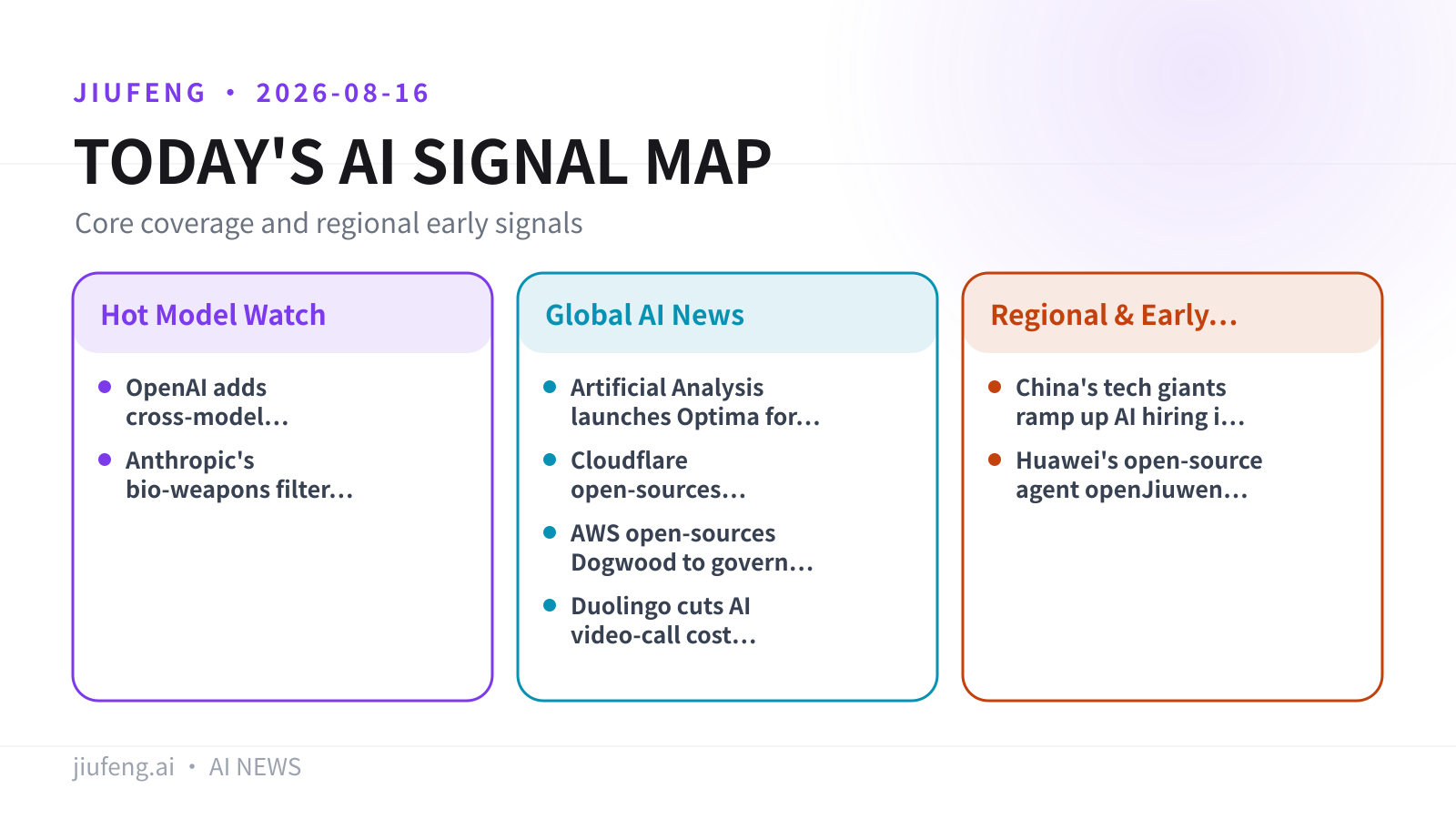
Jiufeng graphic based on the sources cited in this issue.
Hot Model Watch
01/09
OpenAI adds cross-model delegation to Codex, letting Sol offload work to cheaper Luna
GPT-5.6 Sol can stay the orchestrator while handing bounded tasks to the faster, lower-cost Luna.
OpenAI has shipped cross-model delegation for Codex's Multi Agents v2 system, letting a model assign work to any supported model, including GPT-5.6 Luna. According to Eric Provencher (@pvncher), who joined OpenAI's developer relations after building the codebase-context tool Repo Prompt, a capable model such as GPT-5.6 Sol can remain the orchestrator while sending narrowly defined tasks to a faster worker, per his August 15th thread on X. OpenAI describes Luna as the fastest and lowest-cost model in the GPT-5.6 family, making the routing useful for controlling latency and consumption during agent-heavy coding jobs. The feature answers a routing gap documented in a GitHub issue filed on July 22nd, where users wanted to pick both model and reasoning level.
Limitations: this is a routing capability for Codex's agent system, surfaced through Provencher's X thread rather than a formal OpenAI product announcement.
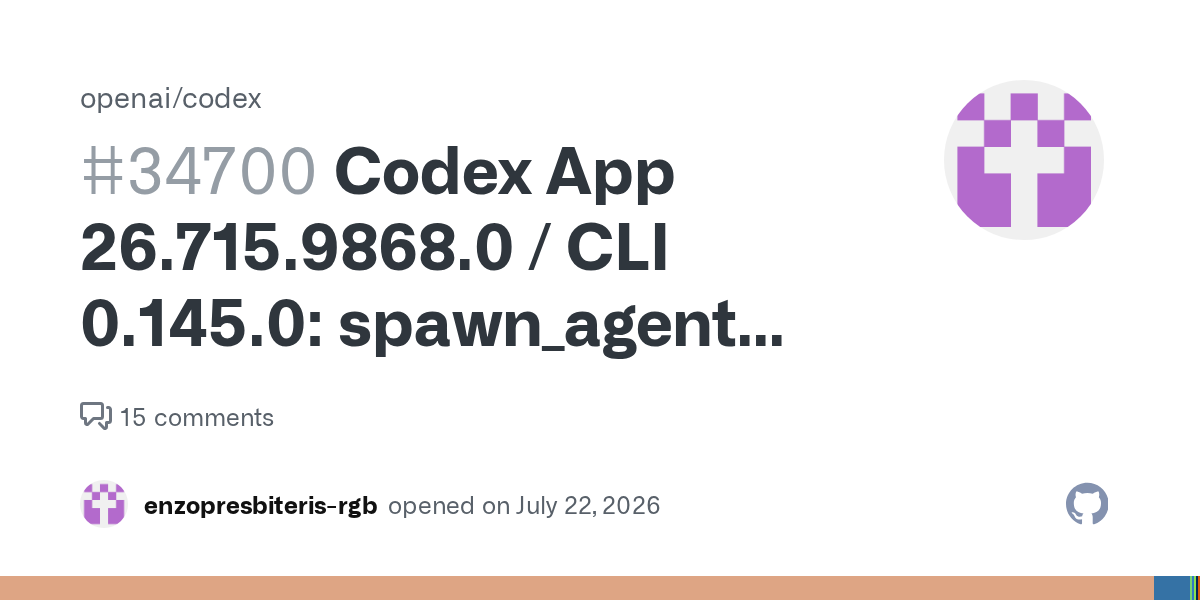
Image source: GitHub; mirrored on Jiufeng R2.
Source: RuntimeWire · X @pvncher · GitHub issue
02/09
Anthropic's bio-weapons filter was down for nearly a year, exposing 133 million chats
Classifiers meant to block bio/chem-weapon risks sat inactive from May 2025 to April 2026; Anthropic says it found no evidence of actual misuse.
In a safety report, Anthropic disclosed that its blocking biological (and chemical) classifiers were inactive from May 2025 through April 2026 — close to a full year. During that window, all traffic from external contractors providing human feedback ran without them. The report says the gap affected about 50,000 contractors who ran roughly 133 million chats, and that these individuals had been vetted only by external vendors whose screening was "often insufficient." Anthropic states its internal investigation found no evidence of actual misuse and that it has since tightened contractor requirements.
Limitations: the report is redacted; "no evidence of misuse" is Anthropic's own internal finding, and the filters covered the external-feedback contractor pool rather than all user traffic.
Source: The Decoder · Anthropic safety report (PDF)
Global AI News
03/09
Artificial Analysis launches Optima for building custom model benchmarks from your own data
Users build tailored benchmarks from their own data and workflows, comparing models on quality, cost per task and time per task.
Artificial Analysis, known for independent LLM evaluations such as GDPval-AA and AA-Briefcase, has launched Optima, a platform that lets users build custom benchmarks from their own data sources or a description of a target scenario with sample inputs and outputs. Beyond quality, Optima compares models on cost per task and time per task, targeting the limited real-world usefulness of general-purpose public benchmarks.
Limitations: The Decoder notes that whether a custom benchmark is methodologically sound and captures real business value still depends on how it is designed; the report gives no specific head-to-head model scores.
Source: The Decoder
04/09
Cloudflare open-sources Computer, a runtime giving AI agents a persistent machine
It uses Cloudflare isolates instead of ephemeral containers, aiming for over 90% of agent work to run without a container.
Cloudflare has released Cloudflare Computer, an open-source runtime that gives AI agents a more computer-like environment than ephemeral containers, arguing that container-based agents cannot scale to "hundreds of millions or billions of concurrent agents." The @cloudflare/computer package lets the runtime decide whether code runs in an isolate, a container sandbox or a web browser, with the goal that under 10% of work — coding, audio/video processing, document creation — needs a container. Its core is a SQLite-based shared filesystem accessible to both isolate and container so tasks can move between them, offered through three backends: a container project exposing SQLite state via a FUSE mount, an isolate shell running just-bash in a Dynamic Worker, and an isolate JavaScript backend.
Limitations: Cloudflare says Computer is an early preview suitable only for experimentation, exploration and prototyping.
Source: InfoQ · @cloudflare/computer
05/09
AWS open-sources Dogwood to govern sequences of agent tool calls
Dogwood extends the Cedar policy language with temporal conditions so rules can reason over an agent's prior tool calls, not just one request.
AWS has open-sourced Dogwood, a policy language that extends Cedar with temporal conditions so authorization rules can reason about an agent's prior tool calls rather than evaluating each request in isolation. Per InfoQ, it covers scenarios such as approvals and is aimed at governing the sequences of tool calls agents make.
Limitations: coverage is thin so far — only the language's features and design goals have been disclosed, with no deployment cases or performance data.
Source: InfoQ
06/09
Duolingo cuts AI video-call cost below one cent using open models
Cost per AI video call fell from about $0.30 to under $0.01, prompting Duolingo to push the feature down-tier and reconsider its Max plan.
Duolingo co-founder and CEO Luis von Ahn said on the company's August 5th earnings call that it cut the cost of an AI-powered video call from roughly $0.30 to less than $0.01, giving it room to distribute the conversation feature beyond its most expensive subscription. As excerpted by The Transcript, the reduction comes from switching to open-weight models, and Duolingo is weighing moving Video Call into the broader Super Duolingo tier and whether Duolingo Max still needs to exist.
Limitations: the figures come from an earnings call as relayed by The Transcript on X, and von Ahn did not name which open model Duolingo uses.
Source: RuntimeWire · The Transcript on X
07/09
Study: barring models from self-reflection also shifts their views on animal rights and religion
Google-affiliated researchers find the "brake" that makes chatbots deny consciousness has side effects well beyond that topic.
A team from Google's Paradigms of Intelligence research group, the University of Chicago and several other universities found that the fine-tuning "brake" that stops chatbots from claiming consciousness reaches far beyond that subject. Using three open-weight models from Meta and Google and disabling the internal brake via two different methods, the researchers observed that removing it changed not only what the models said about themselves but also the significance they attributed to animal rights, religion and life satisfaction.
Limitations: the findings rest on three open-weight models and two intervention methods and describe behavioral side effects; The Decoder does not provide a fully reproducible evaluation setup.
Source: The Decoder
Regional & Early Signals
08/09
China's tech giants ramp up AI hiring in 2027 campus recruiting (Chinese-language source)
Baidu says over 90% of its campus roles are AI-related and Alibaba about 80%, per Chinese media.
According to TMTPost, Tencent, Xiaomi and others have opened 2027 campus recruiting with heavy AI content: Tencent added native roles such as AI full-stack engineer, agent-development engineer and AI application engineer; Xiaomi says demand for AI-related roles is up more than 50%, with R&D roles at 70% of openings; ByteDance says tech and product roles exceed 70% of demand, with new AI full-stack and AI agent roles and a 20% rise in non-R&D product roles. Alibaba is recruiting across 16 business groups with AI-related roles at about 80%, Baidu's 2027 campus roles are over 90% AI-related, and DeepSeek began recruiting in late June, saying it aims to at least double the size of every department.
Limitations: this is a Chinese-language roundup of multiple companies' recruiting pages; the share figures are largely companies' own framing and are not independently verified, with no headcount disclosed.
Source: TMTPost
09/09
Huawei's open-source agent openJiuwen becomes WorkSwarm, targeting multi-agent office work (Chinese-language source)
The "swarm" office agent lands on the HarmonyOS PC app store; a demo claims a 200-page deck in 20 minutes.
Per QbitAI, openJiuwen — an open-source agent jointly built by Huawei's 2012 Labs, Huawei Cloud, and its device and computing teams — last Thursday upgraded its "swarm agent" into WorkSwarm, a swarm office agent that debuts on the HarmonyOS PC app store and also supports Windows and Mac. WorkSwarm uses "Coordination Engineering" to organize multiple agents into a division of labor, and a human can join the team as a full member to take on a step. Vendor demos include generating a 200-page slide deck in 20 minutes in swarm mode, seven agents splitting lyrics/composition/arrangement/vocals to make a song, and turning a one-sentence request into ArkTS code compiled into an app that runs on a HarmonyOS PC.
Limitations: the output sizes and timings are official demos and vendor claims (Chinese-language source); QbitAI's report offers no independent reproduction or third-party evaluation, and licensing and availability details are not listed.
Source: QbitAI
Write a prompt in your browser and get an image — 1K, 2K or 4K output, up to 15 reference images. 50 free generations on sign-up, no credit card.
Generate free