Overview
9 stories in this issue. The first 3 are today's priorities.
Hot Model Watch
- Top · Z.ai ships GLM-5.3 with post-training-only gains
- Top · One DeepSeek model, a 20-point swing across harnesses
- Top · Claude agents rewrote Bun in 11 days; Zig's creator calls it unsupervised
Global AI News
- Apple trained a custom China model with Alibaba's help
- Code in OpenAI's desktop app points to an unreleased ChatGPT Wallet
- Google Sheets canvas turns data into apps from one prompt
- NOPE's founder maps AI text watermarks; Declaude erases them by rewriting
Regional & Early Signals
- Embodied-AI compute demand up 5–10× in two years (Chinese-language source)
- WeChat Pay ships an agent-payment card; open platform opens AI access (Chinese-language source)
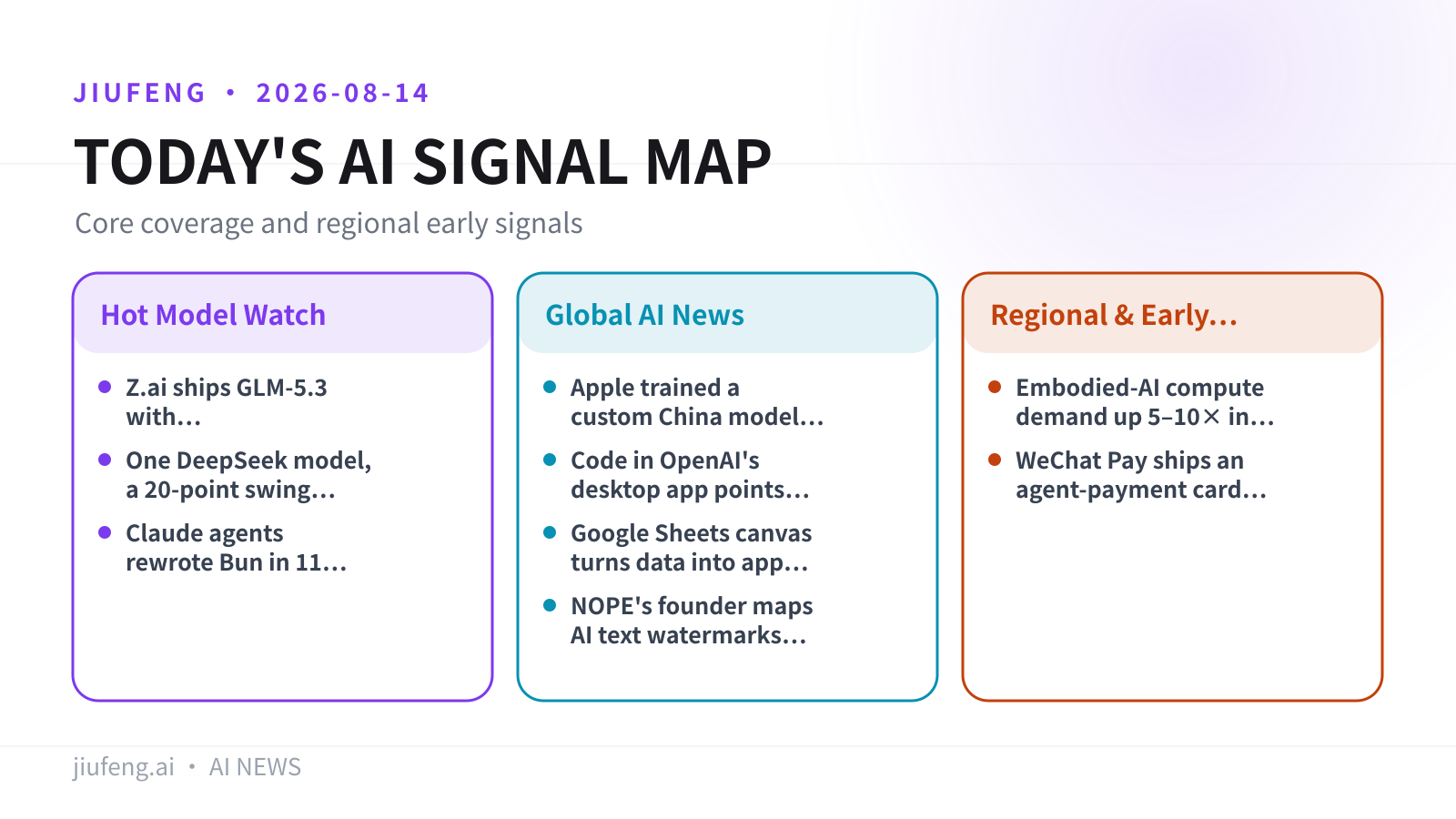
Jiufeng graphic based on the sources cited in this issue.
Hot Model Watch
01/09
Z.ai ships GLM-5.3 with post-training-only gains
Z.ai released GLM-5.3 on August 14, reusing the 743B GLM-5.2 base unchanged, with every gain coming from more post-training.
Z.ai says GLM-5.3 runs on the same 743B base as GLM-5.2, adding only more task environments, more environment types and another month of reinforcement learning; the training stack reuses the three components introduced with GLM-5.2, including IndexShare and SAO. On its own benchmarks, coding on the long-horizon Terminal-Bench 3.0 jumps from 4.6 to 28.3, and the CyberGym security benchmark reaches 84.5% (a gain Z.ai says exceeded its expectations). The model is live through the Z.ai API, the GLM Coding Plan and ZCode.
Limitations: weights are not public; Z.ai says it will publish them about two weeks after launch, once safety evaluation and hardening finish. RuntimeWire notes that as of August 14 Z.ai's release notes still list GLM-5.1 as the latest documented release and its GLM-5 docs give no GLM-5.3 endpoint, hosted-model ID or downloadable artifact, so the reported scores cannot yet be independently reproduced. All figures are Z.ai's own.
Source: MarkTechPost · RuntimeWire · Z.ai
02/09
One DeepSeek model, a 20-point swing across harnesses
Composio ran DeepSeek V4 Flash through eight harnesses; Pi Agent led at 66.7% and cost roughly a seventh of Claude Code per task.
Composio, a company that builds tools for AI agents, ran the same DeepSeek V4 Flash model across eight harnesses on 30 hard agent tasks: Pi Agent passed 20/30 (66.7%), Oh My Pi 17, Claude Code / Codex / Deep Agents 16 each, Prime Agent and Hermes Agent 15, and OpenCode 14. Swapping only the harness moved success from 46.7% to 66.7%, a 20-point gap; Pi averaged $0.028 per successful task versus Claude Code's $0.195 (about 7×), with a 132.2s median completion time. Separately, one developer ran ~1 billion input tokens through Pi + DeepSeek V4 Flash at a 99.93% cache-hit rate for $2.65 (versus ~$132 without cache).
Limitations: this is a single Composio run of 30 tasks; Prime Agent had 6 unscored runs (2 grader timeouts, 4 with no record), and cache behavior differs across harnesses.
Source: InfoQ · Mario Zechner/X
03/09
Claude agents rewrote Bun in 11 days; Zig's creator calls it unsupervised
Bun's creator ported the project from Zig to Rust in 11 days using parallel Claude agents at ~$165K, and the code quality drew immediate pushback.
Bun creator Jarred Sumner says a batch of parallel Claude agents ported Bun from Zig to Rust in 11 days at roughly $165,000 in API costs; Anthropic acquired Bun in December 2025 and built its core state machine on it, and a Claude bot named RoboBun is already the top PR-merger in the repo. Sumner says Bun's own test suite of over 1 million assertions passes 100% on every supported platform with no tests skipped or deleted; HashiCorp co-founder Mitchell Hashimoto wrote on X that "at those salaries, engineers absolutely could not achieve in 11 days what Claude accomplished."
Limitations: Zig creator Andrew Kelley pushed back publicly, saying the move was not about language features or even AI use but about "two projects' fundamentally different value systems," blaming Sumner's non-standard coding practices; the report also traces a bug tied to Anthropic's March 512K-line code leak to a Bun bundler flaw, per NodeSource.
Source: InfoQ · Mitchell Hashimoto/X
Global AI News
04/09
Apple trained a custom China model with Alibaba's help
The Verge, citing Reuters, reports Apple built a China-market LLM in partnership with Alibaba.
The Verge, citing a Reuters report based on three unnamed sources, says Apple trained a custom large language model for the China market in partnership with Alibaba and with Alibaba's support. That marks a departure from Apple's prior China strategy of relying on domestic third-party models and would give it more control in a competitive smartphone market; the report says it comes as Apple prepares to launch an on-device generative AI service in China.
Limitations: the account rests on anonymous sources cited by Reuters; neither Apple nor Alibaba has confirmed it publicly, and the model's name, size and timeline are undisclosed.
Source: The Verge
05/09
Code in OpenAI's desktop app points to an unreleased ChatGPT Wallet
RuntimeWire reverse-engineered OpenAI's desktop client and found an unreleased wallet flow letting ChatGPT use saved cards during tasks.
RuntimeWire says OpenAI's production Windows ChatGPT/Codex desktop bundle contains a native "Introducing ChatGPT Wallet" announcement plus secure card enrollment, validation, save, retry and success states, referencing feature gate 3398492218, connector connector_openai_wallet and resource internal://wallet-vgs-card-enrollment. The flow points to letting users save cards for ChatGPT to use while completing tasks, with card details entered in a secure session outside the conversation; if shipped, it would pull the payment layer for agent purchases back to OpenAI after it steered checkout toward merchants in March.
Limitations: the feature is unreleased and exists only in bundled code; the findings are based on reverse engineering, RuntimeWire says exact-name searches found no prior public report, and OpenAI has not commented.
Source: RuntimeWire · OpenAI Codex app
06/09
Google Sheets canvas turns data into apps from one prompt
Google's new Sheets canvas uses Gemini to turn rows and columns into interactive dashboards and trackers with a single prompt.
Google's blog says Sheets canvas lets users describe a need in plain language and have Gemini build custom layouts—dashboards, study trackers, seating charts—that sync automatically with the underlying spreadsheet; you start by opening a sheet, clicking the Gemini icon and choosing "create canvas."
Limitations: the announcement does not specify rollout scope, regions or plan requirements.
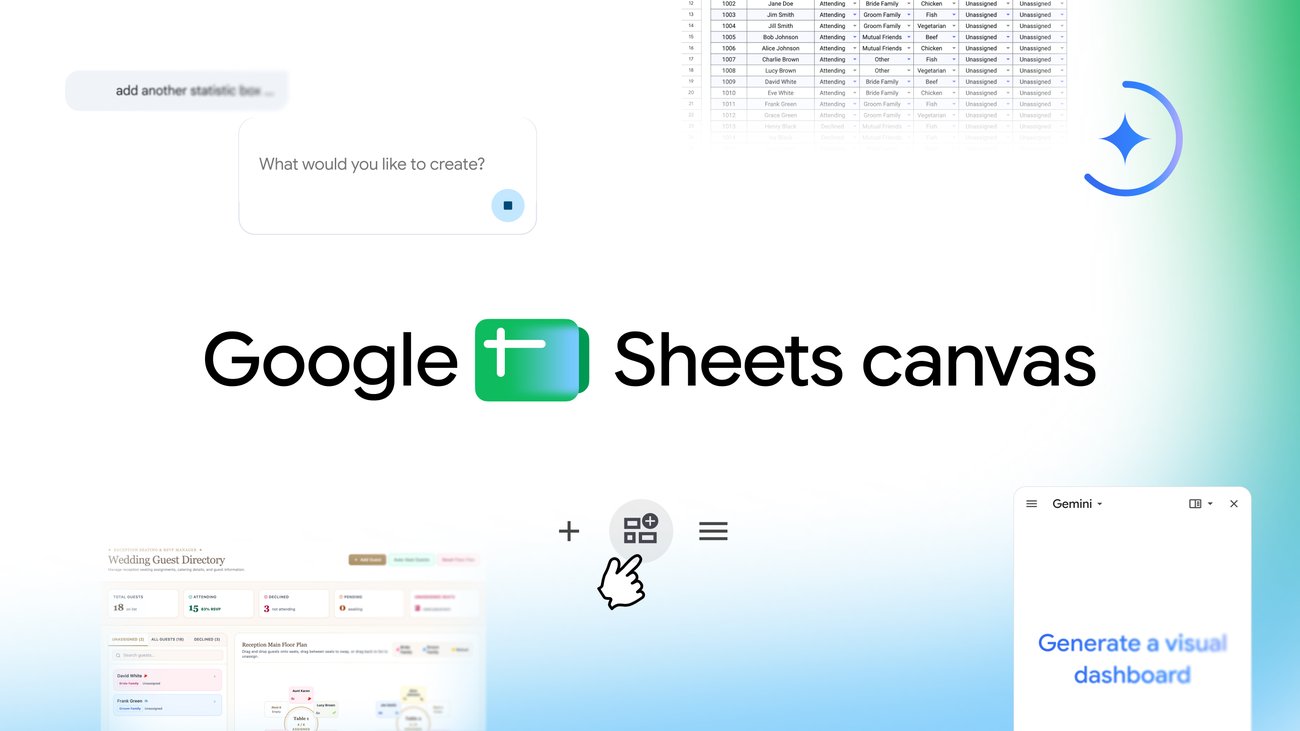
Image source: Google; mirrored on Jiufeng R2.
Source: Google
07/09
NOPE's founder maps AI text watermarks; Declaude erases them by rewriting
James Padolsey published an interactive guide to how text watermarks survive copying but fade under rewrites, alongside his Declaude rewriting tool.
RuntimeWire reports that NOPE founder James Padolsey published an interactive guide to AI text watermarking—where an invisible mark hides, how its owner detects it, and why rewriting can erase it—paired with Declaude, his tool that recomposes "AI-flavored" text while preserving meaning. For context, Anthropic said on August 12 that new Claude models will mark AI-generated content from launch (Claude models launched in the EU on or after August 2, 2026, applied worldwide); Google has watermarked Gemini text with SynthID since 2024 and open-sourced a reference implementation; and OpenAI noted in 2024 that such marks lose a detectable signal after heavy editing, translation or excerpting.
Limitations: text watermarks remain probabilistic and key-gated and can be weakened by rewriting; Declaude is a removal tool with dual-use implications.
Source: RuntimeWire · Google DeepMind SynthID · OpenAI
Regional & Early Signals
08/09
Embodied-AI compute demand up 5–10× in two years (Chinese-language source)
Chinese outlet QbitAI reports robotics firm LimX Dynamics saw compute needs grow 5–10× in two years, with Alibaba Cloud moving simulation to cloud workstations.
LimX Dynamics co-founder and CTO Chen Hua told QbitAI that his R&D team's compute demand grew roughly 5–10× over the past two years; embodied-AI work must juggle simulation training, data capture, model iteration and real-robot validation, and standing up a local CUDA/ROS2/Isaac Sim environment can take four to five hours with frequent version conflicts. Alibaba Cloud's "Wuying Lingou" AI R&D compute platform offers cloud workstations that unify the environment, scale compute on demand and pipe Isaac Sim and NVIDIA Omniverse graphics into the workflow.
Limitations: this is a single Chinese-language report; claims such as "deployment efficiency up 80%" and "half the cost" are Alibaba Cloud's own, unverified independently, and the piece centers on a LimX-hosted event with clear vendor framing.
Source: QbitAI — Chinese-language source
09/09
WeChat Pay ships an agent-payment card; open platform opens AI access (Chinese-language source)
IT Home reports WeChat Pay released an "AI-dedicated card" for agent payment scenarios, while WeChat's open platform opened access to its AI ecosystem.
IT Home reports that WeChat is strengthening its self-built models and agent capabilities. WeChat Pay this week released an "AI-dedicated card" built for agent payment scenarios, closing the loop from recommendation to checkout, and WeChat's open platform now lets developers connect to its AI ecosystem via "automatic" and "developer" modes that allow WeChat AI to call and operate mini-programs. WeChat's native AI assistant "Xiao Wei" entered gray-scale rollout in June.
Limitations: this is a single Chinese-language report; the card's specific fees, rollout scope and access conditions are not given, and "Xiao Wei" was previously reported with no new developments here.
Source: IT Home — Chinese-language source
Write a prompt in your browser and get an image — 1K, 2K or 4K output, up to 15 reference images. 50 free generations on sign-up, no credit card.
Generate free