Overview
8 stories in this issue. The first 3 are today's priorities.
Hot model watch
- Top · Alibaba open-sources Qwen 3.8 27B under Apache 2.0
- Top · Grok 4.6 arrives in GitHub Copilot
- Top · Anthropic explains how Claude's text watermark works
- Google lets users turn off Gemini's visible watermark
Global AI news
- NVIDIA, Indosat and UGM open Indonesia's first university AI center
- Mole, an open-source deep-research agent for the terminal
Regional & early signals
- SpaceX completes $60B acquisition of Cursor (Chinese-language source)
- IBM and Red Hat extend Lightwell to secure the AI software supply chain (Chinese-language source)
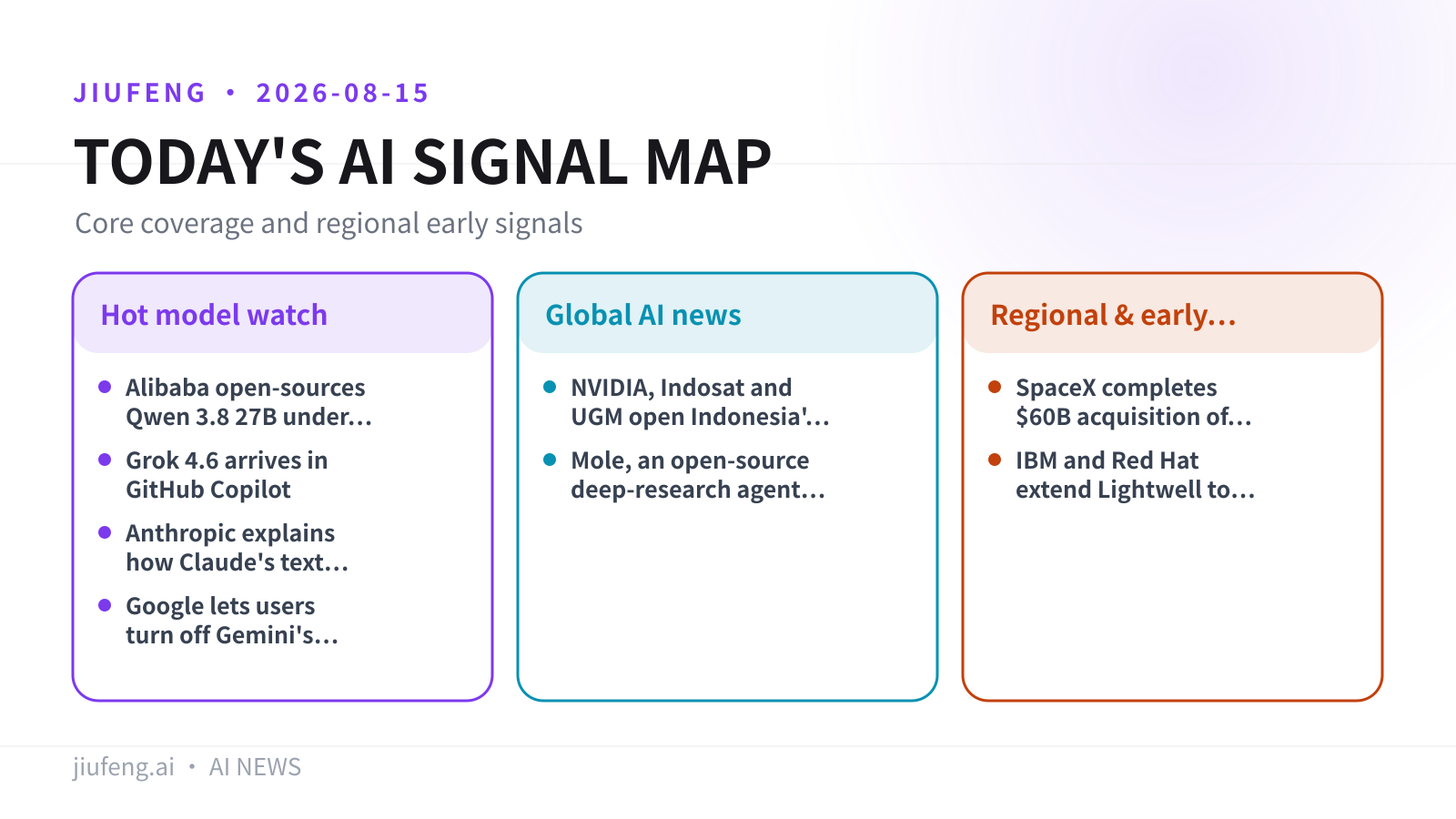
Jiufeng graphic based on the sources cited in this issue.
Hot model watch
01/08
Alibaba open-sources Qwen 3.8 27B under Apache 2.0
Alibaba's Qwen team releases the 27B dense multimodal Qwen 3.8 with open weights under Apache 2.0.
Qwen3.8-27B is a 27-billion-parameter dense multimodal model that, per Qwen, outperforms the larger Qwen3.7-Plus on coding and office tasks and plans more independently as an agent. It natively handles 262,000 tokens of context and can scale to one million via the YaRN method; beyond text it processes images and video, including diagrams, documents and multi-hour footage, with a flexible thinking mode on by default and toggleable per query. Weights are on Hugging Face and ModelScope, and a hosted one-million-token version is coming to Alibaba's Qwen Cloud.
Limitations: on Hacker News, one user reported Qwen3.8-27B is only the second local model after Gemma 4 to pass their private reasoning benchmark, but it used about 5x the tokens and 12m30s with MTP enabled, and its VRAM use is less efficient — 32K of context alone takes 2.5GB. The "beats the previous generation" claims are largely vendor self-assessments awaiting third-party benchmarks.
Image source: huggingface; mirrored on Jiufeng R2.
Source: The Decoder · Hugging Face · Hacker News
02/08
Grok 4.6 arrives in GitHub Copilot
xAI's Grok 4.6 enters GitHub Copilot two days after launch, under usage-based billing.
GitHub added Grok 4.6 to Copilot on August 14 for Copilot Pro, Pro+, Max, Business and Enterprise subscribers. Developers can select the reasoning model in VS Code, Visual Studio, the Copilot CLI, the Copilot cloud agent, the Copilot app, JetBrains IDEs, Xcode and Eclipse. Grok 4.6 launched on August 12, reaching GitHub's editors, command line and cloud coding agent two days later. xAI was acquired by SpaceX on February 2, 2026, and now uses the SpaceXAI brand.
Limitations: GitHub said availability will expand gradually rather than reach every eligible account immediately.
Source: RuntimeWire · GitHub docs
03/08
Anthropic explains how Claude's text watermark works
Anthropic details its text-watermarking method, citing EU AI Act compliance.
Anthropic published an explainer on August 14 describing how future Claude models will embed a watermark in generated text. The company says the method has no practical impact on output quality or content, that watermarked and un-watermarked text are indistinguishable to readers, and that nothing is added — no hidden characters, no extra tokens, no added cost. It says the watermark carries no identifying information and can't be traced to a person, organization or chat, and isn't specific to Claude. The change is driven by the EU AI Act: since August 2, providers serving the EU market must mark AI-generated content, and several major model developers signed the same commitment.
Limitations: these properties come from Anthropic's own account and are not independently verified; watermarking applies to "future Claude models," not all current ones.
Source: Anthropic
04/08
Google lets users turn off Gemini's visible watermark
Google will let users remove the visible watermark on AI images, video and music, while invisible SynthID and C2PA stay.
Google announced on August 14 that users can toggle off a new "Media watermark" setting in Gemini and its video tool Flow, removing the bottom-right "sparkle" watermark on content from the Nano Banana, Omni and Lyria models. Per Josh Woodward, VP of Google Labs, Gemini and AI Studio, disabling the visible mark still leaves invisible SynthID watermarks and C2PA metadata embedded for provenance checks.
Limitations: only the visible watermark can be removed; support in Search is "coming soon" and not yet broadly available.
Global AI news
05/08
NVIDIA, Indosat and UGM open Indonesia's first university AI center
Indonesia's digital ministry, Indosat, NVIDIA and Universitas Gadjah Mada launch the country's first university-based AI technology center.
This week the Ministry of Communication and Digital Affairs (Komdigi), Indosat Ooredoo Hutchison, NVIDIA and Universitas Gadjah Mada (UGM) opened the UGM Indosat NVIDIA AI Technology Center (NVAITC) in Yogyakarta — Indonesia's first university-based AI technology center. Established under Indonesia's AI Center of Excellence initiative, it brings together government, industry and academia to develop local AI talent and address national priorities. Minister Meutya Hafid framed it as laying the foundations of Indonesia's "AI sovereignty."
Limitations: the center has just launched; official statements focus on "laying foundations," with talent and research outcomes still to come.
Source: NVIDIA
06/08
Mole, an open-source deep-research agent for the terminal
An open-source terminal research agent promises hard budget caps, sourced claims and local-data privacy.
A developer posted Mole on Hacker News, an open-source deep-research agent that runs in the terminal. Its stated design has three parts: never spending more than a set budget (measured overshoot of 0%), attaching a source to every claim, and a local-data privacy boundary — hand it a CSV and it analyzes the data without it leaving your machine. It says it works with most LLMs, including coding agents, subscriptions and local models, and is free and open source.
Limitations: an HN commenter called it "a LOT of code for a pretty basic feature," and the post drew limited attention (about 42 points).
Source: GitHub · Hacker News
Regional & early signals
07/08
SpaceX completes $60B acquisition of Cursor (Chinese-language source)
Per IT Home, citing regulatory filings and Bloomberg, SpaceX closed its $60 billion purchase of AI coding startup Cursor, effective August 14.
IT Home reports that SpaceX completed a $60 billion acquisition of AI coding startup Cursor, with a regulatory filing showing it took effect on August 14 local time; the deal was announced two months earlier, and Bloomberg calls it one of the largest acquisitions in tech history. Cursor launched its AI coding assistant in 2023 and became a key player in "vibe coding"; its co-founders become billionaires and the team gains access to SpaceX's large GPU cluster. The two had already shipped a first joint model, Grok 4.5 (for coding, finance and legal), in July, followed by Grok Bot and the upgraded Grok 4.6. Musk's AI business is now branded SpaceXAI.
Limitations: the report says SpaceXAI previously had limited enterprise adoption and went through several rounds of layoffs and restructuring; only a Chinese-language source (citing Bloomberg) is available here.
Source: IT Home
08/08
IBM and Red Hat extend Lightwell to secure the AI software supply chain (Chinese-language source)
IBM and Red Hat launch a commercial product built on the open-source Lightwell project to make human- and AI-generated software verifiable.
Per InfoQ China, IBM and Red Hat announced an expansion of Lightwell, a commercial product built on the open-source Lightwell project for software signing, provenance tracking, artifact verification and policy enforcement. It builds on existing standards — Sigstore, in-toto, SLSA and software bills of materials (SBOM) — unifying otherwise separate tools into one platform, which matters as AI speeds up the volume of code entering enterprise delivery pipelines. The goal is to verify who or what (human or AI) performed each action, under which identity and policy.
Limitations: the report notes Lightwell introduces no new security concepts, instead packaging emerging standards into a commercially supported platform; the main report is in Chinese, with CodeQL and GitHub Advanced Security as English primary pages.
Write a prompt in your browser and get an image — 1K, 2K or 4K output, up to 15 reference images. 50 free generations on sign-up, no credit card.
Generate free