Overview
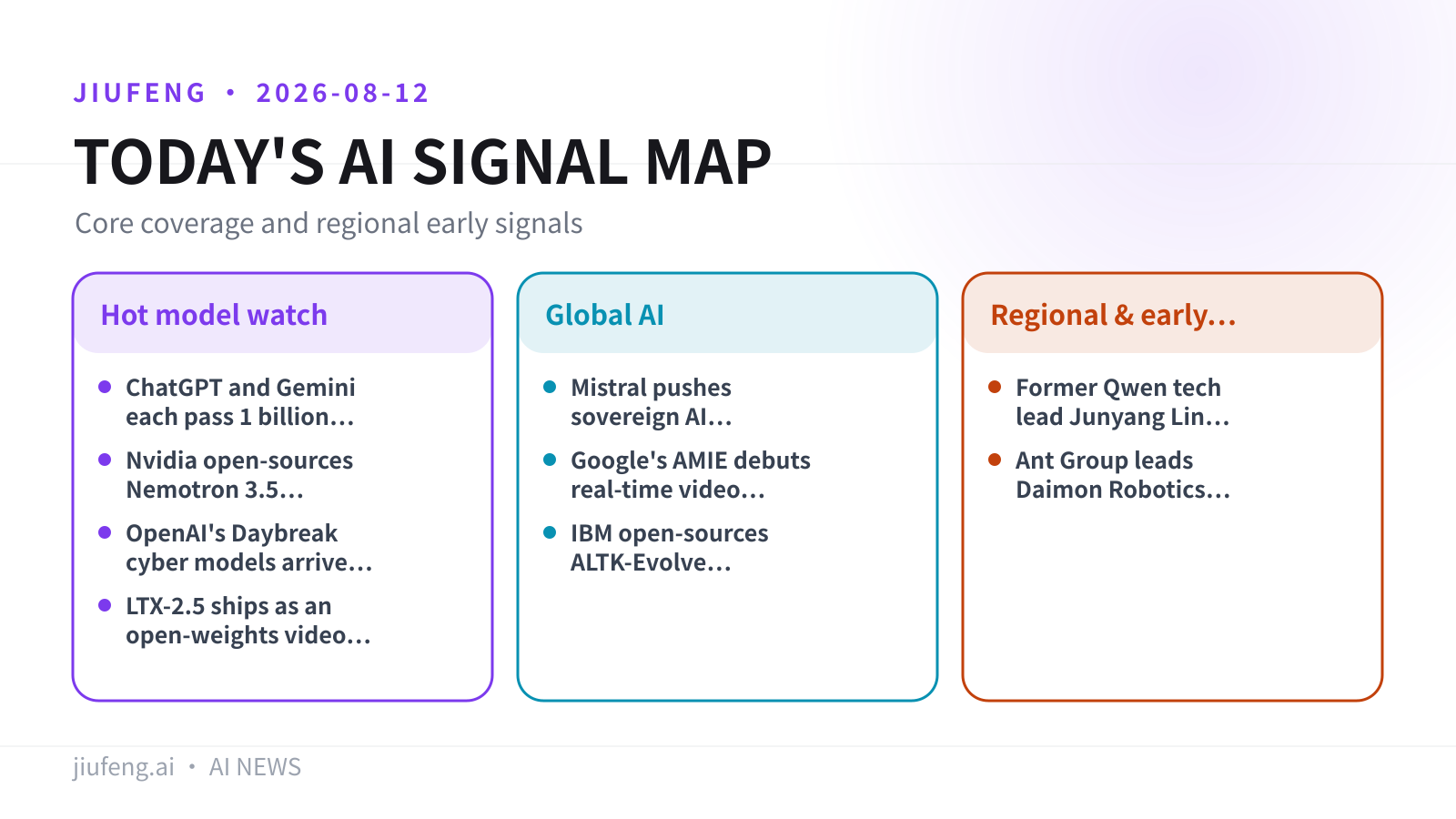
9 stories in this issue. The first 3 are today's priorities.
Hot model watch
- Top · ChatGPT and Gemini each pass 1 billion monthly users
- Top · Nvidia open-sources Nemotron 3.5 Lightning, a fast 30B MoE
- Top · OpenAI's Daybreak cyber models arrive on Amazon Bedrock
- LTX-2.5 ships as an open-weights video world model that runs on one desk
Global AI
- Mistral pushes sovereign AI: in-region inference, open models, a compute coalition
- Google's AMIE debuts real-time video consultations, built on Gemini and Project Astra
- IBM open-sources ALTK-Evolve: ACE-style agent self-learning at fewer tokens
Regional & early signals
- Former Qwen tech lead Junyang Lin founds Pragmatik Labs
- Ant Group leads Daimon Robotics round, betting on robotic touch (Chinese-language source)
Jiufeng graphic based on the sources cited in this issue.
Hot model watch
01/09
ChatGPT and Gemini each pass 1 billion monthly users
Google's Pichai says Gemini hit 1 billion monthly users, its 14th product to do so; ChatGPT crossed the same mark earlier.
Facts: On August 11, Sundar Pichai posted on X that a billion people use Gemini every month, calling it Google's fastest-growing product ever and the company's 14th product to reach 1 billion users. Per TechCrunch, 63% of Gemini users talk to the assistant by voice, and Gemini now generates more than 150 million images a day. OpenAI disclosed its own milestone in an August 6 blog post phrased as "more than 1 billion people are putting ChatGPT to work"; spokesperson Lindsay McCallum said ChatGPT crossed 1 billion monthly users some time ago and hit a billion in a single week in July.
Limitations: Both figures are self-reported; OpenAI gave no exact date, and external data suggested ChatGPT crossed 1 billion as early as June. The Verge notes OpenAI remains the chatbot leader but the race is tightening fast.
Source: The Verge · TechCrunch · OpenAI blog · Google on X
02/09
Nvidia open-sources Nemotron 3.5 Lightning, a fast 30B MoE
A 31.6B-parameter, 3.6B-active hybrid Mamba-Transformer that matches gpt-oss-120b on intelligence while topping its class on speed.
Facts: Nvidia released Nemotron 3.5 Lightning, the first model in its Nemotron 3.5 line, directly succeeding Nemotron 3 Nano 30B A3B and keeping the hybrid Mamba-Transformer architecture with 31.6 billion total and 3.6 billion active parameters. Per the independent platform Artificial Analysis, it scores 24 on the Intelligence Index — a nine-point jump from its predecessor (15) — matching OpenAI's gpt-oss-120b (24) and trailing the roughly 4x-larger Nemotron 3 Super (26). The text-only model supports a 1M-token context, and NVFP4 weights are on Hugging Face.
Limitations: It prioritizes speed over maximum intelligence; the strongest small models in its class — Qwen3.6 35B A3B (32) and Meta's Muse Glimmer (35) — still lead, the scores come from a single benchmark platform, and Artificial Analysis calls the NVFP4 quantization's quality loss minimal.
Image source: huggingface; mirrored on Jiufeng R2.
Source: The Decoder · Nvidia developer blog · Hugging Face weights
03/09
OpenAI's Daybreak cyber models arrive on Amazon Bedrock
Daybreak Red and Daybreak Blue reach eligible customers with zero-operator access enforced.
Facts: OpenAI's specialized cyber-defense models Daybreak Red and Daybreak Blue are now available to eligible customers on Amazon Bedrock, running with zero-operator access enforced. AWS says such frontier models can reason across an entire code base, trace a vulnerability to its root cause, and propose a fix in minutes — capabilities also available to attackers, which shrinks the window between disclosure and exploitation. The models run in AWS Region US East (N. Virginia), and access requires enrollment in OpenAI's Trusted Access for Cyber program.
Limitations: Availability is limited to eligible customers vetted through Trusted Access for Cyber, and for now to a single AWS region.
Source: AWS ML Blog · OpenAI Trusted Access for Cyber
04/09
LTX-2.5 ships as an open-weights video world model that runs on one desk
An open-weights video world model that generates 10-second clips, with a 10-second clip rendered in about 6.8 seconds on 2× Nvidia GB200 — faster than the clip's own runtime.
Facts: LTX released LTX-2.5, an open-weights world model for video generation, real-time applications, and physical AI. It generates 10-second clips, and per LTX a 10-second clip renders in about 6.8 seconds on 2× Nvidia GB200 (generation faster than the clip's own runtime), with native multishot generation — rendering a whole sequence as one coherent piece and holding a character's look shot to shot — and day-one ComfyUI support. LTX optimized it for local inference on Nvidia RTX GPUs and Nvidia DGX Spark, cutting VRAM requirements.
Limitations: This item rests on a single report (MarkTechPost); the 6.8-second figure is generation time on 2× Nvidia GB200, local inference still depends on Nvidia RTX/DGX Spark hardware, and generation-speed and consistency claims are vendor/report figures.
Source: MarkTechPost
Global AI
05/09
Mistral pushes sovereign AI: in-region inference, open models, a compute coalition
Mistral swaps multi-year demand commitments for "European Compute Units," targeting up to 1 GW by 2030; pricing and contracted capacity undisclosed.
Facts: On August 11, Mistral (co-founders Arthur Mensch, Guillaume Lample, Timothée Lacroix) announced three steps: strengthening the reliability and regional control of inference (regional endpoints, priority tiers), expanding access to third-party open models within that infrastructure, and forming a coalition to lock in long-term European compute. Members that make multi-year commitments receive European Compute Units (ECUs) usable across Mistral Compute products. Mistral says it plans to build up to 1 GW of capacity by 2030.
Limitations: Pricing and contracted capacity are undisclosed; the mechanism asks customers to commit demand before capacity is built; the 1 GW figure is a 2030 target, not current capacity.
Source: Mistral AI · RuntimeWire
06/09
Google's AMIE debuts real-time video consultations, built on Gemini and Project Astra
In a simulated randomized study, evaluators rated AMIE well on history-taking and diagnostic accuracy, but it remains a research system.
Facts: Google Research and Google DeepMind unveiled real-time clinical video consultation capabilities for AMIE, their research medical AI, in what they call a first-of-its-kind demonstration. Built on Gemini and Project Astra with a multi-agent architecture, AMIE interprets visual and auditory cues, guides virtual physical exams, and reasons diagnostically in real time. In a randomized study of simulated consultations with patient actors and primary care physicians, clinical evaluators rated AMIE favorably on history-taking thoroughness, diagnostic accuracy, management appropriateness, and communication quality, and patient actors preferred the video experience to text chat.
Limitations: AMIE is still a research system evaluated on simulated consultations with actors rather than real patients; Google says more research is needed before responsible real-world use.
Source: Google blog
07/09
IBM open-sources ALTK-Evolve: ACE-style agent self-learning at fewer tokens
It lets an agent learn from its own trajectories at a fraction of ACE's inference cost, per IBM Research.
Facts: IBM Research published ALTK-Evolve, which — like ACE — lets an LLM agent learn from its own trajectories, but at a fraction of ACE's inference cost (fewer tokens), according to its blog. The write-up argues agents fail realistic multi-step tasks (splitting a bill, finding a song, reconciling an order across nine simulated apps) not for lack of knowledge but by mis-paginating an API, resolving the wrong person, or returning a value when none was asked — reliability that can be learned from the agent's own history. The library is available on GitHub.
Limitations: This is IBM Research's own write-up; it says that on a weaker model the approach was "the difference between guidance that helped and guidance that got in the way," a qualitative claim.
Source: Hugging Face blog · GitHub
Regional & early signals
08/09
Former Qwen tech lead Junyang Lin founds Pragmatik Labs
The lab targets AI agents spanning software and the physical world; third-party data pegs a $2 billion valuation, unconfirmed by the company.
Facts: Junyang Lin (@JustinLin610), former technical lead of Alibaba's Qwen model family, launched Pragmatik Labs in Shanghai on August 11 to research AI agents that operate across software and the physical world. Lin said HSG and Gaorong Ventures co-led the financing, with Tencent participating. Per S&P Capital IQ, the lab raised hundreds of millions of dollars at a $2 billion post-money valuation in a June 15 transaction — about $100 million each from HSG and Gaorong and $20 million from Tencent; The Information earlier tied Lin's plans to world models and embodied intelligence.
Limitations: Valuation and investment figures come from S&P Capital IQ and earlier reporting, are not confirmed by the lab, and no product has shipped.
Source: RuntimeWire · Junyang Lin on X
09/09
Ant Group leads Daimon Robotics round, betting on robotic touch (Chinese-language source)
A hundreds-of-millions-yuan strategic round marks Ant's first move into the tactile-sensing layer; Daimon claims a "world-first physical interaction brain."
Facts: On August 11, Daimon Robotics (戴盟机器人) said it closed a strategic round of several hundred million yuan led by Ant Group, with existing shareholders over-subscribing. Daimon works on embodied tactile sensing and closed a 100-million-yuan Series A two months earlier, with backers including China Mobile and China Telecom. Per QbitAI, this is Ant's first move into the tactile-sensing layer after earlier embodied-AI bets such as Unitree. Daimon says it unifies physical cognition, reasoning, and instantaneous control into what it calls the "world's first physical interaction brain" for dexterous robot manipulation.
Limitations: Chinese-language source only; the round size is disclosed loosely as "several hundred million yuan," and the "world's first physical interaction brain" is a vendor claim not independently verified.
Source: QbitAI
Write a prompt in your browser and get an image — 1K, 2K or 4K output, up to 15 reference images. 50 free generations on sign-up, no credit card.
Generate free