Overview
9 stories in this issue. The first 3 are today's priorities.
Hot Model Updates
- Top · Grok 4.6 briefly appears in Cursor's production model list
- Top · Z.ai says ZCode passed 1 million users, resets GLM plan limits
- Top · OpenAI adds $125 Premium Seats to ChatGPT Business
- Claude's global text watermark draws developer backlash over control
- Alibaba launches CosyVoice Studio, its first full-stack voice platform
Global AI News
- Open-source LangAlpha ships as a "Claude Code for finance"
- Amp adds global plugins and skills for unattended orbs
Regional & Early Signals
- Reading seven papers on China's "world model vs VLA" divide (Chinese-language source)
- Chery-incubated Mojia robots pass 2,000 units across 60+ countries
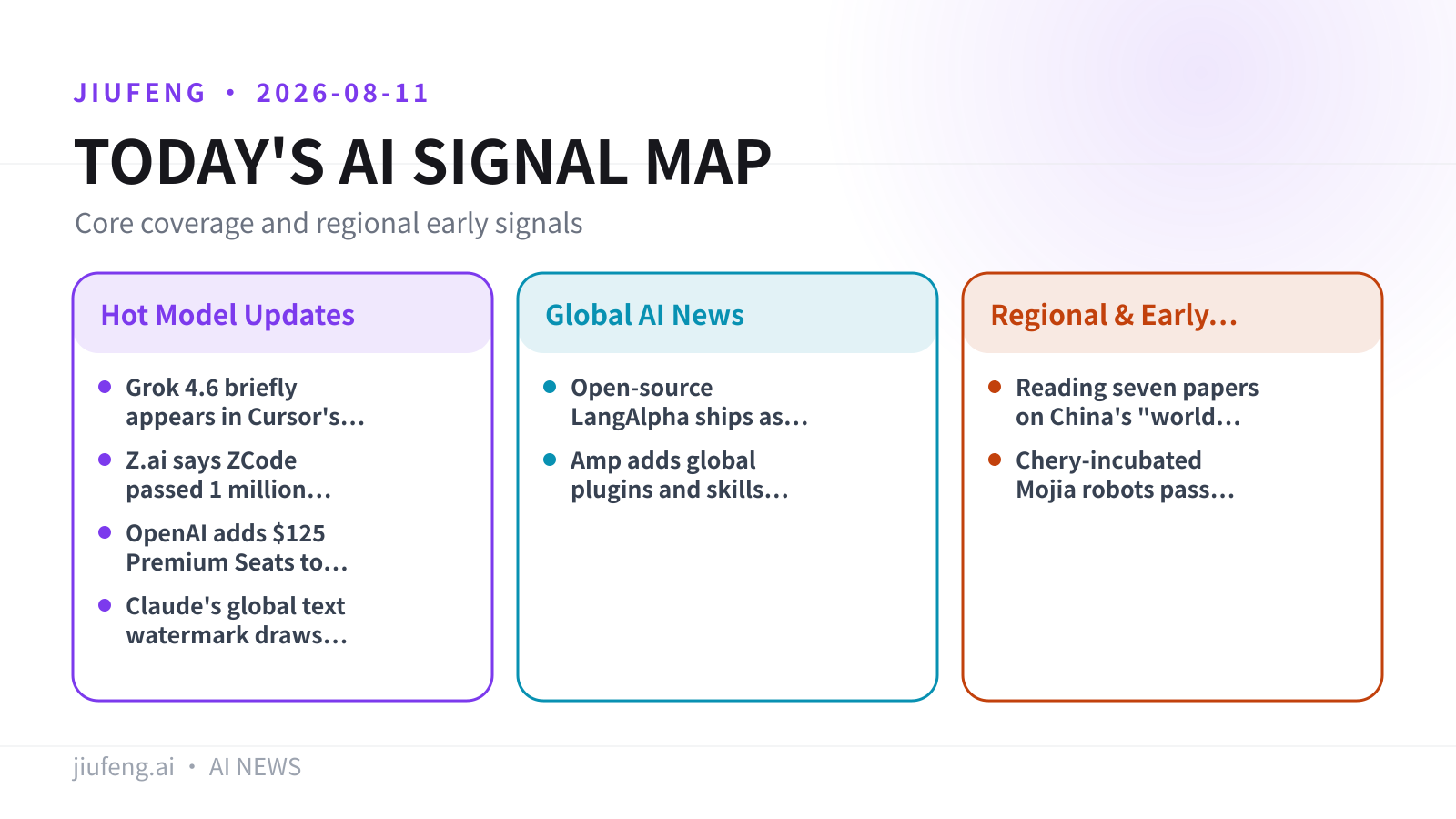
Jiufeng graphic based on the sources cited in this issue.
Hot Model Updates
01/09
Grok 4.6 briefly appears in Cursor's production model list
xAI's unreleased Grok 4.6 surfaced in Cursor's picker before being pulled; there is still no official announcement.
Per RuntimeWire, at about 5:19 p.m. Central on August 10th, Cursor users spotted an option labeled "Cursor Grok 4.6 (fast)" in the production model picker, described as "Cursor and SpaceXAI's most powerful model" for "complex, long-running agentic coding tasks," listing a 256,000-token context window and high-effort reasoning. By roughly 6 p.m., Cursor had removed it. At 1:18 a.m. Central on August 11th, developer Francesco Ciulla received preview access.
Some developers said they could send requests; others hit usage restrictions or could not get Grok 4.6 to edit code, pointing to an early production exposure rather than a general release. RuntimeWire cautions that specs shown inside Cursor should not automatically be treated as those of the standard xAI release, and xAI has not announced Grok 4.6.
Image source: spacexai; mirrored on Jiufeng R2.
Source: RuntimeWire · xAI docs · Francesco Ciulla (X)
02/09
Z.ai says ZCode passed 1 million users, resets GLM plan limits
The figure is self-reported and does not separate registered, active or paying users; no revenue or retention data.
Z.ai, the Beijing company founded by Tsinghua researchers Jie Tang, Li Juanzi and Zhang Peng, is using its ZCode desktop coding app to route its GLM models toward paid developer usage. Z.ai's official account says ZCode has reached 1 million users and that it has reset usage limits for all GLM Coding Plan users.
RuntimeWire notes the post provides no evidence for the count, does not say whether 1 million counts registered, active or paying users, and gives no publication date, revenue, retention or paid-conversion figures. The quota reset lets developers who had exhausted allocations run repository-scale workflows again, which will also raise Z.ai's inference demand. ZCode competes directly with Anthropic's Claude Code.
Source: RuntimeWire · Z.ai on X · Claude Code
03/09
OpenAI adds $125 Premium Seats to ChatGPT Business
The new seat costs five times the standard seat; OpenAI says agentic tasks burn far more tokens.
OpenAI is rolling out "Premium Seats" for ChatGPT Business at $125 per user per month ($100 with annual billing), five times the existing standard seat's $25 ($20 annual). Premium users get five times the standard usage capacity, are not bound by the five-hour limit, and have usage reset weekly; both seat types can be mixed in one workspace, with admins assigning tiers per member. OpenAI says the change reflects teams tackling more complex tasks and needing more capacity as agent-based AI consumes far more tokens.
The Decoder notes the labs' flat-rate plans were likely loss leaders with increases expected; by contrast, Microsoft has taken the opposite route with Copilot, swapping some pricey OpenAI and Anthropic models for cheaper in-house alternatives.
Source: The Decoder · OpenAI
04/09
Claude's global text watermark draws developer backlash over control
Anthropic says the marks cover all generated text, while EU guidance excludes source code — exposing a scope gap.
Anthropic will apply model-level watermarks to text generated by supported Claude models across Claude Code, its API and consumer products worldwide. Nick Dobos, a software and prompt engineer at The Browser Company, objected in a three-post X thread on August 10th: "I don't want invisible information in my codebase that I don't control." He argues that letting an AI coding agent embed an imperceptible mark creates a channel developers cannot independently inspect.
Per RuntimeWire, the dispute centers on scope: EU transparency guidance excludes source code, whereas Anthropic says its marks cover all generated text. Dobos invoked Hugging Face's July agent intrusion as an example of the stakes when autonomous systems act in ways people cannot readily observe.
Source: RuntimeWire · Nick Dobos (X) · Hugging Face timeline
05/09
Alibaba launches CosyVoice Studio, its first full-stack voice platform
The platform bundles the Qwen-Audio family, including Qwen-Audio-3.0-Realtime, reported to top Artificial Analysis.
Per Pandaily, Alibaba has launched CosyVoice Studio, its first full-stack voice AI platform, bundling the Qwen-Audio speech family — including Qwen-Audio-3.0-Realtime, which Pandaily reports as top-ranked on Artificial Analysis — into one platform with three product modules. Alibaba is positioning speech as the next productivity entry point.
This rests on a single English-language report from Pandaily; pricing, regional availability and the specific capabilities of the three modules are not detailed there and await Alibaba's own documentation.
Source: Pandaily
Global AI News
06/09
Open-source LangAlpha ships as a "Claude Code for finance"
An open-source financial Agent OS built on a Harness architecture, driving research workflows in natural language.
The ginlix-ai team has open-sourced LangAlpha, positioned as a "financial Agent OS" and self-described as "Claude Code for finance": natural language drives investment research, data, code and workflows. The code lives at github.com/ginlix-ai/LangAlpha, with a hosted SaaS at langalpha.ai. The team says it is built on a Harness architecture, where the model handles reasoning while the Harness keeps tasks running, data trustworthy, the process traceable and failures recoverable.
Per InfoQ, unlike the general-purpose Claude Code, LangAlpha targets finance and adds time-semantics for financial data, a long-lived Workspace, code computation, an evidence chain, validation rules, and permissions and auditing. It is a first release with no adoption figures or third-party benchmarks yet.
Source: GitHub · InfoQ (Chinese-language source)
07/09
Amp adds global plugins and skills for unattended orbs
Plugins and skills become Amp-hosted and work everywhere Amp runs.
The coding agent Amp has added "Global Plugins and Skills." Amp says that because so much work now happens inside orbs — machines where an agent can run without supervision — it needed a new place to store plugins and skills, so it made them Amp-hosted, built for agents, and available everywhere Amp runs.
The update was published in Amp's own documentation; it is a tooling change, with no usage figures or comparisons to other agent platforms provided.
Source: Amp
Regional & Early Signals
08/09
Reading seven papers on China's "world model vs VLA" divide (Chinese-language source)
Commentary sorts Huawei/NIO as world-model and XPeng/Li Auto as VLA, but the papers blur that line.
Per Titanium Media (republishing HiEV), Li Auto's CVPR 2026 oral paper SparseWorld-TC studies world models yet opens by conceding the field still lacks a unified definition. XPeng, which publicly frames its stack as VLA, released five 2026 technical reports on arXiv authored by four separate teams — predictive world model, generative world model, AI Infra and foundation model; its X-Foresight acknowledgments note the generative world-model team's X-World underpins its diffusion-renderer pretraining.
The papers also name each other: Xiaomi Auto and Huazhong University of Science and Technology's DriveLaW cites Epona and DriveVLA-W0 (the latter from Huawei-spun-off Yinwang), arguing such methods split generation and planning and leave a gap between visual imagination and action; Yinwang and CAS Institute of Automation's DynVLA criticizes pixel-level visual chain-of-thought for redundancy and compute overhead. These are the papers' own technical claims and route debates, not independent benchmark results. This is a single Chinese-language report.
Source: Titanium Media (Chinese-language source)
09/09
Chery-incubated Mojia robots pass 2,000 units across 60+ countries
The humanoid and quadruped brand Mojia is in 60+ countries, led by Malaysia, the UAE, Thailand and South Africa.
Per Pandaily, Mojia — the humanoid and quadruped robot brand incubated inside Chery — has cumulatively delivered more than 2,000 robots across 60-plus countries, anchored by Malaysia, the UAE, Thailand and South Africa; the report frames the real "product" as Chery's own globalization stack.
This is a single English-language report from Pandaily; the delivery basis, time window and per-model breakdown are not detailed, making it an early globalization signal.
Source: Pandaily
Write a prompt in your browser and get an image — 1K, 2K or 4K output, up to 15 reference images. 50 free generations on sign-up, no credit card.
Generate free