Overview
9 stories in this issue. The first 3 are today's priorities.
Hot model updates
- Top · Meta open-sources Muse Glimmer, a 30B model for one GPU
- Top · Anthropic releases Claude Sonnet 5
- Top · Anthropic will watermark future Claude text worldwide
- Cactus ships Needle 2, a 14MB on-device agentic model
Global AI news
- Nvidia lines up six Wall Street firms for a $500B+ AI compute financing push
- Microsoft ships Agent Framework Harness and Hosted Agents
- VectorWare maps Rust's portable SIMD onto Nvidia GPUs
Regional & early signals
- Someone trained a 1B model from scratch for about $200
- Qwen3.8 "Qwen Office": a polished single-purpose tool that doesn't carry your data across devices
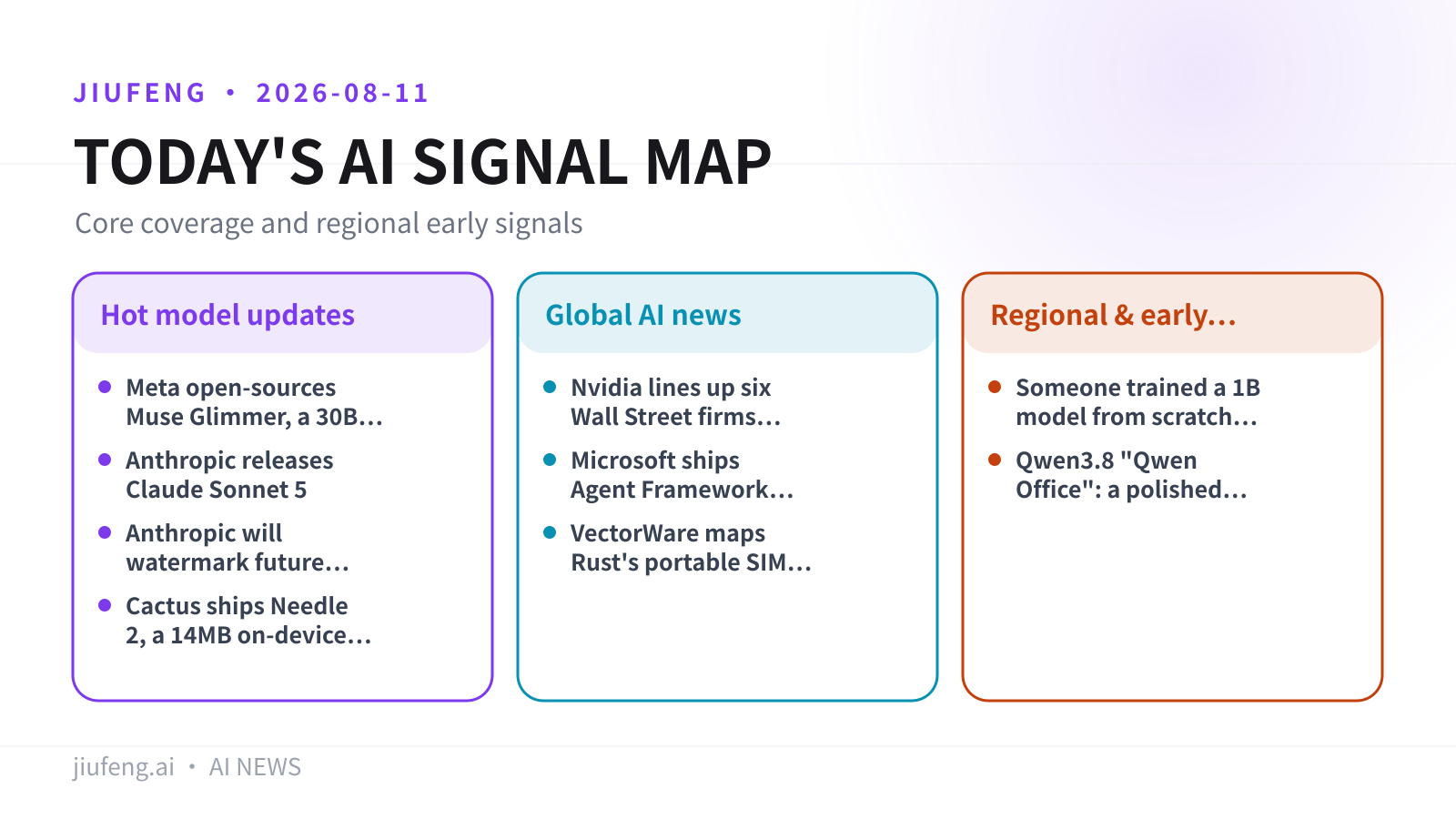
Jiufeng graphic based on the sources cited in this issue.
Hot model updates
01/09
Meta open-sources Muse Glimmer, a 30B model for one GPU
Meta ships an Apache-2.0 open agentic model that runs on a single consumer GPU.
Meta released Muse Glimmer, a 30B open-weights agentic model under Apache 2.0 that fits a single 24 GB consumer GPU. Meta says it decodes 3.1x faster with DFlash speculation. The Hugging Face collection ships BF16 weights, GGUF k-quants, ExecuTorch builds and the DFlash drafter, and self-hosting is supported.
Limitations: the 3.1x figure is Meta's own, measured with its DFlash method and requiring the drafter model; as a 30B open-weights agentic model it has no third-party benchmarks yet, so its capability remains to be independently verified.
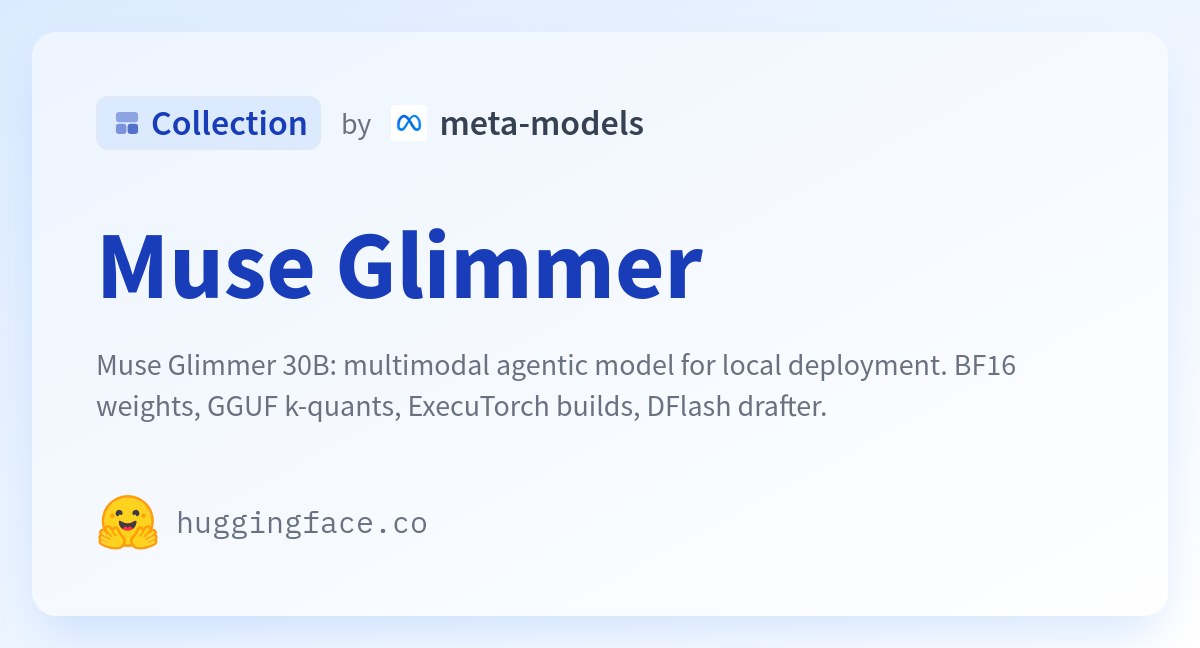
Image source: huggingface; mirrored on Jiufeng R2.
Source: MarkTechPost · Hugging Face collection
02/09
Anthropic releases Claude Sonnet 5
Anthropic calls it its "most agentic Sonnet yet," priced at $2/$10 per million input/output tokens.
Anthropic introduced Claude Sonnet 5 on its newsroom, positioning it as its "most agentic Sonnet yet" with top-tier intelligence for coding and everyday professional work. Anthropic prices it at $2 per million input tokens and $10 per million output tokens, below its own Opus 4.8 at $5/$25. The announcement cites a System Card and shows BrowseComp and OSWorld-Verified benchmark charts.
Limitations: the benchmark results and pricing all come from Anthropic's own announcement (including self-reported System Card data); it is the only primary source in this cycle and no independent third-party evaluation has appeared yet, so capability comparisons remain to be verified.
Source: Anthropic Newsroom
03/09
Anthropic will watermark future Claude text worldwide
The policy covers Claude's API and cloud partners; generated files carry C2PA provenance metadata where supported.
Anthropic said it will watermark text generated by future Claude models worldwide. The policy covers Claude's API and cloud partners, and generated files will carry C2PA provenance metadata where supported. The plan drew wider attention on Monday (Aug 10) after user M1 (@M1Astra) reposted it.
Limitations: models released before the cutoff date get a transition period, and Anthropic says it is still adding marking support to them, so older models aren't covered yet; C2PA metadata is attached only "where supported." The source doesn't detail the text-watermark implementation or its tamper resistance.
Source: RuntimeWire · M1 (@M1Astra)
04/09
Cactus ships Needle 2, a 14MB on-device agentic model
A 14MB agentic LLM for phones, wearables, smart home and small robots, built for tool calls and structured extraction.
Cactus (posted by Henry) released Needle 2, a 14MB agentic LLM for phones, wearables, smart homes and small robots, focused on tool calling, device use and structured extraction. It follows the team's earlier 14MB Cactus Needle and ships with an arXiv paper (2607.18363).
Limitations: it was announced via Show HN on Hacker News; at 14MB its scope is tool-calling and structured extraction rather than general chat, and technical details rest on the accompanying arXiv paper.
Source: arXiv · Hacker News
Global AI news
05/09
Nvidia lines up six Wall Street firms for a $500B+ AI compute financing push
Nvidia partners with Apollo, BlackRock and others to build financing pools for its infrastructure customers.
Nvidia said Monday (Aug 10) it signed preliminary agreements with six investment firms — Apollo, BlackRock, Blackstone, Brookfield, Goldman Sachs and KKR — to set up AI compute infrastructure financing platforms aiming to mobilize more than $500 billion of third-party capital, creating financing pools for Nvidia customers building AI infrastructure.
Limitations: the agreements are preliminary. RuntimeWire reads the move as turning access to capital into another engine for Nvidia hardware sales, tying the financing directly to Nvidia's own product demand.
Source: Nvidia Newsroom · RuntimeWire
06/09
Microsoft ships Agent Framework Harness and Hosted Agents
The Harness and Hosted Agents turn the framework from a build library into something platform teams can run and manage.
Microsoft formally released the Agent Framework Harness and (Foundry) Hosted Agents, giving platform teams a way to run and manage agents rather than only a library to build them. The Harness is a single binary that runs across local dev, container and hosted deployment environments. InfoQ cites an April 2026 paper from MBZUAI's VILA lab, "Demystifying Claude Code" (analyzing Claude Code v2.1.88), arguing the harness makes up most of an agent system, so a supported harness matters more than it looks. The framework was previously seen as consolidating Semantic Kernel and AutoGen.
Limitations: the "harness is most of the system" argument comes from a third-party academic analysis of Claude Code, not Microsoft's own benchmarks; the release specifics rest on Microsoft's docs and InfoQ's reporting.
Source: InfoQ · arXiv · InfoQ 中文
07/09
VectorWare maps Rust's portable SIMD onto Nvidia GPUs
A compiler team stretches ordinary Rust abstractions across GPU threads, lanes and async execution.
VectorWare (founder Christian Legnitto) demonstrated on August 10 Rust's portable SIMD API running on an Nvidia GPU. The compiler team treats a GPU warp as another vector target — Nvidia organizes GPU threads into warps of 32 lanes — so developers can write portable SIMD once instead of maintaining separate implementations per instruction set.
Limitations: this is a demonstration, not a shipping product; portability was shown specifically against Nvidia's warp model, and maturity across other targets isn't detailed.
Source: RuntimeWire · NVIDIA CUDA docs
Regional & early signals
08/09
Someone trained a 1B model from scratch for about $200
A developer trained a 1B LLM on 20B tokens for ~$200, with open, reproducible code and weights.
As a personal learning/resume project, a developer trained a 1B-parameter LLM from scratch on 20B tokens for about $200. It was trained only on pre-2024 data with an intentional knowledge cutoff to enable "surprise" experiments (using logprobs to measure how predictable a post-cutoff event looks). Its main departure from Gemma 3 is dropping sliding-window attention; the vocab is 32,768 (versus Gemma's 262,144), English-only, with byte fallback (no UNK) and split digits. Code and weights are on GitHub and reproducible.
Limitations: this is a small personal project, English-only and cut off before 2024 — not a production model; parts of the design follow the Llama paper.
Source: GitHub · arXiv (Llama paper)
09/09
Qwen3.8 "Qwen Office": a polished single-purpose tool that doesn't carry your data across devices
Chinese hands-on review: useful but siloed — switch computers and local data is gone.
TMTPost tested "Qwen Office," built on Qwen3.8, and concluded it is a "polished single-purpose toolbox": the single-point experience is refined but the product is siloed. One concrete limitation it surfaced: data is stored locally and doesn't sync across devices by account, so switching to another computer loses prior data.
Limitations: this is a single Chinese outlet's hands-on assessment, not vendor metrics; the data-loss finding is the reviewer's observation in specific use, and coverage of versions/scenarios follows the original. (Chinese-language source)
Source: TMTPost
Write a prompt in your browser and get an image — 1K, 2K or 4K output, up to 15 reference images. 50 free generations on sign-up, no credit card.
Generate free