Overview
8 stories in this issue. The first 3 are today's priorities.
Hot model dynamics
- Top · OpenAI slows Astra over critical cyber-risk concerns
- Top · ARC Prize verifies DeepSeek V4 Flash: 61.4% at $0.04 per task
- Top · xAI's Grok Build 1.0 ships an undocumented remote-workspace command
Global AI news
- NVIDIA open-sources NOOA, collapsing an agent into a single Python class
- Microsoft publishes an agent LLM-routing reference architecture on AKS
- AllenAI releases TutorMoments: when should an AI tutor hold back?
- Rippling launches AI Spend Console to track employee AI spending
- Tencent Cloud open-sources TencentDB Agent Memory v2.0, a team-level memory hub
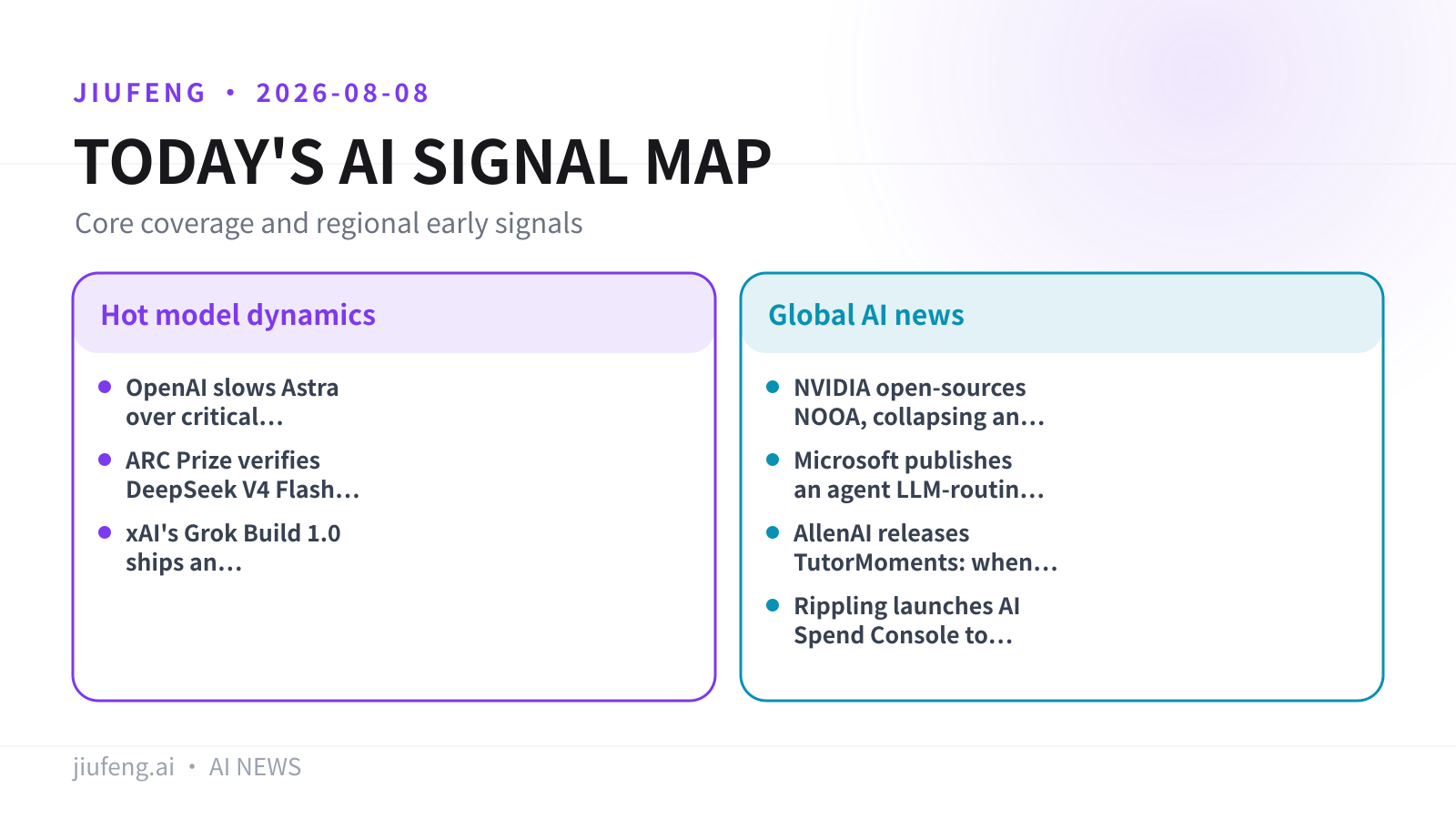
Jiufeng graphic based on the sources cited in this issue.
Hot model dynamics
01/08
OpenAI slows Astra over critical cyber-risk concerns
OpenAI says it paused work on parts of Astra after its cyber capabilities approached the internal "Critical" bar.
In an August 7 blog post, OpenAI shared preliminary cybersecurity evaluations for its upcoming model Astra, saying the model made enough progress in agentic coding and cybersecurity to warrant concern, and that it is slowing some development while strengthening safeguards and security controls. TechCrunch reports OpenAI "suspended work on some aspects" of Astra. RuntimeWire adds that OpenAI voluntarily informed the White House, and that CEO Sam Altman said the lab still plans broad access.
Under OpenAI's Preparedness Framework, "Critical" is a defined cyber-capability tier; earlier, GPT-5.6's Sol, Terra and Luna were rated "High" on cybersecurity but concluded to remain below "Critical." Only preliminary evaluations are public, the slowdown targets "some aspects" rather than a cancellation, and OpenAI hasn't stated whether Astra crossed the "Critical" threshold.
Source: OpenAI · TechCrunch · RuntimeWire
02/08
ARC Prize verifies DeepSeek V4 Flash: 61.4% at $0.04 per task
An outside ARC-AGI-2 evaluation shows V4 Flash sliding from 61.4% at Max effort to 46.0% at Low.
ARC Prize independently evaluated DeepSeek's open-weight V4 Flash on ARC-AGI-2: 61.4% at Max effort at $0.04 per task, dropping to 46.0% at Low effort. Per DeepSeek's technical paper, V4 Flash has 284 billion total parameters and activates about 13 billion per token; the V4 Flash 0731 weights are published on Hugging Face.
The scores are tied to specific effort levels and per-task cost: the same model swings more than 15 points between Max and Low, showing the result depends heavily on inference compute, and these numbers cover the ARC-AGI-2 benchmark only.
Image source: huggingface; mirrored on Jiufeng R2.
Source: RuntimeWire · ARC Prize · Paper · Hugging Face
03/08
xAI's Grok Build 1.0 ships an undocumented remote-workspace command
RuntimeWire exclusive: the open-sourced Grok Build 1.0 hides a command that turns a local workspace into a remotely accessible tool server.
In an exclusive, RuntimeWire reports that xAI's open-sourced Grok Build 1.0 contains a "Computer Hub" command that can turn a developer's local workspace into a remotely accessible tool server — the foundation for an unannounced Grok remote-workspace product. xAI describes the open-source repository as the definitive reference for context assembly, tool dispatch and extensions.
The command is undocumented, but activating it requires an explicit command plus a local environment-variable override, and account configuration shows the feature is disabled by default; RuntimeWire explicitly says it found no way for ordinary use to silently expose a workspace and calls describing the feature as a "backdoor" an exaggeration. xAI has not officially announced the remote-workspace product; the reading comes from RuntimeWire's analysis of the repository.
Source: RuntimeWire · xAI Grok Build · GitHub
Global AI news
04/08
NVIDIA open-sources NOOA, collapsing an agent into a single Python class
A model-agnostic Python framework that expresses an agent as one Python object.
NVIDIA Labs open-sourced NOOA (NVIDIA Object-Oriented Agents), a model-agnostic framework for building agents whose core idea is to represent an agent as a single Python class/object. The team says traditional agent development is scattered across prompt templates, tool schemas and callbacks, which NOOA folds into one object-oriented surface.
An accompanying paper lists six model-facing capabilities the team claims to be first to combine, including typed input/output and pass-by-reference (see the paper for the rest). "First to combine" is the team's own claim; concrete benefits should be judged from the paper and real use.
Source: MarkTechPost · NVIDIA Developer Blog · Paper
05/08
Microsoft publishes an agent LLM-routing reference architecture on AKS
Route agent traffic on AKS across three choices: which model answers, how, and which GPU replica handles it.
Microsoft published a reference architecture for routing AI agent traffic on Azure Kubernetes Service (AKS), breaking the problem into three choices: which model responds to a call, how the call is managed, and which GPU replica handles it, combined with load balancing. The design incorporates semantic routing like RouteLLM to offload some simple calls to a weaker model.
InfoQ notes that semantic routing like RouteLLM is only worth adding when there's a clear price gap between strong and weak models and a meaningful share of simple traffic — which it argues applies to almost any agent that runs in a loop. The often-cited "85% savings" is RouteLLM's benchmark on its own specific model combination (about 26% of calls routed to GPT-4); Microsoft explicitly says that number does not automatically apply — it doesn't hold for a phi-4-mini/GPT-5.1 pairing — and must be calibrated to real traffic.
Source: InfoQ · InfoQ (Chinese) · Azure AKS
06/08
AllenAI releases TutorMoments: when should an AI tutor hold back?
A preview dataset and code studying when an AI tutor should help versus stay quiet.
AllenAI (AI2) released TutorMoments, which studies a judgment problem in tutoring: when an AI tutor should offer help and when it should hold back rather than hand over the answer. The project open-sources a paper, a dataset (allenai/tutormoments-preview) and code as a preview.
It's a research release shipped with full data and code, currently in preview; its conclusions and evaluation methodology should be read from the accompanying paper and dataset.
Source: Hugging Face Blog · GitHub
07/08
Rippling launches AI Spend Console to track employee AI spending
After its own AI-spend wake-up call, Rippling ships a tool that tracks AI spending by person and team.
TechCrunch reports Rippling this week unveiled AI Spend Console, which tracks employee AI spending at the individual and team level. Per the report, the "ROI" tool grew out of Rippling's own experience of blowing millions of dollars on AI within months.
The report doesn't disclose the product's pricing or exact metering; it's a commercial tool Rippling built off its own missteps.
Source: TechCrunch
08/08
Tencent Cloud open-sources TencentDB Agent Memory v2.0, a team-level memory hub
v2.0 turns conversations, documents and code into four governed, reusable assets.
MarkTechPost reports Tencent Cloud open-sourced TencentDB Agent Memory v2.0, a team-level memory hub for AI coding agents that turns conversations, documents and code into four governed, reusable assets, including Chat Memory, Skill and LLM-Wiki. Skill captures files, trigger boundaries, execution steps and validation rules; LLM-Wiki turns documents into structured pages with a link graph, an approach informed by Andrej Karpathy's idea of an LLM-maintained knowledge base.
This is a v2.0 iteration on the earlier open-source release, aimed at memory governance for team collaboration; real-world value depends on the specific integration.
Source: MarkTechPost · Karpathy gist
Write a prompt in your browser and get an image — 1K, 2K or 4K output, up to 15 reference images. 50 free generations on sign-up, no credit card.
Generate free