Overview
8 stories in this issue. The first 3 are today's priorities.
Hot model watch
- Top · 4B open model matches GPT-5.6 Sol at ~100x lower cost
- Top · Claude Code's creator: wipe your CLAUDE.md every six months
Global AI
- Top · Amp ships Portals: an HTTPS tunnel into services running in a cloud orb
- Mobileye cuts internal-ticket response time 90% on Bedrock AgentCore
- Prime Intellect open-sources Prime Agent: sub-agents as calls in a persistent IPython kernel
Regional & early signals
- Alibaba's Qwen Office lands on HarmonyOS, covering Windows/macOS/HarmonyOS
- AMIRO co-founder starts an "AI + women's health" hardware venture with ex-Qwen trainers
- As AI-for-science accelerates, lab infrastructure becomes the decisive variable
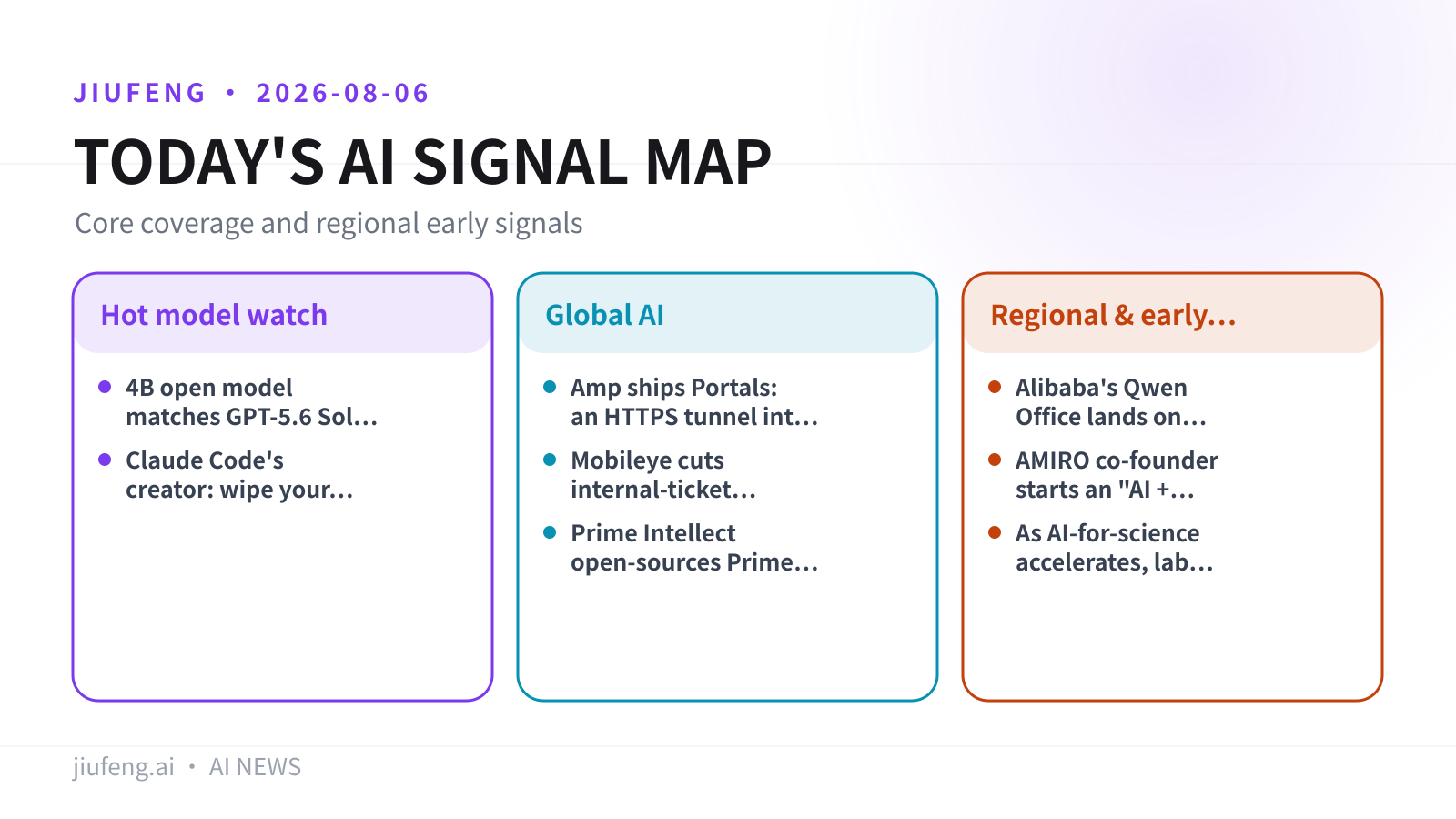
Jiufeng graphic based on the sources cited in this issue.
Hot model watch
01/08
4B open model matches GPT-5.6 Sol at ~100x lower cost
A Neon/Castform case study claims a 4-billion-parameter open-weight model, after targeted post-training, matched GPT-5.6 Sol on retrieval accuracy at about 1/100th the per-inference cost.
Facts: Per an August 5, 2026 case study published by Neon and co-authored by Castform co-founder Ying Hang Seah, Databricks product executive Pranav Aurora, and Angel Pan, a 4B open-weight model post-trained with Castform retrieved search results as accurately as OpenAI's GPT-5.6 Sol while costing about 100x less per inference workload. Castform's pitch: teams can turn their own databases, documents and production traces into specialized models without building an internal ML platform, using the same search interface in training and production inference to shrink the train/deploy gap (a retrieval-training example is on GitHub).
Limitations: The benchmark is a vendor-authored, task-specific evaluation with limited methodology; the 100x figure rests on that self-authored test, not an independent reproduction. RuntimeWire frames it as "a narrow win with useful economics," not a general capability claim.
Image source: OpenAI Developers; mirrored on Jiufeng R2.
Source: RuntimeWire · GPT-5.6 Sol docs · GitHub example
02/08
Claude Code's creator: wipe your CLAUDE.md every six months
Boris Cherny says each model generation deserves a fresh CLAUDE.md, Skills and Hooks; Opus 5 with Auto Mode can run for days to months without stopping.
Facts: In a podcast interview published (in Chinese) by InfoQ, Claude Code creator Boris Cherny argues that models should be treated as "a living creature" whose personality shifts each generation, so roughly every six months you should delete your CLAUDE.md, Skills and Hooks and re-check how many instructions the newest model still needs. He says that after Opus 5 shipped, the team deleted more than 80% of its system prompt, and that for each new model they wipe the prompt and add it back line by line, using ablations to see what still helps. On capability, he says Opus 5 reached 30% on ARC-AGI-3 (prior bests were single digits to low teens) and that, paired with Auto Mode, it can run continuously for days, weeks or months without extra scaffolding or a goal command.
Limitations: These are first-person claims from one interview, not third-party retests. One experiment he cites — having Claude rewrite the Electron-based Claude desktop app into Swift, verified pixel-by-pixel via Mac VM screenshots — has run for over two weeks, possibly invoking thousands to tens of thousands of agents, and still isn't finished. (Chinese-language source)
Source: InfoQ
Global AI
03/08
Amp ships Portals: an HTTPS tunnel into services running in a cloud orb
Amp's new portals let you reach any HTTP service listening on a port inside an orb by saying "show me in a portal," with live reload and multiplayer.
Facts: Amp (ampcode.com) announced portals: if a service inside a remote-dev orb listens on a port and speaks HTTP, saying "show me in a portal" exposes it over HTTPS — to try an agent's changes, annotate and comment on the page, or have the agent build an ad-hoc web app to debug the system. Under the hood the agent creates or looks for a .amp/services.yaml and runs amp orb services ensure|start to launch the app and expose it; the app must respect the injected PORT and PUBLIC_URL env vars. Portals are open to anyone with access to the thread and sleep/wake with the orb; make a thread multiplayer and teammates see changes live.
Limitations: Portals only cover services that "listen on a port and speak HTTP," and the app must honor PORT/PUBLIC_URL. This is Amp's own launch note, with no third-party evaluation.
Source: Amp Chronicle
04/08
Mobileye cuts internal-ticket response time 90% on Bedrock AgentCore
Mobileye deployed an AI support agent on Amazon Bedrock AgentCore that, it says, cut internal-ticket response times 90% and exceeded a 95% accuracy target with "zero infrastructure overhead."
Facts: Per the AWS Machine Learning Blog, Mobileye deployed an AI support agentic solution on Amazon Bedrock AgentCore — from the support bottleneck that sparked the idea, through a proof of concept, to production. It says the solution cut internal-ticket response times by 90% and exceeded a 95% accuracy target with "zero infrastructure overhead." For context, Mobileye has 230M+ EyeQ chips across ~1,200 vehicle models and ingests thousands of drive-recording sessions daily; after launch it turned AgentCore into a self-service platform for other internal teams.
Limitations: The figures come from AWS's own blog and Mobileye's self-reporting, not independent evaluation, and the solution is tied to a single cloud vendor (Amazon Bedrock), with no migration cost or comparative benchmark disclosed.
Source: AWS ML Blog · Mobileye
05/08
Prime Intellect open-sources Prime Agent: sub-agents as calls in a persistent IPython kernel
Prime Intellect released Prime Agent, an MIT-licensed coding-and-research harness whose "Recursive Language Model" turns sub-agent calls into functions inside a persistent IPython kernel; with Opus 5 it reports 95.5% on ARC-AGI-3.
Facts: Prime Intellect has open-sourced Prime Agent, an MIT-licensed coding and research harness. Per MarkTechPost, it is built on two abstractions, centered on the Recursive Language Model (RLM): sub-agent calls become functions inside a single persistent IPython kernel, so research and coding tasks unfold recursively within one runtime. On results, the report says that paired with Opus 5, Prime Agent reports 95.5% on ARC-AGI-3 — above the reported human-expert baseline of 95.4% — at lower token usage.
Limitations: The license and scores come from Prime Intellect's own account, relayed by a single source (MarkTechPost), with no independent third-party retest; the "lower token usage" claim isn't quantified with baseline figures or comparison conditions, and runtime-overhead details should be confirmed against the project repo.
Source: MarkTechPost
Regional & early signals
06/08
Alibaba's Qwen Office lands on HarmonyOS, covering Windows/macOS/HarmonyOS
Alibaba's enterprise agent product Qwen Office shipped a HarmonyOS desktop build on Aug 6, now spanning all three major desktop OSes.
Facts: Per Leiphone, on August 6 Alibaba's enterprise agent product "Qwen Office" (千问办公) released a HarmonyOS PC version, downloadable from Huawei's app market; it now supports Windows, macOS and HarmonyOS. The report also notes Qwen Office passed an office-agent capability assessment by China's CAICT.
Limitations: This is a platform-availability update with no new model capability or parameters, from a single Chinese-language media report; the CAICT assessment's specific criteria and scores aren't given. (Chinese-language source)
Source: Leiphone
07/08
AMIRO co-founder starts an "AI + women's health" hardware venture with ex-Qwen trainers
Leiphone reports AMIRO co-founder Li Ke has founded Congrongdi Health, entering AI women's-health hardware, with an AI lead from Alibaba's Qwen model-training team.
Facts: In an exclusive, Leiphone's Jingxi reports that Li Ke (郦轲) — co-founder, CMO and chief innovation officer of the beauty-device brand AMIRO — has quietly founded Shenzhen Congrongdi Health Technology to enter "AI + women's health." Sources say the first product may be a women's AI health necklace, with a later series spanning diet, emotion and menstrual-cycle scenarios. The report says the core team is set: the AI lead comes from Alibaba's Qwen model-training team, and the design team from France's Lucas-Bernard (LB) jewelry house. Li, born 1989, was a research scientist at the MIT Media Lab and in 2015 co-founded Zongjiang Technology, which launched AMIRO.
Limitations: No product has shipped (the report says "may be"), and the team and direction come from a Leiphone exclusive citing unnamed sources, with no official announcement or funding disclosed — an early signal. (Chinese-language source)
Source: Leiphone · Jingxi
08/08
As AI-for-science accelerates, lab infrastructure becomes the decisive variable
Pandaily argues AI now generates hypotheses faster than AI can verify experiments, with MegaRobo betting on lab tools rebuilt for machines.
Facts: Per Pandaily, in the AI-for-science rush "infrastructure" is becoming the decisive variable: AI-generated hypotheses now outrun AI-verified experiments. The piece says MegaRobo has made a ten-year bet on rebuilding lab tools for machines rather than humans, shipping closed-loop Perception–Conception–Execution systems into pharma.
Limitations: This is a Pandaily analysis piece; the candidate material gives no concrete throughput, scale or third-party validation, so the closed-loop system's real-world results should be judged against primary material.
Source: Pandaily
Write a prompt in your browser and get an image — 1K, 2K or 4K output, up to 15 reference images. 50 free generations on sign-up, no credit card.
Generate free