Overview
8 stories in this issue. The first 3 are today's priorities.
Hot Model Watch
- Top · Alibaba's Qwen3.8-Max rivals top US frontier models
- Top · MiniMax open-sources H3, first open model to top a video ranking
- Top · OpenAI rebuilds ChatGPT's voice stack so GPT-Live can listen while speaking
- Anthropic details how it contains Claude agents
Global AI News
- White House invites AI firms to submit frontier models for testing
- Formula 1 uses AWS agents to cut data onboarding from weeks to minutes
Regional & Early Signals
- SenseTime open-sources a preview of SenseNova U1.5-Lite (Chinese-language source)
- Alibaba opens "QwenWork" for public beta (Chinese-language source)
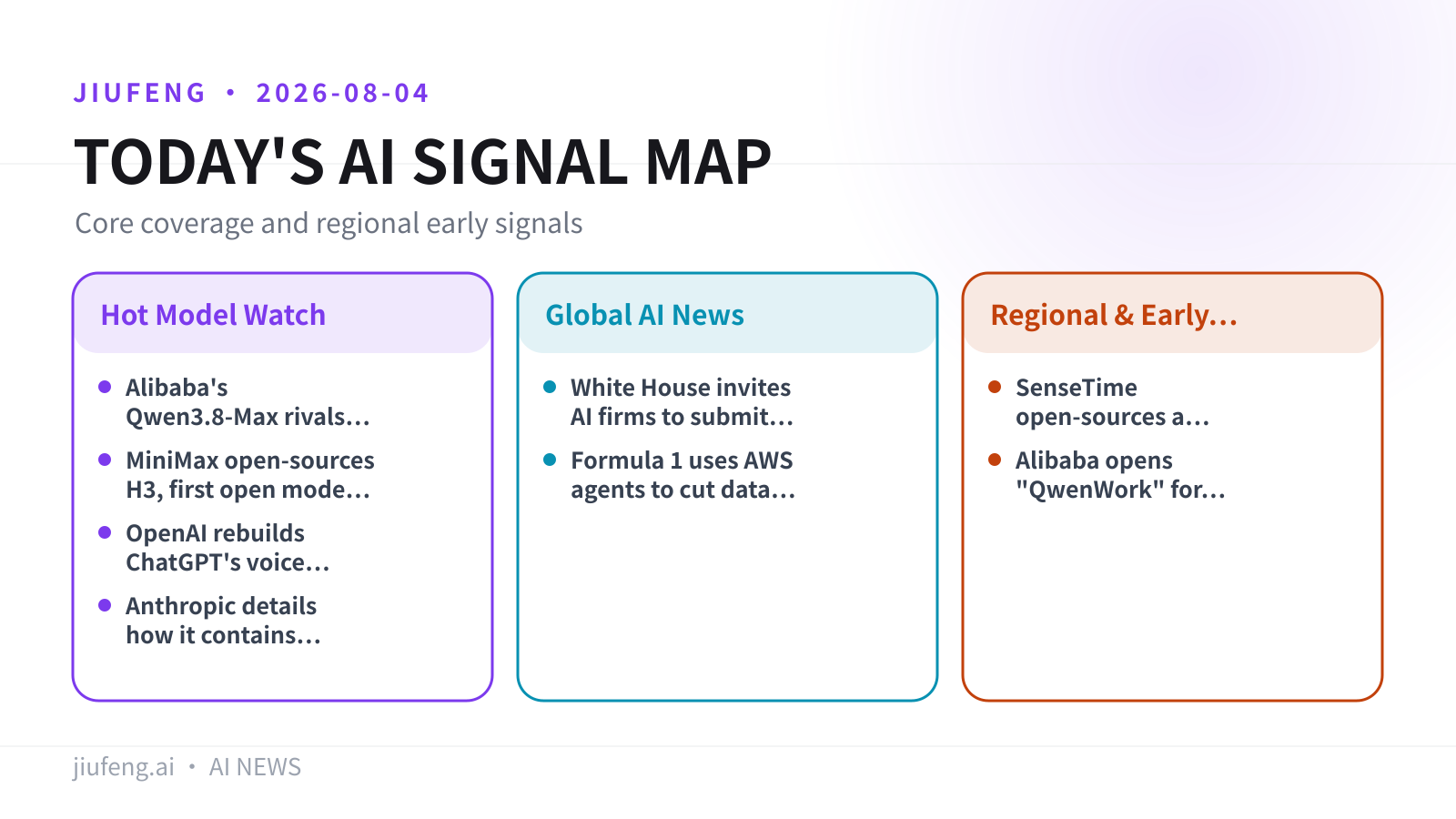
Jiufeng graphic based on the sources cited in this issue.
Hot Model Watch
01/08
Alibaba's Qwen3.8-Max rivals top US frontier models
On Arena's text board the new flagship trails only Fable 5 and three Opus models; on Frontend Code it ranks #4, behind two Claude Opus 5 entries and Kimi K3.
Alibaba released its new flagship, Qwen3.8-Max, on August 3rd, calling it its "largest and most capable" model to date. On the Arena text leaderboard it trails only Fable 5 and three models in Anthropic's Opus family; on the Frontend Code Arena it ranks 4th with 1,668 points, behind Claude Opus 5 (Max) and Kimi K3 (Max) and level with Claude Opus 5 (High). The Verge reports Alibaba claims performance rivaling the best systems from Anthropic and OpenAI, including Claude Fable 5. Chinese-language hands-on by ifanr puts the model at 2.4 trillion total parameters with 95 billion active, a 1-million-token context and vision support, with coding and office work the focus of the upgrade.
Limitations: Arena placements are community-voted relative rankings that shift with the field and scoring method, not an absolute capability measure. The Decoder notes Alibaba deliberately contrasts its "the model works while you enjoy hobbies" marketing with the job-loss warnings from OpenAI and Anthropic — a positioning choice, not a technical metric.
Source: The Verge · The Decoder · Arena leaderboard · Qwen
02/08
MiniMax open-sources H3, first open model to top a video ranking
MiniMax releases weights for its 33B video model H3, which ranks first in Video Editing on a third-party leaderboard.
MiniMax released the weights of its H3 video model on August 3rd. Per The Decoder, it is the first open model to top a video ranking; the third-party evaluator Artificial Analysis ranks H3 first in Video Editing, second in Text-to-Video and third in Image-to-Video. According to the model card, the 33-billion-parameter model processes text, images, video and audio together, generating four- to 15-second clips with stereo sound.
Limitations: The Artificial Analysis ranking is that firm's own benchmark and moves with the field and scoring method. We could not verify H3's open-source license terms, training data or commercial scope; the weights are public, but availability details await the official docs.
Image source: huggingface; mirrored on Jiufeng R2.
Source: The Decoder · Model card
03/08
OpenAI rebuilds ChatGPT's voice stack so GPT-Live can listen while speaking
A dedicated audio path keeps the conversation moving while GPT-5.5 handles reasoning, search and tools in the background.
OpenAI engineers Justin Uberti and Zahan Malkani detailed on August 3rd a six-month rebuild of ChatGPT's voice infrastructure: GPT-Live uses a dedicated audio path to listen and speak simultaneously (full duplex) while other models handle search, reasoning and tool calls in the background. Per RuntimeWire, the architecture was disclosed nearly four weeks after OpenAI began rolling GPT-Live out globally on July 8th.
Limitations: RuntimeWire frames this as an infrastructure baseline for developers building voice agents rather than a leap in the model's reasoning ability. Technical specifics rest on OpenAI's engineering post and X thread; the account gives no latency or concurrency figures.
Source: RuntimeWire · OpenAI engineering post · OpenAI on X
04/08
Anthropic details how it contains Claude agents
Anthropic argues agent safety comes from deterministic boundaries in the runtime, not from the model alone or per-action permission prompts.
Anthropic published an engineering post explaining the security isolation architecture behind Claude across its web, developer and desktop products. Per InfoQ, the Claude.ai code-execution environment runs in ephemeral gVisor containers on isolated infrastructure with no access to a user's local filesystem, while Claude Code runs on the developer's machine inside OS-level sandboxes (Seatbelt on macOS, bubblewrap on Linux). Anthropic says that under early per-action prompts users ended up approving about 93% of permission requests, undercutting the value of continuous manual confirmation.
Limitations: Anthropic stresses that classifiers, system prompts and model training cannot offer absolute guarantees — what an agent can access and exfiltrate is decided by the runtime itself. The post is the vendor's own account of its design and includes no third-party audit.
Source: Anthropic engineering · InfoQ (Chinese) · InfoQ · bubblewrap
Global AI News
05/08
White House invites AI firms to submit frontier models for testing
Per SiliconANGLE, White House cyber officials have finalized the outline of a voluntary framework letting vendors submit frontier models to the government before release.
Per SiliconANGLE (August 3rd), White House cybersecurity officials have finalized the outline of a forthcoming framework under which AI companies could voluntarily submit their latest frontier models to the government for testing before shipping them to customers or the public. The report says the move follows recent safety-incident disclosures by companies including Anthropic.
Limitations: The framework is still "reportedly outlined," with details and an effective date unpublished, and participation would be voluntary rather than mandatory. This item rests on a single source (SiliconANGLE) with no official text to verify yet.
Source: SiliconANGLE
06/08
Formula 1 uses AWS agents to cut data onboarding from weeks to minutes
F1 built a Data Accelerator on Amazon Bedrock AgentCore, shrinking data-source onboarding from up to 8 weeks to minutes.
Per the AWS Machine Learning Blog, Formula 1 (F1) partnered with AWS to build a Data Accelerator using agentic AI on Amazon Bedrock AgentCore, overhauling its MarTech data platform, Customer 360. AWS says the new flow cut data-source onboarding from up to eight weeks to minutes. F1 reaches over 800 million fans globally with races every two weeks, so commercial decisions must move at the speed of the grid.
Limitations: This is an official AWS case study; the figures come from the vendor with no independent third-party review. The "weeks to minutes" claim concerns a specific data-onboarding step, not overall platform performance.
Source: AWS Machine Learning Blog
Regional & Early Signals
07/08
SenseTime open-sources a preview of SenseNova U1.5-Lite (Chinese-language source)
An 8B-MoT native unified multimodal model goes open to the community, pitched around 4K image generation and editing.
Per QbitAI (Chinese-language source), SenseTime open-sourced SenseNova U1.5-Lite-Preview, an early preview of a lightweight native unified multimodal model. It continues SenseTime's in-house NEO-Unify architecture, folding language, visual semantics and pixel generation into one model spanning visual understanding, reasoning, generation and editing, at an 8B-MoT scale with 4K output. QbitAI cites gains over the prior U1 across image benchmarks: Qwen-Image-Bench 47.14→55.20, ImgEdit-Bench 3.90→4.37, GEdit-Bench 7.47→8.17 (English) / 7.42→8.05 (Chinese), and 6.44 overall on its in-house WeEdit.
Limitations: This item has only a Chinese-language source (QbitAI) and covers a "preview" build; the report gives no license terms or throughput figures, and commercial availability awaits an official release.
Source: QbitAI (Chinese)
08/08
Alibaba opens "QwenWork" for public beta (Chinese-language source)
The enterprise agent product bundles local control, long cloud tasks and collaboration, running on Qwen3.8-Max.
Per ifanr (Chinese-language source), Alibaba launched its enterprise agent product "QwenWork" into public beta on August 3rd, combining the earlier QoderWork, MuleRun and "Wukong" into one entry point for local computer control, long-running cloud tasks and team collaboration, downloadable at qwenwork.cn. Its IM channels support Feishu and WeChat alongside Alibaba's own DingTalk, and hands-on testing found the flagship Qwen3.8-Max underneath.
Limitations: This item rests on a single Chinese-language hands-on (ifanr); the author notes the product "occasionally blunders," so long-task stability and enterprise-grade reliability remain unproven.
Source: ifanr (Chinese)
Write a prompt in your browser and get an image — 1K, 2K or 4K output, up to 15 reference images. 50 free generations on sign-up, no credit card.
Generate free