Overview
9 stories in this issue. The first 3 are today's priorities.
Hot model watch
- Top · OpenAI previews Astra, a bet on coordinating long-running agents
- Top · Tracer launches Echo, claiming near-Claude Fable scores at a third of the cost
- Top · Two DeepSeek-V4 findings: a retry lesson from the paper, and V4 Flash's coding score
Global AI news
- Google pulls Google Earth's AI generation feature one day after launch
- Amazon completes its $50 billion investment in OpenAI
- AWS launches an Agentic Catalog Experience in Amazon Quick
Regional & early signals
- InfoQ runs a "self-building agent" experiment with LangChain4j
- Qiunao AI raises tens of millions of yuan in seed funding for a multimodal long-memory base
- Seedance 2.5 video model arrives in the creation tool "Xiaoyunque"
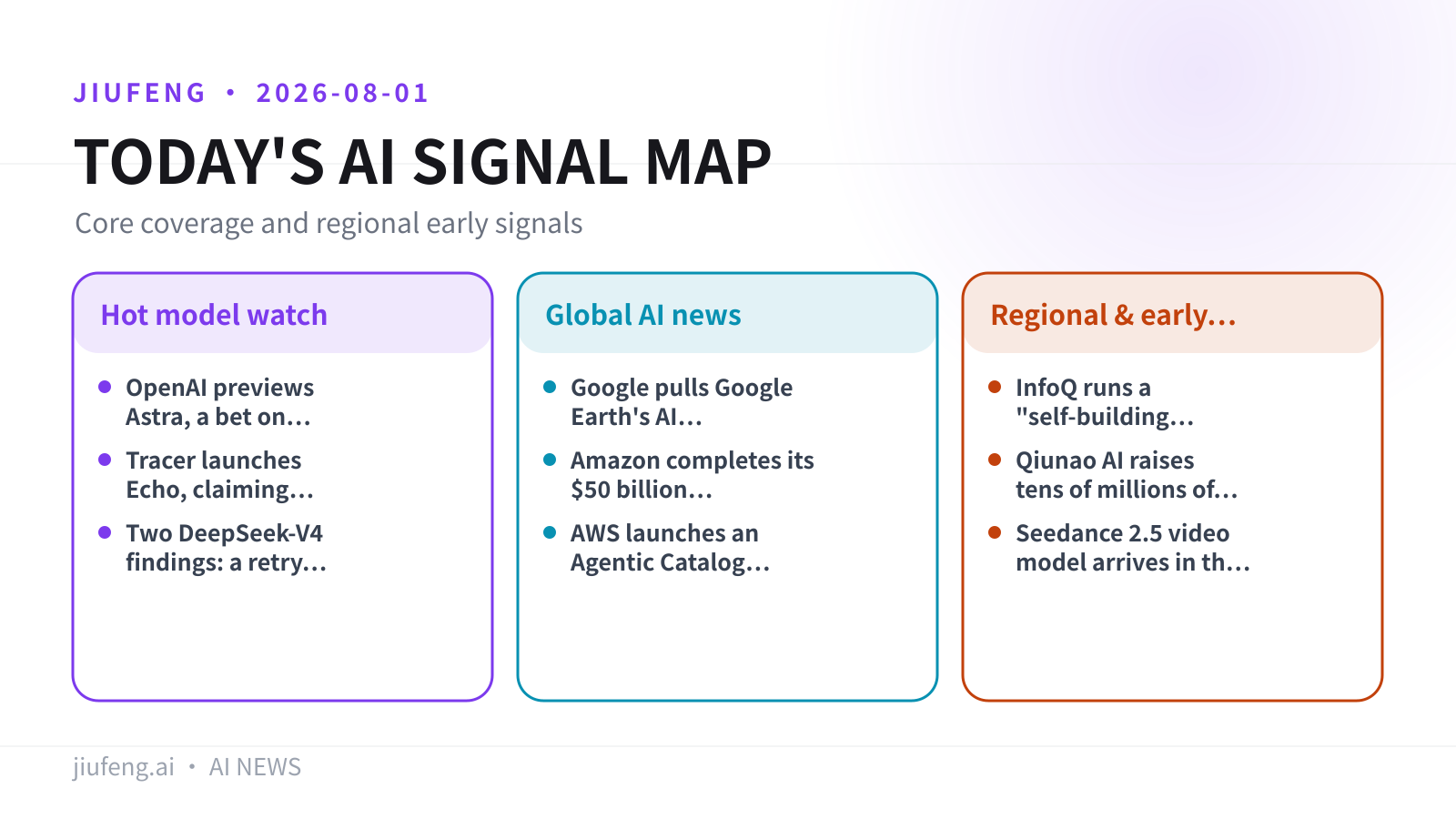
Jiufeng graphic based on the sources cited in this issue.
Hot model watch
01/09
OpenAI previews Astra, a bet on coordinating long-running agents
Altman demonstrated the unreleased Astra model family to Washington policymakers this week, as a federal review nears its August 1st deadline.
Per RuntimeWire, citing The Information, OpenAI CEO Sam Altman this week demonstrated an unreleased model family called "Astra" to policymakers and regulators in Washington, pitched as a system designed to coordinate multiple AI agents over long periods. The report frames Astra as pushing OpenAI from parallel agent features toward models built around persistent coordination, while folding federal review directly into the release process.
Astra remains unreleased; its parameters, context length and availability are undisclosed, and the details come via The Information's account rather than an official OpenAI writeup. Demonstrating it to regulators rather than developers itself signals how tightly release and compliance review are now coupled.
Source: RuntimeWire · OpenAI
02/09
Tracer launches Echo, claiming near-Claude Fable scores at a third of the cost
A solo-founder team routes requests across open-weight models through one OpenAI-compatible endpoint, targeting inference cost.
Tracer (a San Francisco AI lab founded by Adam Rida, YC S26) launched Echo on July 31st, an adaptive inference system that coordinates multiple open-weight models and returns a single answer through an OpenAI-compatible API. In an eight-post thread on X, Tracer said Echo scored 98.6% on MATH-500 at a recorded inference cost of $4.58, benchmarking against Anthropic's Claude Fable 5 and claiming near-equal scores at about one-third the cost. It is callable through OpenCode and compatible agent harnesses.
These scores and costs are self-reported by Tracer in the founder's X thread and have no third-party reproduction yet; Echo comes from a solo-founder team, and the range of models and tasks it covers is not fully disclosed.

Image source: anthropic; mirrored on Jiufeng R2.
Source: RuntimeWire · Tracer (X) · Claude Fable
03/09
Two DeepSeek-V4 findings: a retry lesson from the paper, and V4 Flash's coding score
A DeepSeek-V4 paper detail warns that retrying failed requests introduces length bias; a community benchmark bounds V4 Flash's coding ability.
A passage in the DeepSeek-V4 paper drew attention: regenerating unfinished requests from scratch is mathematically incorrect, because shorter responses are more likely to survive an interruption, so retrying biases the model toward producing shorter sequences — length bias. A developer tested this with roughly 100,000 AI-generated poems and confirmed the effect. Separately, a community run put DeepSeek V4 Flash on SlopCodeBench: under strict scoring it solved only 3 of 17 checkpoints (17.6%) and zero of three problems end to end; on looser criteria 6 checkpoints passed in isolation and 11 passed weaker correctness checks, at a total cost of $0.68.
The SlopCodeBench run is a small sample (3 problems, $0.68) published by an individual on GitHub, not an official evaluation; the paper's retry caveat is a general benchmarking-methodology point rather than a single score.
Source: Quesma blog · DeepSeek-V4 paper · SlopCodeBench run
Global AI news
04/09
Google pulls Google Earth's AI generation feature one day after launch
The feature let users overlay Nano Banana 2-generated images onto real satellite imagery via text prompts; it was taken down within a day over misinformation concerns.
Per TechCrunch, Google on Thursday rolled out a feature in its satellite-imagery app Google Earth that let users invoke its AI image model Nano Banana 2 to generate and superimpose fabricated images onto real maps; Google said the point was to "get creative with geography." Critics quickly noted that the prompt-based tool, which could overlay almost any image onto real maps, was a recipe for creating and spreading misinformation. Google shut the feature down about a day after launch.
The feature's announcement page remained live on Google's blog. This was a product pulled over misuse risk, not a technical failure of the model itself.
Source: TechCrunch · Google blog
05/09
Amazon completes its $50 billion investment in OpenAI
The equity deal ties OpenAI more tightly to AWS cloud and Trainium chips, and is the largest single piece of OpenAI's record financing.
Per RuntimeWire, citing the Financial Times, Amazon has completed its $50 billion investment in OpenAI, turning a conditional commitment into paid-in capital and the largest piece of OpenAI's record financing. The report says OpenAI's new round totals $110 billion, drawn mainly from three companies that supply the capital and infrastructure to train and serve its models; Amazon uses equity to secure OpenAI as a major customer of AWS and its in-house Trainium chips.
This is a deal that fuses capital and infrastructure: Amazon's return on the $50 billion is tied directly to demand for its own AI infrastructure rather than a standalone financial return. Exact equity stake, funding schedule and contract terms are not fully disclosed.
Source: RuntimeWire · OpenAI
06/09
AWS launches an Agentic Catalog Experience in Amazon Quick
An AI workflow for data curators to discover upstream catalog assets in natural language and auto-create Datasets and Topics with inherited semantics.
AWS announced the Agentic Catalog Experience in Amazon Quick. AWS says that as organizations move to AI analytics, the quality of a natural-language (Text2SQL) answer depends on the business context behind it, so semantic information such as table/column descriptions and relationships must flow from upstream data catalogs and semantic tools into the AI products serving end users. The new experience lets data curators discover upstream catalog assets in natural language and auto-create Datasets and Topics that inherit that semantics.
This is an enterprise data-governance feature aimed at data curators rather than end users; the announcement gives no availability regions, pricing or quantified performance metrics.
Source: AWS Machine Learning Blog
Regional & early signals
07/09
InfoQ runs a "self-building agent" experiment with LangChain4j
Handing LangChain4j's docs to a coding assistant and asking it to design a multi-agent system that writes, tests and debugs code, modeled on the framework itself.
An InfoQ experiment describes a "meta-experiment": giving LangChain4j's documentation to a coding assistant and asking it to build an agent modeled on the framework itself — a multi-agent system that writes, tests and debugs code like an engineer. The authors argue that an LLM building "itself" from docs alone shows both that the API is clear enough for the model to use directly and that the framework offers enough orchestration for the generated system to run end to end on real debugging tasks; the exercise also stress-tested LangChain4j's new observability tooling. The resulting project is published on GitHub. (Chinese-language source.)
This is a single engineering write-up, not a general benchmark; its conclusions depend on the chosen prompts and framework version and have no third-party reproduction.
Source: InfoQ (Chinese) · GitHub repo
08/09
Qiunao AI raises tens of millions of yuan in seed funding for a multimodal long-memory base
Founded November 2025, the startup bets on "proactive intelligence" with a native multimodal memory base; the round funds R&D and hiring.
Per 36Kr's startup column, Qiunao AI (丘脑智能) recently closed a seed round of tens of millions of yuan from a top Shenzhen fund and industrial capital, earmarked for R&D and hiring. Founded in November 2025, its CEO Zhang Yuan holds dual degrees in electronics and economics from Peking University; the team averages around 26 years old, with core members from Alibaba DAMO Academy, Tencent, SenseTime and universities including CUHK and PKU. The company builds a native multimodal memory base, betting that AI moves from general to personalized and ultimately to "proactive intelligence" (interacting on its own initiative once it understands the user), treating memory as a threshold that must be crossed.
The report calls it "the only company in China doing multimodal long-term memory," which is the company's own claim, not independently verified; the exact funding amount, product form and traction are not quantified. (Chinese-language source.)
Source: 36Kr (Chinese)
09/09
Seedance 2.5 video model arrives in the creation tool "Xiaoyunque"
The first official Seedance 2.5 creation tool, pitching 30-second native output, multimodal references and more controllable long takes.
Per an ifanr hands-on, the Seedance 2.5 video model has arrived in the creation tool "Xiaoyunque" (小云雀), described as the first official Seedance 2.5 creation tool. The article says upgrades include 30-second native generation, up to 50 multimodal reference assets, white-model rendering, green-screen editing and audio separation, plus character asset packs and libraries, a 3D "director's desk," clip reshoots and built-in dubbing — aimed at moving AI video from "generating short clips" toward a more controllable, near-professional workflow.
These features are a media hands-on and vendor statements, not an independent evaluation; the model's parameters, license, availability scope and objective benchmark scores are not given. (Chinese-language source.)
Source: ifanr (Chinese)
Write a prompt in your browser and get an image — 1K, 2K or 4K output, up to 15 reference images. 50 free generations on sign-up, no credit card.
Generate free