Overview
8 stories in this issue. The first 3 are today's priorities.
Hot model developments
- Top · DeepSeek retunes V4-Flash to strengthen coding agents
- Top · Alibaba's Qwen upgrades speech recognition for technical terms
- Top · MiniMax H3 folds editing, effects and scoring into the video model
Global AI news
- OpenAI rolls out Sign in with ChatGPT as an app identity layer
- Google says AI helped it patch more Chrome bugs in a month than in two years
- OpenAI sets out its responsible-AI governance stance for Europe
Regional & early signals
- EU AI Act enforcement starts Aug 2, with new transparency rules
- US judge questions the basis for the government's Anthropic ban
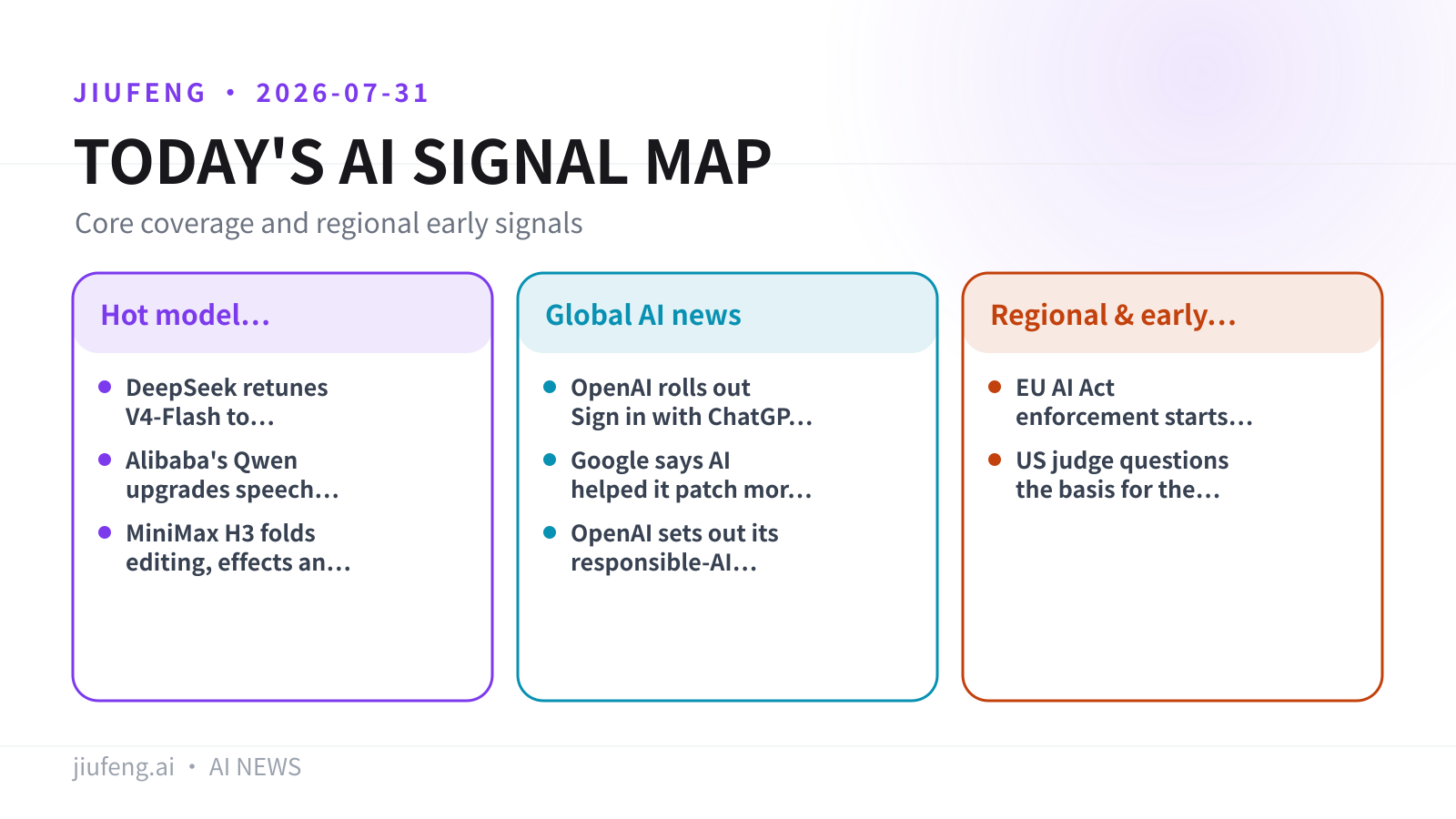
Jiufeng graphic based on the sources cited in this issue.
Hot model developments
01/08
DeepSeek retunes V4-Flash to strengthen coding agents
DeepSeek moved V4-Flash to an official API public beta on July 31, keeping the architecture and parameter count fixed and re-running only post-training to sharpen coding and tool-use behavior.
DeepSeek put an updated DeepSeek-V4-Flash into public beta on July 31, on the API side only, calling it the "official" version. Per DeepSeek, V4-Flash-0731 keeps the same model structure and parameter scale as the earlier Preview and was only re-post-trained — no redesigned architecture and no larger parameter count. RuntimeWire, citing official materials, says the model keeps its mixture-of-experts design with 284 billion total parameters and 13 billion activated per token, and adds native Responses API support aimed at coding-agent workflows.
The update covers only deepseek-v4-flash; the V4-Pro API and the models in DeepSeek's app and website are unchanged, and DeepSeek says an official V4-Pro release will follow without giving a date. DeepSeek also did not disclose the post-training data, reward methods or pipeline, so the size of the agent-capability gain is not yet independently quantified.
Image source: huggingface; mirrored on Jiufeng R2.
Source: RuntimeWire · DeepSeek on X · Hugging Face · Leiphone (Chinese-language report)
02/08
Alibaba's Qwen upgrades speech recognition for technical terms
Alibaba's Qwen team announced Qwen-Audio-3.0-ASR-Flash on July 31, emphasizing domain-term recognition, context consistency and custom hotwords — but the public API docs still point to older model snapshots.
Alibaba's Qwen team announced a speech-recognition update on July 31 aimed at keeping technical vocabulary intact and turning rough speech into structured transcripts. Per Qwen, Qwen-Audio-3.0-ASR-Flash improves context consistency, domain-term recognition and custom hotwords; RuntimeWire notes the service is relatively inexpensive, a bid to pull developers and their production audio into Alibaba Cloud.
RuntimeWire also flags an availability gap: Alibaba's public API documents still point to older model snapshots, QwenCloud's current recognition docs do not identify a Qwen-Audio-3.0-ASR-Flash model ID, and the hotwords description does not match the announcement. Its conclusion is that Qwen's internal results are strong, but developers need model-specific API documentation and production tests before relying on the upgrade.
Source: RuntimeWire · Qwen3-ASR (GitHub) · Qwen3-ASR-Flash service
03/08
MiniMax H3 folds editing, effects and scoring into the video model
A QbitAI hands-on says MiniMax H3 integrates editing, subtitle typography, transitions, pacing, background music and visual effects end-to-end into the model, and reports it topping Artificial Analysis's video-editing leaderboard.
According to QbitAI, MiniMax released a video model, H3, that departs from prior video models that only output "a clip" and still require manual work in a video editor for subtitles, color, transitions and music. H3 folds editing logic, font typography, transition design, pacing, background music and visual effects end-to-end into the model. QbitAI reports H3 ranked first in the video-editing category on the Artificial Analysis leaderboard, and that in testing a text-only prompt was enough for the model to grasp the intended visual and editing style and produce hand-drawn effects, animated intros and trailer cuts.
Note: this is a single Chinese-language source (QbitAI hands-on), and the leaderboard ranking is as reported there; QbitAI itself writes that while AI can generate footage, using editing, lighting and effects to "tell a story" still needs human subjective taste. There is no global English coverage or third-party retest yet.
Source: QbitAI (Chinese-language source)
Global AI news
04/08
OpenAI rolls out Sign in with ChatGPT as an app identity layer
OpenAI began rolling out Sign in with ChatGPT on Friday, with Airtable, GitLab, HubSpot, Notion, Supabase and Vercel as initial partners.
OpenAI began rolling out Sign in with ChatGPT on Friday. Per RuntimeWire, co-founder and president Greg Brockman described it on X as support for a wider network of third-party applications: the identity-provider service lets ChatGPT users create, connect or access accounts on participating sites with their existing OpenAI credentials. Initial partners are Airtable, GitLab, HubSpot, Notion, Supabase and Vercel.
RuntimeWire notes this gives OpenAI a foothold inside third-party apps before an AI agent takes any action, and could turn the ChatGPT account into a distribution and permissions layer for developers. Existing enterprise allow and deny policies remain in effect in the Global Admin Console, and specific handoffs remain subject to separate permission checks.
Source: RuntimeWire · OpenAI help docs
05/08
Google says AI helped it patch more Chrome bugs in a month than in two years
Google says its internal AI tools helped fix 1,072 security bugs across the two Chrome versions shipped in June — more than the 1,036 fixes across the previous 23 versions over two years.
Per TechCrunch, Google announced Thursday that, with help from its internal AI tools, it patched more Chrome security flaws in the last month than in the past two years combined. Specifically, it fixed 1,072 security bugs in the last two Chrome versions, both released in June, versus 1,036 fixes across the previous 23 versions released over the last two years.
TechCrunch frames this as a continuation of two years of warnings that some companies — Microsoft, and now Google — are finding and patching an exponential number of bugs using LLMs. The figures come from Google's own announcement and are its own count.
Source: TechCrunch · Google blog
06/08
OpenAI sets out its responsible-AI governance stance for Europe
OpenAI published "Advancing responsible AI across Europe," describing how its safety, transparency and provenance practices support AI governance there as the EU AI Act advances.
On July 31 OpenAI published "Advancing responsible AI across Europe," describing how its safety, security, transparency and content-provenance practices support responsible AI governance in Europe, and saying the work will continue as the EU AI Act advances.
This is a first-party position post; it gives no specific metrics or new products. Its backdrop is the EU AI Act's enforcement start in the same window (see Regional & early signals).
Source: OpenAI
Regional & early signals
07/08
EU AI Act enforcement starts Aug 2, with new transparency rules
The European Commission says that from Aug 2 it will enforce AI Act provisions with member-state authorities, requiring chatbots to disclose they are AI and deepfake content to carry machine-readable marks.
Per CCTV News and 36Kr, the European Commission announced on July 31 that from Aug 2 its AI Office, together with member-state competent authorities, will begin enforcing provisions of the AI Act, as new transparency requirements take effect. Under the rules, interactive AI systems such as chatbots must clearly tell users they are AI and not a human; AI-generated or -edited deepfake images, video and audio must be labeled, and AI-generated or -modified content must carry machine-readable marks for identification and tracking.
The Commission says the measures aim to reduce deception and manipulation, help the public make informed judgments, and give businesses clearer compliance requirements. This item is a Chinese-language source relaying a CCTV News policy brief; the precise scope of the provisions follows the EU's official text.
Source: 36Kr, relaying CCTV News (Chinese-language source)
08/08
US judge questions the basis for the government's Anthropic ban
Federal judge Rita F. Lin said the government failed to provide enough evidence to justify listing Anthropic as a "supply-chain risk" and barring federal use of its technology.
Per ITHome, on July 30 local time US federal district judge Rita F. Lin said at a hearing that the government failed to provide enough evidence to justify listing Anthropic as a "supply-chain risk" and banning federal government use of its technology. She issued a temporary injunction against the ban in March and is now deciding whether to make it permanent. The dispute stems from stalled contract-renewal talks between Anthropic and the US Department of Defense — in July 2025 the two signed a $200 million contract under which Claude became the first frontier model approved for deployment on US military classified networks.
Per the report, in renewal talks Anthropic sought to keep clauses barring use of its systems for mass surveillance of US citizens or for lethal-weapon strike and launch decisions, arguing the technology is not yet mature, while the Pentagon argued private firms should not impose technology-use conditions on the military. This item is a single Chinese-language source; the case is still being heard and the outcome is undecided.
Source: ITHome (Chinese-language source)
Write a prompt in your browser and get an image — 1K, 2K or 4K output, up to 15 reference images. 50 free generations on sign-up, no credit card.
Generate free