Overview
8 stories in this issue. The first 3 are today's priorities.
Hot model dynamics
- Top · Anthropic sets out its position on open-weights models
- Top · Chinese open models top OpenRouter; Xiaomi MiMo-V2.5 is No. 1 by usage
Global AI news
- Top · Cyera to acquire Oasis Security for ~$1B to secure proliferating AI agents
- Perplexity brings its "Personal Computer" agent to Windows
- MCP ships its 2026-07-28 spec: now stateless, with hardened authorization
- Ai2 launches OlmoEarth: geospatial inference at planetary scale
Regional & early signals
- BYD's AI team debuts with the HyWorldVLA autonomous-driving world model
- Tencent Cloud launches CodeBuddy NPC around an "AI-native Git" workflow
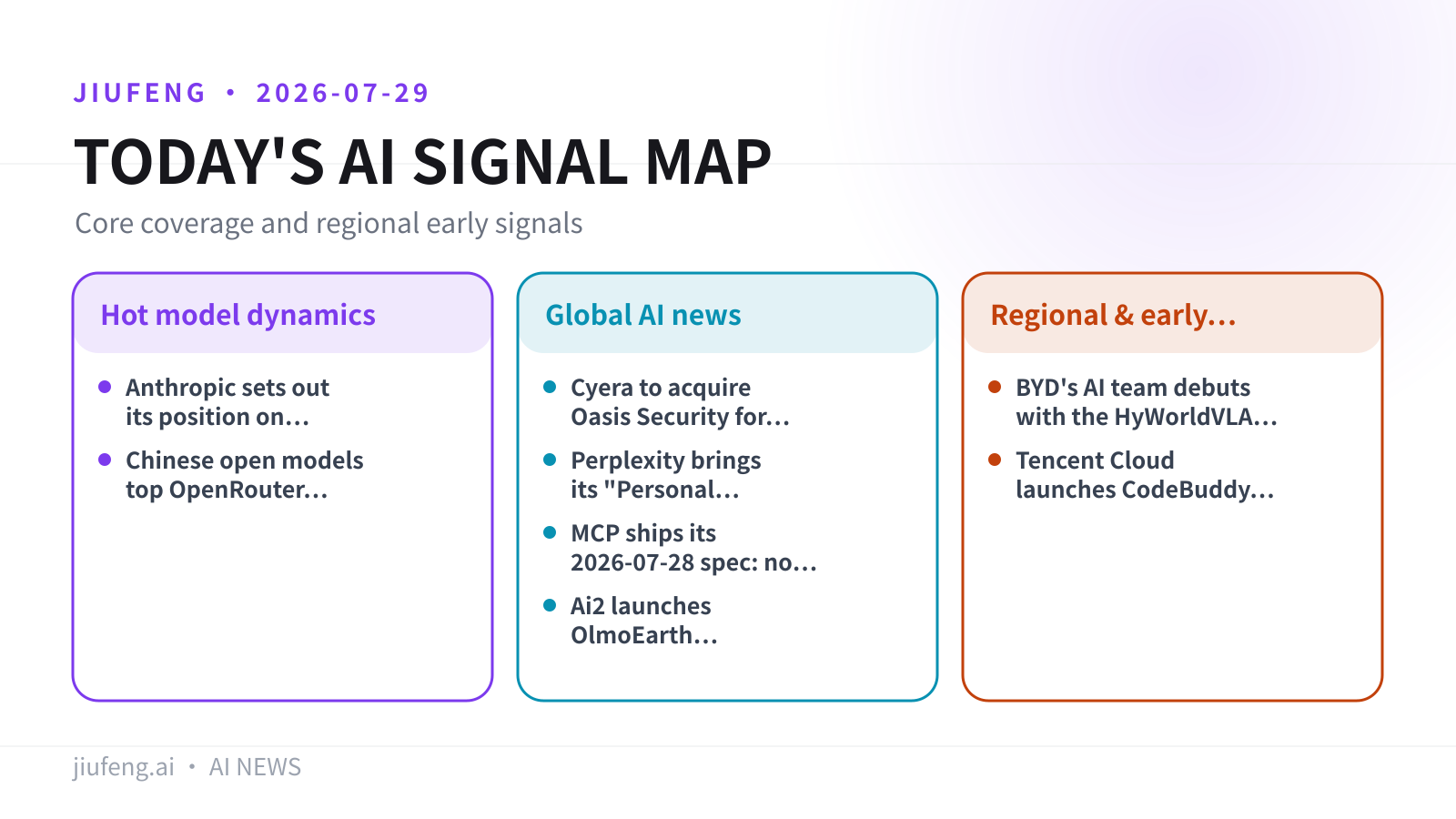
Jiufeng graphic based on the sources cited in this issue.
Hot model dynamics
01/08
Anthropic sets out its position on open-weights models
Anthropic publishes an official stance on open weights, responding to reports that the US may bar Chinese open-weights models.
On July 24, Nvidia CEO Jensen Huang's first post on his new personal X account shared the open letter "Open Weights and American AI Leadership," which Nvidia had signed, arguing the world needs both frontier closed and frontier open models. The letter's first version was signed by 25 organizations, including Nvidia, Microsoft, Meta, IBM, Hugging Face, the Linux Foundation, Mistral AI, and Mozilla; Anthropic was not among them. Microsoft CEO Satya Nadella, Google CEO Sundar Pichai, and DeepMind's Demis Hassabis subsequently voiced support for open source.
On July 27, Anthropic CEO Dario Amodei published "Our position on open-weights models." He noted that recent discussion has centered on open-weights models — especially those from China — and that reports suggest some US officials are considering banning US companies from using Chinese open-weights models; in response, many companies signed the pro-open-weights letter, and some accused Anthropic of wanting to ban open-weights models. Amodei said Anthropic has never advocated banning open-weights models and considers open models without dangerous capabilities a "public good" valuable to businesses, developers, and researchers; he then laid out his national-security concerns at length and argued for measures including chip export controls and a crackdown on model distillation. Andrew Ng replied that whether a company may protect its own technology and whether it may use policy to stop others from opening theirs are two different questions: "You can choose not to open source, but don't stop others from doing so."
Limitations: this is an unfolding stance debate, not enacted policy — the "ban on Chinese open-weights models" is so far only a report that officials are "considering" it, and Anthropic's post is a position statement whose full details should be read in the original.
Image source: anthropic; mirrored on Jiufeng R2.
Source: InfoQ (Chinese-language source) · Anthropic · Jensen Huang on X · Andrew Ng on X
02/08
Chinese open models top OpenRouter; Xiaomi MiMo-V2.5 is No. 1 by usage
On OpenRouter last week, the top five models by global usage were all Chinese, led by Xiaomi's MiMo-V2.5.
Per TMTPost, an OpenRouter ranking shared by Xiaomi communications head Xu Jieyun showed that for the week of July 20–26, the top five models by global call volume were all Chinese: Xiaomi MiMo-V2.5, DeepSeek V4 Flash, Tencent HY3, Zhipu GLM-5.2, and DeepSeek V4 Pro. No. 1 MiMo-V2.5 logged 10.5 trillion tokens for the week, up 12% month over month; the series entered public beta on April 23, supports a million-token context window, and parses text, image, video, and audio.
Limitations: the report itself flags the ranking's boundaries — it excludes traffic from Chinese big-tech's own apps, private enterprise deployments, and US vendors' closed APIs, and is only a window into the overseas open-source track; its data does aggregate real paid calls from tens of thousands of overseas independent developers under a unified token-metering standard.
Source: TMTPost (Chinese-language source)
Global AI news
03/08
Cyera to acquire Oasis Security for ~$1B to secure proliferating AI agents
Data-security firm Cyera signs an LOI to buy Oasis Security, which focuses on "non-human identities," for about $1 billion.
Per TechCrunch, Cyera announced Tuesday it signed a letter of intent to acquire Oasis Security for approximately $1 billion, paid mostly in cash with the remainder in Cyera shares. Cyera recently raised $600 million at a $12 billion valuation; Oasis focuses on non-human identities — primarily AI agents. As the number of AI agents proliferates, companies need security software to monitor their behavior and grant access permissions. This is Cyera's third acquisition this year.
Limitations: the deal is at the letter-of-intent stage and has not closed; the final amount and share split are subject to a definitive agreement.
Source: TechCrunch
04/08
Perplexity brings its "Personal Computer" agent to Windows
Perplexity extends its Personal Computer agentic-automation software from Mac to Windows, reaching over a billion devices.
Per SiliconANGLE, Perplexity on July 28 released a Windows version of Personal Computer, expanding the agentic-automation software from its original Mac platform to more than 1 billion Windows devices. First released in April, the software acts as a general-purpose "digital worker" that can access authorized files and applications on a user's computer and carry out tasks. The Windows version rolls out first to Perplexity's Max and Enterprise Max subscribers, starting at $200 per month.
Limitations: the report does not detail Windows system requirements or the full scope of accessible apps; real-world capability remains to be tested by users.
Source: SiliconANGLE
05/08
MCP ships its 2026-07-28 spec: now stateless, with hardened authorization
The Model Context Protocol lands its largest revision since launch, going stateless and adding a governed extensions system.
Per the AWS blog, the Model Context Protocol (MCP) published its 2026-07-28 specification, the largest revision since launch: MCP is now stateless, adds a governed extensions system, and hardens authorization. AWS says its AgentCore Gateway already supports the new spec.
Limitations: this entry currently rests on AWS's account alone; the full spec text and other platforms' support should be checked against the MCP specification itself and subsequent vendor announcements.
Source: AWS blog
06/08
Ai2 launches OlmoEarth: geospatial inference at planetary scale
Ai2 releases its OlmoEarth family of Earth-observation foundation models and a platform for planetary-scale geospatial inference.
Per the Hugging Face blog, Ai2 (allenai) launched the OlmoEarth Platform for geospatial inference at planetary scale. OlmoEarth is a family of Earth-observation foundation models pretrained on roughly 10 TB of multimodal satellite data; governments, NGOs, and other mission-driven organizations are already adapting it for their applications.
Limitations: the post is an official launch note; model specs (parameter counts, license) and specific benchmark scores should be read from its technical documentation and model cards.
Source: Hugging Face blog
Regional & early signals
07/08
BYD's AI team debuts with the HyWorldVLA autonomous-driving world model
BYD's AI team goes public for the first time; its HyWorldVLA scores 90.59 PDMS on NAVSIM v1, entering autonomous-driving foundation models.
Per Pandaily, BYD's AI team made its first public appearance and released HyWorldVLA, combining hybrid pixel-latent world modeling with a VLA (vision-language-action) architecture and scoring 90.59 PDMS on the NAVSIM v1 benchmark — reported as state of the art on that benchmark; the team includes robotics researchers from the Harbin Institute of Technology (HIT). It marks BYD's entry into autonomous-driving foundation models.
Limitations: the score comes from a single media report and is a team-reported benchmark, with no paper, model card, or third-party reproduction; training scale and any open release remain unclear.
Source: Pandaily
08/08
Tencent Cloud launches CodeBuddy NPC around an "AI-native Git" workflow
Tencent Cloud unveils CodeBuddy NPC, letting developers @-summon AI "NPC" teammates to run parts of the dev workflow autonomously.
Per Pandaily, Tencent Cloud launched CodeBuddy NPC, proposing an "AI Native Git paradigm": developers can @-summon NPC teammates that autonomously handle issue investigation, code development, PR submission, and CI repair.
Limitations: the report is a product-launch overview and gives no underlying model, availability, pricing, or measured results; real-world automation quality remains to be verified.
Source: Pandaily
Write a prompt in your browser and get an image — 1K, 2K or 4K output, up to 15 reference images. 50 free generations on sign-up, no credit card.
Generate free