Overview
10 items this issue; the 3 marked Top are today's focus.
Hot model developments
- Top · Kimi K3 open weights land, inference providers onboard on day one
- Baseten open-sources a Rust tokenizer it says is 18x faster for K3
Global AI news
- Top · Microsoft ships its first in-house cybersecurity model, MAI-Cyber-1-Flash
- Top · Amodei rejects a categorical ban on open-weight models
- Court approves Anthropic's $1.5B book copyright settlement
- SSI partners with Nvidia for Vera Rubin compute
- Alibaba ships 50+ HarmonyOS-native features across 20+ apps
- Meta AI arrives in Threads DMs
Regional and early signals
- CCTV investigates AI robocall telemarketing: 800-1,500 calls per bot per day
- Anhui TV airs "Taohuatan Chronicles," a fully AI-made series
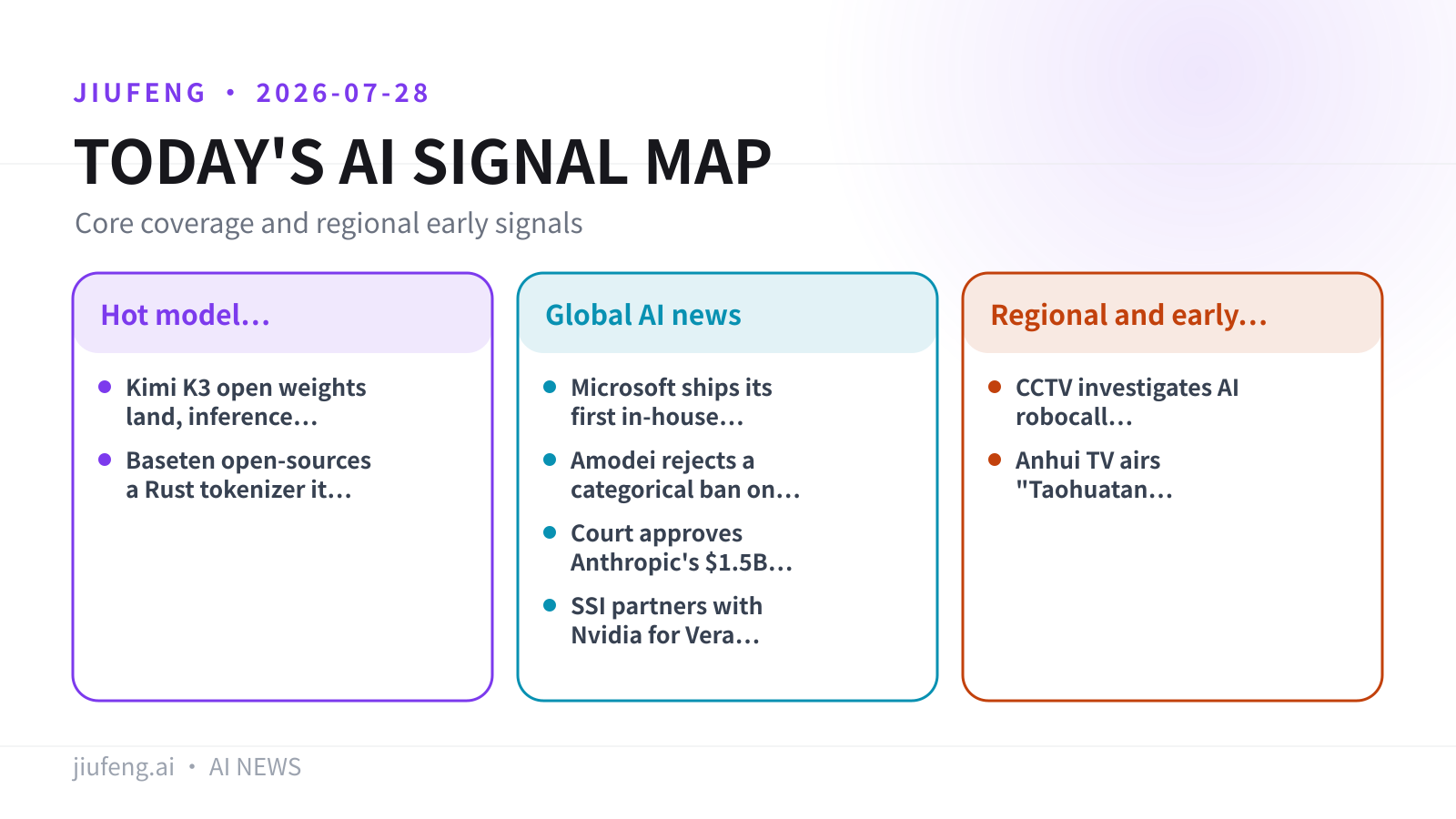
Jiufeng graphic based on the sources cited in this issue.
Hot model developments
01/10
Kimi K3 open weights land, inference providers onboard on day one
Moonshot AI released Kimi K3's open weights on July 27 as promised; the 2.8T-parameter weights are on Hugging Face and third-party inference went live the same day.
Moonshot AI released the open weights of Kimi K3 on July 27: the moonshotai/Kimi-K3 repository on Hugging Face is now available for download, listed at 2.8T parameters — delivering on the technical blog's pledge to release full weights "by July 27." The blog's published specs include a 1-million-token context window, Kimi Delta Attention (KDA) with Attention Residuals (AttnRes), and a Stable LatentMoE architecture activating 16 of 896 experts. Ecosystem adoption started the same day: Telnyx announced K3 is live on its Inference API. The Verge reports that Silicon Valley has spent the past week digesting K3's arrival, with Chinese labs' open-weight strategy forcing OpenAI, Google, and Anthropic to rethink what they lock away.
Caveats: the official blog does not state a license, so commercial terms should be checked against the model repository; the Telnyx news was posted on Hacker News by a Telnyx employee, and the benchmarks cited there are Moonshot's own.

Image source: huggingface; mirrored on Jiufeng R2.
Sources: Moonshot technical blog · Hugging Face (moonshotai/Kimi-K3) · Hacker News (Telnyx) · The Verge
02/10
Baseten open-sources a Rust tokenizer it says is 18x faster for K3
A Baseten engineer open-sourced basetenkenizer, a Rust-backed K3 tokenizer the company's own tests put at 18x faster for long-prompt preparation — the speedup is in tokenization, not the model itself.
Baseten model performance engineer Michael Feil said in an X thread on July 27 that he had shipped Baseten Tokenizer (package name: basetenkenizer), a Rust-backed package built to cut the CPU time required to prepare long prompts for Kimi K3. RuntimeWire notes the bottleneck it targets: as agent prompts approach K3's one-million-token limit, latency moves away from the GPU and into CPU-side prompt preparation. The package is on PyPI, with a companion K3 tokenizer repository on Hugging Face.
Caveats: the 18x figure is Baseten's own benchmark, with the code released for engineers to verify; RuntimeWire frames this as Baseten competing by optimizing an overlooked CPU path.
Sources: RuntimeWire · Hugging Face (K3 tokenizer)
Global AI news
03/10
Microsoft ships its first in-house cybersecurity model, MAI-Cyber-1-Flash
Microsoft introduced its first in-house cybersecurity model plus the agentic system Project Perception, self-reporting 95.95% on the CyberGym benchmark.
Microsoft on July 27 introduced MAI-Cyber-1-Flash, its first in-house cybersecurity model — a compact, code-tuned derivative of the MAI-Thinking-1 line trained on Microsoft's own exploit and remediation records. The companion agentic system, Project Perception, fields teams of AI agents to probe for weaknesses, investigate threats, and remediate them, starting with software vulnerability management. Microsoft's numbers: on CyberGym, a benchmark spanning 1,507 vulnerability-reproduction tasks, its MDASH system running the model scored 95.95%, versus roughly 84% for Anthropic's Mythos and 88.45% for an earlier MDASH version. The model reaches Azure AI Foundry on August 3, the same day Project Perception enters public preview inside Microsoft Defender.
Caveats: high-impact actions still require human sign-off, with Microsoft officials saying agents must "earn the right" to more autonomy; all scores are Microsoft's own, with no third-party replication yet.
Sources: SiliconANGLE
04/10
Amodei rejects a categorical ban on open-weight models
Amodei says Anthropic has never advocated banning open weights, calling models without dangerous capabilities a "public good," while backing chip controls, anti-distillation rules, and mandatory testing.
Anthropic CEO Dario Amodei published a policy post on July 27 stating that "Anthropic has never advocated for a ban on open-weights models" and that protectionist bans would not address his most serious national-security concerns. Open-weight models without dangerous capabilities are "a public good," he wrote — they cost nothing beyond the compute to run them and provide value to businesses, developers, and researchers. He restated three policy asks: no sales of powerful chips or chipmaking equipment to China plus a crackdown on smuggling, action against industrial-scale distillation operations, and mandatory safety testing for all sufficiently capable models, open and closed. On the July 24 industry letter on open weights, he says he agrees with much of it but disputes some of its assertions.
Caveats: this is a position piece, not regulation; RuntimeWire's analysis is that Amodei is trying to keep Anthropic's safety agenda from being recast as protectionism — a distinction that could shape whether US rules target open models broadly or apply capability tests to every frontier lab.
Sources: Anthropic · RuntimeWire · Industry letter PDF
05/10
Court approves Anthropic's $1.5B book copyright settlement
A federal judge approved Anthropic's $1.5B copyright settlement, with court records exposing the buy-cut-scan "Project Panama" book operation.
A federal judge on July 20 gave final approval to the $1.5 billion copyright settlement covering the more than 7 million pirated books Anthropic downloaded in its early years. Court records show that beyond the pirated downloads, Anthropic bought, cut, and scanned millions of physical books under an internal operation code-named Project Panama. RuntimeWire's summary of the working legal boundary the case leaves for AI developers: model training and internal scanning of purchased books may qualify as fair use, while pirated acquisition can create billion-dollar liability.
Caveats: Anthropic deputy general counsel Aparna Sridhar told the Associated Press that the pirate datasets were not used in any commercially released model's training corpus; the fair-use boundary is this case's outcome and does not automatically extend to other pending lawsuits.
Sources: RuntimeWire · Associated Press
06/10
SSI partners with Nvidia for Vera Rubin compute
After two years in stealth, Safe Superintelligence struck a long-term partnership with Nvidia: Vera Rubin platform access plus an investment of undisclosed size.
Safe Superintelligence (SSI), the lab founded by Ilya Sutskever, announced a long-term strategic partnership with Nvidia on July 27. Per Nvidia's press release, SSI gains access to the next-generation Vera Rubin GPU platform — which SSI says will increase its compute by an order of magnitude — and Nvidia has additionally made an investment in SSI of undisclosed size. "We have research that is worthy of scaling up… our big bet on the Vera Rubin platform will take us to the next level," Sutskever said. TechCrunch notes this is SSI's first major public move after two years in stealth, with the company saying it has achieved significant research milestones.
Caveats: neither the investment amount nor SSI's specific research progress has been disclosed; the order-of-magnitude compute figure is SSI's own projection.
Sources: Nvidia press release · TechCrunch · SiliconANGLE
07/10
Alibaba ships 50+ HarmonyOS-native features across 20+ apps
Alibaba delivered 50+ HarmonyOS-native innovations across 20+ apps, including a unified drag-and-drop AI analysis feature in the Qwen app.
Pandaily reports that Alibaba has delivered more than 50 HarmonyOS-native innovation features across over 20 apps: Amap adds AR walking navigation, DingTalk gains AI meeting capability via Xiaoyi, Taobao offers immersive browsing, and the Qwen app supports unified drag-and-drop AI analysis.
Caveats: this is a roundup report from Pandaily; technical details and rollout scope for individual features are not broken out.
Sources: Pandaily
08/10
Meta AI arrives in Threads DMs
Meta is rolling out its Meta AI chatbot inside Threads direct messages.
Meta said on July 27 that it is rolling out the Meta AI chatbot within Threads' DMs. Threads users in select markets could already interact with Meta AI in public posts — much like Grok on X — and the new integration lets users talk with the assistant privately.
Caveats: this is a gradual rollout; the earlier public-post interactions were also limited to select markets.
Sources: TechCrunch
Regional and early signals
09/10
CCTV investigates AI robocall telemarketing: 800-1,500 calls per bot per day
A China National Radio investigation details the AI robocall telemarketing chain: one bot dials 800-1,500 calls a day at rates as low as 0.12 yuan per minute.
China Media Group's China National Radio reported on July 28 that marketing calls are surging over the summer, with many of the calls made by AI rather than humans. Per the report, AI telemarketing runs on two main paths: renting robots through "line companies" on prepaid per-minute billing at roughly 0.14-0.16 yuan per minute, or leasing compute from robocall firms at roughly 0.12-0.15 yuan per minute. A single bot can dial 800 to 1,500 calls per day. Practitioners interviewed describe a standardized workflow: set up the agent, load the contact data, create a task, and schedule the dialing; call recordings and transcripts are pushed to merchants via WeChat service accounts, and callers who opt for a human are screened and transferred.
Caveats: prices and call volumes come from practitioners quoted in the report; this item is based on Chinese-language sources (IT Home relaying the CCTV/CNR report).
Sources: IT Home (Chinese-language source)
10/10
Anhui TV airs "Taohuatan Chronicles," a fully AI-made series
Anhui TV became the first Chinese satellite broadcaster to air an AI-generated series: 20 episodes of about 10 minutes each.
Netizens surfaced the broadcast on July 28 and IT Home verified it: Anhui TV is airing the AI-generated series "Taohuatan Chronicles" (《桃花潭记》), the first Chinese satellite channel to broadcast an AI series, with daily episodes at 21:50 since July 22. The show runs 20 episodes of about 10 minutes each, built around the 108 steps of traditional Xuan paper making in Jingxian, Anhui, and is described as the country's first fully AI-made intangible-heritage series to obtain an online drama distribution license. Every frame is labeled "AI-made" on screen. The series is produced under the guidance of the Anhui provincial party publicity department and the provincial culture and tourism department, and co-produced by the Xuancheng municipal party publicity department with two media companies.
Caveats: this item currently rests on Chinese-language regional reporting; the "first" claims are IT Home's description, and production and licensing details should be checked against official announcements.
Write a prompt in your browser and get an image — 1K, 2K or 4K output, up to 15 reference images. 50 free generations on sign-up, no credit card.
Generate free