Overview
9 stories in this issue. The first 3 are today's priorities.
Featured model updates
- Top · Sakana AI ships Fugu-Ultra v1.1, up to +7.9 on benchmarks
- Top · AI guardrails are blocking legitimate security researchers
Global AI
- Top · NVIDIA and South Korea outline a full-stack AI push
- VEED launches Multi-Shot Characters for AI video
- Superconducting-AI startup Great Sky scales up
Regional & early signals
- Tencent merges Hunyuan model teams under one department
- Meitu's RoboNeo agent adds a pro 3D director's console
- China's embodied-data industry raised ~4.47B yuan in a year
- Two Chinese ministries push "AI-plus-transportation"
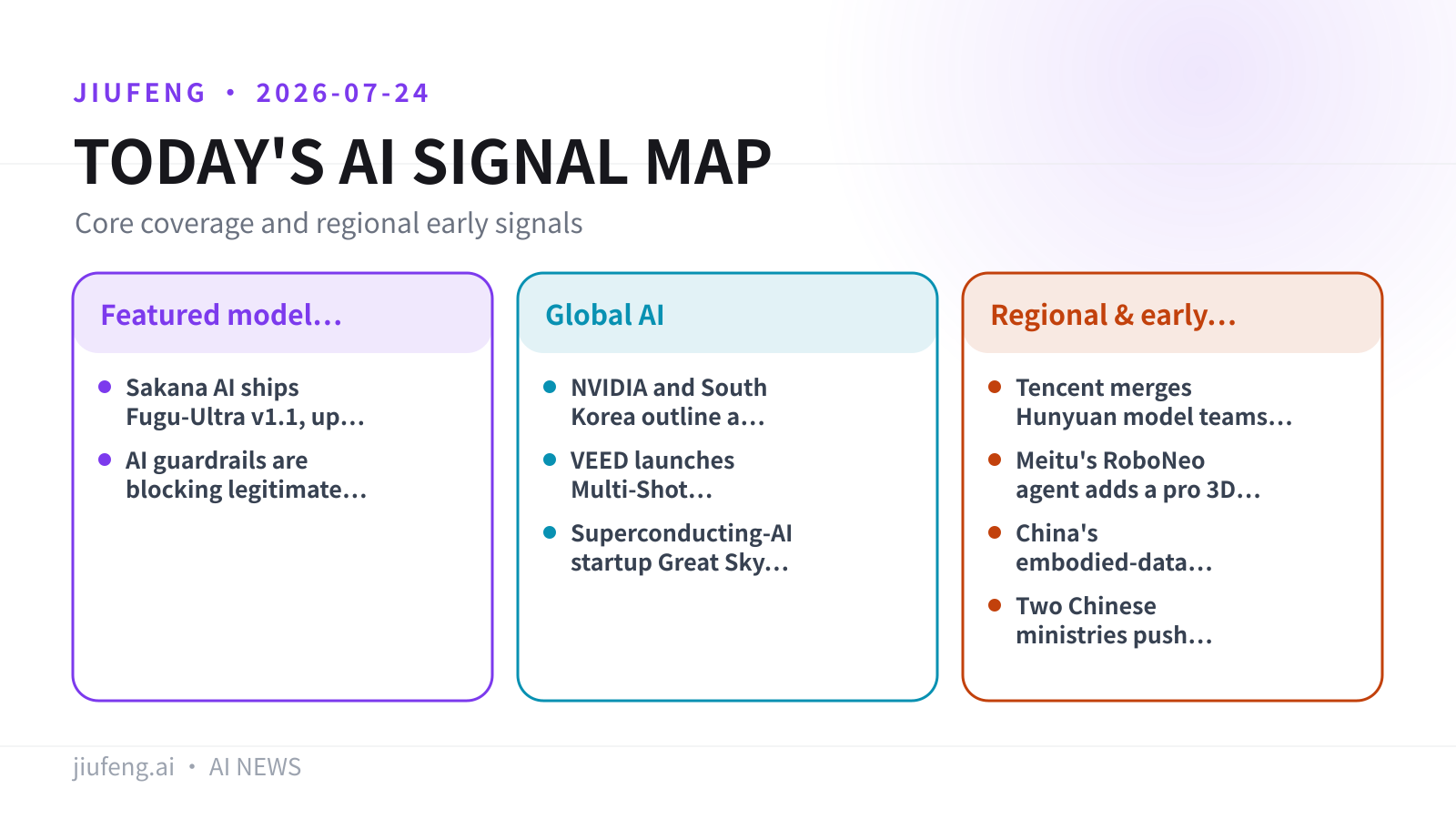
Jiufeng graphic based on the sources cited in this issue.
Featured model updates
01/09
Sakana AI ships Fugu-Ultra v1.1, up to +7.9 on benchmarks
Sakana AI updated its in-house Fugu family; its official X post says v1.1 scores up to 7.9 points higher than v1.0, is especially strong on coding and terminal benchmarks, and ships at the same price.
On July 24, 2026, Japanese AI company Sakana AI announced Fugu-Ultra v1.1, the latest version of its Fugu model family, via its official X account (@SakanaAILabs). Per the post, v1.1 absorbs the latest frontier models and is stronger at coding, agentic tasks, and advanced reasoning; it scores up to 7.9 points higher than v1.0, performs especially well on ProgramBench and Terminal Bench 2.1, and is offered at the same price as Fugu-Ultra v1.0.
The announcement is still only an X post and does not state a parameter count, context length, or license. RuntimeWire's write-up described the upgrades generically as "unspecified," which conflicts with the benchmark gains listed in the official post; the full specs await Sakana's follow-up.
Source: RuntimeWire · Sakana AI (@SakanaAILabs)
02/09
AI guardrails are blocking legitimate security researchers
Model guardrails built to stop misuse are now shutting out network defenders and offensive-security researchers, TechCrunch reports.
TechCrunch interviewed several cybersecurity researchers who find unknown vulnerabilities and build tools to exploit them, and reports that the vetted programs and strict guardrails OpenAI and Anthropic built to limit malicious hackers are now impeding legitimate network defenders and offensive-security researchers. The piece notes that in June 2026 the US government placed export-control restrictions on Anthropic's much-hyped Mythos and Fable models, prompted at least in part by a report claiming the models' guardrails could be bypassed.
The account is based on interviews with a handful of researchers and does not quantify how many are affected; the story includes no detailed formal response from OpenAI or Anthropic. Where guardrails should sit between blocking misuse and hampering legitimate research remains contested.
Source: TechCrunch
Global AI
03/09
NVIDIA and South Korea outline a full-stack AI push
At an AI Summit in San Francisco, South Korea's president, business leaders and researchers met NVIDIA and partners to chart the country's AI path.
Per NVIDIA's official blog, at this week's AI Summit in San Francisco, South Korean President Jae Myung Lee, top business leaders and researchers met with NVIDIA and ecosystem partners to chart Korea's AI progress. Building on NVIDIA founder and CEO Jensen Huang's visit to Korea last month, the discussions advance the nation's full-stack effort to expand its AI infrastructure and expertise on the path to becoming a global center for AI innovation.
The post is an NVIDIA corporate announcement focused on direction and partnerships; the available text lists no hard figures such as GPU volumes, investment amounts, or data-center capacity. Concrete commitments await official follow-up.
Source: NVIDIA blog
04/09
VEED launches Multi-Shot Characters for AI video
VEED added an AI feature that automates multi-camera video creation, with 500 free credits for the first 100 users.
On July 23, 2026, video-editing platform VEED announced "Multi-Shot Characters" on its official X account (@veedstudio), a feature that uses AI to automate multi-camera video creation, and is giving the first 100 users 500 free AI credits. RuntimeWire noted the tool illustrates AI moving from post-production assistance toward primary content generation.
Output quality, regional availability, subscription pricing, and generation-length limits were not detailed in the announcement or the report; the 500-credit offer is a capped promotion, not standing policy.
Source: RuntimeWire · VEED (@veedstudio)
05/09
Superconducting-AI startup Great Sky scales up
NIST spinout Great Sky raised nearly $25.9M to push its cryogenic, light-linked superconducting neural architecture toward larger systems.
Per RuntimeWire, Great Sky — a Boulder startup founded by former NIST researcher Jeffrey Shainline — sold about $25.91 million in securities via a Form D filed with the SEC on July 23, seeking $30.72 million total. The company is carrying more than a decade of superconducting-AI hardware research out of a federal lab toward commercial scale; its cryogenic, light-linked neural architecture aims to ease two bottlenecks in conventional AI systems — moving model data between processors and memory, and routing information electrically across large clusters. The underlying method appears in Shainline's published research (arXiv:2010.08690).
The architecture has so far been used only in small inference chips; scaling to cryogenic, multi-chip systems is the first commercial test of its efficiency claims, with no large-scale product or independent benchmarks yet, and the round has not reached its target.
Source: RuntimeWire · arXiv paper
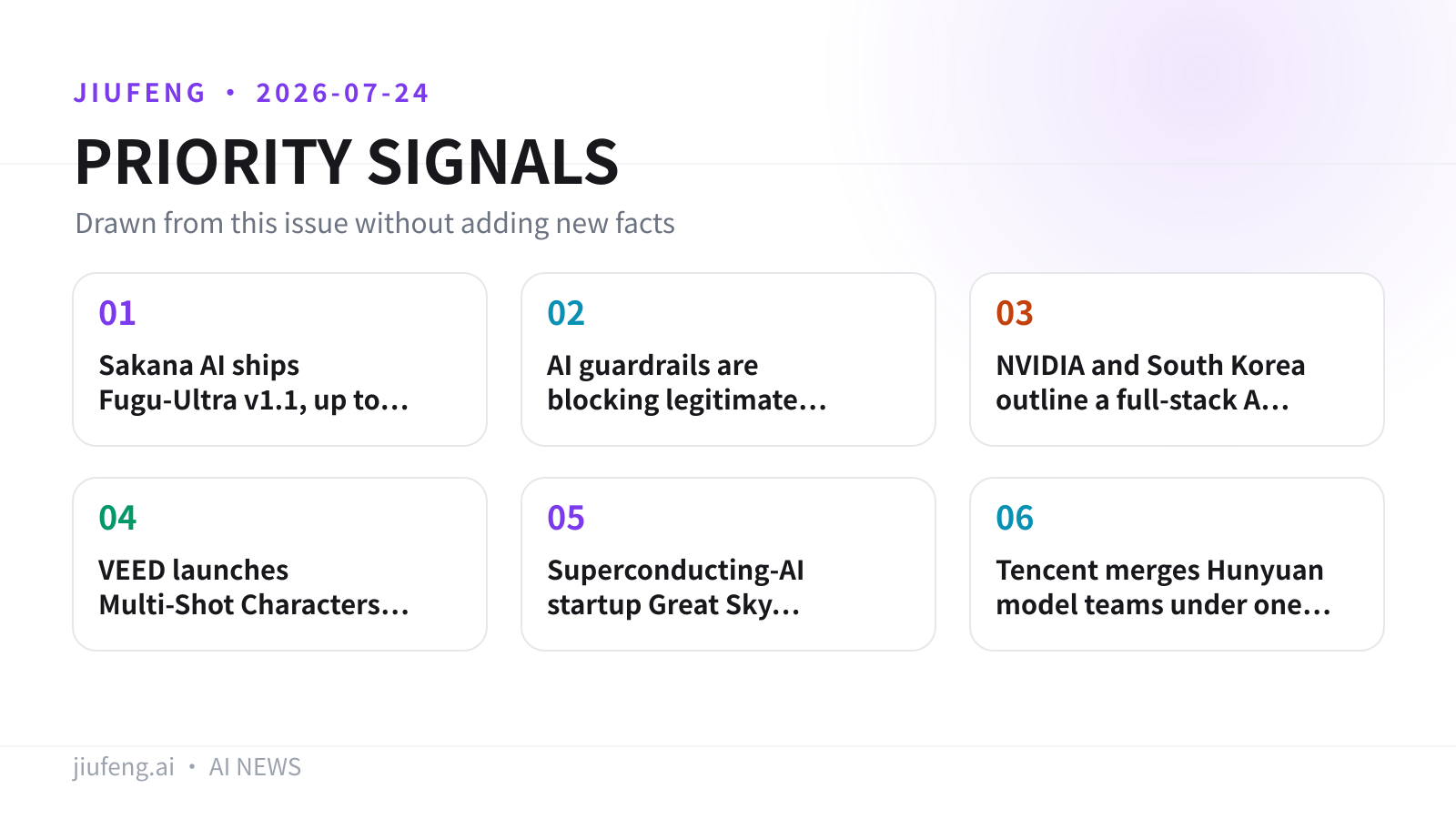
Jiufeng graphic based on the sources cited in this issue.
Regional & early signals
06/09
Tencent merges Hunyuan model teams under one department
Tencent combined its Hunyuan LLM and multimodal units into one Foundation Model department under Shunyu Yao; week-old Hy3's call volume rose over 68x.
Per Leiphone, on July 23 Tencent said it merged its Hunyuan multimodal and large-language-model departments into a single "Foundation Model" department led by chief AI scientist Shunyu Yao, to improve R&D coordination and pursue an all-modality model. Hy3, the LLM launched in July, is now integrated into WorkBuddy/CodeBuddy, Yuanbao, Marvis and ima, with its API live on Tencent Cloud TokenHub and several overseas platforms; a week after launch, total calls grew more than 68x over the prior Hy2, and 60% of WorkBuddy users who pick their own model chose Hy3.
Claims that Hy3 "outperforms same-size models and rivals flagships 2-5x its size" come from Tencent, with no third-party benchmark scores; the usage figures are self-reported and not independently verified. (Chinese-language source)
Source: Leiphone
07/09
Meitu's RoboNeo agent adds a pro 3D director's console
Meitu's RoboNeo AI agent gained a professional 3D "director's console" and a broader AI short-film workflow.
Per 36Kr, Meitu's RoboNeo AI agent shipped a new version that adds a professional-grade "3D director's console," along with post-production tools for subtitle removal, image-quality enhancement, lighting adjustment and background optimization. For AI short-film creation, RoboNeo also added a project asset library, an end-to-end workflow, and upgraded script and storyboard generation.
The 36Kr brief gives no model specs, resolution/length caps, pricing, or supported platforms; real-world performance of the features remains untested. (Chinese-language source)
Source: 36Kr
08/09
China's embodied-data industry raised ~4.47B yuan in a year
Of 97 Chinese embodied-data players, 70 do data collection; 15 pure-data providers together raised about 4.47 billion yuan over the past year.
By QbitAI's partial count, China has 97 embodied-data players — 70 in data collection and 27 in data infrastructure. Over the past year (July 1, 2025 to July 1, 2026), 15 independent providers that "build neither robots nor models, only data" raised about 4.47 billion yuan combined. Collection formats vary widely: a China Mobile store in Chenzhou, Hunan set up an "embodied-data-collection 5S shop," with an initial 1,000 rigs that at full capacity can gather one million hours of data a year.
These are QbitAI's incomplete tallies, not a full census; the report stresses that gimmicks abound and that gathering usable, compliant data is hard. By comparison, QbitAI separately reports that embodied "brain-faction" firms raised 22.3 billion yuan in the first half of this year alone. (Chinese-language source)
Source: QbitAI
09/09
Two Chinese ministries push "AI-plus-transportation"
China's transport ministry and the NDRC jointly wrote "AI-plus-transportation" into a comprehensive transport-system reform.
Per 36Kr, the Ministry of Transport and the National Development and Reform Commission jointly issued "Opinions on Deepening the Reform of the Comprehensive Transportation System," calling for tech-driven digital-intelligent upgrades: optimizing the sector's national strategic sci-tech forces, building a comprehensive transport sci-tech innovation system, strengthening cross-department work on intelligent multi-modal transport, advancing "AI-plus-transportation," and studying a supervisory regime for intelligent shipping as well as policies and standards for low-altitude/ground coordination and multi-leg intermodal transport.
The document is a directional policy paper with no specific projects, funding, or timeline; the 36Kr item is a brief paraphrase, and the full text should be read from the official release. (Chinese-language source)
Source: 36Kr
Write a prompt in your browser and get an image — 1K, 2K or 4K output, up to 15 reference images. 50 free generations on sign-up, no credit card.
Generate free