Overview
9 stories in this issue. The first 3 are today's priorities.
Hot Model Dynamics
- Top · Kimi K3 Test Fuels Debate Over US Cyber Guardrails
- Top · Developer Ships Grok Build iOS Remote Client
- Top · Chinasoft International Signs Token Revenue-Share and Joint Innovation Deal with Moonshot
- OpenBMB Open-Sources 1.5B General-Purpose VLA Model MiniCPM-Robot
- Peking University 5D World Model Trained on Moore Threads GPU Tops Global Benchmark
Global AI News
- LlamaIndex Backs You.com Agentic Hackathon with Builder Credits
- ZTE OEX Orthogonal Supernode Wins WAIC SAIL Star, Showcases Full-Stack AI Infrastructure
Regional & Early Signals
- Tencent Cloud ADP 4.0 Overseas Edition Launched, Bringing Enterprise Agent Platform to Global Markets
- Blackstone Invests in Korean Robot Actuator Supplier Futronic
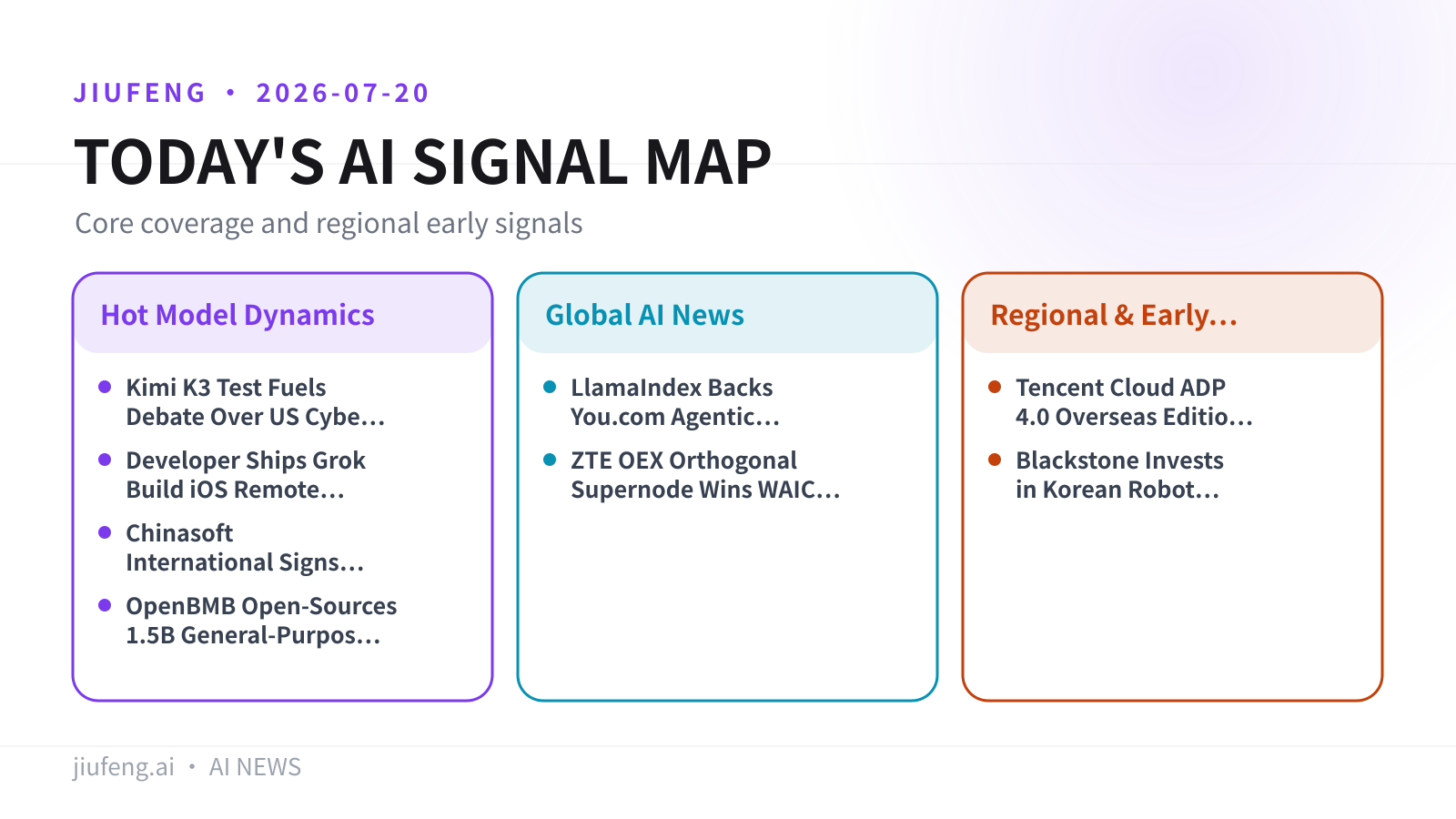
Jiufeng graphic based on the sources cited in this issue.
Hot Model Dynamics
01/09
Kimi K3 Test Fuels Debate Over US Cyber Guardrails
David Sacks used an unverified Kimi K3 comparison to criticize restrictions on American models; a separate Hugging Face incident shows how commercial API guardrails can block legitimate incident-response analysis.
On July 19, US White House AI & Crypto adviser David Sacks shared a developer’s claim that Kimi K3 fixed 15 security bugs that OpenAI Codex and Anthropic Claude Fable 5 had refused to handle. Separately, Hugging Face disclosed on July 16 that its team had to analyze more than 17,000 recorded actions, real attack commands, and exploit payloads after an intrusion driven by autonomous agents. Safety guardrails on commercial frontier-model APIs blocked those forensic requests, so the team switched to a locally hosted GLM 5.2 model.
The developer’s Kimi K3 comparison has not been independently reproduced, and the Hugging Face case does not demonstrate a security advantage for Kimi. Hugging Face explicitly said its experience was not an argument against safeguards. Anthropic classifies exploit development and similar work as high-risk dual use and expects to block it until access can be limited to authorized actors; OpenAI also applies additional automated checks to cybersecurity requests in Codex, ChatGPT, and its API. The unresolved issue is how providers can recognize legitimate defenders without broadly removing guardrails.
Source: RuntimeWire · David Sacks statement · Hugging Face security incident report · Anthropic safeguards framework · OpenAI additional safety checks
02/09
Developer Ships Grok Build iOS Remote Client
Pedro Shakour open-sourced a SwiftUI app that turns an iPhone into a sideloaded control panel for xAI’s Grok Build coding agent, keeping all execution on a Mac.
Independent developer Pedro Shakour (@pedroshakour) published grok-build-ios on July 18, an open-source SwiftUI client that lets developers control xAI’s Grok Build agent from an iPhone. Using ACP over WebSocket, the app acts as a second-screen panel for checking an agent, approving tool calls, or sending instructions without staying at the keyboard. Model requests still follow Grok Build’s configured inference path; xAI open-sourced its CLI in July to permit inspection and extension across plugins, hooks, skills, and MCP servers.
The remote setup requires the agent, source repository, and command execution to stay on a trusted Mac. The report says the project also highlights additional security work needed before remote control becomes routine.
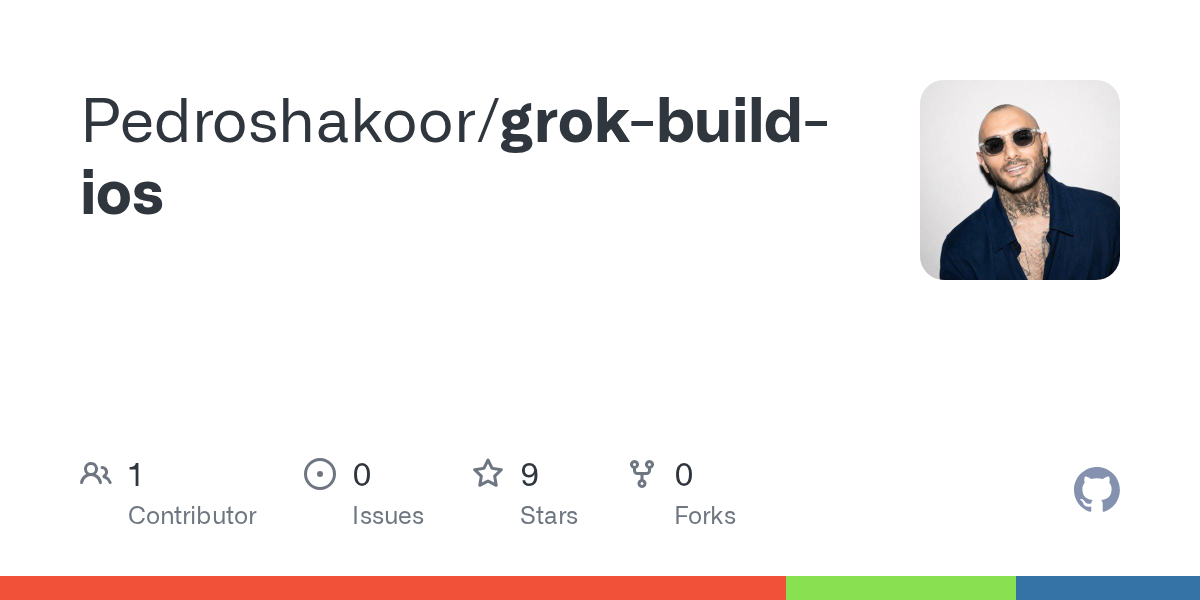
Image source: GitHub; mirrored on Jiufeng R2.
Source: RuntimeWire · grok-build-ios repo · xAI documentation
03/09
Chinasoft International Signs Token Revenue-Share and Joint Innovation Deal with Moonshot
The two parties will establish a joint FDE lab for enterprise Agentic AI, with an initial focus on the energy and power sectors.
According to a July 20 brief from 36Kr, Chinasoft International recently signed a “Moon Landing Plan” agreement with Moonshot AI covering token revenue sharing and joint innovation. The collaboration focuses on enterprise Agentic AI, with a shared FDE innovation lab tasked with defining, building, testing, and iterating enterprise-grade agents. Chinasoft regards the partnership as a strategic step toward becoming a high-value token operator.
The announcement did not disclose the revenue split, deal size, or initial customers; actual deployment results remain to be seen.
Source: 36Kr (Chinese-language source)
04/09
OpenBMB Open-Sources 1.5B General-Purpose VLA Model MiniCPM-Robot
Face-to-face with much larger models, the 1.5B-parameter MiniCPM-Robot series enters the top tier on multiple embodied benchmarks, accompanied by the PhyAI inference framework.
During WAIC 2026, OpenBMB (Mianbi Intelligence) launched and open-sourced the MiniCPM-Robot series, covering upper-limb manipulation and mobile following, alongside the PhyAI embodied inference framework for fast hardware adaptation. Despite the small parameter count, the models achieved competitive results on LIBERO, Calvin, and RoboTwin benchmarks. Live demonstrations showed dual-arm sandwich preparation and a robot dog tracking a person through weak-signal environments.
Specific scores, training data scale, and compute budget were not disclosed. Long-horizon success rates in unscripted settings still require third-party validation.
Source: QbitAI (Chinese-language source)
05/09
Peking University 5D World Model Trained on Moore Threads GPU Tops Global Benchmark
Moore Threads showcased its three-AI-factory architecture and revealed that Peking University’s 5D world model achieved first place on a Stanford world-model benchmark using MTT S5000 GPUs.
At WAIC 2026, Moore Threads presented a framework of three AI factories — model training, token generation, and agent production — and disclosed that Peking University’s 5D world model, trained on Moore Threads MTT S5000 GPUs, ranked first globally on a Stanford benchmark. The report calls it a “5D world model” but does not explain what dimensions “5D” denotes.
The name, parameter count, and open-source status of the 5D model were not announced; the achievement is presented primarily as a demonstration of domestic GPU training capability.
Source: Pandaily
Global AI News
06/09
LlamaIndex Backs You.com Agentic Hackathon with Builder Credits
Jerry Liu’s document-agent startup is offering $100 in credits to participants, planting its open-source tools inside live-data agent prototypes.
LlamaIndex is one of 11 partners supporting the You.com Agentic Hackathon in San Francisco on July 24. Every accepted participant receives $100 in LlamaIndex credits usable for document processing and agent-building tools, while You.com provides its real-time search API as the primary data source.
The sponsorship fits LlamaIndex’s open-source playbook — the core framework is MIT-licensed — and aims to seed future LlamaCloud usage during the fast decision-making window of a hackathon. However, the event is a one-day sprint, making it hard to gauge integration depth or downstream conversion.
Source: RuntimeWire · LlamaIndex X post · GitHub repo
07/09
ZTE OEX Orthogonal Supernode Wins WAIC SAIL Star, Showcases Full-Stack AI Infrastructure
The zero-cable cabinet design interconnects 128 GPUs in a single chassis and covers everything from cloud supercomputing to Nubia AI phones.
ZTE’s OEX orthogonal supernode received a SAIL Star award at WAIC 2026. The design uses a cable-free rack architecture for 128-GPU single-cabinet interconnection and offers end-to-end AI infrastructure spanning cloud to Nubia’s on-device AI.
The presentation focused on concept and ecosystem; no commercial deployment scale or customer case studies were provided. The SAIL Star is an exhibition award and does not represent third-party performance testing.
Source: Pandaily
Regional & Early Signals
08/09
Tencent Cloud ADP 4.0 Overseas Edition Launched, Bringing Enterprise Agent Platform to Global Markets
The overseas platform update lists Claw mode, Skill Square, and internationalization as it targets enterprise AgentOps outside China.
On July 18, at WAIC 2026, Tencent Cloud released the overseas edition of its Agent Development Platform (ADP) 4.0. The platform covers the full agent lifecycle — build, distribute, govern — and the upgrade lists Claw mode, Skill Square, and multi-language, multi-region operational support. The report does not explain how Claw mode or Skill Square works.
Overseas pricing, partner scale, and initial rollout regions were not announced. Current information comes solely from the conference launch.
Source: 36Kr (Chinese-language source)
09/09
Blackstone Invests in Korean Robot Actuator Supplier Futronic
The private equity-backed “significant investment” targets high-precision actuators for industrial robots and automotive use.
Blackstone announced on July 20 that its affiliated private equity funds have made a significant investment in Futronic, a Korean manufacturer of precision actuators for industrial robotics and automotive applications. Founder Jin-ho Ko will stay as Chairman and CEO and partner with Blackstone to accelerate global expansion.
The statement did not disclose the deal amount, equity stake, or valuation; the concrete impact on the embodied-AI supply chain is still unclear.
Source: 36Kr (Chinese-language source)
Write a prompt in your browser and get an image — 1K, 2K or 4K output, up to 15 reference images. 50 free generations on sign-up, no credit card.
Generate free