Overview
9 stories in this issue. The first 3 are today's priorities.
Hot Model Updates
- Top · Kimi Pauses New Subscriptions as GPU Capacity Tightens
- Top · Alibaba Previews 2.4-Trillion-Parameter Qwen3.8
Global AI Updates
- Top · Apple Suit Clouds OpenAI's Hardware Plans
- Current AI Builds an Open Public-Interest AI Stack
- Tencent Takes WorkBuddy Mobile Across HarmonyOS, iOS, and Android
Regional and Early Signals
- Arm China Connects Its Edge-AI Chips and Software Stack
- IntelliFusion Maps Out Three Inference Chips
- Seislimit Details Progress on Panshi 2.0
- WAIC Forum Releases Five AI-Safety Outputs
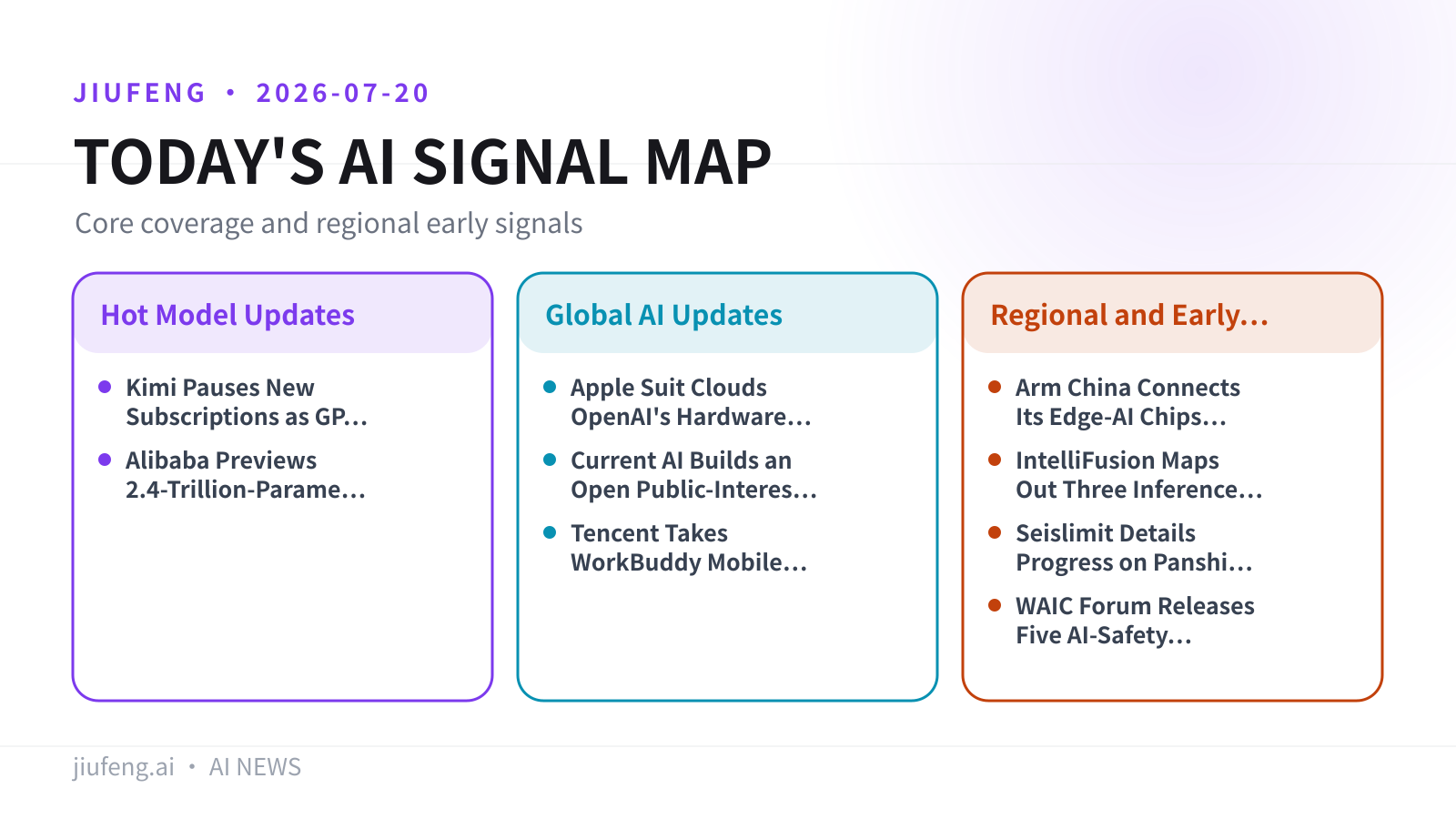
Jiufeng graphic based on the sources cited in this issue.
Hot Model Updates
01/09
Kimi Pauses New Subscriptions as GPU Capacity Tightens
Moonshot is protecting access for existing Kimi subscribers while it adds serving capacity and prepares a phased reopening.
Moonshot said demand during the previous 48 hours had pushed Kimi's GPU capacity close to its limit. New subscriptions are paused, while existing subscribers retain access. The company says it is adding capacity and will reopen subscriptions in batches, but it has not published a schedule or the scale of the expansion.
The announcement demonstrates strong launch demand, not service quality by itself. Moonshot has not disclosed utilization, latency, or reliability data, so the operational impact on existing users cannot yet be independently assessed.
Sources: Kimi's official announcement · RuntimeWire
02/09
Alibaba Previews 2.4-Trillion-Parameter Qwen3.8
Qwen3.8-Max-Preview is available through Alibaba's developer products, but its headline capability claim still lacks published benchmarks and independent evaluation.
Alibaba previewed Qwen3.8-Max at WAIC with 2.4 trillion total parameters and multimodal support for text, images, video, and documents. The preview is available through the Token Plan and Qoder products; Alibaba's official Token Plan page lists subscription tiers starting at $6 per month.
Alibaba says the model ranks behind only Anthropic's Claude Fable 5, but it has not released benchmark scores, a model card, an activated-parameter count, weights, or license terms. Those omissions make the ranking a vendor claim rather than a verified comparison.
Sources: Alibaba Qwen Token Plan · SiliconANGLE
Global AI Updates
03/09
Apple Suit Clouds OpenAI's Hardware Plans
Apple alleges that OpenAI's hardware team improperly obtained trade secrets; the unresolved case adds legal uncertainty to OpenAI's consumer-device schedule.
Apple's federal complaint in California alleges that two former Apple employees improperly accessed or used confidential hardware information after joining OpenAI, and it names OpenAI and io Products among the defendants. OpenAI says it is not aware of evidence supporting the complaint. AP previously reported that OpenAI acquired Jony Ive's io for nearly $6.5 billion and was still targeting consumer hardware later this year.
These remain allegations, not judicial findings. Recent discussion suggests that an injunction or discovery could slow development, but a delay has not been ordered and should not be treated as established fact.
Sources: Associated Press · TechCrunch
04/09
Current AI Builds an Open Public-Interest AI Stack
The nonprofit is funding shared AI infrastructure and community-led projects, with early devices, datasets, and an open-source chatbot now providing concrete tests of its model.
Current AI says it is backed by more than €400 million in commitments and brings together governments, philanthropy, researchers, and industry. Its work includes grants for language and cultural-data projects, the offline Suno Sutra device for 22 Indian languages, and Alpha Chat, an open-source chatbot assembled by a multi-organization coalition.
The initiative is early: a recent grant round allocated $3.2 million across four organizations, and its projects have not yet demonstrated global scale. Its value will depend on whether local governance, consent, and open infrastructure can survive expansion beyond pilots.
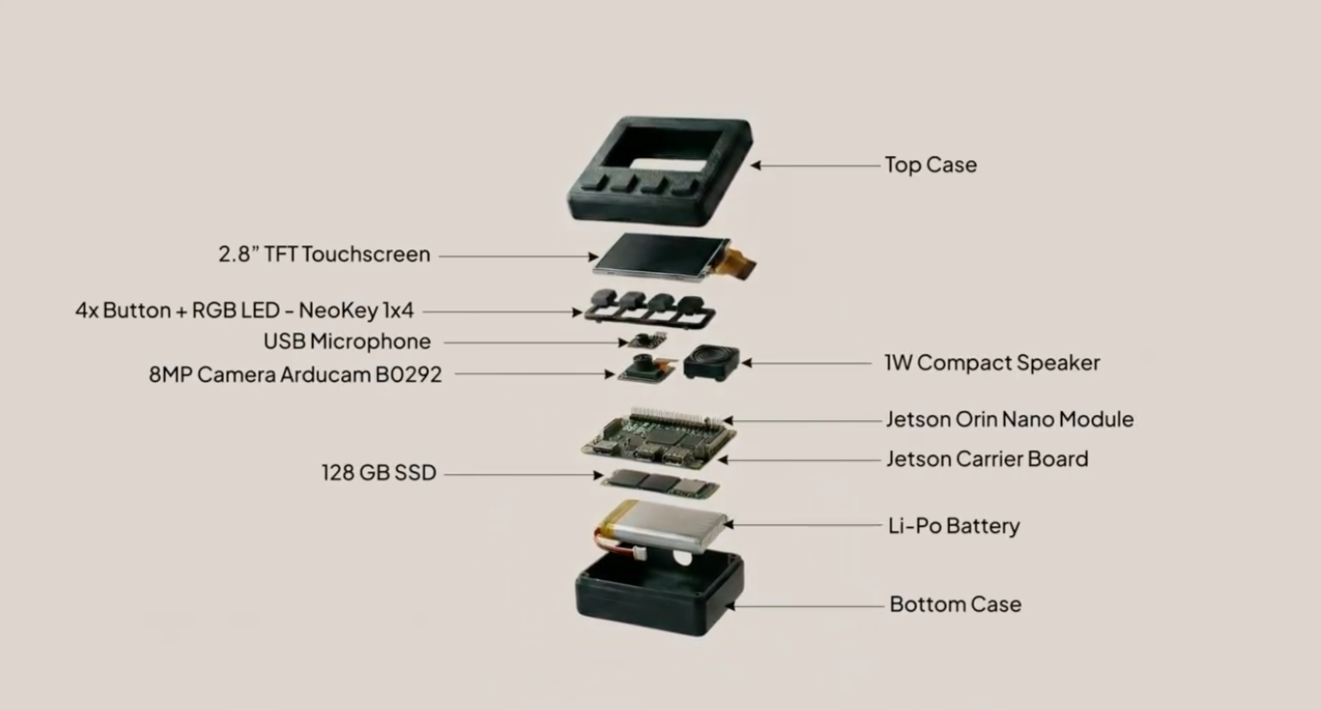
Image source: Current AI; mirrored on Jiufeng R2.
Sources: Current AI · TechCrunch
05/09
Tencent Takes WorkBuddy Mobile Across HarmonyOS, iOS, and Android
Tencent's coding agent is moving from desktop and developer tools to a cross-platform mobile app, with a HarmonyOS release alongside iOS and Android.
The WorkBuddy app brings the product's AI work-agent experience to mobile devices across HarmonyOS, iOS, and Android. Tencent's product materials position WorkBuddy as a general-purpose work agent that can plan and execute multi-step tasks, while the mobile release is intended to extend those workflows beyond the desktop.
Public reporting does not yet provide usage, retention, pricing, or comparative performance data for the mobile versions. Cross-platform availability is therefore verifiable, but its practical advantage over established mobile assistants remains unproven.
Sources: Tencent WorkBuddy documentation · Pandaily
Regional and Early Signals
06/09
Arm China Connects Its Edge-AI Chips and Software Stack
Arm China used WAIC to present an edge stack spanning CPU, NPU, VPU, and AI operating-system layers, shifting attention from peak compute to integration.
InfoQ's Chinese-language report frames the portfolio around the Xingchen CPU, Zhouyi NPU, Linglong VPU, and a supporting software ecosystem. The practical question for developers is whether shared interfaces, operators, and tooling can reduce the cost of deploying across heterogeneous edge hardware.
This signal currently rests on one regional report, without a complete set of independently comparable benchmarks, power data, or availability dates. It indicates a product direction, not proven performance leadership.
Source: InfoQ — Chinese-language report
07/09
IntelliFusion Maps Out Three Inference Chips
IntelliFusion is splitting Prefill, Decode, and Decode-stage FFN workloads across three planned chips in an attempt to lower token-generation cost with heterogeneous pools.
At WAIC, the company outlined DeepVerse100P, 100D, and 100L for long-context prefill, token-by-token decode, and FFN compute, respectively, with a plan for clusters at the 10,000-card scale. The report says 100D targets 1,024-card scale-up and optical links, 100L uses 3D Memory, and the IFWA stack is being aligned with PyTorch ATen, vLLM, and SGLang.
This is a roadmap spanning more than two years. Third-party measurements for throughput, latency, power, cost, and tape-out progress are not available; the single report verifies the stated targets, not their delivery.
Source: InfoQ — Chinese-language report
08/09
Seislimit Details Progress on Panshi 2.0
Panshi 2.0 combines general reasoning with scientific-domain knowledge, but its scale and reproducible full evaluations remain undisclosed.
At a WAIC forum, Seislimit CEO Xu Nan described Panshi 2.0 as a general-and-specialized scientific foundation model. The report says its ScienceOne-Omni base uses a three-layer architecture and was trained with 8 million scientific-reasoning records spanning more than 200 tasks; Seislimit also says ScienceOne is used by dozens of research organizations in more than 100 scenarios.
Figures from more than 60 evaluations, a sub-10-second simulation, and a claimed 38% catalyst-activity gain come from the team and are not accompanied by a model card, reproducible experiments, or a complete benchmark table. This Chinese-language report is useful as a regional signal, but the performance claims remain unverified.
Source: Leiphone — Chinese-language report
09/09
WAIC Forum Releases Five AI-Safety Outputs
A WAIC forum released five research outputs focused on frontier-risk monitoring, agent-loss-of-control response, and global AI governance.
A Chinese-language TMT Post roundup says the forum brought together more than 20 experts and decision-makers across three themes, with five outputs spanning technical tools, risk tiers, emergency response, and industry analysis. Separately, 29 countries signed an agreement to establish the World AI Cooperation Organization, with capacity building, industry cooperation, and governance dialogue among its stated priorities.
The roundup does not link each of the five documents, so their exact titles, scope, adopters, and legal force cannot be fully checked from this single source. Treat this as a governance signal, not as evidence that a binding international standard is already in force.
Write a prompt in your browser and get an image — 1K, 2K or 4K output, up to 15 reference images. 50 free generations on sign-up, no credit card.
Generate free