Overview
11 stories in this issue. The first 3 are today's priorities.
Hot Model Updates
- Top · GPT-6.2 billing bug fixed; Astra and Sol limits now drain faster
- Top · MiniMax H3 at 100 days open source: 1,472 derivatives and 148M+ downloads
- Top · Sakana AI releases Namazu Small, a 30B-A3B reasoning model built on Nemotron 3 Nano
- inclusionAI's medical VLM LingSante 3.1 Air VL lands on OpenRouter
Global AI News
- OpenAI's other eight math papers: Lean proofs check less than the headlines claim
- Nvidia halts server shipments to Malaysia, Singapore, Thailand and Indonesia
- C4ADS links some US-based Nvidia partners to Chinese firms
- Uber publishes a security framework for AI agents, from registration to replay
Regional & Early Signals
- ShengShu releases Motubrain 2.0, a 20B world action model trained live on stream
- VAST's Tripo H3.5 Preview reads relief text at 90.7%
- Switzerland reports five AI-agent cyberattacks hitting power, water and telecom operators
Hot Model Updates
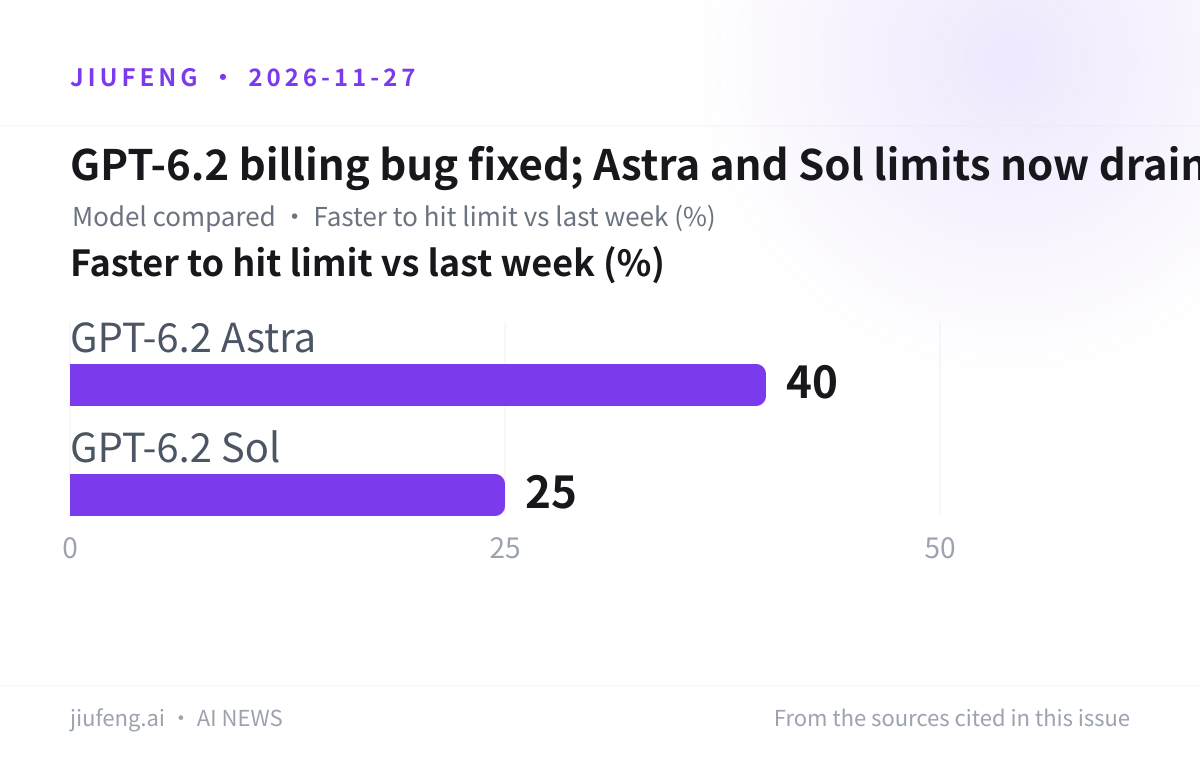
OpenAI had applied the wrong discounts at launch. With the fix, GPT-6.2 Astra users hit their limits 40% faster than last week, and Sol users 25% faster.
According to OpenAI Codex engineer Thibault Sottiaux, a billing bug during the GPT-6.2 rollout gave most users the wrong discounts on GPT-6.2 Astra and Sol. The bug is now fixed, so the same usage uses up quota faster:
| Model | Faster to hit limit vs last week (%) |
|---|---|
| GPT-6.2 Astra | 40 |
| GPT-6.2 Sol | 25 |
Sottiaux says quotas should still last longer than they did with GPT-6 Astra and GPT-6.1 Sol. Other models were not affected, and OpenAI will not charge retroactively for the difference. To make up for it, Go, Plus, Pro and Business subscribers get an extra saved reset, and Business users get free Fast Mode through the end of the year.
Limitations: The details come from an engineer's post on X and media coverage of it. OpenAI has not published the actual quota for each plan, so users cannot work out the absolute change themselves.
Jiufeng graphic based on the sources cited in this issue.
Source: Original source Thibault Sottiaux (X) · The Decoder
02/11
MiniMax H3 at 100 days open source: 1,472 derivatives and 148M+ downloads
MiniMax says H3 has spawned 1,472 derivative models and is downloaded more than 17 times a second on average.
According to MiniMax's research blog, developers have built 1,472 derivative models on H3 in the 100 days since it was open-sourced, with more than 148 million total downloads.
- Companies with their own versions: NVIDIA, Tencent and Alibaba
- Apps and platforms: fal, Suno, HeyGen, Pika and Creatify
- Research groups: MIT, the National University of Singapore and The Hong Kong Polytechnic University
- Licensing: More than ten companies worldwide have licensing deals with MiniMax and use H3 in e-commerce, gaming, film and TV, animation and comics, short-form dramas and industrial design work
Limitations: All of these figures come from MiniMax, with no third-party count to check them against. The post does not say how derivative models were identified or counted.
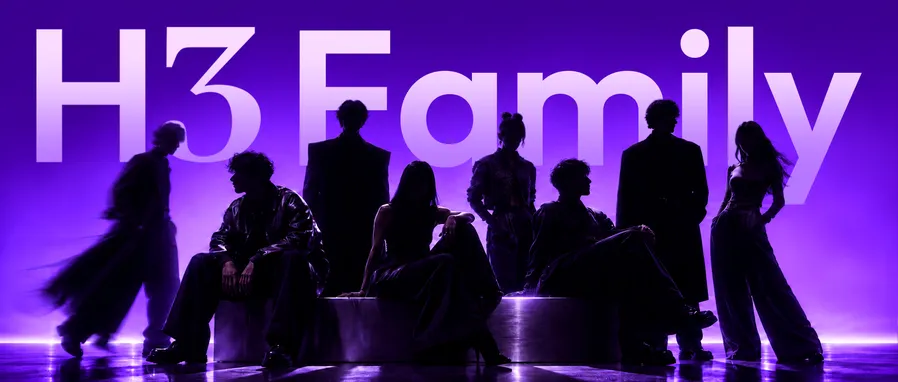
Image source: MiniMax.
Source: Original source MiniMax Research
03/11
Sakana AI releases Namazu Small, a 30B-A3B reasoning model built on Nemotron 3 Nano
Sakana Namazu Small has only 3B active parameters, yet it beats the 120B Nemotron 3 Super on a 25-benchmark average.
Sakana AI started from NVIDIA's pretrained Nemotron 3 Nano base and did its own continued pretraining and post-training. Nemotron 3 Nano is a hybrid Mamba-Transformer MoE model that NVIDIA lists at 30B total and 3B active parameters. Sakana says Namazu Small is small enough to run in your own environment.
| Model | 25-benchmark avg | BrowseComp | SimpleQA Verified |
|---|---|---|---|
| Namazu Small | 60.1 | 73.5 | 6.8 |
| Nemotron 3 Super | 56.2 | 36.1 | 18.1 |
| Nemotron 3 Nano | 50.2 | 29.3 | 9.1 |
Web research is its strongest area, with a DeepSearchQA score of 84.3.
Limitations: All scores are self-reported. Context length and target hardware have not been disclosed. On SimpleQA Verified, a factual-recall test, it scores 6.8, below both its Nano base and Super.
Source: Original source Hugging Face: Nemotron 3 Nano · NVIDIA Developer Blog · MarkTechPost
LingSante 3.1 Air VL is a 124B-total, 5.5B-active medical MoE vision-language model priced at $0.06 per million input tokens.
It takes text plus up to 16 images, such as scans, skin and meal photos, and lab reports. Uses include drafting imaging reports, health questions, clinical Q&A and medical agents, with tool calling and JSON output. Thinking is on by default. It was released on Nov 26, and the weights are on Hugging Face.
- Context: 131K
- Price: $0.06 input / $0.18 output per 1M tokens; cache reads $0.012
- Hosting: DeepInfra is the only provider for now, with 0.30 s latency and 41 tok/s throughput
Limitations: The developer states it is a research model, not a medical device, and qualified professionals should review its output. With only one hosting provider, there is no fallback route.
Source: Original source Hugging Face weights · OpenRouter
Global AI News
05/11
OpenAI's other eight math papers: Lean proofs check less than the headlines claim
All nine manuscripts OpenAI posted on Nov 24 come with machine-checked Lean proofs, but in several the checked statement is narrower than the paper's main claim.
The manuscripts are in the public openai/math repository. Besides the paper claiming the matrix multiplication exponent is 9/4, the other eight make equally large claims. One says it answers Smale's ninth problem on linear programming. One says it disproves the polynomial Hirsch conjecture. One says it proves the fixed-petal sunflower conjecture. Two more say they separate classes in Valiant's algebraic hierarchy, including VP and VNP.
Limitations: The report's point is that a Lean proof only confirms the formal statement that was written down, and in several papers that statement is narrower than the headline.
Source: Single report RuntimeWire
06/11
Nvidia halts server shipments to Malaysia, Singapore, Thailand and Indonesia
After the US tightened export controls aimed at Chinese cloud access, Nvidia told partners including Dell and Supermicro to stop shipping servers to four Southeast Asian countries.
According to the report, Nvidia has told partners such as Dell and Supermicro to pause server shipments to Malaysia, Singapore, Thailand and Indonesia. The trigger is a new set of US export controls targeting Chinese companies' access to compute through foreign cloud services. Since the rules came out, dealers have been left with large numbers of Nvidia GPUs listed for sale.
Limitations: The report does not say how long the halt will last or how many orders it affects.
Source: Single report The Decoder
07/11
C4ADS links some US-based Nvidia partners to Chinese firms
An investigation by the nonprofit C4ADS, done at CBS News' request, found that Nvidia preferred partner RiCloud AI is a unit of a Shenzhen company.
RiCloud AI is based in San Jose. As an Nvidia preferred partner, it can buy high-end GPUs and use Nvidia's GPU software and technical support. The investigation says it belongs to Shenzhen-based Yuxing InfoTech Investment Holdings. Yuxing's CEO reportedly holds a degree from a university run by China's military, and its chair previously worked at a Chinese tech firm that faced national security scrutiny in Australia. RiCloud AI recently signed a $120 million deal to rent out Nvidia-powered servers to a Taiwanese whisky company that made a profit of only $609,000 last year.
Limitations: The investigation shows ownership and personnel links. The report does not say RiCloud AI broke export controls, and it does not include responses from Nvidia or the companies named.
Source: Single report SiliconANGLE
08/11
Uber publishes a security framework for AI agents, from registration to replay
Uber says identity checks and API permissions are not enough for agents, so it adds "behavioral authorization" to decide whether an action makes sense in the current context.
The framework has three layers:
- Before deployment: Each agent registers in Uber AI Registry with its identity, owner, role, allowed intents and risk class. A tool called Argus automatically scans its code, prompts, dependencies and tool-call paths, and MCP servers get the same checks.
- At runtime: Agent Guard hooks call AI Guard at key checkpoints. AI Guard checks proposed actions against policy and decides whether to allow or block them.
- After deployment: A unified execution trace links actions, tool calls and security decisions, and past interactions can be replayed to retest them after policy changes.
Limitations: Uber acknowledges trade-offs between strict policies, false positives, runtime latency and the cost for developers to adopt it. UN IT official Tristan G. commented that writing policy for each agent becomes more work as the number of workflows grows, that the strongest control is basically least privilege, and that the hooks cannot be added to third-party or SaaS agents.
Source: Multiple outlets InfoQ · InfoQ China
Regional & Early Signals
09/11
ShengShu releases Motubrain 2.0, a 20B world action model trained live on stream
Motubrain 2.0 scored 41.28 on RoboDojo's five-part composite, ahead of GPT-6 Astra's 28.97. ShengShu says it will be open-sourced soon. Chinese-language source.
The release includes a 20B-parameter world action model (WAM) and an agent system called Motubrain-Harness. The whole pretraining run was livestreamed: 25 days, 600 hours and 200,000 steps, with 19 checkpoints tested on real robots in 5,624 valid trials. During the stream the team found a batch of data where gripper "open" and "close" labels were swapped, and restarted training from step 0. Another time, a sampling weight that was not adjusted dropped the success rate from 62% to 45%.
| Model | RoboDojo 5-part composite |
|---|---|
| Motubrain 2.0 | 41.28 |
| GPT-6 Astra | 28.97 |
Without the Open tasks, it averages 49.95 across four core abilities and ranks first. ShengShu says it took first place on five of six robot manipulation benchmarks.
Limitations: The weights are not out yet. This item relies on a Chinese-language source.
Source: Single report Leiphone (Chinese)
With textures removed, OCR can read 90.7% of the relief text in H3.5 Preview's 3D output, compared with 46.1% for the previous H3.1. Chinese-language source.
In a blind review of 192 untextured models by senior 3D artists, H3.5 Preview came first 82 times (42.8%), 2.3 times as often as the runner-up. In a second blind test covering more than 200 cases, judged by an agent and ranked by experts, it lost none of 22 single-view and four-view comparisons. All models got the same inputs at maximum geometry quality, with textures and normal maps removed.
Limitations: VAST ran these evaluations itself, and the report does not name the five competing models. The model is still a preview. This item relies on a Chinese-language source.
Source: Single report QbitAI (Chinese)
11/11
Switzerland reports five AI-agent cyberattacks hitting power, water and telecom operators
Switzerland's federal cybersecurity office says attackers used AI agents in five attacks, and four of them succeeded. Chinese-language source.
According to Reuters, as relayed by IT Home, the Swiss Federal Office for Cybersecurity (BACS) reported five attacks over the past few days in which attackers used AI agents against companies and critical infrastructure operators. Three of the targets were critical infrastructure operators, which Swiss broadcaster SRF identified as electricity, water and telecom providers. BACS advised companies to put protections in place, including regular security testing.
Limitations: BACS has not named the attackers, the AI tools used or the extent of the damage. This item relies on a Chinese-language summary of Reuters' report.
Source: Single report IT Home (Chinese)
This digest is compiled by AI from the sources linked in each item and published after automated fact-checking, without article-by-article human review before publication. If anything differs from the original, the original source prevails. How this digest is made, or report an error: About this digest
Generate short videos with sound in your browser — from a prompt or a first-frame image. 5 free credits on sign-up, no credit card.
Open MiniMax H3