Overview
11 stories in this issue. The first 3 are today's priorities.
Hot model updates
- Top · ChatGPT merges Chat and Work under a single usage meter
- Top · OpenAI pilots Private Inference, which keeps enterprise data out of its own reach
- Top · Report: chip curbs and anti-distillation are slowing DeepSeek, Moonshot AI and Alibaba
Global AI news
- Amodei calls claims that he favors surrendering control to AI "absurd"
- US remote-access chip licensing puts billions in Asian data-center loans on hold
- Google open-sources AQuA to diagnose silent failures in production AI agents
- Netflix builds an operations knowledge graph for AI-driven troubleshooting
- Splitting a model across 5,600 Lambda calls cost over 80 times Gemini Decision 1's price
Regional and early signals
- South Korea's Detect AI uses radio signals to spot AI glasses in exam rooms
- AgiBot's LinkSoul platform says it hosts more than 30,000 robot agents after one year
- Doubao tests a shopping entry that pulls products from Douyin Mall
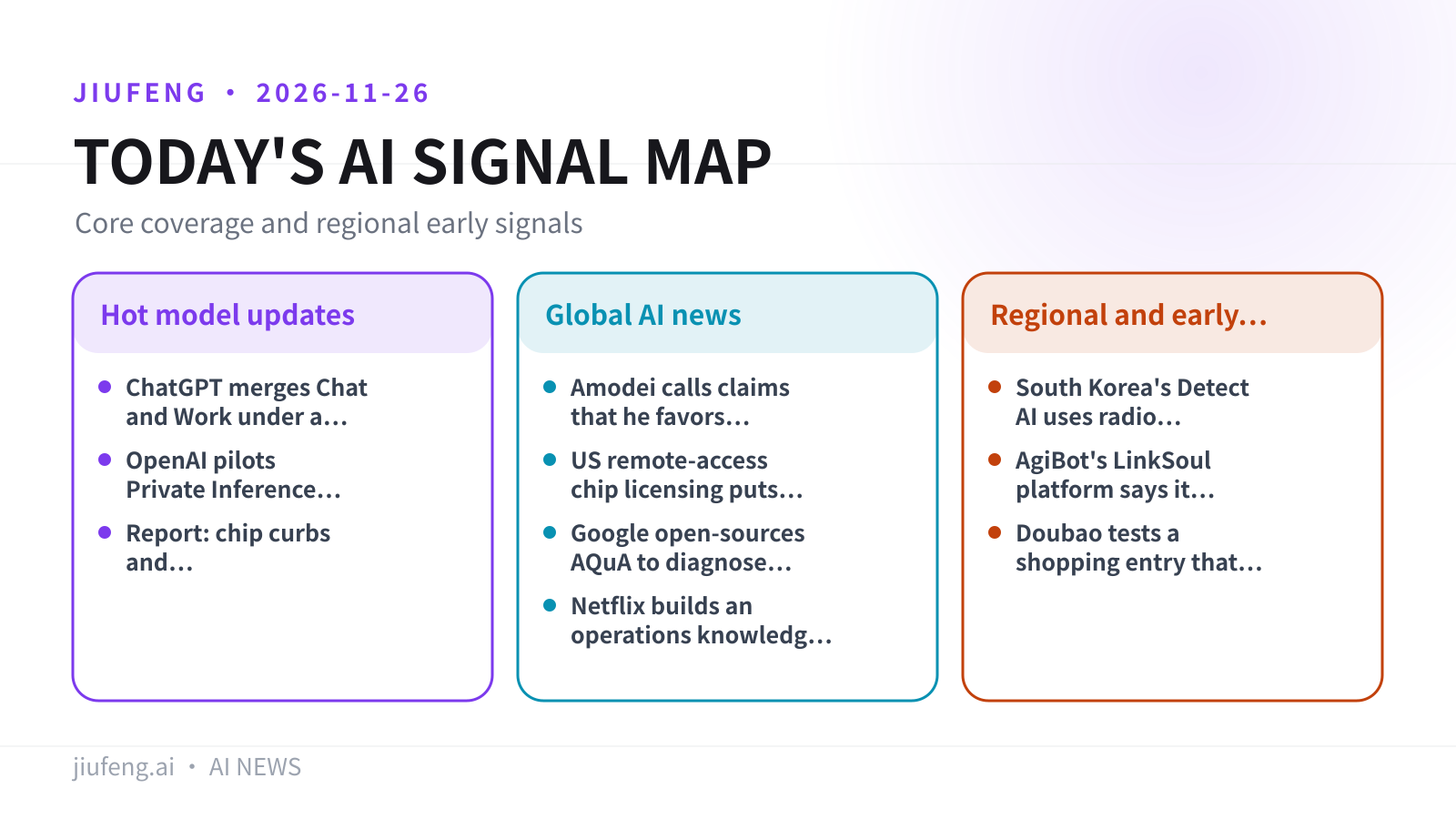
Jiufeng graphic based on the sources cited in this issue.
Hot model updates
OpenAI has begun combining ChatGPT's Chat and Work experiences into one, with a single usage meter. A small group of the heaviest users may hit their limits sooner.
- Rollout: Starts with a small group of Pro subscribers, product lead Thibault "Tibo" Sottiaux said in a post on X on Tuesday.
- Prior notice: OpenAI had already announced the merger to users by email.
- Limits: One usage meter now covers all of ChatGPT. An OpenAI spokesperson told TechCrunch that most users are not expected to see more frequent usage resets, but a small fraction of the heaviest users may hit their limits sooner.
Limitations: Some subscribers have criticized the merger, saying it could restrict their usage. The report gives no specific new limit figures and no timeline for a full rollout.
Source: Original source Thibault Sottiaux on X · TechCrunch
02/11
OpenAI pilots Private Inference, which keeps enterprise data out of its own reach
OpenAI is piloting Private Inference with its first enterprise customers. Queries run on isolated hardware that can be independently verified, and OpenAI cannot access the data.
Sam Altman said the previously announced offering is now in a pilot with its first enterprise customers. Shekar, the OpenAI employee leading the effort, called it a first step toward "private intelligence for everyone." According to OpenAI, queries are processed on specially isolated hardware whose security can be independently verified. Altman also pointed to Private Safety Processing, which lets OpenAI scan for abuse without storing customer data. Flagged content is encrypted and stored in the customer's own cloud.
Limitations: The service is only for business customers, whose data OpenAI already does not use for training. Consumer ChatGPT conversations are still used for training by default unless users opt out. OpenAI is still scaling up the compute it needs, and the report gives no pricing or general-availability date.
Image source: OpenAI.
Source: Original source OpenAI Private Intelligence interest form · The Decoder
03/11
Report: chip curbs and anti-distillation are slowing DeepSeek, Moonshot AI and Alibaba
According to The Information, US limits on Chinese firms' remote access to Nvidia chips, plus anti-distillation measures from OpenAI and Anthropic, have delayed projects at several Chinese labs.
- Timing: The pressure has been building since September, the report says.
- DeepSeek: Last month its researchers estimated internally that their gap to top US models could grow from three to six months to nine months if distillation disappears completely.
- Moonshot AI: Canceled a $150 million deal for Nvidia Blackwell chips in Indonesia.
- Workarounds: Some firms are renting compute through non-Chinese third parties. MiniMax, Mihoyo and Alibaba are relying more on domestic chips and spending more on training data for their own reinforcement learning.
Limitations: This is The Information's reporting as relayed by The Decoder. The source does not include confirmation or comment from the companies named.
Source: Single report The Decoder
Global AI news
04/11
Amodei calls claims that he favors surrendering control to AI "absurd"
In a long post on X, Anthropic CEO Dario Amodei said handing governance over to AI would be "a bad idea" and denied that he wants humans to surrender their free will.
He was responding to an Axios report, which cited people familiar with internal discussions. It said some Anthropic employees believe humanity will, and often should, safely hand authority to superintelligent systems rather than fight for control. Amodei pushed back, saying "turning over governance to AI is a bad idea" and that AI must be governed by "legitimate democratic processes," with political decisions left in human hands. He called it absurd to suggest that he himself believes people should "surrender human free will" to AI. He wrote that the argument against autocracy "applies word for word" against governance by AI. He added that automating specific tasks, such as driving, developing cancer drugs and writing software, could benefit humanity.
Limitations: This is a personal statement and comes with no policy or product change. TechCrunch notes that the accusations came from rivals, and that leading AI companies are increasingly automating their own research and model development.
Source: Original source Dario Amodei on X · TechCrunch · The Decoder
05/11
US remote-access chip licensing puts billions in Asian data-center loans on hold
A new US rule requires a license for large-scale remote access to advanced AI chips by China-headquartered firms. Lenders have paused or reassessed data-center loans linked to ByteDance, Alibaba and Tencent as a result.
- Rule: Took effect November 19th and covers chip sales to five countries as well as large-scale remote access for China-headquartered firms.
- Grace period: Some existing operators have 90 days to seek a license.
- Impact: Lenders have paused or reassessed billions of dollars in loans, Semafor reported on November 25th, citing Bloomberg.
Until now, a data center in Malaysia or Thailand could be financed around a long-term contract with a large Chinese tenant. The rule turns that tenancy into a US licensing question, which can delay chip deliveries, customer access and the cash flow used to repay the loan.
Limitations: The report does not name individual loans or give their amounts, and the information has passed through several outlets.
Source: Single report RuntimeWire
06/11
Google open-sources AQuA to diagnose silent failures in production AI agents
Google has open-sourced AQuA (Ambient Quality Agent), a reference implementation that catches problems such as agents skipping required tool calls or ignoring user preferences while still returning success, and traces them back to source code.
AQuA runs as a sidecar alongside production agents, outside the request path, and reads telemetry from Cloud Trace, Cloud Logging or BigQuery. Each run samples up to 1,000 recent sessions and moves through five stages: sampling, review, cluster discovery, candidate-cluster verification and issue tracking. Developers can set domain-specific quality criteria in a goal.md file. For root-cause analysis, it compares failing sessions with an immutable source snapshot captured at deploy time and cites the relevant files and line ranges.
In Google's test on a multi-agent travel app, 32 sessions produced 42 observations and 9 candidate clusters. Verification discarded 3, leaving 6 confirmed issues. Results after the prompts were fixed and the sessions replayed:
| Issue (sessions) | Before | After |
|---|---|---|
| Seat-availability check skipped | 15 | 2 |
| Vegetarian preference dropped | 7 | 0 |
| All checks passed | 5 | 13 |
Limitations: These figures come from a controlled replay, not live traffic. AQuA does not fix code or open PRs on its own. Google lists two main constraints: sampling can miss rare failures, and replays may not reproduce external state.
Source: Original source GitHub: google/adk-recipes · InfoQ · InfoQ China
07/11
Netflix builds an operations knowledge graph for AI-driven troubleshooting
Netflix is building an ontology-based knowledge graph that links applications, incidents, deployments, alerts and infrastructure dependencies, as groundwork for automated root-cause analysis.
- Scale: Netflix says it handles more than 2 billion requests a day and more than 38 million real-time log events per second. A typical application regression takes about four hours to investigate.
- Stack: The ontology uses RDF, OWL, SHACL and SPARQL. The graph is stored in QuipuDB, a distributed RDF database Netflix built on the Rust storage engine redb.
- Ingestion: An Enricher pipeline turns data from operational systems into triples. Part of the logic is deterministic and part uses LLMs, with outputs constrained by rules such as entity types and URI naming conventions.
- Analysis: A correlation engine examines 13 signal types, including log errors, metric anomalies, deployments, config changes and experiments. It outputs ranked failure hypotheses and supports AutoRCA.
Limitations: The system is still in development, and the report gives no measured reduction in investigation time.
Source: Multiple outlets InfoQ presentation · InfoQ China
08/11
Splitting a model across 5,600 Lambda calls cost over 80 times Gemini Decision 1's price
Bevyl co-founder Noah Lindner tested whether serverless CPU could replace a GPU for model inference. It worked, but it was slow and expensive.
In a November 14th post, Lindner said he split a 9.3 GB model by layer and spread one model call across 5,600 AWS Lambda calls. Reading about 4,000 tokens took 17 seconds and cost about 3.4 cents.
| Setup | USD per million tokens |
|---|---|
| Lambda split (estimate) | 8.40 |
| Gemini Decision 1 | 0.10 |
Limitations: The figures are Lindner's own rounded estimates from a single personal experiment, and no third party has reproduced it.
Source: Single report RuntimeWire
Regional and early signals
09/11
South Korea's Detect AI uses radio signals to spot AI glasses in exam rooms
SKIP, a drone-detection startup spun out of Korea East-West Power, has built Detect AI, which applies its drone-signal spectrum analysis to exam rooms. Chinese-language source.
According to Yonhap, as relayed by IT Home, the system picks up nearby wireless signals and cross-checks vendor and unique device identifiers. It flags devices such as AI smart glasses, pinhole and button-style wireless cameras, and wireless earbuds. It does not decode or separately store any communication content. It can selectively block unauthorized devices, show how close a device is and list detections by risk score. SKIP plans to demo it at COMEUP 2026 at COEX in Seoul from December 9th to 11th.
Limitations: Only the vendor's description and a Chinese-language relay are available so far. No detection-accuracy figures or real exam deployments have been published.
Source: Single report IT之家 (Chinese-language source)
10/11
AgiBot's LinkSoul platform says it hosts more than 30,000 robot agents after one year
AgiBot says LinkSoul, its platform for building robot agents, has drawn more than 20,000 users and produced more than 30,000 agents in its first year. Chinese-language source.
LinkSoul is part of AgiBot's AIMA embodied-AI ecosystem. AgiBot also announced a "Yuansheng" ecosystem program and says it will spend at least 2 billion yuan on it over five years. The platform lets users create and configure agents in natural language, organize tasks with knowledge bases, skills and workflows, debug in a 3D environment, and connect to external tools and robots through SDK, MCP and Skill interfaces. It holds more than 70,000 pieces of content, and Peking University People's Hospital uses it for patient guidance.
Limitations: All figures are AgiBot's own. The article reads as promotional and gives no active-user numbers or data on how the agents are actually used.
Source: Single report 量子位 QbitAI (Chinese-language source)
11/11
Doubao tests a shopping entry that pulls products from Douyin Mall
ByteDance's Doubao app is gray-testing a "Doubao Shopping" entry in its sidebar, and it loads products from Douyin Mall. Chinese-language source.
According to Jiemian News on November 24th, the entry sits in the sidebar next to the main chat, new chat, plugins and skills, and projects. To see full prices or stock, or to place an order, users are prompted to link a Douyin account.
Limitations: The feature is still in limited testing, and the report gives no rollout scope or conversion data. The TMTPost source is a commentary piece; only the Jiemian reporting it cites is used here.
Source: Single report 钛媒体 TMTPost (Chinese-language source)
This digest is compiled by AI from the sources linked in each item and published after automated fact-checking, without article-by-article human review before publication. If anything differs from the original, the original source prevails. How this digest is made, or report an error: About this digest
Create AI images and videos with sound in your browser: write a prompt, pick a model, download the result. 5 free credits on sign-up, no credit card.
Start creating free