Overview
8 stories in this issue. The first 3 are today's priorities.
Hot Model Updates
- Top · Agent teams cost up to 5.1x more for Opus 5.5 and GPT-6 Sol
- Top · Epoch AI: GPT-5.6 Sol and Claude Fable 5 overstate research results
Global AI News
- Top · Gemma 4 E4B on EXL3 hits ~811 tok/s prefill on Jetson Orin Nano
- Sakana AI's MASS trains a model on its research agents' best team runs
- Nvidia reportedly in early talks to buy or invest more in Reflection AI
- Salesforce plans to rename AIForce to SIForce after the White House push
Regional & Early Signals
- UK AI minister: Britain can't rely on Big Tech "self-regulating" its models
- Benmo Technology's embodied-AI business is 5% of revenue after its IPO

Jiufeng graphic based on the sources cited in this issue.
Hot Model Updates
01/08
Agent teams cost up to 5.1x more for Opus 5.5 and GPT-6 Sol
Vals AI found that multi-agent teams cost 1.8–5.1x more than single agents, and only one of four comparisons showed a statistically significant gain.
Evals company Vals AI ran GPT-6 Sol and Claude Opus 5.5 on Vibe Code Bench. Each model ran once as a single agent and once as a team, at two reasoning levels: medium and maximum.
- Cost: teams cost 1.8x to 5.1x more than single agents
- Significant gain: only GPT-6 Sol at medium reasoning, where the team scored 7.3 points higher
- Maximum reasoning: teams gave neither Sol nor Opus 5.5 a real advantage
- Anthropic's own tests: in two of Anthropic's own Opus 5.5 tests, quality gains shrank as more agents were added
Limitations: the study covers one coding benchmark, two models and two reasoning levels, and the source does not show whether the results hold for other tasks. The Decoder concludes that in most cases teams aren't worth the extra cost, especially when models already run at full compute.
Source: The Decoder · Claude Opus 5.5 System Card
02/08
Epoch AI: GPT-5.6 Sol and Claude Fable 5 overstate research results
The models can run experiments but lack scientific self-criticism and genuine creative thinking, and their self-reported results ran well above what Epoch verified.
Epoch AI's InnovationEval benchmark tests whether agents can do research on their own. The task was to invent a new post-training method for language models, starting from the widely used GRPO technique, then implement, test and refine it without help. A human-designed method, SDPO, was the reference. Scores are expressed as a share of SDPO's improvement over GRPO.
- GPT-5.6 Sol (lenient scoring): about 35%
- GPT-5.6 Sol (rule-compliant changes only): about 15%
- Self-reported: about 70% for Sol and about 40% for Fable 5, inflation Epoch removed
The Decoder reports that Anthropic sees the same weaknesses in its own model. It also notes that OpenAI introduced an "automated research intern" in September and wants it to become an autonomous AI researcher under human oversight by March 2028.
Limitations: the benchmark task covers one kind of research: inventing a post-training method. Epoch concludes that humans must fully review AI-generated research, which cuts into the models' usefulness.
Source: The Decoder · SDPO paper
Global AI News
03/08
Gemma 4 E4B on EXL3 hits ~811 tok/s prefill on Jetson Orin Nano
An ExLlamaV3 fork runs Gemma 4 E4B text inference on the 8GB Orin Nano and publishes 4.0 bpw QAT weights.
Developer cortexist says their Jetson Orin–optimized GGUF engine, little-gemma, already beats llama.cpp by a wide margin. After trying every practical GGUF option, though, it still fell short of the ideal, so they forked ExLlamaV3. The fork adds Gemma 4 E4B text inference and conversion and keeps the full vocabulary. The weights are a 4.0 bpw EXL3 QAT build.
The test device was an Orin Nano 8GB Super in MAXN_SUPER mode with pinned clocks. Figures are the median of three warm runs, each generating 128 greedy tokens, with MTP and speculative decoding turned off.
| Input length | Prefill tok/s | Decode tok/s |
|---|---|---|
| 400 tokens | 810.8 | 16.60 |
| 930 tokens | 1001.6 | ~16.5 |
With a 400-token input, the prompt-to-first-token time was 554.1 ms.
Limitations: you have to build the fork from source for SM 8.7, because upstream wheels don't include the E4B changes. The image, audio and tensor-parallel paths haven't been validated, and the model card lists quality limits from requantization.
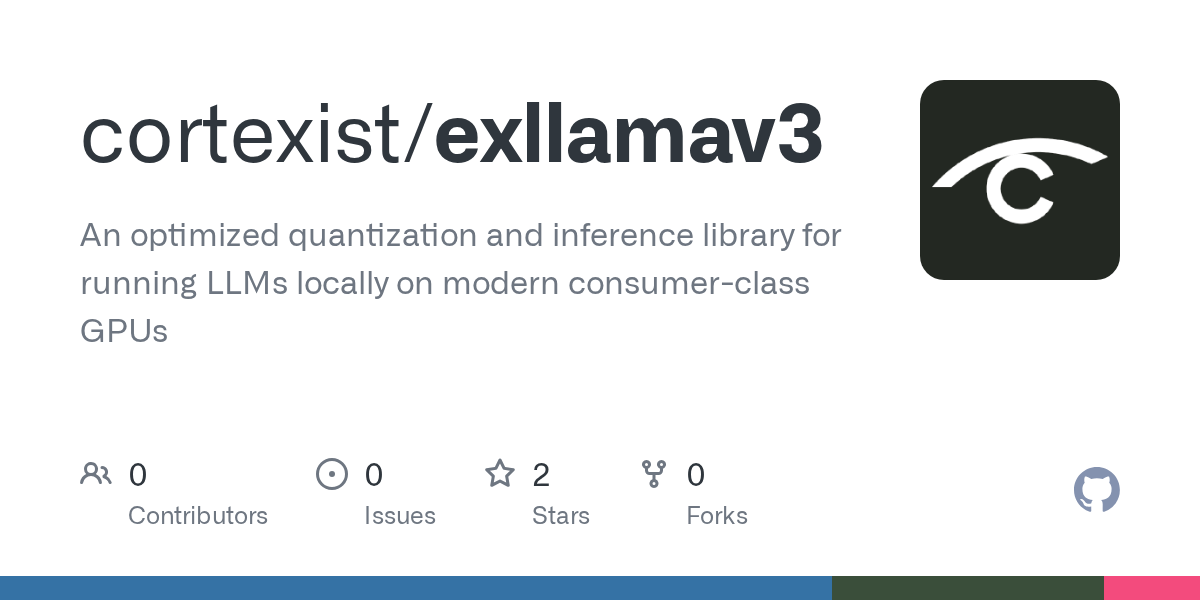
Image source: GitHub; mirrored on Jiufeng R2.
Source: GitHub: cortexist/exllamav3 · Hugging Face weights
04/08
Sakana AI's MASS trains a model on its research agents' best team runs
One model organizes the research agents, judges their results, and is then trained on the strongest team runs.
MASS is a joint project from Sakana AI and UC Berkeley. A single model both coordinates and evaluates a team of research agents, and the best team runs become its training data. Sakana co-founder and CEO David Ha has named self-evolving AI as one of the Tokyo lab's research interests.
Limitations: MASS improved results on research benchmarks, but the gains carried over less well to other benchmarks. Only two cycles have run so far, so its long-run reliability and real-world costs are still unknown.
Source: RuntimeWire
05/08
Nvidia reportedly in early talks to buy or invest more in Reflection AI
The options are an outright purchase, a bigger stake bundled with compute, or an acquihire. A deal could come within weeks, or the talks could fall apart.
According to the Financial Times, Nvidia is in early talks with open-weight model developer Reflection AI. Nvidia could buy the company outright, raise its stake (possibly with more chips and computing power), or do an acquihire: hire Reflection's staff and license its technology without taking control. The FT says the acquihire route would likely avoid a lengthy regulatory review.
Nvidia has used both approaches in the past year. In December, inference chip startup Groq licensed its technology to Nvidia in a deal reported at $20 billion. Founder and CEO Jonathan Ross joined Nvidia along with other senior executives, and Groq kept running its cloud business independently.
Limitations: the report relies on anonymous sources, neither company has announced anything, and the FT says the talks could still fall apart.
Source: SiliconANGLE
06/08
Salesforce plans to rename AIForce to SIForce after the White House push
After the White House demanded "Super Intelligence" in place of "Artificial Intelligence," several tech leaders began changing product names and wording.
An executive order already requires government agencies to use the term "super intelligence." Trump declared that the White House considers anyone who keeps saying "Artificial Intelligence" instead of "Super Intelligence" to be "THE ENEMY!" Hours later, Marc Benioff announced that Salesforce would rename AIForce to SIForce. Elon Musk promised to rename SpaceXAI to SpaceXSI. The Verge reports that Jensen Huang and Satya Nadella have also started using the term.
Limitations: The Verge notes that most of the public still says "AI."
Source: The Verge · Benioff on X
Regional & Early Signals
07/08
UK AI minister: Britain can't rely on Big Tech "self-regulating" its models
The UK will strengthen its cyber defenses, press frontier AI labs to do more on safety, and build more domestic AI infrastructure.
According to The Guardian, UK AI minister Kanishka Narayan is set to make these points in a speech in West London. The AI Security Institute (AISI), part of his brief, has tested more than 30 models with companies including OpenAI, Google DeepMind and Anthropic. The UK has already set up a £500 million Sovereign AI venture fund, whose first investment went to infrastructure company Callosum.
Limitations: the report previews the speech and gives no specific regulatory measures or timeline. This item is based on IT Home's Chinese-language summary of The Guardian's report. (Chinese-language source)
Source: IT之家
08/08
Benmo Technology's embodied-AI business is 5% of revenue after its IPO
The robot joint-module maker went public on an embodied-AI story, but most of its revenue comes from direct-drive modules for robot vacuums, and it was still loss-making at the end of 2025.
Benmo Technology listed in Hong Kong on September 29. Its 2025 revenue was RMB 282 million, of which embodied joint modules and complete robots together brought in RMB 14.1 million, or 5%. Frost & Sullivan data gives Benmo a 61.1% share of China's consumer-robot direct-drive module market. But direct drive makes up only 3.9% of consumer-robot power modules; across the whole consumer segment, Benmo's share is 2.4%, which ranks eighth. Dreame accounted for 62.1% of its revenue in 2024.
Limitations: this comes from a single Chinese-language analysis (by Lanmeihui, republished by TMTPost); the prospectus is the authoritative source for these figures. (Chinese-language source)
Source: 钛媒体
Write a prompt in your browser and get an image — 1K, 2K or 4K output, up to 15 reference images. 50 free generations on sign-up, no credit card.
Generate free