Overview
9 stories in this issue. The first 3 are today's priorities.
Hot Model Updates
- Top · Qwen-Image-2.1-Turbo ships open weights with 8-step generation and editing
- Top · OpenAI Decisions API enters public beta on GPT-6 Luna
- Top · Claude Code's Windows app contains hidden per-folder worktree controls
Global AI News
- Jev maker TypeSafe AI raises $870M at a $7.5B valuation
- GitHub uses AI to move the Copilot runtime to Rust
- Postman runs Agent Mode for 40 million developers on Amazon Bedrock
- Warehouse robot maker Ultra Robotics raises $62M
- Amazon stops requiring NDAs in data center talks with local governments
Regional and Early Signals
- Tian Keyu's world-model lab raises $30M at a $200M valuation
Hot Model Updates
01/09
Qwen-Image-2.1-Turbo ships open weights with 8-step generation and editing
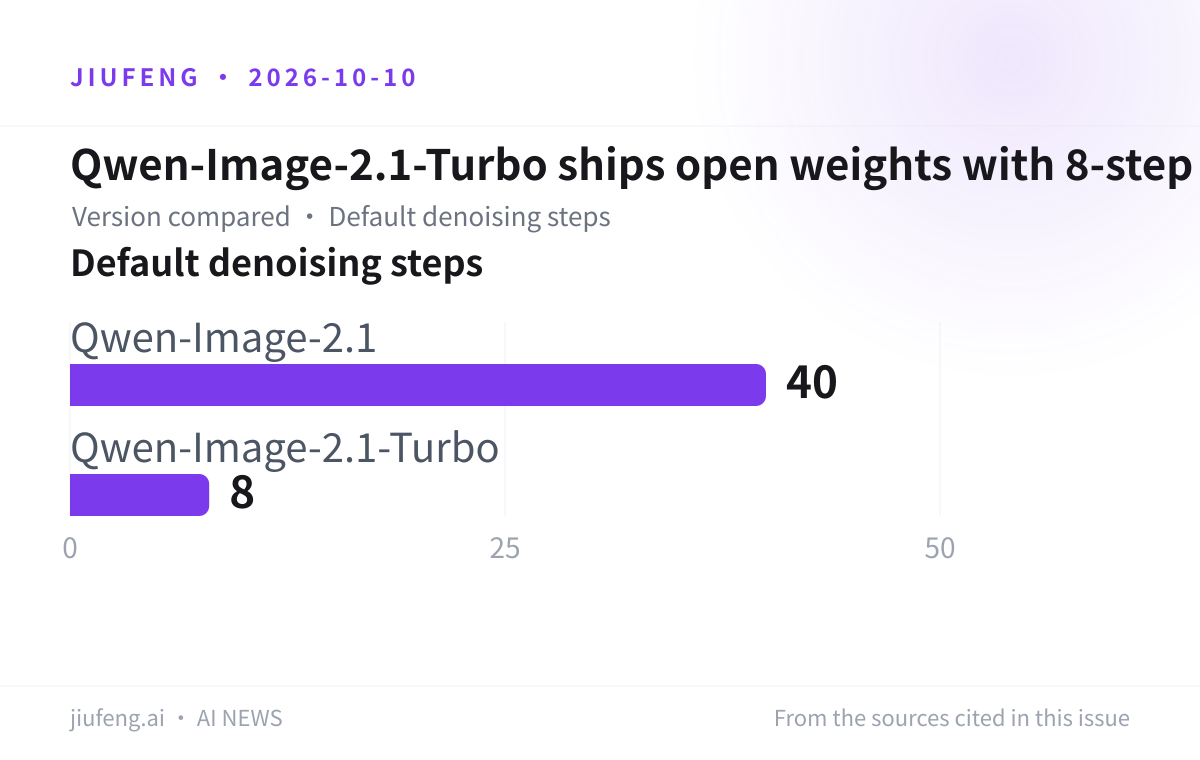
Qwen cut Qwen-Image-2.1's default 40 denoising steps to 8 without changing the model size, and the weights are downloadable.
Alibaba's Qwen team released Qwen-Image-2.1-Turbo on October 9. It is an accelerated checkpoint of the open-weight Qwen-Image-2.1 model, and one model handles both image generation and editing with a recommended 8-step schedule. The weights are on Hugging Face and ModelScope. Pro and Turbo APIs are also live on Alibaba Cloud Model Studio.
| Version | Default denoising steps | Visual generator params | Max output |
|---|---|---|---|
| Qwen-Image-2.1 | 40 | 7B | 2K |
| Qwen-Image-2.1-Turbo | 8 | 7B | 2K |
- Text encoder: Qwen3-VL 8B
- Runtime: CUDA GPUs in BF16 via Diffusers
- Base score: Qwen-Image-2.1 scores 60.28 on Qwen-Image-Bench, the top open-weight score Qwen reports
- VRAM guidance: Unsloth estimates about 11 GB for the base model with GGUF and about 24 GB with INT8/FP8
Limitations: The weights are under a research license, so commercial self-hosting requires separate permission. Qwen has not published a minimum VRAM figure for Turbo. Eight steps is Qwen's technical claim, and real deployment cost still depends on hardware, latency and output quality. Neither report includes independent quality evaluations of Turbo.
Jiufeng graphic based on the sources cited in this issue.
Image source: huggingface; mirrored on Jiufeng R2.
Source: Hugging Face model card · GitHub · MarkTechPost · RuntimeWire
02/09
OpenAI Decisions API enters public beta on GPT-6 Luna
The Decisions API is now in public beta. It returns typed answers with probabilities instead of generated prose, and output is not billed.
The endpoint takes text, images or both and returns typed answers such as probabilities, choices and scores that code can branch on directly. OpenAI says it runs about 10x faster than the Responses API. It is available at POST /v1/decisions and in a Playground.
- Model: GPT-6 Luna only. Parameter count is undisclosed, and the model card lists a 1,050,000-token context window
- Pricing: $0.10 per 1M input tokens, with no output, cache-read or cache-write charges. Prompts above 272K tokens are billed at 2x the input rate
- Minimum SDK versions: Python 3.26.0, JavaScript 7.30.0
- Deployment: OpenAI-hosted API only, no open weights
Limitations: The API is still in beta and supports one model. The 10x speed figure comes from OpenAI, and MarkTechPost notes there are no independent evals yet.
Source: OpenAI docs · OpenAI Playground · MarkTechPost
03/09
Claude Code's Windows app contains hidden per-folder worktree controls
RuntimeWire found code that is not yet switched on in Anthropic's Windows app: it lets one Claude Code session create a separate Git worktree for each of several repositories.
RuntimeWire reverse-engineered Windows x64 package 2.31226.0.0. It found per-folder worktree controls behind a feature flag, meant for starting one Claude Code session with separate Git worktrees for additional repositories. The package also contains code for starting local and SSH sessions. If worktree creation fails, the added repository stays as it is and the session works in the original folder.
Limitations: The feature is hidden behind a flag, and RuntimeWire did not confirm that users can access it or reproduce the finding independently. Anthropic was not contacted before publication. Because of the fallback to the original folder, developers need to check which folders actually received isolated working copies.
Source: RuntimeWire · Anthropic
Global AI News
04/09
Jev maker TypeSafe AI raises $870M at a $7.5B valuation
TypeSafe AI raised $870 million at a $7.5 billion valuation, only weeks after releasing its non-text model Jev on September 15.
Andreessen Horowitz led the round, with Sequoia and existing investor DCVC participating. TypeSafe says Jev is faster than LLMs and uses fewer tokens. It also says a third of Fortune 500 companies already use the model.
Limitations: The speed, token-use and adoption figures are company claims, and TechCrunch's report includes no third-party data.
Source: TechCrunch
05/09
GitHub uses AI to move the Copilot runtime to Rust
GitHub moved more than 800,000 lines of Copilot runtime code from TypeScript and Node.js to Rust in about 14.5 weeks.
InfoQ reports that the migration used AI-assisted development and was done incrementally. Old and new code ran side by side through N-API interop, so parts could be replaced one at a time.
Limitations: Only a summary is available. It gives no performance, memory or incident figures after the migration, and does not say what share of the code AI produced.
Source: InfoQ
06/09
Postman runs Agent Mode for 40 million developers on Amazon Bedrock
Postman and AWS published the architecture behind Agent Mode and concluded that context, not model capability, is the main bottleneck.
Agent Mode covers API testing, documentation, discovery and implementation. The post lists three practices: limiting how many tools the agent sees, exposing schema-based reads, and treating context as the primary bottleneck. Postman uses Amazon Bedrock to switch between models, along with geographically scoped cross-Region inference, model-dependent zero data retention and multi-tier prompt caching.
Limitations: AWS and Postman co-wrote the post, and the available excerpt gives no latency, cost or cache-hit figures.
Source: AWS Machine Learning Blog
07/09
Warehouse robot maker Ultra Robotics raises $62M
Ultra Robotics raised $62 million over two rounds. Its product, OP1 Operator, is a humanoid-style robot mounted on the end of a robotic arm.
According to Fortune, $50 million came from a Series A led by Framework Ventures. Y Combinator and NextView Ventures co-led the seed round. OP1 Operator carries items with forklift-prong-shaped grippers and can reach up to 10 feet. It takes items off shelves, picks up anything that falls, and sorts mixed inbound shipments into bins that each hold a single type of component. Ultra says one OP1 Operator can handle up to 1,000 items a day once deployed.
Limitations: The throughput figure is the company's own claim, and the report gives no customer deployment count or price.
Source: SiliconANGLE
08/09
Amazon stops requiring NDAs in data center talks with local governments
Amazon says it will stop using NDAs when it negotiates data center deals with local governments.
The report says secrecy around AI infrastructure has fueled community opposition, with hundreds of moratoriums proposed or enacted from New York to San Francisco.
Limitations: The source is a TechCrunch Equity podcast page. It does not link Amazon's original statement or explain the policy's scope or start date.
Source: TechCrunch Equity
Regional and Early Signals
09/09
Tian Keyu's world-model lab raises $30M at a $200M valuation
Leiphone reports that Tian Keyu's 10-person world-model lab raised $30 million from 5Y Capital and IDG at a $200 million valuation. Chinese-language source.
The lab has no product and no public name yet. Tian Keyu was at the center of the 2024 ByteDance intern sabotage incident that drew wide attention in China's AI community.
Limitations: This comes from a single Chinese-language source with thin material. It gives no details on technical approach, team or product timeline.
Write a prompt in your browser and get an image — 1K, 2K or 4K output, up to 15 reference images. 50 free generations on sign-up, no credit card.
Generate free