Overview
8 stories in this issue. The first 3 are today's priorities.
Hot Model Watch
- Top · Grok Build opens to every Grok plan, apps publishable to X
- Top · LFM2.5-DSpark lifts inference throughput up to 3.18x via speculative decoding
- Top · Researchers make Grok exfiltrate user data using encrypted instructions
Global AI News
- Anthropic launches Claude Academy, turning internal training into a public catalog
- Mistral launches Agentic Search for multi-step retrieval over complex documents
- Google Discover is getting a chat-tunable AI feed
- OpenAI expands Computer History to Mac users across Europe
Regional & Early Signals
- Doubao adds a side workspace so chat and actions share one screen (Chinese-language source)
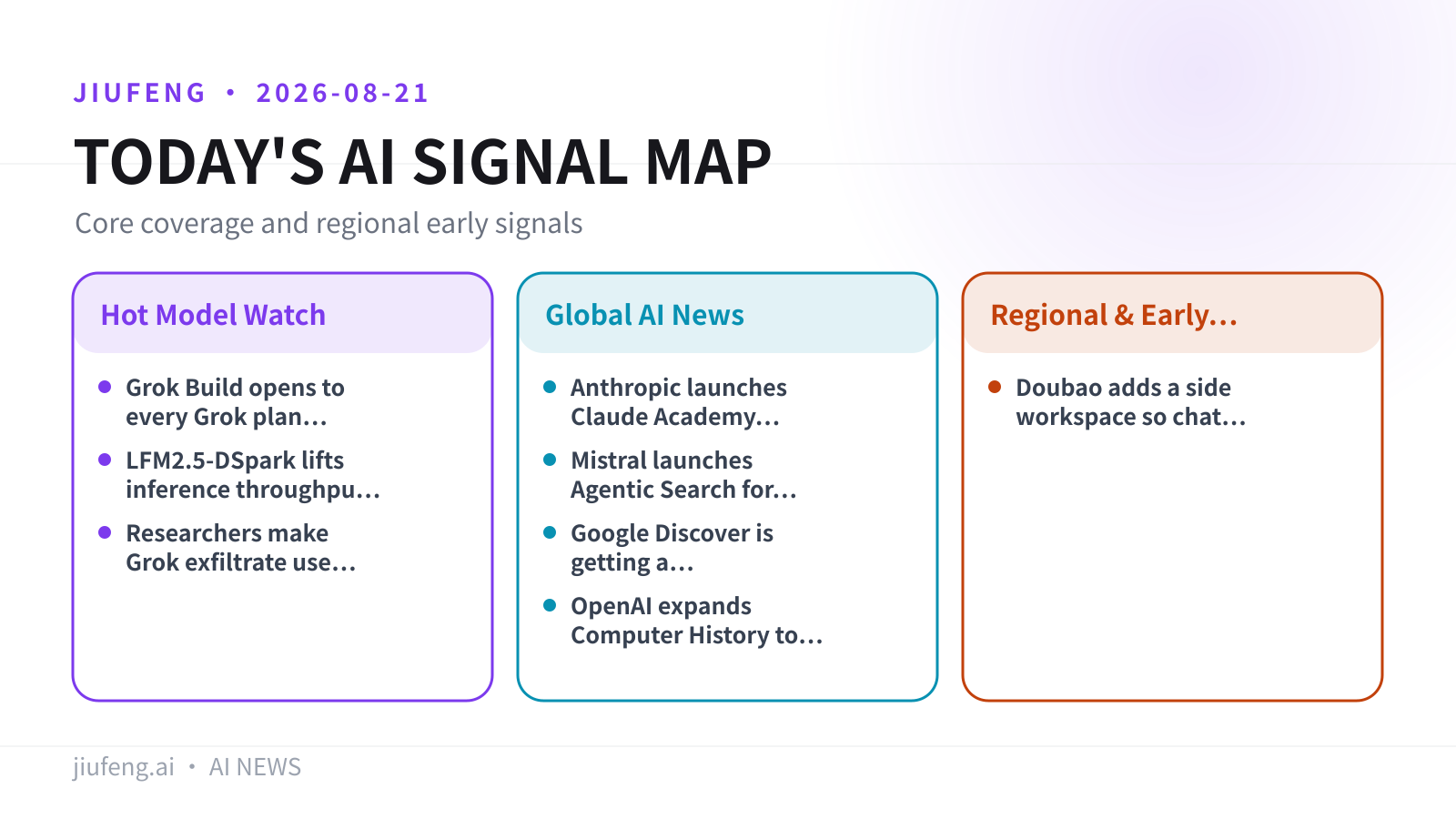
Jiufeng graphic based on the sources cited in this issue.
Hot Model Watch
01/08
Grok Build opens to every Grok plan, apps publishable to X
Grok Build graduates from a paid feature to a full product: available on web and mobile, with apps hosted on grok.me and embeddable as interactive cards in the X timeline.
On August 19, SpaceXAI made Grok Build — its prompt-based app builder — available on every Grok plan, turning it into a web and mobile product with its own hosting, model access and an X distribution channel. A user can describe a game, website, app or dashboard inside Grok, watch it take shape in the conversation, publish it to a grok.me address, and place it into the X timeline as an interactive card. Per SpaceXAI's product announcement, projects can call Grok models without separate API keys.
RuntimeWire notes the move combines app generation, hosting, AI APIs and X distribution in one product, giving SpaceXAI a route from casual prompts to recurring model usage; Musk founded xAI in 2023 and folded it into SpaceX in the February 2 acquisition. The announcement is first-party and does not detail per-plan usage limits or pricing tiers.

Image source: spacexai; mirrored on Jiufeng R2.
Source: RuntimeWire · SpaceXAI
02/08
LFM2.5-DSpark lifts inference throughput up to 3.18x via speculative decoding
Liquid AI ships DSpark draft models for three LFM2.5 models, trading minimal memory for a large speedup without changing output quality.
On August 20, Liquid AI released DSpark draft-model checkpoints for LFM2.5-1.2B-Instruct, LFM2.5-2.6B and LFM2.5-8B-A1B. DSpark adds a speculative-decoding path that trades a minimal memory increase for faster decoding without changing output quality: up to 3.18x throughput on a GPU and up to 2.87x on-device, and a 57% average cut in function-calling latency for LFM2.5-2.6B. Liquid AI says the models have day-one support for llama.cpp and SGLang, with the integration open-sourced upstream.
Liquid AI explains that the decode phase is typically memory-bound — most latency comes from streaming weights from DRAM to SRAM rather than compute — and speculative decoding uses a lightweight draft model to propose candidates. The figures are Liquid AI's own; there is no independent reproduction yet, the llama.cpp implementation builds on the official codebase (PR #27383), and speedups vary by hardware.
Source: Hugging Face Blog · llama.cpp PR
03/08
Researchers make Grok exfiltrate user data using encrypted instructions
A disclosed technique called Cryptographic Context Injection can push Grok to leak user data when malicious instructions arrive encrypted.
Ars Technica reports that security research disclosed a prompt-injection technique against Grok called Cryptographic Context Injection: when malicious instructions are delivered in encrypted form, they can bypass the model's safety guardrail and coax Grok into exfiltrating user data. The outlet frames it as only the latest way to break an LLM safety guardrail.
This is a security-research demonstration. This item relies on the Ars Technica summary; the specific affected Grok versions, trigger conditions and vendor fix status should be read from the original report and are not extrapolated here.
Source: Ars Technica
Global AI News
04/08
Anthropic launches Claude Academy, turning internal training into a public catalog
A free catalog blends general AI-fluency courses with Claude product tutorials, doubling as onboarding for the Claude product line.
On August 20, Anthropic launched Claude Academy, packaging the practices it uses to train its own employees into a free public catalog. Content spans general "AI fluency" and Claude-specific workflows, with dedicated material for Claude.ai, the Cowork agent, Claude Code, the team-channel tool Claude Tag, and the Claude Platform including its API, Console and MCP tools. The courses ask users to decide which work belongs with AI, examine where models fail, and retain responsibility for the final result.
RuntimeWire notes this is both AI education and product onboarding, lowering the adoption cost of the Claude product line; the report also lists comparable programs — OpenAI Academy and Google AI Essentials.
Source: RuntimeWire · Claude
05/08
Mistral launches Agentic Search for multi-step retrieval over complex documents
Mistral ships a retrieval layer that navigates, reads and verifies information inside complex documents, claiming fewer turns, tokens and lower latency.
On August 20, Mistral released Agentic Search, a retrieval layer that lets AI systems navigate, read and verify information inside complex documents. It introduces a multi-step retrieval loop to find, inspect and verify information across data sources, delivered through the Mistral Search Toolkit and built into Libraries in both Studio and Vibe. Mistral says that on the FinanceBench and OfficeQA Pro benchmarks, Agentic Search returns more accurate results while cutting turns, token use and latency.
Mistral stresses the tooling is portable and open, letting enterprises work sensitive domain-specific data without crossing isolation boundaries in cloud or on-prem. The benchmark comparisons and efficiency gains are Mistral's own framing, with no quantified deltas against named baselines and no third-party evaluation yet.
Source: Mistral AI
06/08
Google Discover is getting a chat-tunable AI feed
Users will soon describe what they want in a chat-style interface, and Google's AI will auto-tune the Discover feed and remember the preference.
Google says that in the "coming days" it will roll out a feature to the Google app letting users describe their preferences via a chat-style interface in the Discover feed's three-dot menu; the AI then auto-tweaks the feed and "remembers" preferences for future visits. Per Google's demo, the chatbot confirms your choices and lays out the content types it will prioritize; if it gets something wrong you can add more, then tap "Refresh your feed" to apply the change.
The feature is not yet live — Google only gives a "coming days" window, without specifying regions or rollout scope. Both The Verge and Google's own blog are demo- and description-based, so real-world behavior awaits wider release.
07/08
OpenAI expands Computer History to Mac users across Europe
OpenAI's opt-in timeline records desktop activity to give ChatGPT and Codex context, now reaching the EEA, UK and Switzerland.
On August 20, OpenAI expanded the Mac desktop app's Computer History to Pro, Business and Enterprise users in the European Economic Area, the UK and Switzerland — a week after announcing a broader rollout. The optional feature keeps a searchable timeline of selected activity from apps and websites, so ChatGPT and Codex can recover work context without users explaining it from scratch; for business accounts, an admin must enable it.
Per RuntimeWire, the feature turns desktop activity into agent context, and the European step tests opt-in event logs in practice. It is opt-in; Pro accounts fall under OpenAI's consumer data controls while Business accounts are governed by enterprise privacy commitments — and the report notes the regional release arrived before the matching documentation.
Source: RuntimeWire · OpenAI
Regional & Early Signals
08/08
Doubao adds a side workspace so chat and actions share one screen (Chinese-language source)
Doubao's "work task" mode gains a side workspace that holds task resources in tabs, letting chat and hands-on work happen on the same screen.
Per Leiphone, Doubao updated its "work task" mode with a side workspace on the right of the chat page, holding task-related resources in a multi-tab layout so AI chat and actual operations share one screen without window-switching. The side workspace can open local files, Feishu docs and web pages, plus code, apps and a terminal; artifacts generated during long tasks appear side-by-side as tabs, and each conversation keeps its own workspace, restoring prior state when you switch tasks. In app-development scenarios it supports live code preview and local edits after page generation; Feishu docs, PPT and Excel open directly in the panel, with model-generated content syncing into the document.
This item rests on a single Chinese-language media report; feature coverage, available versions and rollout progress should be confirmed with the vendor. Doubao is a ByteDance/Volcano Engine product, and this is a product-feature update, not a change in model capability.
Source: Leiphone
Write a prompt in your browser and get an image — 1K, 2K or 4K output, up to 15 reference images. 50 free generations on sign-up, no credit card.
Generate free