Overview
10 stories in this issue. The first 3 are today's priorities.
Hot Model Moves
- Top · Grok Bot's hidden picker lists 33 models from rival providers
- Top · Microsoft's MAI Code 1.1 Flash trails DeepSeek on price and performance
- Top · OpenArt promotes Alibaba's Qwen-Image-3.0 as cloud API stays in limited preview
Global AI News
- OpenAI launches a dedicated ChatGPT desktop app for Linux
- ONESTRUCTION builds construction-BIM foundation model Ishigaki-IDS with AWS
- River AI raises $1.1B seed/Series A for personal agents
Regional & Early Signals
- Zidongtaichu's GMC pruning drops ~80% of visual tokens without training
- Alibaba's Qwen app expands: Honor Robot Phone debut and Midea integration
- iOS 27 beta ties Apple Intelligence usage to iCloud+ tiers
- ByteDance's Doubao applies a 12% rate to hotel bookings
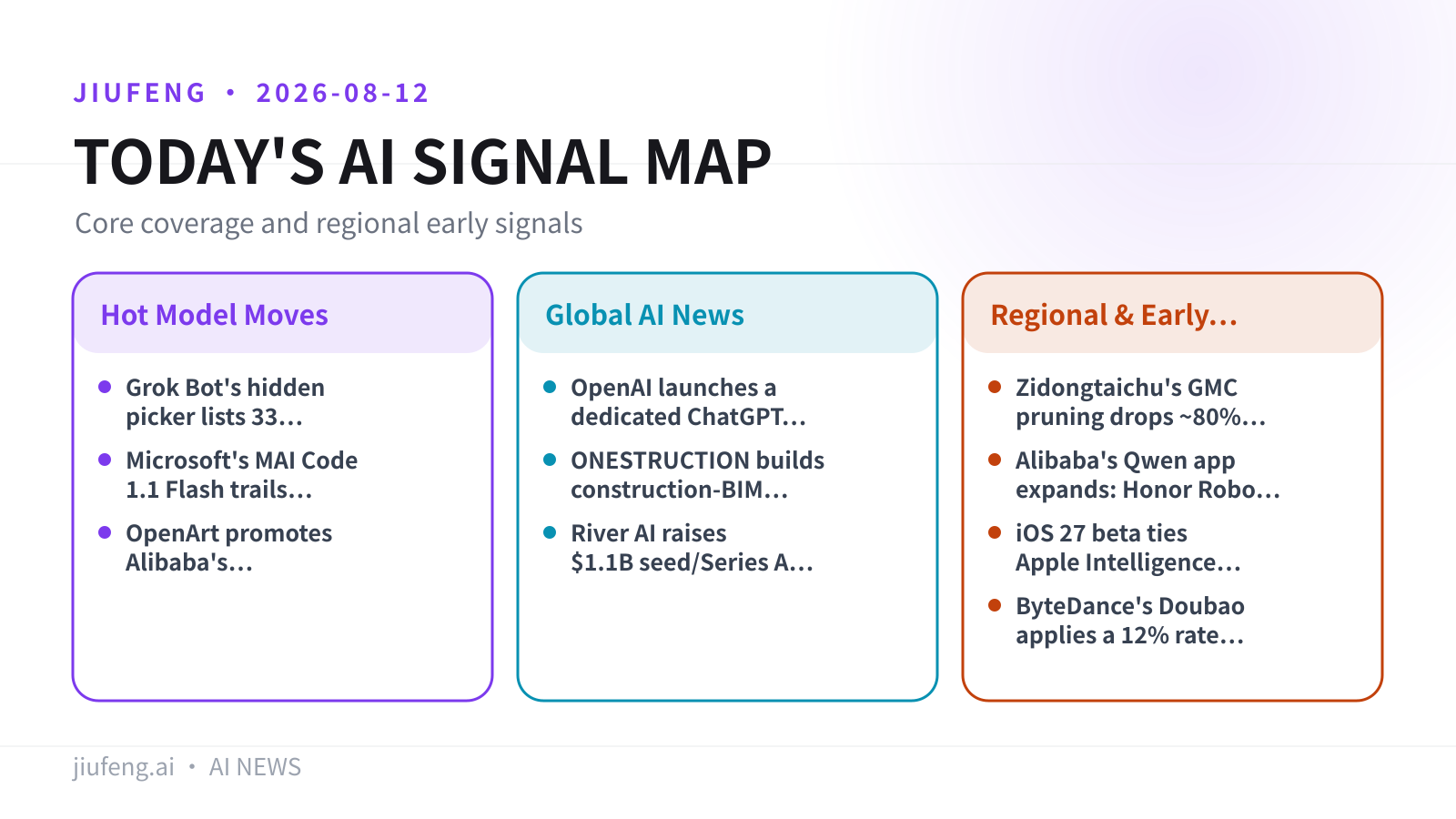
Jiufeng graphic based on the sources cited in this issue.
Hot Model Moves
01/10
Grok Bot's hidden picker lists 33 models from rival providers
SpaceXAI shipped Grok Bot 0.16.0 with a hidden "Elon-Only Settings" card whose model picker pulls an account-scoped catalog of 33 models.
RuntimeWire reverse-engineered Grok Bot's Windows installer and app.asar and reconstructed TypeScript from bundled source maps, confirming that the hidden "Elon-Only Settings" card contains a working model picker. Runtime testing returned 33 USER_AVAILABLE catalog entries and rendered them in the picker. The catalog spans xAI's own Grok alongside GPT, Claude, Gemini, Kimi and GLM, served over an authenticated, account-scoped persistence path. RuntimeWire notes this lets Grok Bot route persistent agents across rival models, putting SpaceXAI and Cursor in control of the interface, account and billing layer above the models.
Limitations: the card is dormant/hidden and not exposed to ordinary users. RuntimeWire also found SpaceXAI's public docs give two conflicting accounts of model selection that disagree with each other and with the shipped client; outsiders currently rely on the reverse-engineering rather than an official published list.

Image source: spacexai; mirrored on Jiufeng R2.
Source: RuntimeWire · docs.x.ai
02/10
Microsoft's MAI Code 1.1 Flash trails DeepSeek on price and performance
Microsoft's new GitHub Copilot code model is cheaper and more token-efficient than its predecessor, yet DeepSeek-V4-Flash beats it on a key coding benchmark.
Microsoft released MAI Code 1.1 Flash for GitHub Copilot, saying it is 25% more token-efficient at a quarter of the cost of its June predecessor, with developers accepting 4% more of its output; training used "hundreds of thousands of reinforcement-learning environments in GitHub Copilot." It scores 72.6% on SWE-bench Verified (predecessor 71.6%, Haiku 4.5 69.8%, GPT-5.4 mini 69.2%) and 62.9% on Terminal Bench 2.1 (predecessor 51.7%, Haiku 4.5 49.4%, GPT-5.4 mini 60.7%).
Limitations: on Terminal Bench 2.1, DeepSeek-V4-Flash-0731 scores 82.7%, nearly 20 points ahead; The Decoder says the model "gets crushed by Deepseek" and remains pricier than DeepSeek despite the cost cut. Microsoft did not publish a SWE-bench figure for DeepSeek.
Source: The Decoder
03/10
OpenArt promotes Alibaba's Qwen-Image-3.0 as cloud API stays in limited preview
OpenArt is pushing Alibaba's July 21 Qwen-Image-3.0, aimed at dense layouts and multilingual small text, but direct cloud API access still needs a limited-preview application.
Alibaba's launch materials say Qwen-Image-3.0 accepts inputs up to 4,500 tokens, renders text in 12 languages, and generates layouts such as newspapers, storyboards, exam papers and interface mockups, with demos claiming legible text at roughly 10 pixels. OpenArt, the San Francisco creative platform founded by Coco Mao and John Qiao, has put up a promotional page, and Qwen's official X account directs users to try the model on OpenArt.
Limitations: those performance figures come from Alibaba's launch materials and were not independently tested in the sources RuntimeWire reviewed; the cloud API remains in limited preview. The reviewed materials also do not state the date or commercial terms of the OpenArt arrangement.
Source: RuntimeWire · Qwen on X
Global AI News
04/10
OpenAI launches a dedicated ChatGPT desktop app for Linux
ChatGPT's desktop lineup fills its last gap, arriving on Linux this week as a preview.
OpenAI has launched a dedicated ChatGPT desktop app for Linux. Per OpenAI's official X post, the preview build includes ChatGPT, ChatGPT Work and Codex, ships as .deb and .rpm packages for both x64 and ARM64, and supports Ubuntu 24.04/26.04 LTS, Debian 13 and Fedora 43/44. Parts of the open-source developer community had long been clamoring for OpenAI to bring the chatbot to Linux, and this week the company filled that gap.
Limitations: the release is a preview, and OpenAI has not given a timeline for a stable version; TechCrunch's report also does not compare the build's feature differences from the Windows/macOS apps.
Source: TechCrunch · OpenAI on X
05/10
ONESTRUCTION builds construction-BIM foundation model Ishigaki-IDS with AWS
A construction-tech startup trained a Qwen3-based foundation model for BIM workflows with help from AWS GenAIIC.
As part of Japan's GENIAC (Generative AI Accelerator Challenge) Phase 3, ONESTRUCTION built Ishigaki-IDS with technical advisory from the AWS Generative AI Innovation Center, targeting IDS (Information Delivery Specification) in openBIM. The model is built on the open-source Qwen3 (8B/14B/32B) with a three-stage pipeline—continued pretraining (CPT), supervised fine-tuning (SFT) and reinforcement learning with verifiable rewards (RLVR)—using synthetic data and distributed training on Amazon EC2 P5en; the RLVR stage optimizes with verifiable rewards for structured-output generation.
Limitations: this is a case study for a data-scarce construction niche, so the model's ability is tied to BIM/IDS tasks, and the AWS post gives no head-to-head public benchmark against general models.
Source: AWS Machine Learning Blog · Qwen on Hugging Face
06/10
River AI raises $1.1B seed/Series A for personal agents
xAI co-founder Igor Babuschkin's two-month-old River AI has pulled in $1.1 billion.
River AI, founded by xAI co-founder Igor Babuschkin, raised $1.1 billion in a seed/Series A round led by General Catalyst and AMP PBC, with Nvidia, AMD Ventures, Y Combinator and Temasek participating. AMP PBC is an AI-focused firm started in 2026 by former a16z general partner Anjney Midha, a backer of Black Forest Labs, Mistral AI, LMArena and OpenRouter.
Limitations: the company is only about two months old and has shared only a vision for personal agents, with no shipped product or model; TechCrunch did not disclose a valuation or product roadmap.
Source: TechCrunch
Regional & Early Signals
07/10
Zidongtaichu's GMC pruning drops ~80% of visual tokens without training
A CAS Institute of Automation team says its method removes about 80% of visual tokens while preserving multimodal capability, with no training. (Chinese-language source)
The Zidongtaichu team at the Chinese Academy of Sciences' Institute of Automation proposed GMC (Grounded Message Coreset Pruning) to tackle vision-language models encoding images into hundreds-to-thousands of tokens that slow inference and fill the KV cache. GMC works in two steps: complementary-evidence adaptive selection that keeps salient regions plus scattered cues like text, numbers and axes; then "Population Transport," which moves the hidden states of to-be-deleted tokens into the most suitable representative tokens, doing real sequence compression rather than masking. The method is training-free and needs no task labels, parameter updates, detectors or OCR. Across benchmarks including TextVQA, ChartQA, MME, POPE, MMBench and GQA, cutting 80.2% of visual tokens (keeping only 256) preserves 97.78% of average capability, and cutting 90.1% (keeping 128) still preserves 99.11%; on LLaVA-1.5-7B it reaches 99.76% and 99.82%, which the team says matches or slightly exceeds the full-model baseline.
Limitations: these are the team's self-reported method and measured scores, reported exclusively by QbitAI, and the "training-free yet faithful" result awaits independent third-party replication.
Source: QbitAI
08/10
Alibaba's Qwen app expands: Honor Robot Phone debut and Midea integration
Alibaba's Qwen model landed in two new places in a day—Honor's new phone debuts a Qwen-powered YOYO Pro, and Midea joins the Qwen app as an exclusive appliance partner. (Chinese-language source)
At Honor's Robot Phone global launch, Honor said the device runs an "Agentic OS" multimodal operating system and debuts a YOYO Pro mode "deeply powered by" Alibaba's Qwen model, supporting long-horizon task execution and cross-ecosystem coordination; the phone is 9.59mm/248g with a 6.31-inch screen, a fifth-gen Snapdragon 8 Elite, and a 7,060mAh battery. Separately, per Leiphone, on August 10 Midea joined the Qwen app as its exclusive home-appliance partner via the A2A (Agent-to-Agent) protocol, letting users who bind Midea's "Xiaomei" AI agent handle product queries, home-environment monitoring, energy-use checks and maintenance inside the Qwen app.
Limitations: both are vendor announcements—Honor describes the Qwen capabilities in qualitative terms ("deeply powered by") without quantified metrics, and Midea's integration emphasizes ecosystem connectivity with no user-scale or usage data disclosed.
09/10
iOS 27 beta ties Apple Intelligence usage to iCloud+ tiers
In iOS 27 beta 5, some Apple Intelligence usage starts to scale with iCloud+ plan tiers. (Chinese-language source)
Per ifanr, citing creator Stephen Robles, the Home app in iOS 27 beta 5 adds an Apple Intelligence page: a 2TB iCloud+ plan supports AI summaries for 5 cameras, rising to 15 at the 12TB tier, with an "upgrade iCloud+ for more Apple Intelligence usage" prompt. Apple had confirmed at June's WWDC that some server-model features, including image generation, carry daily caps that a higher iCloud+ plan can raise.
Limitations: this is a beta observation, with tiering clearly seen only for the camera AI-summary feature; whether image generation and other features adopt the same tiering awaits later builds.
Source: ifanr
10/10
ByteDance's Doubao applies a 12% rate to hotel bookings
From August 10, hotel orders via the Doubao channel are billed at a standalone rate totaling about 12%. (Chinese-language source)
Per TMTPost (republishing Meadin), from August 10 hotel orders through the Doubao channel are billed at a standalone rate: an 11.4% software-service fee plus a 0.6% payment fee, for roughly 12% total. The report frames this as AI recommendation graduating from a "conceptual traffic entry" into a separately accounted, independently billed, standardized customer-acquisition channel.
Limitations: the report reflects a hotel-industry trade-media view, hoteliers are divided on the higher rate, and Doubao has not disclosed order volume or the channel's overall commission scale.
Source: TMTPost
Write a prompt in your browser and get an image — 1K, 2K or 4K output, up to 15 reference images. 50 free generations on sign-up, no credit card.
Generate free