Overview
10 stories in this issue. The first 3 are today's priorities.
Hot model updates
- Top · Claude Code ports Quake to safe Rust, tested against the original
- Top · Anthropic publishes its 2026 Usage Policy, effective November 12
- Top · Sophos cuts threat investigation time by 96% with OpenAI Daybreak
Global AI news
- Gallatin AI raises a $50M Series A for military logistics software
- openJiuwen open-sources an enterprise AgentOS for agent swarms
- KingKong Technology open-sources the toolchain for its Jumper crab robot
- CAIR unveils CARES 4.0, a clinical agent that gives doctors suggestions
Regional and early signals
- Doubao 2.1 Lite comes to Doubao Work, along with a canvas mode
- Lenovo's TianxiCode with DeepSeek-v4.1-Flash solves 71% on SWE-bench-Live Lite
- Google's AMIE study in The Lancet: 98 patients used it before their visits
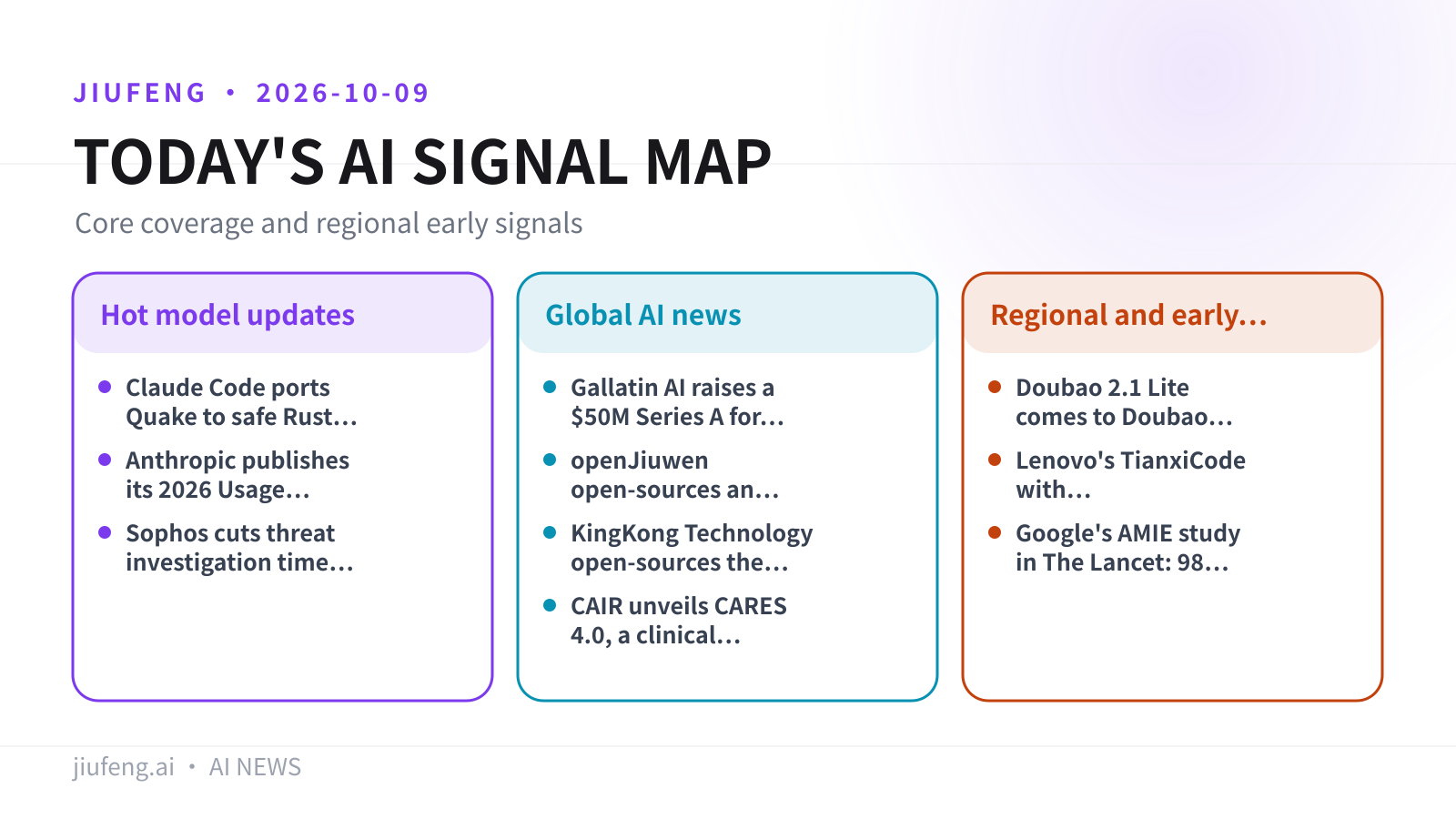
Jiufeng graphic based on the sources cited in this issue.
Hot model updates
01/10
Claude Code ports Quake to safe Rust, tested against the original
A solo developer used Claude Code to port id Software's 1996 game Quake from C to Rust, with a test harness that checks the port against the original.
The project is called Quake-SRP. It ports the single-player engine from WinQuake and runs in a browser. The developer, who announced it on Hacker News as ilreb, credits Claude as the author of the code and documentation.
- Safety: the port contains no
unsafeRust code - Reference testing: runs alongside a headless build of id's C source and compares rendered frames, game state and audio
- Human role: the developer set constraints, played the game, reported problems and directed work across agent-generated branches
- Merge rule: per the README, a coordinating agent merged a branch only after the full checks passed
Limitations: RuntimeWire notes that the project shows the workflow works when there is a known implementation to compare against. It does not prove that agents can safely replace systems whose behavior cannot be checked independently. Project materials identify Anthropic only as the maker of the coding model, not as a sponsor or funder.
Image source: GitHub; mirrored on Jiufeng R2.
Source: Quake-SRP (GitHub) · RuntimeWire
02/10
Anthropic publishes its 2026 Usage Policy, effective November 12
Anthropic has updated Claude's Usage Policy with new examples for the longer, more independent work its models now do.
The new policy takes effect on November 12. Anthropic says most of the changes clarify existing rules:
- New section: a dedicated section on deceptive activity
- Misuse patterns: new examples based on misuse seen over the past year in influence operations, weapons development and surveillance
- High-risk uses: clearer requirements for high-risk uses in areas such as health and finance
- Physical actions: new controls for cases where Claude takes physical actions on its own
- Abuse of models: new rules on users abusing the models
Limitations: the announcement only summarizes the changes. The full rules are on the separate Usage Policy and Supported Regions Policy pages, and the summary does not explain how the physical-action controls work.
Source: Anthropic Newsroom
03/10
Sophos cuts threat investigation time by 96% with OpenAI Daybreak
In a customer story from OpenAI, security firm Sophos says Daybreak cut its cyber-threat investigation time by 96%.
According to OpenAI, Daybreak cut Sophos's investigation time by 96%, and Sophos now automates 52% of its MDR cases. OpenAI says humans still oversee the process.
Limitations: OpenAI published this customer story itself. The 96% and 52% figures come from the two companies, with no independent check and no published baseline.
Source: OpenAI
Global AI news
04/10
Gallatin AI raises a $50M Series A for military logistics software
Gallatin AI builds supply-chain software for the U.S. military and has raised $50 million.
8VC, Silent Ventures and several other investors joined the Series A, which follows a $15 million seed round in 2024. Gallatin is based in El Segundo, California. Its Navigator platform helps the U.S. military manage its supply chain, and its customers include the U.S. Army and the U.S. Air Force. The company says the Defense Department's commercial logistics partners can also use Navigator.
Limitations: the time-savings claims come from the company, and the report gives no figures to back them up.
Source: SiliconANGLE
05/10
openJiuwen open-sources an enterprise AgentOS for agent swarms
Huawei-backed openJiuwen has open-sourced AgentOS for Enterprise, a runtime that lets multiple agents work together.
Pandaily reports that the runtime supports multi-agent swarms, sandboxes and tenant isolation. It can also be deployed as an appliance, and the project says deployment takes only hours.
Limitations: the report summary gives no license or repository link, and the claim that deployment takes hours comes from the project itself.
Source: Pandaily
06/10
KingKong Technology open-sources the toolchain for its Jumper crab robot
KingKong Technology, a Beijing maker of encoders and servos, has open-sourced the simulation, reinforcement learning and deployment toolchain for its Jumper robot.
- Degrees of freedom: 22
- Weight: 1.8 kg
- Jump height: over 400 mm
- Open-sourced: simulation, RL training and deployment toolchain
Limitations: Pandaily is the only source, and the jump height is the maker's own figure. The summary does not say whether the hardware design is also open or which license applies.
Source: Pandaily
07/10
CAIR unveils CARES 4.0, a clinical agent that gives doctors suggestions
CARES 4.0 is a multimodal clinical agent built to give doctors suggestions, not verdicts.
CARES 4.0 comes from CAIR, the Chinese Academy of Sciences' AI and robotics centre in Hong Kong. The agent drafts reports and analyses for doctors to review.
Limitations: the report summary gives no evaluation results and no deployment scale, so its accuracy and where it is used are still unknown.
Source: Pandaily
Regional and early signals
08/10
Doubao 2.1 Lite comes to Doubao Work, along with a canvas mode
Doubao Work has added the lightweight Doubao 2.1 Lite model, an infinite canvas in task mode, and the Seedream 5.0 Flash image model. Chinese-language source.
Doubao 2.1 Lite is aimed at frequent office tasks: everyday Q&A, documents, spreadsheets and slides. The official description says it responds faster, uses less quota and is strong at understanding images, video and audio. Users can select it after updating the client.
The new canvas puts materials, plans and generated output on one page. After an image is generated, users can keep editing its text, colors and layout. Doubao Work launched on August 25 and has been updated every week since.
Limitations: the claim that its multimodal ability "leads" comes with no benchmark name or score, and there is no comparison with Doubao 2.1 Pro.
Source: IT Home (Chinese-language source) · Leiphone (Chinese-language source)
09/10
Lenovo's TianxiCode with DeepSeek-v4.1-Flash solves 71% on SWE-bench-Live Lite
Lenovo Tianxi AI's coding-agent framework TianxiCode, paired with DeepSeek-v4.1-Flash, solved 71% of issues on the SWE-bench-Live Lite split and reportedly ranks first. Chinese-language source.
SWE-bench-Live draws its tasks from real GitHub issues and tests whether a system can write patches that fix them. The result passed the benchmark's "Verified" review, in which entrants submit full agent trajectories and the organizers check that no answers or test cases leaked to the agent. Lenovo plans to use TianxiCode in its AI hardware.
Limitations: the 71% score is for the framework and model together, not the model alone, and it covers only the Lite split. The report does not link to the leaderboard.
Source: QbitAI (Chinese-language source)
10/10
Google's AMIE study in The Lancet: 98 patients used it before their visits
In a study by Google and BIDMC, AMIE's differential diagnoses matched doctors' final diagnoses 90% of the time. Chinese-language source.
The study ran in BIDMC's outpatient primary care clinic with 98 patients. Physicians watched every conversation live, and none had to be stopped under the preset safety criteria. Key results:
| Measure | Result (%) |
|---|---|
| Summary helped clinicians prepare | 75 |
| Differential matched final diagnosis | 90 |
In more than half of the cases, AMIE's output changed how the clinician thought about the case. The report says this is the first time Google research has appeared in The Lancet's main journal.
Limitations: the study had only 98 patients, and AMIE is a research-grade system. The researchers say larger trials are needed before patient-facing AI can be deployed at scale.
Source: QbitAI (Chinese-language source)
Write a prompt in your browser and get an image — 1K, 2K or 4K output, up to 15 reference images. 50 free generations on sign-up, no credit card.
Generate free